
Are 2005 Ford F150 Reliable

The 2005 Ford F150 has a mixed reliability reputation. Its 5.4L Triton V8 engine is powerful and durable with proper care, but the 4R75E transmission is a known weak point, and frame rust can be severe. Regular maintenance is crucial, and while affordable to buy, repair costs can add up. For budget buyers willing to invest in upkeep, it’s a capable workhorse; for others, newer models may be wiser.
Key Takeaways
- The 5.4L Triton V8 is a mixed bag: It offers strong power and can last long with meticulous care, but suffers from costly cam phaser rattle and spark plug issues that require specialized repair.
- The 4R75E transmission is the truck’s Achilles’ heel: This unit is notorious for solenoid failures and harsh shifting, often requiring a rebuild or replacement around 100,000-150,000 miles.
- Frame and bed rust are a serious concern: Especially in states that use road salt, the 2005 F150’s frame can corrode severely, potentially compromising structural integrity and leading to expensive repairs.
- Maintenance history is everything: A well-maintained 2005 F150 with records can be a reliable workhorse. A neglected one will become a money pit very quickly.
- It’s a value proposition with caveats: You get a lot of truck for a low purchase price, but you must budget for potential major repairs like a transmission or rust treatment.
- Best for the hands-on owner: This model year is ideal for DIY enthusiasts or those with a trusted mechanic who can address its known flaws proactively.
- Pre-purchase inspection is non-negotiable: Never buy a 2005 F150 without a thorough inspection by a Ford specialist focusing on the transmission, engine, and frame.
📑 Table of Contents
The 2005 Ford F150: A Brief Overview
So, you’re thinking about buying a used truck and the 2005 Ford F150 has caught your eye. It’s a smart move, really. The F150 is America’s best-selling truck for a reason—it’s tough, capable, and everywhere. The 2005 model sits in the middle of the 10th generation (2004-2008), a period where Ford really refined the platform. It was a huge seller, which means there are plenty out there, and that drives down prices. You can find them for a fraction of what a newer truck costs. But here’s the million-dollar question: are 2005 Ford F150 reliable? The answer isn’t a simple yes or no. It’s a “yes, but…” with a lot of “buts.” This truck has a legendary engine paired with a problematic transmission, all wrapped in a body that can turn to dust if it’s seen harsh winters. To really understand if this truck is for you, we need to dig into the specifics. We’ll look at the powertrain, the rust, the maintenance needs, and what it truly costs to own one today. By the end, you’ll know exactly what to look for and whether this classic hauler fits your needs and budget.
A Generation of Refinement
The 2004-2008 F150 was a major redesign for Ford. It featured a stronger frame, more powerful engine options, and a more car-like ride compared to its predecessors. The 2005 model year was essentially a carryover from the 2004 redesign, meaning it benefited from all those improvements but also inherited their initial quirks. It was the first year for the 5.4L three-valve V8 in the F150, which was a big deal at the time. This generation also introduced the “Tough Bed” with integrated cargo lights and a tailgate step. It was a truck built for the modern worksite and weekend warrior alike. However, with new technology comes new potential failure points, as we’ll see.
The Used Truck Market Context
Fast forward nearly two decades, and these trucks are now 19 years old. Age is the biggest enemy of any vehicle, regardless of its original reliability. Rubber components dry out, seals leak, and electronic modules can fail. A 2005 F150 that has been lovingly cared for in a dry climate is a completely different beast from one that was a daily workhorse in Michigan or Minnesota. The market is flooded with them, which is good for selection and price, but bad for finding a gem. Most are high-mileage, and their value now is almost entirely based on their mechanical health and body condition. This makes your due diligence absolutely critical.
Engine and Performance: The 5.4L Triton V8
Let’s start with the heart of the beast. The 2005 Ford F150 primarily came with the 5.4L three-valve per cylinder Triton V8. This was a significant upgrade from the previous two-valve version. It produced a healthy 300 horsepower and 365 lb-ft of torque, which was class-leading at the time. It’s a torquey, responsive engine that makes the F150 feel strong and capable, especially when towing or hauling. In terms of raw power delivery, it’s one of the engine’s best qualities. But this engine has developed a notorious reputation over the years, and it’s the single biggest factor in the “are 2005 Ford F150 reliable?” question.
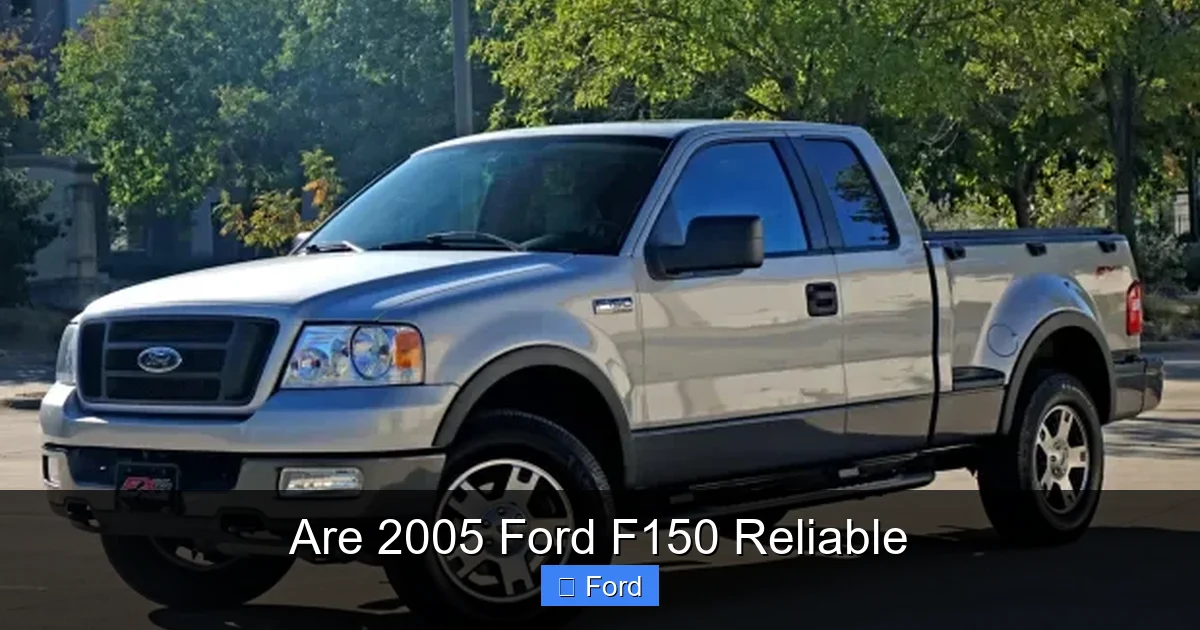
Visual guide about Are 2005 Ford F150 Reliable
Image source: bringatrailer.com
The 5.4L Three-Valve V8: Powerhouse or Problem Child?
The three-valve design (two intake, one exhaust) was meant to improve breathing and efficiency. It worked, but it introduced some complex systems. The engine features variable cam timing (VCT) on both intake and exhaust cams. This system uses oil pressure to advance and retard the camshafts for better power and efficiency. The components that control this, called cam phasers, are the source of the engine’s most infamous issue. As the engine ages and oil pressure varies, these phasers can start to make a loud, distressing rattling noise on cold startup, often described as a “diesel-like clatter” or “timing chain rattle.” This isn’t just an annoyance; it can lead to premature wear and, in severe cases, catastrophic engine failure if a phaser breaks or jumps timing. Repairing this involves replacing the phasers, which is a labor-intensive job that often requires removing the front of the engine. It’s not cheap.
Known Engine Issues: Cam Phasers, Spark Plugs, and More
Beyond the cam phasers, the 5.4L has other well-documented problems. The spark plug design is particularly troublesome. They are threaded into the cylinder head with a thin aluminum shell. Over time, and especially if over-torqued during a previous change, the threads can strip out of the head, causing the plug to blow out of the hole. This is a dramatic and damaging event. Replacing the plugs requires extreme care and often the use of special tools and thread inserts (like Time-Serts) to repair damaged threads. It’s a job many shops shy away from due to the risk. Other issues include oil consumption (some engines burn a quart every 1,000 miles), intake manifold failures (the plastic can crack), and issues with the plastic valve covers that can become brittle and leak. A healthy 5.4L is a great engine, but it demands respect and a history of proper maintenance—especially regular oil changes with the correct oil specification (Ford’s WSS-M2C947-A/B or equivalent).
Longevity with Proper Care
Despite these issues, many 5.4L Triton engines have surpassed 250,000 miles. The key is preventive maintenance. This means strict adherence to oil change intervals (every 5,000 miles is a safe bet, not the 10,000-mile modern interval), using high-quality oil and filters, and addressing small leaks before they become big problems. A pre-purchase inspection by a mechanic who knows these engines is vital. They should check for the cold-start rattle, look for signs of oil consumption, and verify the spark plugs were changed correctly. If you find a truck with a clean history and an engine that runs smoothly hot and cold, the powertrain can be a reliable workhorse. You might also consider looking into our guide on the best battery for a 2005 Ford F150, as a strong, reliable battery is crucial for starting this large V8, especially as it ages and in cold climates.
Transmission and Drivetrain Concerns
If the engine is a complicated but potentially reliable partner, the transmission is the clear weak link in the 2005 F150’s chain. The 4R75E 4-speed automatic transmission was the standard companion for the 5.4L V8. And it has a widespread reputation for failure. This isn’t just internet chatter; it’s a well-known fact among Ford owners and mechanics. The transmission is often the single most expensive repair you’ll face on this truck, and it tends to fail around the 100,000 to 150,000-mile mark, sometimes sooner if it’s been abused or neglected.
Visual guide about Are 2005 Ford F150 Reliable
Image source: fordofpottstown.com
The 4R75E Transmission: A Weak Point?
Why is the 4R75E so problematic? It’s a heavy-duty unit designed for the F150’s torque, but it has several design flaws that become apparent with age and use. The internal solenoid pack is a frequent failure point. These solenoids control hydraulic pressure for shifting, and when they fail, you get harsh, delayed, or missed shifts. The transmission control module (TCM) can also fail. Internally, the clutch packs and bands wear out, and the valve body can become clogged with debris. The 4-speed design itself is outdated, lacking the efficiency and smoothness of modern 6- or 10-speed transmissions. For a truck that was often used for towing and hauling, this transmission was simply not up to the task for the long haul under repeated stress.
Solenoid and Shifting Problems
The most common early symptom is a transmission that shifts erratically. You might feel a hard bang into 2nd or 3rd gear, or a noticeable delay when you press the gas. Sometimes, it will go into “limp mode,” where it stays in one gear (usually 2nd) to prevent further damage. A diagnostic scan will often reveal solenoid-related trouble codes. Replacing the solenoid pack is a relatively common and less expensive repair (often $300-$600), but it’s usually a band-aid. If the transmission is already worn internally, new solenoids won’t stop the inevitable failure. The real fix is a complete rebuild or replacement, which costs between $2,500 and $4,500. That’s a huge chunk of change on a truck that might only be worth $5,000-$8,000.
Maintenance to Extend Life
Can you do anything to help the transmission? Absolutely. The single most important maintenance item is a strict transmission fluid and filter change schedule. Ford’s original recommendation was “lifetime,” which is automotive speak for “until it fails.” Independent experts and mechanics strongly recommend changing the fluid and filter every 30,000 to 50,000 miles. This removes worn clutch material and contaminants that can clog the valve body and cause solenoid issues. Use only Ford-approved Mercon V fluid (or the modern equivalent specified for your transmission). If buying a used 2005 F150, ask for receipts showing this service. If the history is unknown, a fluid and filter change is a wise investment. Also, avoid using the truck for constant heavy towing in overdrive; manually select a lower gear to reduce strain. For owners dealing with shifting issues, understanding the how to reset Ford F150 check engine light process can be useful after repairs, but it’s not a fix for the underlying mechanical problem.
Rust, Body, and Interior Durability
Let’s talk about the elephant in the room: rust. For many used truck buyers, rust is the deal-breaker, and the 2005 Ford F150 is notorious for it. This generation had a significant problem with frame corrosion, particularly in the “Salt Belt” states (the Northeast, Midwest, and parts of the Mountain West). The frame is the truck’s backbone. If it’s compromised by rust, the vehicle’s structural integrity is gone, making it unsafe and often unfixable. It’s not just the frame, either. The bed floors, rocker panels, and cab corners are also common rust sites.
Visual guide about Are 2005 Ford F150 Reliable
Image source: fordauthority.com
Frame Rust: A Structural Nightmare
The 2005 F150’s frame is a fully-boxed, hydroformed design that is generally strong. However, the protective coatings and drain holes were not up to the task of decades of road salt exposure. Rust starts at the seams and welds, working its way through the metal. You’ll often see it first on the inside of the frame rails, where you can’t see it without a proper inspection. By the time you see bubbling paint or holes on the outside, the damage is extensive. A severely rusted frame is a total loss. Even moderate rust can weaken the frame enough to fail safety inspections. This is why a pre-purchase inspection must include a thorough look at the frame, ideally with the truck on a lift. A mechanic should probe any suspicious areas with a screwdriver. If the frame is solid, you’ve dodged a major bullet. If not, walk away, no matter how cheap the truck is.
Bed and Body Rust
The bed is another hotspot. The 2005 introduced the “Tough Bed,” but its integrated cargo lights and tailgate step created crevices where water and dirt collect. The bed floor, especially around the spare tire well and the front corners, can rust through. This creates holes that let water and cargo spill out. It’s mostly a nuisance and cosmetic issue unless it’s severe, but it’s a clear sign of a truck that has lived a hard life in a wet climate. Check the rocker panels (the metal panels under the doors) and the bottom of the cab corners. Rust here is expensive to repair properly, often requiring cutting out the rotten metal and welding in new patches. Interior durability is generally okay for the year. The seats and dashboards hold up reasonably well, but the plastic can become brittle and crack. Aftermarket best seat covers for a 2005 Ford F150 can protect the original upholstery and are a smart upgrade for a work truck.
Prevention and Inspection Tips
If you already own a 2005 F150 in a rust-prone area, prevention is key. Regular washing, especially of the undercarriage in winter, is your best defense. Apply a rust-proofing coating like Krown or Rust-Oleum’s Professional Undercoating. Inspect the frame and bed regularly for early signs of bubbling paint or white powder (oxidation). When buying, be brutal. A truck with significant frame rust is not worth the risk, no matter the price. A little surface rust on the surface of the frame rail that hasn’t penetrated is acceptable, but any thinning metal or holes are a hard no.
Maintenance Costs and Common Repairs
Okay, let’s get down to brass tacks: money. The 2005 Ford F150 is cheap to buy but can be expensive to own if you’re not prepared. We’ve already touched on the big-ticket items—transmission and engine phasers—but there’s a long tail of other maintenance and repairs that come with any 19-year-old vehicle. Understanding these costs helps you budget and decide if this truck fits your financial plan.
The Big Three: Transmission, Engine, Rust
As established, the transmission rebuild ($2,500-$4,500) and cam phaser replacement ($1,500-$3,000) are the financial monsters. Frame rust repair can also easily run into the thousands, often making the truck not worth fixing. Beyond these, you have standard wear-and-tear items that add up. Brakes, tires, shocks, and struts are expected on any high-mileage vehicle. The 2005 F150, especially 4×4 models, can chew through best shocks for a 2005 Ford F150 4×4 if used off-road or on rough roads. A full set of quality shocks can cost $400-$800 installed. Brake jobs (pads and rotors) are $300-$600 per axle. Tires for a full-size truck are never cheap, with a set of good all-terrains running $800-$1,200.
Other Common and Costly Issues
- Spark Plugs: As mentioned, changing them is a delicate procedure. A professional shop will charge $400-$800 for a full set due to the labor and risk. If threads are damaged, add another $200-$400 for Time-Sert repairs.
- Intake Manifold: The plastic upper intake manifold can crack, causing vacuum leaks and poor performance. Replacement is $500-$1,000 in parts and labor.
- Oil Consumption: Some engines burn oil excessively. If you’re adding a quart every 1,000 miles, that’s a long-term cost and a sign of internal wear (likely piston rings). A rebuild is the only fix.
- Electrical Gremlins: Modules like the instrument cluster, HVAC control, and power window motors can fail. These are annoying and can cost $200-$500 each to replace.
- Suspension: Ball joints, tie rod ends, and control arm bushings wear out. A major front-end rebuild can cost $1,000-$2,000.
The takeaway? Budget at least $1,500-$2,000 per year for maintenance and repairs on a 2005 F150 that’s in decent shape but has over 150,000 miles. If it has the original transmission and high mileage, factor in a $3,000 reserve fund for when (not if) it fails.
The Importance of a Service History
When shopping, a detailed service record is worth its weight in gold. It shows the owner was proactive. Look for evidence of:
- Regular transmission fluid/filter changes.
- Timing chain inspections or replacements (the 5.4L has a timing chain, not a belt, but tensioners and guides can wear).
- Spark plug service with notes on thread condition.
- Brake and suspension work.
- Rust prevention measures.
A truck with a thick folder of receipts is a much safer bet than a clean, well-kept-looking truck with no history. It means the owner invested in preventing the big problems.
Verdict: Is the 2005 F150 Reliable?
So, after all that, are 2005 Ford F150 reliable? The honest answer is: they can be, but with significant and well-known qualifications. They are not reliably reliable out of the box like a Toyota Tacoma of the same era. Instead, they are reliably *problematic* in specific, predictable ways. This is actually useful information because it means you can manage the risks. If you buy one knowing exactly what to look for and are prepared to address its flaws, you can have a solid, powerful truck for a fraction of the cost of a newer model. If you want a worry-free, get-in-and-drive experience for the next five years, this is not the truck for you.
Who Should Buy a 2005 Ford F150?
This truck is perfect for:
- The DIY Enthusiast: If you’re comfortable with a wrench, you can save thousands on labor. There’s a massive online community (like F150Online) with endless tutorials for every repair.
- The Budget Work Truck Owner: For farmers, contractors, or anyone who needs a big, powerful truck for light-to-moderate work and has a secure place to park it. The low initial cost allows you to put money into upgrades and repairs.
- The Towing/Hauling Occasional User: The 5.4L has plenty of grunt for weekend boat or trailer duty, as long as you’re not doing it daily over long distances.
- The Patient Optimizer: Someone who enjoys improving a vehicle, who sees fixing the transmission or treating rust as part of the ownership journey, not a burden.
Who Should Avoid a 2005 Ford F150?
Walk away if:
- You have zero mechanical tolerance: If the thought of a $3,000 repair bill makes you sick, buy a newer, more reliable model (like a 2012+ F150 with the Coyote 5.0L or the 3.5L EcoBoost, which have their own issues but better transmissions).
- You live in a heavy rust area without a garage: Frame rust is a constant, losing battle. It’s not worth the safety risk or financial hole.
- You need a daily driver for long commutes: The 4-speed transmission will feel dated and inefficient, and the potential for a breakdown is higher than with a newer vehicle.
- The price seems too good to be true: It probably is. A cheap 2005 F150 is cheap because it has problems—likely a failing transmission or severe rust. You’ll pay for it later.
The Final Word: A Calculated Risk
The 2005 Ford F150 is a classic American truck with a powerful engine and a capable chassis. Its reputation for unreliability is rooted in two major, expensive components: the transmission and the engine’s cam phasers. Add in the ever-present threat of rust, and you have a vehicle that demands respect and a budget. However, because these issues are so well-known, you can go in with your eyes wide open. A pre-purchase inspection by a Ford specialist is the most important $200 you will ever spend on this truck. Check the frame with a magnet and a pick. Listen for cold-start engine noise. Get a transmission scan. Ask for every receipt. If you find one with a solid frame, a transmission that shifts smoothly, an engine that is quiet on cold start, and a stack of maintenance records, you may have found a gem. It won’t be perfect, but for the right person at the right price, the 2005 Ford F150 can still be a reliable and rewarding workhorse. To see how its reliability stacks up against other years, be sure to read our comprehensive list of the 10 most reliable Ford F150 model years.
Conclusion: Making an Informed Decision
Choosing any 19-year-old vehicle is an act of optimism and pragmatism. The 2005 Ford F150 embodies this perfectly. It’s a truck that can still do an honest day’s work, but it requires an honest day’s attention in return. Its 5.4L V8 engine, while powerful, carries a known risk of expensive cam phaser and spark plug issues. Its 4R75E transmission is its greatest vulnerability, often destined for a costly rebuild. And its frame can silently rust away in regions that see harsh winters. These are not minor quirks; they are major financial considerations.
But here’s the other side: this truck is simple. It’s not packed with finicky emissions equipment or complex hybrid systems. Its parts are plentiful and relatively inexpensive. The community of owners and mechanics who know these trucks inside and out is huge and helpful. For a buyer who understands the risks, gets a thorough inspection, and has a plan (and budget) for the known weak points, the 2005 F150 offers incredible value. You get a massive, powerful, and capable truck for a price that allows room for repairs. If you find a clean, well-maintained example from a dry climate with a documented service history, it can be a fantastic and reliable purchase. If you find a rusty, neglected one with no records, it will become a heartbreaking money pit. The difference lies in your homework. Do your due diligence, know the red flags, and you can make the 2005 Ford F150 work reliably for you. Skip the homework, and it will reliably break your heart and your wallet.
Frequently Asked Questions
What are the biggest problems with a 2005 Ford F150?
The largest and most costly issues are the 4R75E transmission failure and the 5.4L Triton V8’s cam phaser rattle and spark plug blow-out problems. Severe frame rust, especially in northern states, is also a major structural concern.
How long does the transmission last in a 2005 Ford F150?
The 4R75E transmission typically fails between 100,000 and 150,000 miles, especially if it hasn’t had regular fluid changes. Some last longer with meticulous maintenance, but it is the most common point of failure on this model year.
Is the 5.4L Triton engine reliable?
It’s reliable only with strict maintenance and if it avoids the known cam phaser and spark plug issues. A well-maintained 5.4L can last over 200,000 miles, but the potential for expensive, specialized repairs is high. It is not considered a worry-free engine.
How much does it cost to maintain a 2005 Ford F150 yearly?
For a truck in decent condition with 150,000+ miles, budget $1,500 to $2,500 annually for maintenance and repairs. This includes oil changes, brakes, tires, and minor fixes. It does not include saving for the likely future transmission or major engine repair.
Should I buy a 2005 Ford F150 with high mileage?
Only if it has a complete, verifiable service history, a solid frame, a transmission that shifts perfectly, and a quiet engine on cold start. High mileage is less concerning than poor maintenance and rust. A high-mileage truck with great records is often a better buy than a lower-mileage truck with none.
How does the 2005 F150 compare to other model years for reliability?
The 2005-2008 (10th gen) F150s are generally considered less reliable than the 2009-2014 models, which had improved transmissions (the 6-speed 6R80) and more robust engines (like the 5.0L Coyote). The 2004-2008 models are also worse for rust than the 2009+ models. For the best reliability in that generation, 2009-2010 are often recommended. You can see a full comparison in our article on the 10 most reliable Ford F150 model years.
