
Does Mazda Use Ford Engines?

Contrary to persistent rumors, Mazda does not currently use Ford engines in any of its production vehicles. While the two automakers shared a deep strategic partnership from 1979 to 2015 involving platform and component sharing, engine technology remained largely separate and developed independently. Today, Mazda’s entire lineup is powered by its proprietary SkyActiv engine family, marking a complete end to any mechanical relationship with Ford powertrains.
You’ve probably heard it at a car meet, read it in an online forum, or even had a friend confidently tell you: “Mazda uses Ford engines.” It’s one of those persistent automotive myths that feels plausible. After all, didn’t the Mazda6 and Ford Fusion look alike for a few years? And didn’t Ford own a big chunk of Mazda? The story seems to fit. But here’s the straight truth: No, Mazda does not use Ford engines. Never have, certainly not in the way people imagine, and definitely not today.
This confusion stems from a real but misunderstood historical partnership. To clear the air, we need to separate fact from fiction. We’ll dive into the actual history of the Mazda-Ford alliance, explain exactly what was shared (and what wasn’t), and show you how to identify the purely Mazda-made engine under the hood of your CX-5 or Miata. By the end, you’ll be equipped to debunk this myth yourself and understand the brilliant, independent engineering that powers every Mazda on the road today.
Key Takeaways
- Historical Alliance, Not Engine Sharing: Mazda and Ford’s 36-year partnership focused on capital sharing, platform development, and manufacturing cooperation, not the exchange of core engine designs.
- Platform vs. Powertrain: The collaboration famously produced shared vehicle architectures (like the Mazda6/Ford Fusion), but each company designed and built its own engines for these shared platforms.
- Complete Separation Since 2015: Ford sold its remaining stake in Mazda in 2015, ending the formal alliance. No subsequent model has shared a Mazda engine with a Ford vehicle or vice versa.
- Mazda’s SkyActiv is 100% In-House: All modern Mazda engines, from the compact 2.0L to the turbocharged 2.5T, are part of the SkyActiv family, developed solely by Mazda’s engineers.
- Ford’s Engines are Ford’s Own: Ford’s current lineup, from EcoBoost four-cylinders to V6s and V8s, is designed and manufactured by Ford, with no input or components from Mazda’s powertrain division.
📑 Table of Contents
- The Historical Mazda-Ford Alliance: A Story of Capital, Not Carburetors
- The Great Engine Misconception: Why the Myth is So Persistent
- The Divorce and Its Aftermath: Mazda Goes It Alone (2015-Present)
- Decoding the Current Mazda Engine Lineup: Pure SkyActiv
- Ford’s Current Engine Lineup: A Different Path
- How to Be Absolutely Sure: Identifying Your Mazda’s Engine
- Conclusion: Celebrating Mazda’s Independent Engineering Spirit
The Historical Mazda-Ford Alliance: A Story of Capital, Not Carburetors
To understand the myth, we must first understand the reality of the relationship. The Mazda-Ford story is a classic tale of global automotive strategy from the late 20th century. It’s a story about survival, scaling, and shared costs—not about swapping cylinder heads.
Origins of a Strategic Partnership (1979-1996)
The partnership began in 1979, a tumultuous time for Mazda. The company was reeling from the second oil crisis and needed a lifeline. Ford, seeking to expand its global footprint and gain a foothold in Asian markets, saw an opportunity. Ford purchased a 7% stake in Mazda, which eventually grew to a controlling 33.4% stake by 1996. This wasn’t a traditional parent-subsidiary relationship; it was a complex, often contentious, strategic alliance.
During this period, the collaboration was largely one-way: Ford provided capital and access to its vast North American dealer network, while Mazda provided engineering expertise, particularly in compact car platforms and flexible manufacturing systems. The first tangible fruits of this labor were vehicles like the 1987 Ford Laser (a rebadged Mazda 323) and the 1991 Ford Escort/Mercury Tracer (based on the Mazda 323 BG platform). But note: these were platform and body shares. The engines? In the Laser/Escort, you’d find Mazda’s own B6 or B8 engines, not a Ford unit.
The “One Ford” Era and Deepening Ties (1996-2010)
As Ford entered the 2000s under CEO Alan Mulally’s “One Ford” plan to globalize platforms, the partnership with Mazda became more integrated. This is where the most visible—and most misunderstood—sharing occurred. The goal was to develop a single, flexible mid-size car architecture that could underpin vehicles for both brands, saving billions in development costs.
The result was the CD3 platform. It gave us the 2006-2012 Mazda6 and the 2006-2012 Ford Fusion (along with the Mercury Milan and Lincoln Zephyr). They shared a fundamental chassis, suspension architecture, and many hardpoints. To the casual observer, they were “the same car.” But open the hood, and the story changed. The base Mazda6 came with Mazda’s 2.5L MZR four-cylinder. The base Fusion came with Ford’s 2.3L Duratec four-cylinder. Even the V6 options were different: Mazda used a 3.0L V6, Ford used a 3.0L V6—but they were entirely distinct designs with no shared parts. The collaboration saved money on the expensive steel structure and tooling, but each company’s powertrain division remained a sovereign kingdom.
This era also saw component sharing in other areas. Mazda supplied complete vehicles to Ford for the European market (like the Ford Courier van, a rebadged Mazda Bongo). They collaborated on manufacturing technology and even shared some transmission calibrations. But the heart of the matter—the engine block, crankshaft, pistons, and cylinder head—was never on the table for exchange. It was a line neither company crossed.
The Great Engine Misconception: Why the Myth is So Persistent
If the engines were always different, why does the “Mazda uses Ford engines” idea stick around? It’s a perfect storm of visual similarity, corporate history, and human psychology.

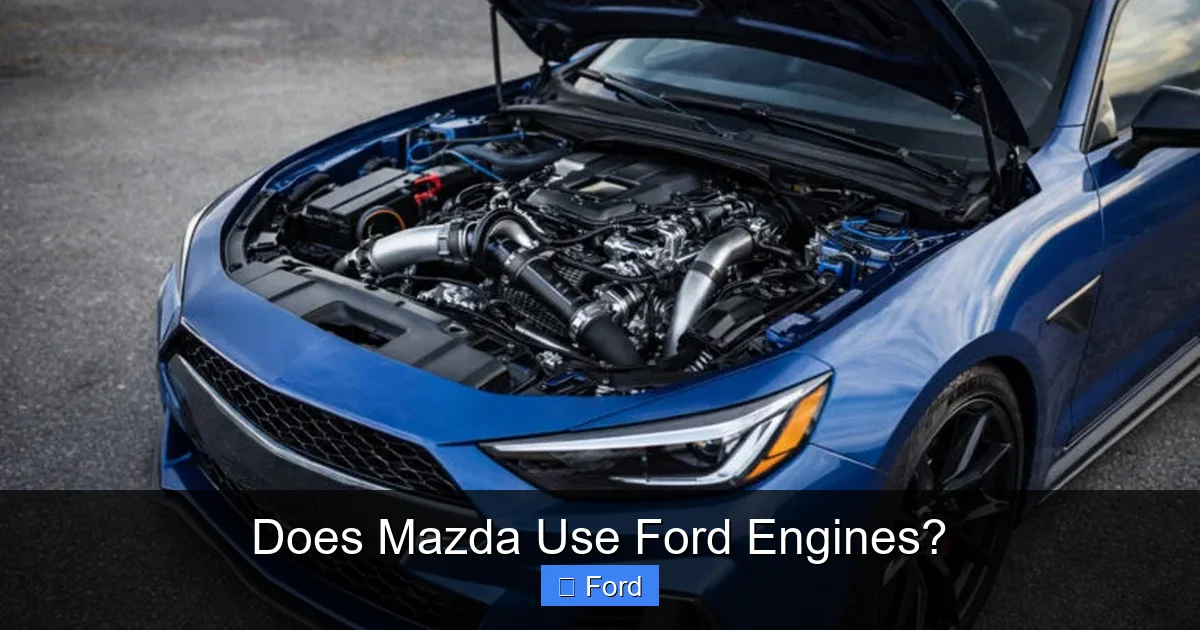
Visual guide about Does Mazda Use Ford Engines?
Image source: smartexplora.com
The Power of Badge Engineering and Platform Sharing
The CD3 platform cars are the primary culprit. When you see two cars from different brands that share the same roofline, doors, and interior structure, your brain assumes they are more alike than they are. This is “badge engineering” at its most visible. The automotive press often referred to them as “twins” or “close cousins,” which, while accurate for the chassis, blurred the lines for the average enthusiast. The myth solidified when Ford’s 3.0L V6 and Mazda’s 3.0L V6 both produced similar power and had similar displacement. For someone not reading a spec sheet, it’s an easy leap to think they must be the same engine just wearing different badges.
This phenomenon isn’t unique to Mazda-Ford. You can find similar confusion with other partnerships. For instance, when researching maintenance for a different brand, you might look up specific requirements like what size tire a Nissan Altima uses or what type of brake fluid Toyota recommends. Each brand has its own precise specifications, even if the cars look similar. The same principle applies to engines: identical-looking applications can have wildly different internal requirements.
Ford’s Ownership Stake Creates Assumptions
The fact that Ford owned a significant minority stake (and at one point a near-controlling interest) in Mazda leads to a simple but flawed assumption: ownership equals parts interchangeability. In the corporate world, a parent company often imposes parts commonality. But in this alliance, Mazda fiercely guarded its engineering independence, especially regarding its core rotary and piston engine programs. Ford’s stake was more about boardroom influence and shared business strategy than a directive to start bolting Ford crate engines into Mazda RX-8s. The two companies were partners, not a master and servant.
The Divorce and Its Aftermath: Mazda Goes It Alone (2015-Present)
The formal strategic alliance began winding down after the 2008 financial crisis. Ford, needing to conserve cash, started reducing its stake in Mazda. By 2015, Ford had completely sold its remaining shares, ending the 36-year partnership. This “divorce” was the final nail in the coffin for any lingering engine sharing.
Mazda’s SkyActiv Revolution
Even before the split was finalized, Mazda was busy on its most important engineering project in decades: SkyActiv. Launched in 2011 with the Mazda3 and CX-5, SkyActiv was not a single engine but a holistic philosophy. It encompassed high-compression gasoline engines (SkyActiv-G), efficient diesel engines (SkyActiv-D), and eventually a breakthrough in ignition technology (SkyActiv-X).
The key to SkyActiv was optimization. Mazda engineers rethought everything: the piston bowl shape, the fuel injector spray pattern, the exhaust manifold integration, the transmission ratios. The result was a family of engines that achieved class-leading efficiency and performance without turbocharging (initially) or hybrid systems. The 2.0L and 2.5L Skyactiv-G engines are Mazda designs from the ground up. They share no parts, no architecture, and no design DNA with any Ford engine, past or present. When you buy a new Mazda, you are buying a car powered by a Mazda engine, through and through.
Ford’s Parallel Development
While Mazda was perfecting SkyActiv, Ford was on its own path: the EcoBoost revolution. Ford invested heavily in downsizing its engines with turbocharging, direct injection, and advanced emissions systems. The 1.5L, 2.0L, and 2.7L EcoBoost four-cylinders and the 3.5L and 3.0L EcoBoost V6s are all Ford developments. There is zero crossover. Ford’s truck and performance engines (like the 5.0L Coyote V8 or the 2.3L EcoBoost for the Mustang) are entirely separate projects. Post-2015, with no corporate ties, the idea of any sharing is not just unlikely—it’s impossible from a business, engineering, and legal standpoint.
Decoding the Current Mazda Engine Lineup: Pure SkyActiv
Let’s get specific. Every single Mazda model sold today—from the entry-level Mazda3 to the flagship CX-90—uses a SkyActiv engine. There are no exceptions, no “special edition” with a Ford-sourced powerplant. Here’s a breakdown of what you’ll find under the hood.
Visual guide about Does Mazda Use Ford Engines?
Image source: autozonic.com
SkyActiv-G: The Workhorse Gasoline Engine
This is the engine most people think of when they think “Mazda.” It’s a naturally aspirated, high-compression design (14.0:1 in most markets) that uses a suite of technologies to prevent engine knock. You’ll find it in:
- Mazda3 & Mazda CX-30: 2.0L (155 hp) or 2.5L (186 hp)
- Mazda CX-5: 2.5L (187 hp) or 2.5L Turbo (227-256 hp)
- Mazda CX-50: 2.5L (187 hp) or 2.5L Turbo (227-256 hp)
- Mazda6: 2.5L (187 hp)
- MX-5 Miata: 2.0L (181 hp)
The turbocharged version of the 2.5L is still a SkyActiv-G variant, just with forced induction. It is not related to Ford’s EcoBoost 2.5L (which doesn’t exist) or any other Ford turbo-four.
SkyActiv-D: The Efficient Diesel (Limited Markets)
Mazda’s diesel engine is a marvel of low-temperature combustion, using a two-stage turbocharger system. It’s available in some CX-5 and previous-generation Mazda6 models in Europe and other markets. It is a Mazda-exclusive design, with no relation to Ford’s diesel engines (like the Power Stroke, which is a joint venture with Navistar, or the older Duratorq, which was a PSA/Ford design).
SkyActiv-X: The Future, Now
The newest technology, first introduced in the Europe-market CX-30 and Mazda3, is Spark Controlled Compression Ignition (SCCI). It’s a gasoline engine that can run on compression ignition like a diesel under certain conditions, offering diesel-like efficiency with gasoline refinement. This is cutting-edge Mazda R&D. No other manufacturer, including Ford, has a production-ready equivalent.
Ford’s Current Engine Lineup: A Different Path
For contrast, let’s quickly look at what powers the Ford vehicles that once shared a platform with Mazdas. The current Ford Fusion (discontinued in 2020) used the 1.5L EcoBoost, 2.0L EcoBoost, and 2.7L EcoBoost V6. The current Ford Escape uses 1.5L and 2.0L EcoBoost four-cylinders. The F-150 offers a range from the 3.3L V6 to the 3.5L EcoBoost V6, the 5.0L V8, and the hybrid PowerBoost. These are all Ford designs, developed in-house or with partner companies like Ricardo (for some diesel tech), but never with Mazda.

Visual guide about Does Mazda Use Ford Engines?
Image source: leatherinsights.com
This independence is crucial. When you need a part for your Ford, you look for Ford-specific components, just as you would for a Nissan Frontier battery or the specific oil for a 2016 Nissan Rogue. Engine parts are no different; they are engineered to the exact tolerances and specifications of their respective manufacturers.
How to Be Absolutely Sure: Identifying Your Mazda’s Engine
So, you own a used Mazda from the partnership era (pre-2015) and you’re still not 100% sure? Here’s how to know for certain what engine is in your car.
The VIN is Your Best Friend
The Vehicle Identification Number is a 17-digit code that contains the engine code. For any Mazda, you can decode it using online VIN decoders or the official Mazda documentation. The 8th digit typically indicates the engine type. For example, in many models, a “W” might denote a 2.5L SkyActiv-G, while a “T” might denote the 2.5L Turbo. For older models, the code will point to the MZR or other Mazda-specific engine families. A Ford engine would have a completely different Ford-specific code, which you will never find in a Mazda VIN.
Pop the Hood and Look for the Badge
This seems obvious, but it’s the quickest check. Mazda engines are prominently badged with “SKYACTIV-G,” “SKYACTIV-D,” “SKYACTIV-X,” or for older models, “MZR” or “Duratec” (note: Ford also used “Duratec,” but in a Mazda, it’s Mazda’s version of the Duratec, not Ford’s). You will never see a “EcoBoost,” “Coyote,” “Duratec 20” (Ford’s 2.0L), or “VCT” badge on a Mazda engine from the factory. The physical design, intake manifold, and valve cover shape will also be distinctly Mazda.
Consult Your Owner’s Manual or Window Sticker
The original documentation will list the exact engine displacement, model number, and specifications. If you have the original window sticker (Monroney label), it will list the engine as a “Mazda SkyActiv-G 2.5L” or similar. There is no scenario where a factory Mazda window sticker would say “Ford engine.”
Conclusion: Celebrating Mazda’s Independent Engineering Spirit
The myth that Mazda uses Ford engines is a fascinating case study in automotive folklore. It’s born from a real, deep partnership that did produce cars that looked and felt similar on the surface. But beneath that sheetmetal was a fundamental truth: Mazda has always been fiercely protective of its powertrain engineering. The SkyActiv family is the culmination of that independent spirit—a suite of technologies designed to extract maximum efficiency and driving pleasure from a gasoline engine, all conceived in Hiroshima.
So, the next time someone tells you your Mazda has a Ford heart, you can confidently set the record straight. You can explain the platform-sharing history of the CD3 cars. You can detail the high-compression, piston-design innovations of SkyActiv-G. You can point to the badge on the valve cover. And you can appreciate that the smooth, responsive acceleration you enjoy comes from a Mazda engineer’s vision, not a Ford assembly line. Your Mazda’s engine is, and always has been, authentically Mazda.
Frequently Asked Questions
Did any Mazda ever come with a Ford engine from the factory?
No. Even during the deepest period of partnership, no production Mazda vehicle was sold in any market with a Ford-designed and Ford-built engine as its standard powerplant. All Mazdas have always had Mazda-designed engines, even when sharing platforms with Ford vehicles.
What about the Ford-powered Mazda Bongo or other commercial vehicles?
In some markets, Mazda sold vehicles that were originally developed by Ford or its subsidiaries. For example, the Mazda Bongo was a Mazda-designed van, but in some regions, it was sold as a Ford Transit Connect or Courier. However, these were Ford-badged vehicles using Mazda platforms and often Mazda engines, not Mazda-badged vehicles using Ford engines. The engine remained a Mazda unit.
Are there any shared components between modern Mazda SkyActiv and Ford EcoBoost engines?
No. Since the formal end of the alliance in 2015 and the full deployment of SkyActiv technology, there is zero parts sharing, engineering collaboration, or common architecture between Mazda’s and Ford’s current gasoline engine families. They are developed in completely separate facilities by different engineering teams.
I have a 2010 Mazda6. Is that engine from Ford?
Absolutely not. Your 2010 Mazda6 with the 2.5L engine has the Mazda MZR 2.5L, a fully Mazda-developed and built engine. It shares no parts with the 2.5L Duratec or other engines in the contemporary Ford Fusion. The only shared elements are the underlying CD3 platform structure.
How can I find out exactly what engine is in my used Mazda?
The most reliable method is to decode your Vehicle Identification Number (VIN). The 8th character will tell you the specific engine code. You can also look for the engine badge under the hood or consult your owner’s manual. For definitive proof, a dealership can run your VIN and provide the exact factory specifications.
Does the Mazda-Ford history mean parts for my Mazda are the same as for a similar Ford?
Generally, no. While some suspension components, body panels, or interior trim pieces from the platform-sharing era (like certain Mazda6/Fusion models) might be interchangeable due to shared architecture, engine parts, transmission parts, and most drivetrain components are brand-specific. Always verify part numbers for your specific vehicle using your VIN, as assuming interchangeability with a Ford can lead to costly mistakes. This is similar to how the correct oil filter for your specific model is critical, regardless of brand platform sharing.
