
How Many Miles Does a Toyota Tacoma Get on a Full Tank

The distance a Toyota Tacoma can travel on a full tank varies significantly based on model year, engine, drivetrain, and driving habits. With gas tank sizes ranging from about 18 to 21 gallons and EPA combined MPG estimates between 18 and 25, your realistic range typically falls between 320 and 500 miles. Understanding your specific Tacoma’s configuration and adopting fuel-efficient driving techniques are key to maximizing every tank.
So, you’re staring at your Toyota Tacoma’s fuel gauge, wondering just how far that needle will actually move before you need to find a gas station. It’s one of the most practical questions a truck owner can ask. The answer isn’t a single, simple number. It’s a calculation wrapped in a riddle, inside an enigma, that all comes down to your specific truck and how you drive it. Think of your Tacoma’s fuel range as a unique fingerprint—no two are exactly alike. In this complete guide, we’re going to pop the hood on that question, “How many miles does a Toyota Tacoma get on a full tank?” We’ll look at the hard numbers from the EPA, the real-world variables that change everything, and give you the tools to estimate your own truck’s range with confidence.
Key Takeaways
- Tank Capacity is the First Variable: Toyota Tacoma fuel tanks hold between approximately 18 and 21 gallons, depending on the model year and cab/bed configuration, directly impacting your maximum possible range.
- EPA Ratings are a Starting Point, Not a Guarantee: Official EPA estimates (18-25 MPG combined) are achieved under controlled conditions; real-world mileage is often 1-3 MPG lower due to driving style, load, and environment.
- Drivetrain Makes a Noticeable Difference: 4×2 (two-wheel drive) models consistently get better fuel economy than 4×4 (four-wheel drive) models, often by 1-2 MPG, due to the added weight and mechanical resistance of the 4WD system.
- Your Driving Habits are the Biggest Wild Card: Aggressive acceleration, high speeds, excessive idling, and frequent off-roading can drastically reduce your miles per gallon, sometimes by 25% or more compared to gentle, steady driving.
- Proper Maintenance is Non-Negotiable for Efficiency: Neglecting basic upkeep like tire pressure, oil changes, air filter replacements, and spark plug service can silently drain your fuel economy by several percentage points.
- Reserve Fuel Provides a Critical Safety Net: When your gas light illuminates, you typically have 1-2 gallons (30-50 miles) of reserve fuel left, but this is an emergency buffer, not a regular practice.
- Know Your Specific Truck: The model year, engine size (2.7L 4-cylinder vs. 3.5L V6), cab style (Access Cab vs. Double Cab), and bed length all influence both tank size and weight, affecting your ultimate miles-per-tank calculation.
📑 Table of Contents
- The Foundation: Tank Capacity and EPA MPG Estimates
- Real-World Fuel Economy: The “It Depends” Chapter
- Model Year, Engine, and Drivetrain: Choosing Your Baseline
- Maximizing Your Tacoma’s Range: Practical, Actionable Tips
- The Gas Light and Reserve Fuel: Your Emergency Buffer
- Putting It All Together: Calculating Your Realistic Range
- Conclusion: Your Tacoma, Your Range
The Foundation: Tank Capacity and EPA MPG Estimates
Before we talk miles, we must talk gallons. Your maximum theoretical distance is a simple multiplication: Gas Tank Size (in gallons) x Fuel Economy (in MPG) = Maximum Range (in miles). But both of those numbers are ranges themselves, not fixed figures. Let’s break down each part.
Understanding Your Tacoma’s Gas Tank Size
Toyota Tacoma gas tank capacities have evolved slightly over the years. For the current third-generation models (2020-present), the capacity is largely consistent but varies by cab and bed configuration. The most common size is a 21.1-gallon tank, found in most Double Cab (crew cab) models with either the 5-foot or 6-foot bed. Earlier Access Cab (extended cab) models and some base trims may have a slightly smaller tank, often around 18.5 gallons. For the previous second-generation (2005-2015), tanks were generally in the 19.5 to 21-gallon range. The best way to know for sure is to check your owner’s manual or look up your specific VIN online. For a comprehensive breakdown of tank sizes across all recent model years and configurations, you can refer to our detailed article on how many gallons a Toyota Tacoma holds.
Decoding the EPA MPG Sticker
The Environmental Protection Agency (EPA) tests every vehicle on a dynamometer under simulated city and highway conditions to assign an official miles-per-gallon rating. For the modern Tacoma, these are the typical combined estimates:
- 2.7L 4-Cylinder Engine (4×2): Up to 22 MPG combined (21 city / 24 highway)
- 2.7L 4-Cylinder Engine (4×4): Up to 20 MPG combined (19 city / 22 highway)
- 3.5L V6 Engine (4×2): Up to 23 MPG combined (21 city / 26 highway)
- 3.5L V6 Engine (4×4): Up to 21 MPG combined (19 city / 24 highway)
Older model years, especially those with the 4.0L V6 (pre-2016), had lower ratings, often in the 16-19 MPG combined range. It’s crucial to find the sticker for your exact model year and configuration. But here’s the critical first rule: the EPA number is a best-case, laboratory scenario. It’s a benchmark for comparison, not a promise you’ll see on your dashboard every week.
Real-World Fuel Economy: The “It Depends” Chapter
This is where the rubber meets the road—literally. Your real-world MPG is a living, breathing number that changes with every trip. Let’s explore the biggest factors that separate the 25 MPG dream from the 15 MPG reality.
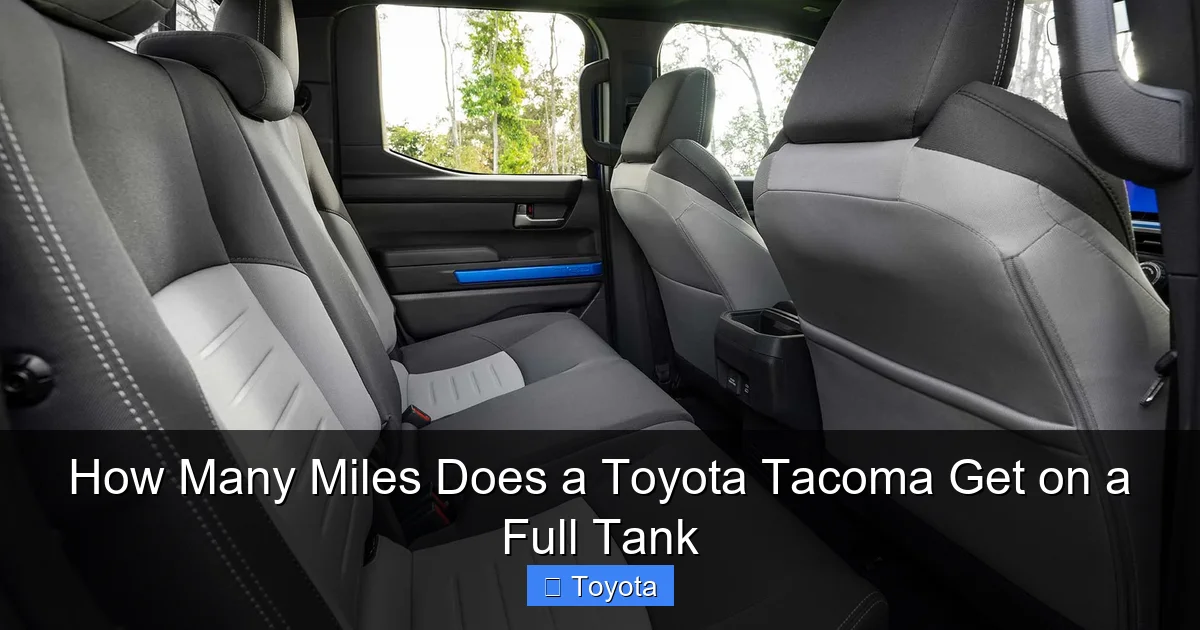
Visual guide about How Many Miles Does a Toyota Tacoma Get on a Full Tank
Image source: motorweek.org
Driving Style: The Single Largest Influence
How you operate the pedals is everything. The EPA test cycle is a gentle, predictable drive. Your life is not. Aggressive acceleration and hard braking are the number one fuel thieves. Every time you launch from a stoplight like you’re at the drag strip, you’re dumping raw gasoline into the engine for a burst of power that you’ll immediately have to waste slowing down at the next stop. Jackrabbit starts can reduce your city MPG by 15-30%. Similarly, cruising at 75 mph on the highway uses significantly more fuel than at 65 mph due to exponentially increased aerodynamic drag. Using cruise control on flat highways is one of the most effective ways to maximize your range, as it maintains a constant, efficient speed.
The Weight of Your World: Load, Cargo, and Towing
A Tacoma is a truck, meant to carry and tow. But every 100 pounds of extra weight reduces fuel economy by about 1-2%. This adds up fast. A fully loaded bed with tools, a heavy aftermarket bumper, a roof rack with gear, and a trailer hitch with a small utility trailer can easily add 500-1,000 pounds. That could mean a 5-10% hit to your MPG. Towing is the ultimate MPG killer. Even a modest 3,000-pound trailer can drop your highway fuel economy by 25-40%, depending on aerodynamics and terrain. The engine works much harder, shifting more frequently and running at higher RPMs. If you regularly tow, you must adjust your range expectations downward significantly.
Terrain, Weather, and Traffic: The Uncontrollables
You can’t change the landscape, but you can understand its impact. Mountainous or hilly terrain forces constant acceleration uphill and regenerative braking downhill, which is far less efficient than steady-state cruising on flat ground. Stop-and-go city traffic is brutal on fuel economy due to constant acceleration from a dead stop. Extreme temperatures also play a role. In winter, the engine runs longer to warm up, and the battery is weaker, making the starter and accessories work harder. Using the heater and defroster puts a slight load on the engine. In summer, running the air conditioning can increase fuel consumption by 5-10%, especially in city driving. Strong headwinds or following a large truck also affects aerodynamics and MPG.
Model Year, Engine, and Drivetrain: Choosing Your Baseline
Not all Tacomas are created equal when it comes to thirst. Your powertrain choice sets the ceiling and floor for your potential fuel economy.

Visual guide about How Many Miles Does a Toyota Tacoma Get on a Full Tank
Image source: facts.net
The 4-Cylinder vs. V6 Debate: Power vs. Efficiency
For the current generation, the 2.7L 4-cylinder is the efficiency leader, especially in 4×2 trim. It’s a torquey, reliable workhorse that prioritizes fuel savings. The 3.5L V6 offers significantly more horsepower and towing capacity, which comes at a slight MPG cost. In real-world mixed driving, the difference between the two engines in the same drivetrain configuration is often 1-3 MPG, with the 4-cylinder winning out. However, a skilled driver with a light foot in a V6 4×2 can sometimes match or even exceed the EPA rating of a 4-cylinder driven aggressively. The older 4.0L V6 (2005-2015) is notably less efficient, often struggling to break 18 MPG combined in real-world use. If maximizing range on a tank is your top priority and you don’t need maximum towing power, the 4-cylinder is the clear choice.
4×2 vs. 4×4: The Permanent Trade-Off
This is one of the most consistent differentiators. A 4×4 (four-wheel drive) system adds substantial weight (hundreds of pounds from the transfer case, front axle, and driveshafts). It also introduces more moving parts and friction in the drivetrain. The EPA reflects this with a 1-2 MPG penalty for 4×4 models across both engines. In real-world use, especially in dry conditions where 4WD is not engaged, the penalty is still present due to that permanent weight. If you rarely encounter snow, mud, or serious off-road conditions, a 4×2 Tacoma will give you more miles per tank, every single time. The 4×4’s value is in capability, not efficiency. For those who need it, the trade-off is worth it, but you must account for the lower MPG in your range calculations.
Maximizing Your Tacoma’s Range: Practical, Actionable Tips
You’ve bought the truck. Now, how do you get the most miles from each precious gallon? It’s a combination of smart habits and diligent maintenance.
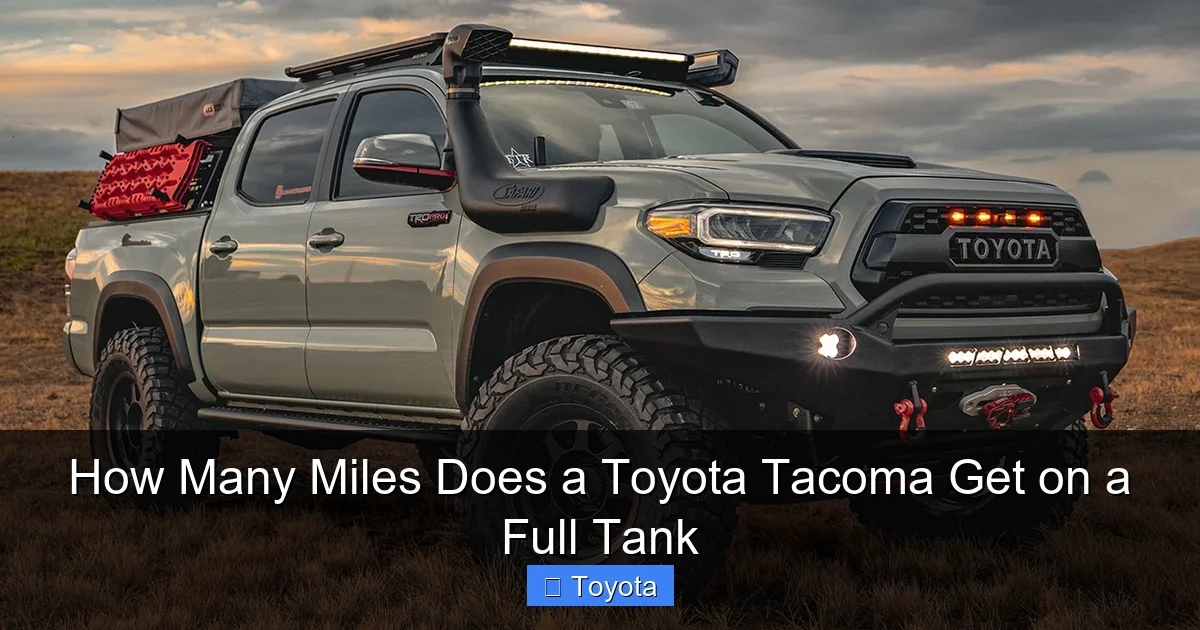
Visual guide about How Many Miles Does a Toyota Tacoma Get on a Full Tank
Image source: trailtacoma.com
Maintenance: The Unsexy Secret to Better MPG
A poorly maintained engine is an inefficient one. Here are the non-negotiables:
- Tire Pressure: Under-inflated tires increase rolling resistance. Check pressures monthly and inflate to the manufacturer’s PSI listed on the driver’s door jamb sticker (not the max on the tire sidewall). This can improve MPG by 0.3-0.5% for every 1 PSI drop.
- Engine Air Filter: A clogged filter starves the engine of air, forcing it to work harder and burn more fuel. Replace it every 15,000-30,000 miles, or more often in dusty conditions.
- Oil Changes: Using the correct viscosity of clean oil reduces internal engine friction. Follow the severe service schedule if you do a lot of short trips, towing, or extreme temperature driving.
- Spark Plugs: Worn plugs cause misfires and poor combustion. Replace them at the recommended interval (often 60,000-100,000 miles on modern iridium plugs).
- Fuel System: Periodically using a quality fuel system cleaner can help keep injectors clean, ensuring optimal fuel spray pattern.
For specific maintenance intervals and capacities, like how much oil your Tacoma takes, always consult your owner’s manual first.
Driving Habits That Save Fuel
Your right foot is your most powerful MPG tool.
- Accelerate Gently: Pretend there’s an egg under your pedal. Take 5-7 seconds to reach your cruising speed from a stop.
- Maintain Steady Speeds: Use cruise control on flat highways. Anticipate traffic flow to avoid unnecessary braking and acceleration.
- Reduce Idling: Modern engines don’t need long warm-ups. 30 seconds is plenty. If you’re stopped for more than 60 seconds (not in traffic), turn the engine off.
- Lighten the Load: Remove unnecessary items from the bed and cabin. Take off the roof rack if you’re not using it; it creates significant wind resistance.
- Plan Your Trips: Combine errands into one trip. A warm engine is more efficient than multiple cold starts.
The Gas Light and Reserve Fuel: Your Emergency Buffer
That glowing amber light isn’t a suggestion; it’s a warning. But it’s not an immediate “you’re out of gas” signal. Most vehicles, including the Tacoma, have a reserve fuel supply beyond what the gauge indicates.
How Much Fuel is Left When the Light Comes On?
There’s no universal standard, but for most modern Tacomas, you can generally expect to have approximately 1.5 to 2.5 gallons of usable fuel remaining when the low fuel warning light illuminates. This is a safety margin designed to prevent you from being stranded. The exact amount can vary by model year and tank shape. Do not make a habit of driving on reserve. Running consistently low can:
- Overheat the in-tank fuel pump (which is cooled by gasoline).
- suck up sediment and debris from the bottom of the tank into your fuel system.
- Leave you stranded if your estimate is off or you encounter unexpected traffic.
As a rule of thumb, plan to refuel when your gauge shows 1/4 tank. This gives you a comfortable buffer and helps keep your fuel system clean. If you do find yourself with the gas light on, you likely have 30 to 50 miles left, but drive calmly and directly to a station. For a deeper look at this safety feature across Toyota models, you might read about how many miles you can drive when the gas light comes on in a Toyota Camry, which follows similar engineering principles.
Putting It All Together: Calculating Your Realistic Range
Let’s do some math with a real example. Take a 2023 Toyota Tacoma Double Cab 4×4 with the 3.5L V6.
- Tank Size: ~21.1 gallons
- EPA Combined MPG: 21 MPG
- Theoretical Max Range: 21.1 gal x 21 MPG = 443 miles
Now, apply real-world factors. This driver has a roof rack, does mostly city driving with some highway, and has a moderate right foot. They see about 18.5 MPG in reality.
- Realistic Range: 21.1 gal x 18.5 MPG = 390 miles
If they tow a small trailer, their MPG might drop to 15 MPG.
- Towing Range: 21.1 gal x 15 MPG = 317 miles
See the dramatic difference? Your personal range is a living calculation. The best way to know is to track your own mileage. Fill the tank completely, reset your trip odometer, drive normally until you refill (ideally when the gauge reads 1/4 tank, not on empty), then divide the miles driven by the gallons you added. That’s your true, real-world MPG for that tank. Do this a few times to get an accurate average for your driving style and conditions.
Conclusion: Your Tacoma, Your Range
So, how many miles does a Toyota Tacoma get on a full tank? The honest answer is: somewhere between 300 and 500 miles, with 350-450 being the most common real-world sweet spot for modern models. Your specific number is determined by a matrix of factors—your truck’s tank size, its engine and drivetrain, the weight you carry, the roads you drive, and how you drive them. The EPA provides a useful baseline for shopping and comparison, but your own driving log is the only true source of truth. By understanding these variables and practicing efficient habits, you can consistently land on the higher end of your Tacoma’s potential range, making every fill-up count and every adventure possible with fewer stops at the pump.
Frequently Asked Questions
Does a 4×4 Toyota Tacoma get significantly worse mileage than a 4×2?
Yes, a 4×4 Tacoma will typically get 1-2 MPG less than an otherwise identical 4×2 model due to the added weight and drivetrain friction of the four-wheel-drive system. This difference is consistent in both EPA ratings and real-world driving.
Is the EPA MPG rating on the window sticker accurate for my driving?
The EPA rating is a standardized laboratory estimate, not a real-world guarantee. Most drivers see 1-3 MPG less than the combined rating, especially if they do a lot of city driving, have a heavy foot, or frequently carry cargo. It’s best used for comparing models, not predicting your exact tank range.
How far can I expect to drive after my Tacoma’s gas light comes on?
When the low fuel light illuminates, you typically have between 1.5 and 2.5 gallons of reserve fuel remaining. Depending on your current MPG, this usually translates to 30 to 50 miles of driving. This is an emergency buffer only; you should refuel as soon as safely possible.
Will using regular 87-octane gasoline affect my Tacoma’s range or performance?
No. Toyota designs the Tacoma’s engines to run optimally on regular 87-octane gasoline. Using higher-octane premium fuel will not improve fuel economy or power in a standard Tacoma and is not recommended unless your manual specifies it for extreme conditions (like severe towing in very hot climates).
Does the Tacoma’s driving mode (Eco, Sport, Normal) actually change the MPG?
Yes, but the change is modest. The “Eco” mode adjusts throttle response and transmission shift points to encourage more efficient driving, which can improve MPG by 0.5-1.5 in mixed driving. “Sport” mode does the opposite, prioritizing quicker response and higher RPMs, which will reduce fuel economy. The difference is more noticeable in city driving than on steady highway cruises.
How does off-roading impact my fuel tank range?
Off-roading drastically reduces fuel economy. Low gears, high RPMs, overcoming obstacles, and often using 4WD all consume fuel at a much higher rate. You can expect your MPG to drop by 25-50% or more compared to highway driving. For every gallon of fuel, you’ll cover far fewer miles on a trail than on pavement. Always plan with a full tank and consider carrying extra fuel for remote adventures.
