
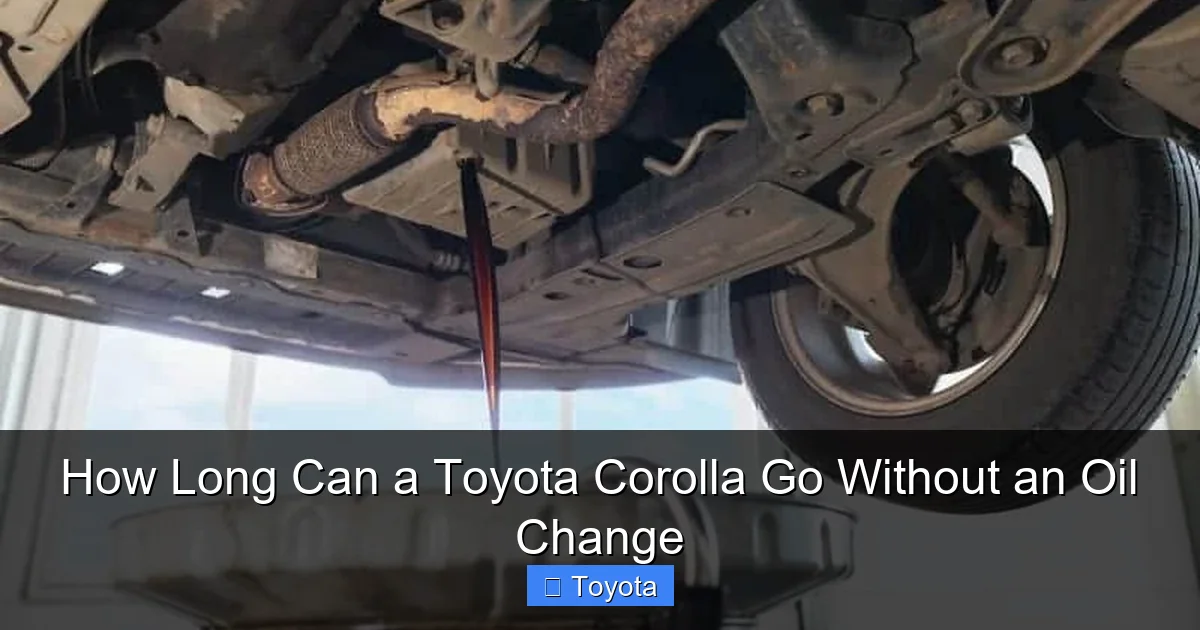
How Long Can a Toyota Corolla Go Without an Oil Change

Your Toyota Corolla’s oil change interval isn’t a one-size-fits-all number. While the traditional 3,000-mile rule is outdated, modern Corollas with synthetic oil can often go 7,500 to 10,000 miles. However, severe driving conditions like extreme temperatures, stop-and-go traffic, or towing can cut that interval in half. Ignoring scheduled oil changes leads to sludge, wear, and potentially catastrophic engine failure. Always prioritize your owner’s manual and monitor your oil life monitor for the most accurate guidance.
Key Takeaways
- Modern Intervals Are Longer: With full synthetic oil and normal driving, a new Toyota Corolla can typically go 7,500-10,000 miles between changes, far beyond the old 3,000-mile myth.
- Your Driving Style is Everything: “Severe” or “extreme” driving conditions—like constant short trips, extreme heat/cold, dusty roads, or heavy loads—can require oil changes every 3,500-5,000 miles, even with synthetic oil.
- The Oil Life Monitor is Your Best Friend: Trust your vehicle’s intelligent Oil Maintenance Required light or percentage-based monitor over generic mileage charts. It calculates real-time engine stress.
- Delaying Risks Costly Damage: Old, broken-down oil turns into abrasive sludge that clogs passages, increases friction, and causes premature wear on bearings, pistons, and valves, leading to engine seizure.
- Oil Type Dictates Lifespan: Conventional oil degrades faster (5,000-mile max) than synthetic blends (7,500 miles) or full synthetic (10,000+ miles). Using the correct oil for your model year is critical.
- Never Ignore the Signs: Besides the dashboard light, watch for dark/opaque oil on the dipstick, engine knocking noises, decreased performance, or exhaust smoke—all signs an immediate change is needed.
- Prevention is Cheaper Than Repair: A single oil change costs less than 1% of a major engine rebuild. Sticking to a proper schedule is the single most important, affordable maintenance task for your Corolla’s longevity.
📑 Table of Contents
- Introduction: The Eternal Question for Corolla Owners
- What Does Toyota Actually Recommend?
- The Oil Life Monitor: Your Car’s Smartest Advisor
- The Real Consequences of Going Too Long
- Signs Your Corolla Needs an Oil Change IMMEDIATELY
- Best Practices for a Long-Lasting Corolla Engine
- Conclusion: Your Simple, Actionable Rule
Introduction: The Eternal Question for Corolla Owners
You’re cruising down the highway in your trusty Toyota Corolla, the odometer clicking away. A little light pops on, or maybe you just have that nagging thought: “When was the last oil change?” It’s one of the most common—and most confusing—questions in car ownership. The old rule of thumb was a simple “every 3,000 miles.” But cars have evolved dramatically since then, and so have lubricants. So, how long can a Toyota Corolla really go without an oil change?
The honest answer is: it depends. It depends on your car’s year, the type of oil it uses, and, most importantly, how you drive it. Pushing your luck with an overdue oil change is a high-stakes gamble with your engine’s health. In this complete guide, we’ll cut through the myths, decode your owner’s manual, explain what “severe service” really means for a Corolla, and give you the clear, actionable rules to keep your engine running smoothly for 200,000 miles or more. Let’s get into the gritty details of engine oil.
What Does Toyota Actually Recommend?
The first and most authoritative place to look is your vehicle’s owner’s manual. Toyota engineers know the Corolla’s engine better than anyone. They provide specific intervals based on extensive testing. For modern Corollas (roughly 2014 and newer), the standard recommendation for “normal” driving is typically every 7,500 miles or 12 months when using Toyota Genuine Motor Oil or an equivalent full synthetic oil that meets Toyota’s specifications.

Visual guide about How Long Can a Toyota Corolla Go Without an Oil Change
Image source: vehicleanswers.com
Understanding the Two Service Schedules
Your manual will almost always list two separate maintenance schedules: “Normal” (or “Standard”) and “Severe” (or “Extreme”) service. Most drivers mistakenly think they fall under “normal.” But if your driving habits match any of the conditions below, you are firmly in the “severe” category, and your interval drops significantly, often to 5,000 miles or 6 months.
Here’s the critical breakdown from Toyota’s typical severe service criteria:
- Driving in extremely cold (below 10°F / -12°C) or extremely hot (above 100°F / 38°C) temperatures.
- Frequent trips of less than 5 miles in normal temperatures, or less than 10 miles in freezing temperatures.
- Extensive idling and/or driving in stop-and-go traffic (think city commuting, not highway cruising).
- Driving in dusty, sandy, or off-road conditions.
- Towing a trailer or carrying heavy cargo on a regular basis.
If you recognize your daily routine in that list, you must use the severe service schedule. Be honest with yourself. The majority of urban and suburban drivers fall into this bucket, meaning their true oil change interval is closer to 5,000 miles with synthetic oil.
The Oil Life Monitor: Your Car’s Smartest Advisor
If you have a Corolla from the last decade or so, you have a powerful tool: the Oil Maintenance Required light or a percentage-based oil life display on your multi-information screen. This isn’t just a simple mileage counter. It’s an advanced algorithm that monitors engine revolutions, engine temperature, and driving patterns to calculate the actual degradation rate of your oil.

Visual guide about How Long Can a Toyota Corolla Go Without an Oil Change
Image source: rxmechanic.com
How It Works and Why You Should Trust It
The system knows that a 10-minute drive to the grocery store in January is far harder on your oil than a 3-hour highway cruise in spring. The short trips don’t allow the engine to fully warm up, leading to fuel dilution (gasoline getting into the oil) and moisture buildup—both of which break oil down faster. The monitor counts these “severe” cycles more heavily. When it reads “0% Oil Life,” it’s not a suggestion; it’s the manufacturer’s calculated endpoint for safe oil life. Resetting it without changing the oil is dangerous and voids a key part of your maintenance contract.
To check it, turn your key to “ON” (without starting) and press the trip/odometer button until you see the oil life percentage. When it gets down to 15-20%, start planning your service. Forgetting this intelligent system and relying solely on a mileage guess is one of the biggest modern maintenance mistakes you can make.
The Real Consequences of Going Too Long
What’s the big deal if you go an extra 1,000 or 2,000 miles? Everything. Engine oil has three primary jobs: lubricate, cool, and clean. As it ages, it fails at all three.
Visual guide about How Long Can a Toyota Corolla Go Without an Oil Change
Image source: rxmechanic.com
The Path from Golden Liquid to Abrasive Sludge
Fresh oil is a smooth, amber-colored liquid. As it’s exposed to heat, oxygen, and combustion byproducts, its chemical structure breaks down. The additives that neutralize acids and suspend soot are depleted. The oil’s viscosity (its thickness) changes—it can become too thin to maintain a protective film or too thick to flow properly to critical parts. The most dangerous outcome is the formation of sludge.
Sludge is a thick, tar-like deposit that clogs oil passages, particularly the tiny galleries that feed the cylinder head and valvetrain. This starves parts of lubrication, causing them to wear rapidly. It can also coat piston rings, leading to oil burning and loss of compression. Once sludge forms inside an engine, a simple oil change often isn’t enough to reverse the damage; a costly chemical flush or even a complete teardown may be necessary.
Specific Damage You’re Risking
Pushing your luck with a Corolla’s 1.8L or 2.0L engine can lead to:
- Premature Timing Chain Wear: The Corolla’s timing chain is oil-pressure lubricated. Low oil pressure from worn-out oil accelerates chain stretch and can ruin tensioners, leading to a $3,000+ repair.
- Valve Train Destruction: The hydraulic lifters rely on clean, pressurized oil to function silently. Dirty oil causes lifter tick, then failure, which can bend valves.
- Rod Bearing Failure: This is the ultimate engine-killer. When the oil film between the crankshaft journal and the rod bearing fails, metal grinds on metal instantly, welding the bearing to the crank and seizing the engine.
The cost of a single oil change is less than 1% of the cost of replacing an engine. The math is brutally simple.
Signs Your Corolla Needs an Oil Change IMMEDIATELY
Don’t wait for the light if you notice any of these symptoms. They are your engine’s cry for help.
Visual and Sensory Clues
The simplest check is the dipstick. Pull it out, wipe it clean, reinsert it fully, and pull it out again. What do you see?
- Color & Clarity: Fresh oil is translucent and amber. If it’s dark brown, black, or opaque, it’s full of contaminants and needs changing now. If it looks milky or foamy, you have a serious coolant leak (head gasket issue) and must stop driving immediately.
- Level: Is it between the “L” and “F” marks? If it’s very low or below “L,” you need to top it up with the correct oil weight (see your manual) and get it changed as soon as possible. Running low on oil causes instant, severe damage.
Other signs include:
- Engine Noise: A new, rhythmic ticking or tapping from the top end (valve train) or a deep, metallic knock from the bottom end (bearings) is a red flag.
- Exhaust Smoke: Blue-ish smoke indicates the engine is burning oil, a sign of worn seals or rings often exacerbated by degraded oil.
- Performance Drop: If your Corolla feels sluggish, has poor throttle response, or stalls more easily, thick, sludgy oil could be creating internal drag.
Best Practices for a Long-Lasting Corolla Engine
Knowing the interval is one thing. Building a habit that protects your investment is another.
Choose the Right Oil and Filter, Every Time
Your manual specifies the exact oil viscosity and specification (e.g., 0W-20, API SP). Using a cheaper, incorrect oil is a false economy. For most modern Corollas, full synthetic 0W-20 is mandatory for achieving the long-change intervals. For older models (pre-2014), synthetic blend or high-quality conventional 5W-20 or 5W-30 may be specified. When in doubt, check the cap under your hood—it often lists the recommended weight.
Equally important is the oil filter. A cheap, low-quality filter can have a poor filtering medium that allows contaminants to circulate or a weak anti-drain back valve that causes dry starts. Use a reputable brand (OEM Toyota, Denso, WIX, Mobil 1, K&N). The few dollars you save on a filter isn’t worth the risk to your engine.
Don’t Just Change the Oil—Do a Full Inspection
A proper oil change is an opportunity for a health check. A good technician should:
- Check and top up all other fluids (coolant, brake, power steering, windshield washer).
- Inspect the air filter—a clogged air filter makes your engine work harder and can introduce more dirt into the oil.
- Look for leaks around the oil filter, drain plug, and valve cover gasket.
- Check tire pressure and for any obvious signs of wear or damage.
Consider pairing your oil change with a tire rotation every other service to ensure even tire wear.
If You Must Extend an Interval (We Don’t Recommend It)
Life happens. If you’re 500 miles past your Oil Maintenance Required light, the first step is to check the oil level and condition on the dipstick. If it’s full and still looks relatively clean (light brown), you can likely drive to your service appointment without immediate harm. However, if it’s low, dark, or gritty, do not start the engine. Have it towed. In a pinch, you can add a quart of the correct oil to get you to a safe location for a change, but this is a temporary fix, not a solution. For a deeper dive into what happens when you delay, you can read our general guide on how long a car can go without an oil change.
Conclusion: Your Simple, Actionable Rule
For your Toyota Corolla, the answer to “how long” is this: follow your Oil Life Monitor religiously for normal driving, and use the severe service schedule (5,000 miles/6 months) if your driving matches the criteria. Never, under any circumstance, exceed 10,000 miles or 12 months on a single oil change, even with synthetic oil. Your Corolla’s legendary reliability is built on consistent, proper maintenance. An oil change is the cornerstone of that maintenance. It’s a cheap, quick, and incredibly effective way to protect a $20,000+ asset. Set a calendar reminder when your oil life hits 20%, book your appointment with a trusted mechanic or dealership, and rest easy knowing you’re doing the single best thing for your car’s long-term health. Your future self—and your engine—will thank you.
Frequently Asked Questions
Can I just add oil instead of getting a full oil change?
No. Adding oil only tops up the level; it does not replace the degraded, contaminated oil and exhausted additives in the sump. The old oil remains, diluting the new oil and reducing its effectiveness. You must perform a full drain and refill to restore proper lubrication and protection.
What happens if I ignore the oil change light for a few hundred miles?
A few hundred miles past the recommended interval is usually not an emergency if your oil level is full and the oil still looks clean on the dipstick. However, every mile beyond the point increases wear. The light means the oil’s protective additives are depleted. Get it changed as soon as is practically possible, ideally within 100-200 miles.
Is it better to change my Corolla’s oil at the dealership or an independent shop?
Both can be excellent choices. A Toyota dealership uses OEM parts and technicians trained specifically on your model, which is ideal for warranty concerns. A reputable independent shop is often less expensive. The key is finding a shop that uses the correct oil specification (Toyota Genuine Motor Oil or an equivalent meeting Toyota’s specs) and a quality filter. You can learn more about dealership costs in our article on how much an oil change costs at Toyota.
My Corolla uses 0W-20 synthetic oil. Can I switch to a cheaper conventional oil?
You should not. 0W-20 is a very thin, specialized oil designed for the tight tolerances of modern Toyota engines. Using a thicker conventional oil can cause increased wear, poorer fuel economy, and may even trigger engine trouble codes. Always use the oil viscosity and specification listed in your owner’s manual. For more on oil types, see our piece on how long synthetic oil can last in a car.
My Corolla has low mileage. Do I still need to change the oil annually?
Yes, absolutely. Even if you only drive 3,000 miles a year, you must change the oil at least once a year. Oil degrades over time from heat, moisture, and fuel dilution, regardless of mileage. The “12 months” part of the interval is just as critical as the mileage.
How many quarts of oil does a Toyota Corolla take?
It varies slightly by engine and model year. Most recent Corollas with the 1.8L 2ZR-FE engine take 4.4 quarts (4.2L) with filter change. The newer 2.0L M20A-FKS engine typically takes 4.2 quarts (4.0L) with filter change. Always confirm the exact capacity in your owner’s manual before adding oil. We have a specific guide on how many quarts of oil a Toyota Corolla takes for precise model-year details.
