
Can a Ford F-150 Tow 8

Yes, a properly configured Ford F-150 can absolutely tow 8,000 pounds, but it’s not automatic. The maximum tow rating depends entirely on your specific truck’s engine, drivetrain, axle ratio, cab, and bed size. You must consult your truck’s official payload and tow rating label, not just marketing materials. Proper setup with the right hitch, weight distribution, and brakes is non-negotiable for safe towing at that weight.
So, you’re looking at your trusty Ford F-150, maybe eyeing a boat, a large camper, or a hefty work trailer. The big question pops into your head: “Can my F-150 tow 8,000 pounds?” It’s a fantastic and very common question for America’s best-selling truck. The short, exciting answer is: Yes, many Ford F-150s are engineered to tow well over 8,000 pounds. But here’s the crucial part—and the focus of this entire guide—it’s not a blanket “yes” for every single F-150 on the road. Your specific truck’s ability hinges on a combination of factors that you, as the owner, must understand and verify. Towing is about confidence, and confidence comes from knowledge, not guesswork.
Think of your F-150’s towing capacity like a recipe. One missing or wrong ingredient—the wrong axle ratio, a missing tow package, or an overloaded truck bed—and the whole dish (or in this case, the safe tow) falls apart. We’re going to break down that recipe piece by piece. We’ll decode the factory jargon, show you exactly where to find the real numbers on your truck, and translate those specs into practical, real-world towing advice. Whether you’re a first-time tower or a seasoned pro looking to maximize your rig, this guide will give you the clarity you need to hitch up and hit the road safely and legally.
Key Takeaways
- Towing 8,000 lbs is possible but configuration-dependent: Only F-150s with the highest-output engines (like the 3.5L EcoBoost V6 or 5.0L V8 with Max Trailer Tow Package) and specific axle ratios can reach or exceed 8,000 lbs.
- Your truck’s door jamb sticker is the final authority: Ignore generic charts. The certified payload and Gross Combined Weight Rating (GCWR) on your specific vehicle’s label dictate your true limits.
- “Tow Rating” is not the same as “Loaded Trailer Weight”: You must subtract the weight of your truck, passengers, cargo, and fuel from the GCWR to find your actual available capacity for the trailer.
- Proper equipment is mandatory: Towing 8k lbs requires a Class IV or V hitch, a weight-distributing system with sway control, and a trailer with its own braking system.
- Drivetrain matters significantly: 4×4 models typically have a lower maximum tow rating than 2WD models due to added weight, and the rear axle ratio is the single biggest factor in towing muscle.
- Driving technique changes: Towing near the limit requires more following distance, anticipating stops, and understanding your truck’s reduced acceleration and longer braking distances.
- Safety over ego: Never exceed your truck’s ratings. Overloading strains components, causes poor handling, increases stopping distances, and is illegal.
📑 Table of Contents
- Decoding the Magic Number: Where 8,000 lbs Actually Comes From
- Finding Your Truck’s TRUE Capacity: The Door Jamb Decoder Ring
- Configurations That Hit (and Miss) the 8,000-Lb Target
- Setting Up for Success: The Gear You Actually Need
- Driving Like a Pro: Technique for an 8,000-Lb Load
- Real-World Scenarios: What 8,000 lbs Looks Like
- The Bottom Line: Yes, But…
Decoding the Magic Number: Where 8,000 lbs Actually Comes From
The number “8,000” isn’t pulled from thin air. It’s a calculated result of engineering, physics, and legal compliance. Ford engineers spend thousands of hours testing every component—from the transmission and engine cooling to the frame and hitch receiver—to determine a maximum safe weight. This maximum is expressed as two critical ratings you must know: Maximum Trailer Weight and Gross Combined Weight Rating (GCWR).
Maximum Trailer Weight vs. Gross Combined Weight Rating
This is the most common point of confusion. Maximum Trailer Weight is the heaviest trailer the truck can pull, assuming the truck itself is empty except for a 150-lb driver. It’s a theoretical, best-case-scenario number you’ll see in glossy brochures. Gross Combined Weight Rating (GCWR) is the real-world number. It’s the total maximum allowable weight of everything: the truck (with all its fluids, passengers, and cargo), plus the fully loaded trailer. Your actual usable towing capacity is: GCWR – (Actual Weight of Your Loaded Truck) = Available for Trailer.
Let’s say your truck’s GCWR is 18,000 lbs. You weigh your truck with a full tank of gas, your family, and your gear in the bed, and it comes to 6,500 lbs. Your available capacity for the trailer is 11,500 lbs (18,000 – 6,500). But if you load up the truck for a weekend trip and it weighs 7,500 lbs, your trailer capacity drops to 10,500 lbs. That 8,000-lb trailer you were planning might suddenly be too heavy. This is why you must know your actual truck weight.
The Power Players: Engine, Axle, and the Tow Package
To even be in the 8,000-lb+ game, your F-150 needs the right powertrain combination. The two main engines for this task are the 3.5L EcoBoost V6 and the 5.0L V8. Both are available with a “Max Trailer Tow Package.” This isn’t just a fancy hitch; it’s a comprehensive upgrade that typically includes:
- A higher numerical rear axle ratio (e.g., 3.73 or 4.10). This is the #1 factor for towing grunt.
- An upgraded trailer brake controller integrated into the dash.
- A heavy-duty radiator and often an auxiliary transmission cooler.
- A specific rear bumper with a larger hitch receiver opening.
- Tow/Haul mode programming in the transmission.
A 3.5L EcoBoost with the 3.73 axle and Max Tow package in a SuperCrew, short bed configuration might have a max trailer weight of 13,000 lbs. The same truck with the standard 3.15 axle might only be rated for 7,000 lbs. That’s a 6,000-lb difference from one option! For the 5.0L V8, the jump between standard and Max Tow packages is similarly massive.
Finding Your Truck’s TRUE Capacity: The Door Jamb Decoder Ring
Forget the owner’s manual’s general chart. Your truck has a specific, certified label. Open the driver’s side door and look at the door jamb itself. You’ll find a yellow and white sticker. This is your bible. It lists:
Visual guide about Can a Ford F-150 Tow 8
Image source: i.ytimg.com
- GVWR (Gross Vehicle Weight Rating): The max your loaded truck can weigh (curb weight + passengers + cargo).
- GAWR (Gross Axle Weight Rating): Max weight for front and rear axles separately.
- GCWR (Gross Combined Weight Rating): The magic number we discussed. Total truck + trailer max.
Here is your step-by-step verification process:
- Find your GCWR on the door jamb sticker.
- Weigh your truck. The most accurate way is to drive onto a public scale at a truck stop, feed store, or moving company. Weigh it with a full tank of gas, all the gear you’d normally have when towing, and all passengers. Get the “truck only” weight.
- Do the math: GCWR – (Your Actual Truck Weight) = Your Safe Trailer Capacity.
If this number is 8,000 lbs or higher, you’re good to go from a weight perspective. If it’s lower, you cannot legally or safely tow an 8,000-lb trailer. Period. This method accounts for your specific truck’s options, wear, and your personal loadout.
Configurations That Hit (and Miss) the 8,000-Lb Target
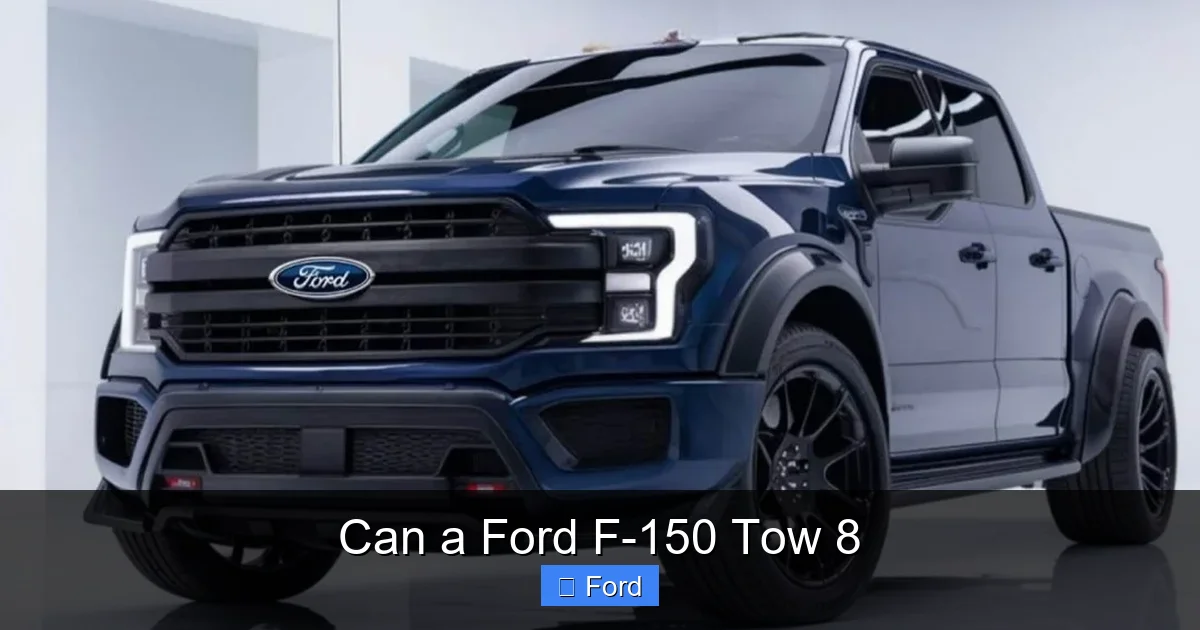
Let’s get practical. Using Ford’s 2023/2024 model year data as a baseline (the principles apply to all recent generations), here are general patterns. Remember, your door jamb is the law.
Visual guide about Can a Ford F-150 Tow 8
Image source: cars2wd.com
The Champions: Who Easily Clears 8,000 lbs
These setups are your go-to for serious towing:
- 3.5L EcoBoost V6 + Max Trailer Tow Package + 3.73 or 4.10 axle + 2WD Regular or SuperCab (Long Bed): These are the kings. GCWRs can push to 14,000 lbs. With a relatively light truck weight, available trailer capacity often exceeds 11,000 lbs.
- 5.0L V8 + Max Trailer Tow Package + 3.73 axle + 2WD Regular or SuperCab (Long Bed): Very close second. Similar GCWRs to the EcoBoost. The V8’s character is different (more linear power, different sound), but the numbers are comparable.
The long bed helps by moving weight rearward, improving tongue weight distribution. The 2WD saves significant weight (400-600 lbs) over a 4×4, directly translating to more trailer capacity.
The Contenders: Who Can Make 8,000 lbs with Careful Calculation
These configurations require you to run the numbers carefully:
- Same powerful engines/packages in a SuperCrew (short bed): The shorter wheelbase and heavier cab reduce capacity. Max trailer weights might be listed at 10,500-12,000 lbs, but your actual available capacity after loading the family and gear in the spacious crew cab might be right around 8,000-9,500 lbs. You must weigh the truck.
- 4×4 models with Max Tow: The 4×4 system adds weight. A 4×4 SuperCrew with Max Tow might have a GCWR of 13,000 lbs. If your loaded truck weight is 6,800 lbs, you have 6,200 lbs for the trailer—not enough. But if your truck is lighter or your trailer is lighter, you might squeak in. It’s borderline.
The Likely No-Gos: Who Should Not Attempt 8,000 lbs
These setups are not designed for this weight:
- Any F-150 without the Max Trailer Tow Package: Standard axle ratios (like 3.15 or 3.31) are for fuel economy, not brute force. Their max trailer ratings are often in the 5,000-7,000 lb range.
- The base 3.3L V6 or 2.7L EcoBoost (non-Max Tow): These are fantastic, efficient engines for light to moderate towing (boats, small campers), but they are not built for 8,000+ lb loads. Their cooling systems and axle ratios are different.
- Heavily optioned trucks (Platinum, Limited, Raptor): All that luxury and off-road gear adds weight. A loaded Platinum 4×4 SuperCrew might have a GCWR of 12,500 lbs, but its curb weight is so high that the available trailer capacity can fall well below 8,000 lbs, even with the Max Tow package. The Raptor is a performance off-roader, not a tow truck; its GCWR is intentionally limited.
Setting Up for Success: The Gear You Actually Need
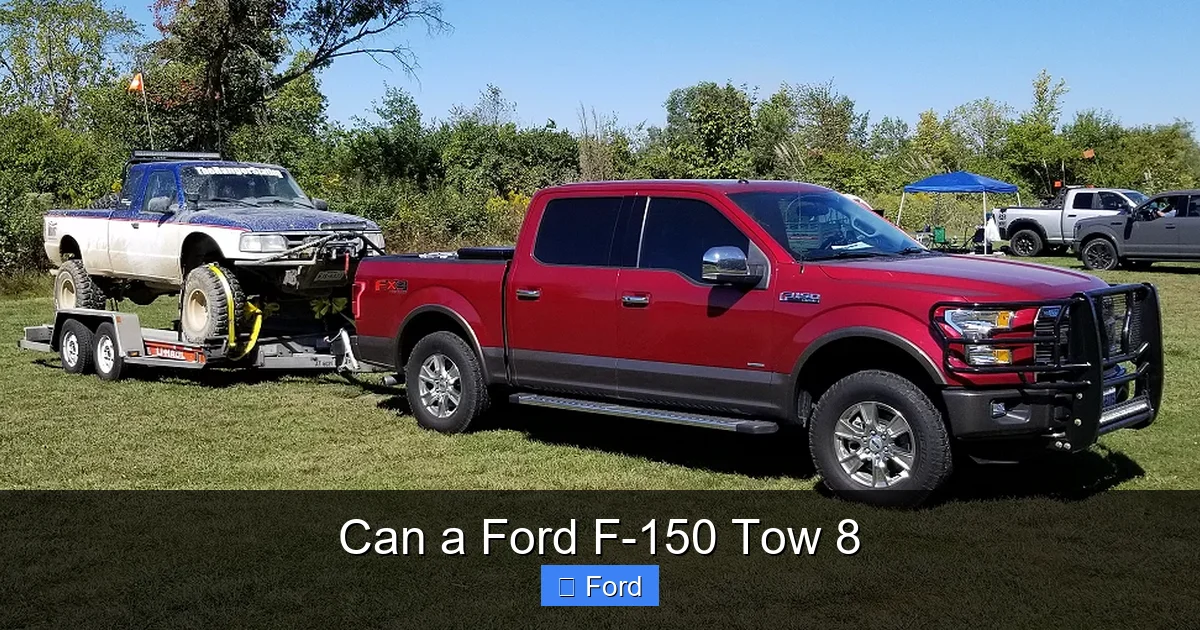
Assuming your math checks out and you have the capacity, the hardware is non-negotiable. Towing 8,000 lbs is serious business.
Visual guide about Can a Ford F-150 Tow 8
Image source: blueovaltrucks.com
The Hitch: It’s Not Just a Ball Mount
You need a Class IV or Class V receiver hitch. Your F-150’s bumper likely has a Class IV receiver if equipped with the Max Tow package. For an 8,000-lb trailer, you must use a weight-distributing hitch (WDH) with sway control. A standard “bumper pull” hitch is unsafe and illegal at this weight. A WDH uses spring bars to distribute the trailer’s tongue weight across both the truck’s front and rear axles, preventing the rear from sagging and the front from lifting (which kills steering and braking). Sway control is essential to counteract trailer sway caused by wind or passing vehicles. Do not cheap out here. Brands like Reese, Curt, and Equal-i-zer are proven. Ensure your hitch’s capacity exceeds your trailer’s loaded weight.
When installing your hitch, pay attention to ground clearance. A large travel trailer or camper can easily bottom out on a steep driveway. You might need to adjust the hitch height or consider a different trailer design. Speaking of which, if you’re hauling a large, boxy trailer, you might want to look into a camper shell or tonneau cover to protect your gear from the elements and keep it secure, which can also slightly improve aerodynamics.
Brakes, Lights, and the All-Important Controller
Your trailer must have electric brakes on all axles. For 8,000 lbs, this is a legal requirement in all 50 states. Your truck needs a trailer brake controller integrated into the dash (standard with Max Tow). You must learn to adjust it properly. Start with a low setting and test on a safe, empty road. You want firm, controlled braking without locking the trailer wheels. Your trailer’s lights (brake, turn signals, running lights) must work perfectly. Use a circuit tester to verify the 7-pin connector on your truck is sending the correct signals. A bad ground is the most common cause of light issues.
Stability and Traction: Tires and Shocks Matter More Than You Think
Your truck’s tires are its only connection to the road. Towing significantly increases load and heat. Never tow with worn, under-inflated, or passenger-car tires. You need full-size, load-range E or F tires on your F-150, properly inflated to the pressure listed on the door jamb sticker for your *loaded* condition (often higher than the standard placard pressure). Under-inflation causes sidewall heat buildup and failure.
The extra weight also demands more from your suspension. While the factory suspension is designed for its GCWR, if your F-150 has 100,000+ miles, worn-out shocks can lead to dangerous trailer sway and poor weight distribution. Upgrading to heavy-duty shocks designed for towing can dramatically improve stability and control, especially in windy conditions or on uneven roads. It’s a highly recommended safety upgrade for anyone regularly towing near their limit.
Driving Like a Pro: Technique for an 8,000-Lb Load
Hooking up is only half the battle. How you drive changes completely.
Starting, Stopping, and the “2-Second Rule”
Acceleration is slow and deliberate. Plan all merges and lane changes miles in advance. Use the “Tow/Haul” mode in your transmission. This holds gears longer, provides more engine braking, and protects the transmission from excessive heat. Braking is the biggest adjustment. Your stopping distance will increase dramatically—think double or more. Leave at least a 4-5 second following distance at highway speeds. The “2-second rule” is for empty trucks; you need 4-5 seconds. Begin braking early and smoothly. Use your trailer brake controller to help slow the trailer before the truck’s brakes are overwhelmed.
Managing Sway and Wind
Crosswinds and passing semis are the two biggest threats. Your weight-distributing hitch with sway control is your primary defense. If you feel a sway begin, do not brake or swerve. Gently take your foot off the accelerator. Hold the steering wheel straight. The sway will often dampen itself. Your sway control device will also work to correct it. If it’s severe, apply the trailer brakes gently using the manual override on your controller. This pulls the trailer straight. Always keep both hands on the wheel at 9 and 3 o’clock.
Backing Up and Maneuvering
Practice in an empty parking lot. Use small, slow steering corrections. Your trailer will move in the opposite direction of your steering wheel. Go slow. Use your mirrors—you may need extended tow mirrors. If your F-150 has the excellent LED headlights, use them at night to see the trailer corners. A good phone mount for a trailer backup camera app can be a game-changer for tight spots.
Real-World Scenarios: What 8,000 lbs Looks Like
Let’s make this tangible. An 8,000-lb loaded weight is a common size for:
- A large travel trailer or “teardrop” camper: Think a 28-32 foot trailer with slide-outs, a full kitchen, and bathroom. Dry weight might be 6,000 lbs, but loaded with water (8 lbs/gallon!), propane, food, clothes, and gear, it easily hits 7,500-8,500 lbs.
- A decent-sized boat and trailer: A 26-28 foot bowrider or cabin boat with a heavy galvanized trailer can land here.
- A large enclosed work trailer: For contractors carrying heavy tools, equipment, and materials.
- A livestock trailer: A gooseneck or bumper pull loaded with multiple horses or cattle.
For a gooseneck, the dynamics are different (the weight is over the rear axle), and your F-150 would need a factory or aftermarket gooseneck hitch installed in the bed. The weight distribution principle still applies, but the hitch itself is different. For a standard bumper pull (the most common), all the weight-distributing hitch advice is critical.
The Bottom Line: Yes, But…
So, can a Ford F-150 tow 8,000 pounds? The definitive answer is: Yes, a significant number of F-150s, particularly those equipped with the 3.5L EcoBoost or 5.0L V8 engines, the Max Trailer Tow Package, and a beneficial axle ratio, are engineered to do so safely.
However, the “but” is everything. You cannot assume. You must:
- Find your truck’s specific GCWR on the door jamb.
- Weigh your truck as you would tow it.
- Do the math.
- Equip it with a proper weight-distributing hitch and sway control.
- Ensure your trailer has working brakes.
- Adjust your driving style completely.
If your math shows you have the capacity and you use the correct equipment, your F-150 is a capable and confident tow vehicle for an 8,000-lb trailer. If the math shows you’re over, don’t try to “make it work.” That’s how accidents, breakdowns, and costly repairs happen. Instead, look at your load. Can you offload some gear from the truck bed? Can you use a lighter trailer? Or is it simply time to consider a truck with a higher GCWR, like an F-250 or F-350? Sometimes, the smartest towing decision is knowing your limit and respecting it. Your safety, your family’s safety, and the safety of everyone on the road depend on it.
Frequently Asked Questions
What’s the difference between payload and towing capacity?
Payload is what you can carry *in* the truck (people, cargo in bed, tongue weight of the trailer). Towing capacity is what you can pull *behind* the truck. They are separate ratings on your door jamb sticker and are both critical. The trailer’s tongue weight counts against your payload.
Can I tow 8,000 lbs with a 4×4 F-150?
It depends. A 4×4 adds weight, which reduces available trailer capacity. A 4×4 with the Max Trailer Tow Package and a beneficial axle ratio might still have a GCWR high enough to allow 8,000 lbs, but only if your loaded truck weight is low enough. You must do the GCWR – truck weight calculation. Many 4×4 crew cabs will fall just short.
Is a weight-distributing hitch really necessary for 8,000 lbs?
Absolutely, yes. It is not optional. A standard “bumper pull” hitch transfers 100% of the trailer’s tongue weight to the rear axle of your F-150. This squats the rear, lifts the front (reducing steering and braking effectiveness), and is dangerously unstable. A weight-distributing hitch is legally required in many states for trailers over a certain weight (often 5,000-6,000 lbs) and is a fundamental safety device for any trailer over 3,500 lbs.
Does my F-150’s transmission need a cooler to tow 8,000 lbs?
If your truck has the Max Trailer Tow Package, it comes with a heavy-duty transmission cooler from the factory. This is essential for managing transmission temperature during sustained towing, especially in hilly terrain or hot weather. If your truck does not have this package and you plan to tow near its limit, an aftermarket transmission cooler is a very wise and recommended investment to prevent transmission overheating and failure.
What if my trailer weighs 8,500 lbs but my truck’s max is 8,000 lbs?
You cannot legally or safely tow that combination. You are exceeding your truck’s certified Gross Combined Weight Rating. This overloads the frame, axles, brakes, and powertrain. It causes severe handling problems, dramatically increases stopping distances, and will lead to premature component failure. You must reduce the trailer weight (empty water tanks, offload gear) or use a truck with a higher rating.
How do I know if my trailer brakes are working properly?
First, ensure your truck’s brake controller is set to zero. Have someone apply the trailer brakes manually using the controller’s “manual override” lever while you listen at the trailer wheels. You should hear the brakes engage firmly. Then, perform a slow test: in a large, empty parking lot, get up to 10 mph, set the controller to a medium setting (e.g., 5.0), and gently apply the manual override. The trailer should slow the entire rig smoothly without locking or skidding. If it’s weak or inconsistent, the trailer brakes or the wiring need service.
