
What Lug Pattern Is a Ford F-150?

The Ford F-150’s lug pattern, also called a bolt pattern, is not one-size-fits-all. It primarily uses either a 5x135mm or 6x135mm pattern, with the critical shift from 5-lug to 6-lug happening for most models in 2004. However, your truck’s specific year, trim level, and drivetrain configuration are absolutely crucial to confirm before purchasing any new wheels or tires.
So, you’re thinking about new wheels for your Ford F-150. Maybe you want a tougher off-road look, a sleeker highway stance, or you just need a spare. The very first question that pops up is almost always: “What lug pattern is my F-150?” It’s the gateway question to everything else. Get this wrong, and you’ve bought a very expensive, very heavy paperweight. Get it right, and you’re on your way to a great upgrade. Let’s clear up the confusion once and for all.
Key Takeaways
- The F-150 uses two main lug patterns: 5x135mm (common on older models) and 6x135mm (standard on most post-2004 models).
- Your truck’s model year is the #1 factor: The 2004 model year was a major redesign that changed the standard lug pattern for most configurations.
- Center bore size is equally important: The F-150 typically uses a 77.9mm center bore, but using hub-centric wheels or rings is essential for a safe, vibration-free ride.
- Not all trims follow the rule: Special editions like the Raptor or certain commercial models can have unique specifications you must verify.
- Always measure to be 100% sure: The most reliable method is to physically measure your truck’s existing wheel or hub, as specifications can vary.
- Lug pattern ≠ wheel compatibility: Correct offset, wheel width, and tire size must also be considered for proper fitment and performance.
- Mixing patterns is dangerous: Using the wrong lug pattern can cause wheel wobble, improper torque, and potentially lead to a wheel coming off.
📑 Table of Contents
Understanding Lug Patterns: The Basics
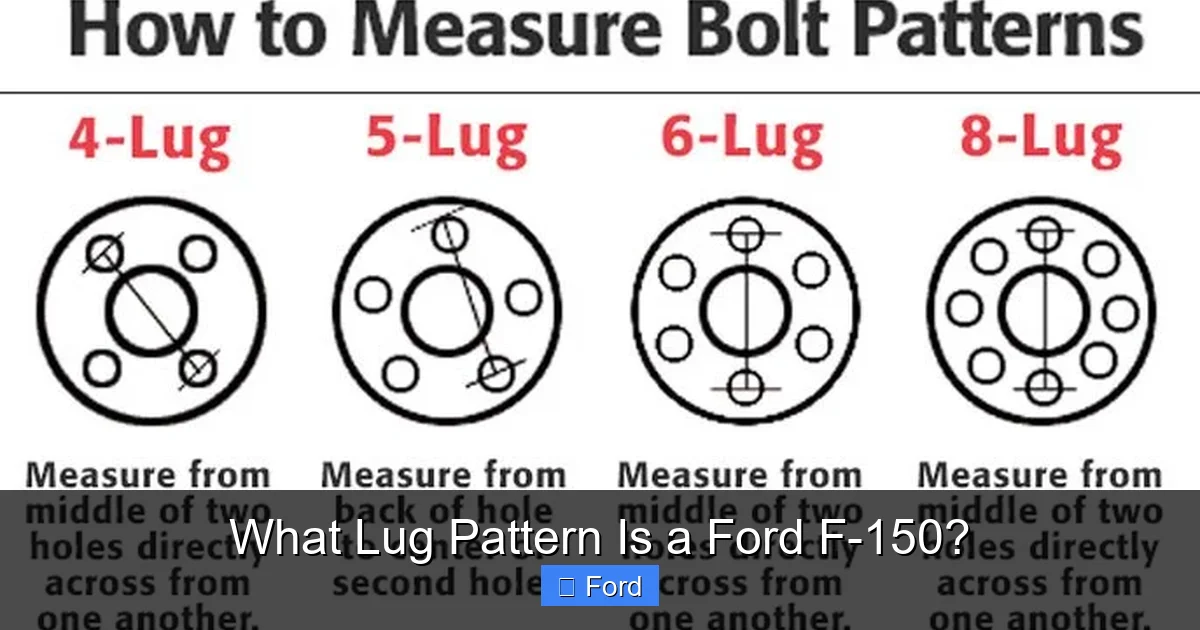
Before we dive into F-150 specifics, let’s make sure we’re all speaking the same language. A “lug pattern,” also called a “bolt pattern,” is simply the arrangement of the mounting holes on a wheel. It’s defined by two key numbers. The first number tells you how many lug holes (or bolts) there are. The second number is the diameter of the imaginary circle those holes are drilled on, measured in millimeters.
Breaking Down the Numbers
When you see “5×135,” it means the wheel has five lug holes, and the circle those holes form has a diameter of 135 millimeters. For “6×135,” it’s six holes on the same 135mm circle. That second number, the 135mm, is actually the constant for almost all modern F-150s. The big variable is that first number: the lug count. This is what changed so dramatically in 2004.
But there’s a third, equally critical measurement: the center bore. This is the hole in the center of the wheel that slides over the hub on your axle. It must match or be larger than your truck’s hub size. The F-150’s hub is typically 77.9mm. A wheel with a larger center bore will need a hub-centric ring to fill the gap and center the wheel properly. A wheel with a smaller bore simply won’t fit. Never skip this step.
A Brief History of Ford F-150 Lug Patterns
To understand why there are two main patterns, we need a quick history lesson. The F-150 has evolved through many generations, and the lug pattern changed with major platform overhauls.
Visual guide about What Lug Pattern Is a Ford F-150?
Image source: trucksauthority.com
The 5-Lug Era (Pre-2004)
For the 1997-2003 model years (the PN-96 and later “N” body platforms), the standard F-150, from the base XL to the top-of-the-line Lariat, used a 5x135mm lug pattern. This was a carryover from the previous generation. It was a workhorse pattern, strong and simple. During this time, the heavy-duty F-250 and F-350 Super Duty trucks used a completely different, larger pattern (6x135mm on the front, 8x170mm on the rear for some models), which is a crucial point of confusion for many shoppers.
This era also saw the introduction of the mighty SVT Raptor in 2010, but we’ll get to that exception later. The key takeaway for pre-2004 trucks is: unless it’s a Super Duty, it’s almost certainly a 5-lug.
The Shift to 6-Lug (2004 and Beyond)
For the 2004 model year, Ford launched an all-new F-150. This was a ground-up redesign. One of the many engineering changes was the switch to a 6-lug wheel pattern—6x135mm—for the vast majority of F-150 models. Why the change? Six lugs provide more clamping surface area, which improves wheel security and distributes the massive torque of the new powerful engines (like the 5.4L Triton V8 and later the 3.5L EcoBoost) more evenly. It was an upgrade for strength and durability.
This 6x135mm pattern became the new standard. From 2004 all the way through the 2020 model year (the P-552 and later platforms), you can confidently assume a standard F-150, F-150 XL, XLT, Lariat, King Ranch, Platinum, and Limited is a 6-lug. The shift was so comprehensive that even the regular cab, long-bed work trucks got six lugs.
Lug Patterns by Generation: Your Year Matters
Now, let’s get specific. Here’s a breakdown of what you can expect for your specific model year range. Remember, these are the *standard* patterns. Always double-check your vehicle’s door jamb sticker or wheel itself.
Visual guide about What Lug Pattern Is a Ford F-150?
Image source: amulettejewelry.com
1997-2003 (Seventh & Eighth Generation)
- Standard F-150: 5x135mm
- F-250/F-350 Super Duty: Different pattern (often 6x135mm front, 8x170mm rear). Do not assume interchangeability with a half-ton F-150.
- Key Note: This is the last major generation for the 5-lug F-150. If you have a truck from this era, it is almost certainly a 5-lug. You can also check out our guide on Dodge Ram 1500 lug patterns to see how competitors compared during this period.
2004-2008 (Ninth Generation)
- All F-150 Models (including Harley Davidson and Platinum): 6x135mm. This is a universal rule for this generation.
- F-250/F-350 Super Duty: Still on their own, larger 6x135mm pattern (though some rear wheels differed).
- Exception: None for the F-150 line. This was a clean-sheet change.
2009-2014 (Twelfth Generation)
- All Standard F-150 Models: 6x135mm. The pattern remained unchanged from the 2004 redesign.
- F-150 Raptor (2010-2014): Also 6x135mm. The Raptor used unique, wider wheels but the same bolt circle.
- Key Note: This generation introduced the popular 20-inch and 22-inch factory wheel sizes, all on the 6×135 pattern.
2015-2020 (Thirteenth Generation)
- All F-150 Models (including Limited and Platinum): 6x135mm. Ford kept the successful pattern.
- F-150 Raptor (2017-2020): Still 6x135mm. The second-gen Raptor ran massive 17-inch wheels with a 135mm bolt circle.
- Key Note: This generation saw the rise of the “Max Trailer Tow” package, which often included heavier-duty wheels, but the lug pattern remained consistent.
2021-Present (Fourteenth Generation)
- All F-150 Models: 6x135mm. The all-new redesign for 2021 maintained this critical specification for continuity and parts sharing.
- F-150 Raptor (2021+): You guessed it—6x135mm.
- F-150 Lightning (Electric): Also uses the standard 6x135mm pattern, ensuring wheel compatibility with its internal combustion siblings.
- Key Note: Ford wisely kept the 6×135 pattern for this generation to maintain a massive aftermarket wheel ecosystem.
- Remove one wheel (or just measure through the hub if the wheel is on, but removal is safer and more accurate).
- Look at the wheel’s lug holes. Count them. If you have an even number (4, 6, 8), you can measure directly.
- Measure from the center of one lug hole to the center of the lug hole directly across from it. On a 6-lug wheel, this is from one hole straight across to the one three holes away (the opposite side).
- That measurement is the bolt circle diameter. For your F-150, it should read very close to 135mm (about 5.31 inches).
- Remove the wheel.
- Measure the distance from the center of one lug hole to the outer edge of the opposite lug hole. This is tricky for 5-lug because there is no directly opposite hole.
- A more reliable hub method: Measure the diameter of the circle formed by the tips of the lug studs (or the inside edges of the lug holes if the studs are damaged). Use a caliper for precision, or a ruler, measuring from the tip of one stud, across the center of the hub, to the tip of the stud farthest away.
How to Measure Your Lug Pattern at Home
While the year-based guide is accurate for 99% of trucks, the only way to be 100% certain is to measure. Don’t trust a seller’s word, a vague forum post, or even this article if you have a unique truck. Here’s how to do it yourself with common tools.

Visual guide about What Lug Pattern Is a Ford F-150?
Image source: opplehouse.com
The Simple Method (For Even-Lug Patterns: 4, 6, 8)
This is the easiest way. You need a ruler or tape measure in millimeters or inches.
If you get 135mm and count 6 holes, you have a 6×135 pattern. If you get 135mm and count 5 holes, you have a 5×135 pattern (likely a pre-2004 model).
The Hub Method (For Any Lug Count)
This works for odd-numbered patterns (like 5-lug) too.
Again, you’re looking for that magic number: 135mm.
Common Mistakes When Choosing Wheels
Knowing your pattern is just step one. Here are the pitfalls that turn a simple upgrade into a headache.
Assuming All F-150s Are the Same
The biggest mistake is thinking every F-150 ever made has the same pattern. As we’ve detailed, the 5-lug vs. 6-lug divide is real and absolute. A wheel from a 2003 F-150 will not fit a 2005 F-150. Always verify your specific model year and trim.
Ignoring the Center Bore
You might find a beautiful wheel listed as “6×135.” Perfect! But if its center bore is 72mm or 80mm instead of the F-150’s 77.9mm, you have a problem. A larger bore requires a hub-centric ring (a plastic or aluminum spacer) to fill the gap and center the wheel. A smaller bore is useless. Never install a wheel with a mismatched center bore without using the correct rings. It causes vibration and can damage your wheel bearings.
Forgetting About Offset and Backspacing
Offset is the distance from the wheel’s mounting surface to its centerline. It determines how far the wheel sits in or out from the fender. The F-150, especially newer models with wide fenders and big brakes, has a specific range of offsets that work. A wheel with the correct 6×135 pattern but an offset of +50 will tuck way inside the fender. An offset of -25 will stick out dangerously far, potentially rubbing the fender, bumper, or suspension components. Always check the manufacturer’s recommended offset range for your specific F-150 year and trim.
Overlooking the Wheel’s Load Rating
Your F-150 is a workhorse. The wheel you choose must have a load rating that meets or exceeds your truck’s Gross Axle Weight Rating (GAWR). This is especially critical for heavy-duty use, towing, or hauling. Cheap, lightweight wheels may look good but can fail under stress. Look for wheels rated for at least 2,500 lbs per wheel for a standard half-ton, more for max-tow packages.
Wheel Compatibility: Beyond the Lug Pattern
So you’ve confirmed 6x135mm and a 77.9mm center bore. You’re not done yet. Here’s your final compatibility checklist.
Diameter and Width
Factory wheel sizes vary by year and trim. A 2018 F-150 Lariat might come with 18×8.5-inch wheels, while a 2022 Platinum could have 20×9-inch wheels. You can generally change the diameter (going to 18s, 20s, 22s) and width, but you must stay within the limits set by your suspension, brakes, and fenders. A very wide wheel (like 12 inches) on a stock F-150 will likely rub the inner fender well during full lock or over bumps.
Brake Caliper Clearance
This is a huge one, especially on later models with massive brake rotors and calipers (like the Raptor or trucks with the Heavy-Duty Brake Option). A wheel with a shallow internal “spoke” design might not clear the caliper. When buying aftermarket wheels, reputable manufacturers will list “brake caliper clearance” or note if it fits “with OEM brakes.” If in doubt, measure the distance from the wheel’s mounting surface to the inner face of the wheel where the brake sits.
Tire Size and Speedometer Accuracy
Changing wheel diameter affects your speedometer and odometer readings. A taller tire (e.g., going from a 32″ to a 35″) will make your speedometer read lower than your actual speed. This can affect mileage logs, warranty claims, and even lead to speeding tickets. More importantly, it changes the effective gear ratio, affecting acceleration and fuel economy. Always use a tire size calculator to see the impact before mounting new rubber.
TPMS (Tire Pressure Monitoring System)
Since 2007, all F-150s have had TPMS. Your new wheel must be compatible with the TPMS sensor. Most aftermarket wheels are, but you’ll need to either reuse your old sensors (have them moved professionally) or buy new ones. This is a cost and step often forgotten in the wheel-buying process.
When you’re ready to outfit your truck with new boots, don’t forget about practical accessories. A great set of wheel locks for your F-150 is a smart investment to protect those new wheels. And if you live where it snows, you’ll want to check out the best tire chains for your F-150 to ensure you have traction when you need it most.
Conclusion
The lug pattern on your Ford F-150 is the foundational piece of information for any wheel or tire purchase. For the vast majority of F-150 owners, the pattern is either 5x135mm (for 1997-2003 models) or 6x135mm (for 2004 and newer). But that “vast majority” is not “every single one.” The 2004 redesign was the great divider.
Your absolute best practice is this: Go out to your truck with a tape measure and confirm. Count the lug holes. Measure the diameter. Write down the center bore. Then, and only then, start shopping for wheels. Don’t rely on memory, a friend’s advice, or a general article. Your specific Vehicle Identification Number (VIN) decoded through a Ford dealer or a reputable wheel retailer’s fitment guide is your ultimate source of truth.
Once you have the correct pattern, center bore, and understand your desired offset and width, you open up a world of aftermarket possibilities. From rugged off-road beads to sleek, modern multi-spokes, the right wheel can transform your F-150’s look and capability. Just start with the pattern. Get that right, and everything else falls into place.
Frequently Asked Questions
What’s the difference between 5-lug and 6-lug F-150s?
The primary difference is the number of lug nuts/bolts—five versus six. The 6-lug pattern, standard from 2004 onward, provides more clamping force and is generally considered stronger for handling the torque of modern V8 and V6 engines. The 5-lug pattern is found on older 1997-2003 models. They are not interchangeable.
How do I measure my F-150’s lug pattern myself?
For the common 6-lug pattern, measure from the center of one lug hole straight across to the center of the lug hole three away (the opposite side). You should get 135mm. For a 5-lug, measure from the center of one hole to the outer edge of the farthest hole (skipping one). The easiest way is to simply count your lugs and rely on your model year guide, but physical measurement is the gold standard.
Are all Ford F-150s from the same generation the same?
Yes, within a single generation and for the standard F-150 line, the lug pattern is consistent. For example, every 2015-2020 F-150 (except the Raptor, which still uses the same pattern) is 6x135mm. The major exception is the split between the pre-2004 (5-lug) and post-2004 (6-lug) generations.
Can I use wheels from a Dodge Ram 1500 on my Ford F-150?
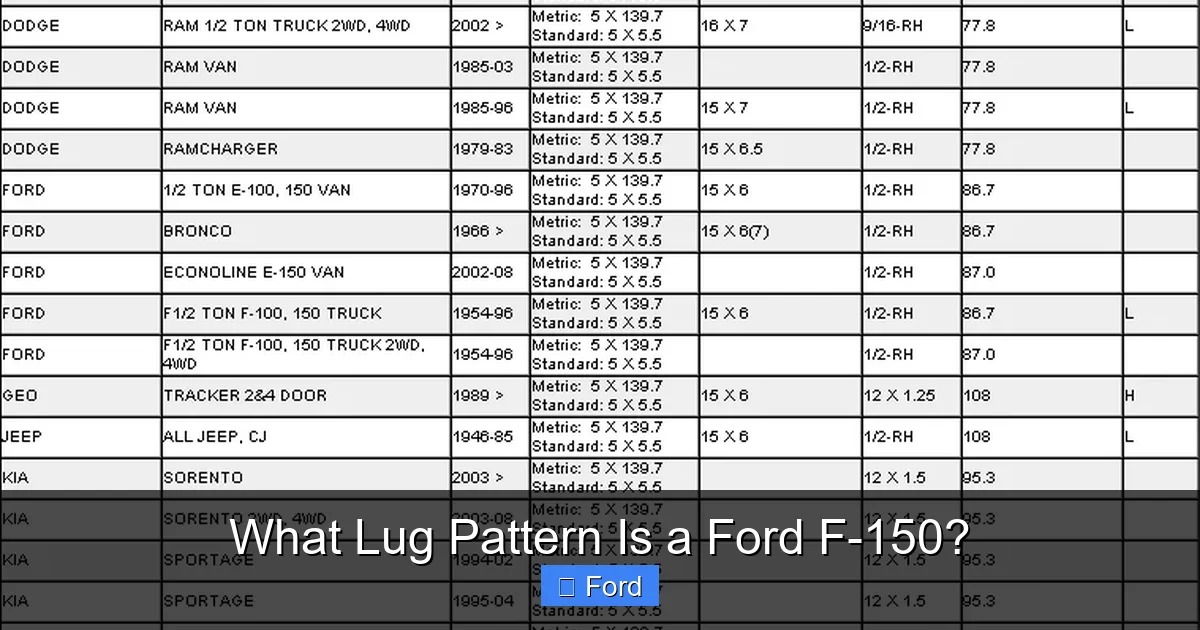
Almost never. Dodge Ram 1500s typically use a 5×5.5″ (139.7mm) or 5x115mm pattern, depending on the year. This is completely different from the F-150’s 5x135mm or 6x135mm patterns. The bolt circles are different sizes and have different lug counts, making them incompatible without extremely expensive adapters, which are not recommended for safety. You can see the specifics for a Dodge Ram 1500’s pattern here.
Does the lug pattern affect my Tire Pressure Monitoring System (TPMS)?
No, the lug pattern itself does not affect TPMS. The TPMS sensors are mounted inside the wheel tire, on the valve stem. However, when changing wheels, you must ensure the new wheel is compatible with TPMS sensors (most are) and that you either transfer your old sensors or purchase new ones that are programmed to your truck’s system. The lug pattern must be correct first for the wheel to mount at all.
What is the center bore size for an F-150?
The factory center bore for most F-150s from 2004 onward is 77.9mm. Pre-2004 models also use 77.9mm. This is the size of the hole in the center of your wheel that slides over the hub. Aftermarket wheels may have a different bore size. A larger bore requires a hub-centric ring to fill the gap; a smaller bore will not fit. Always confirm the center bore of any wheel you consider.
