
How Much Does a Ford F-150 Weigh?

The weight of a Ford F-150 varies significantly based on configuration, ranging from about 4,000 lbs for a base XL Regular Cab to over 5,500 lbs for a top-trim SuperCrew with the heaviest engine and packages. Key factors driving this weight include cab style (Regular, SuperCab, SuperCrew), bed length, engine choice (from efficient V6 to powerful V8 and hybrid), and added features like four-wheel drive or the Tremor off-road package. Understanding your specific F-150’s weight is crucial for calculating payload capacity, towing limits, and even fuel economy expectations.
So, you’re eyeing a Ford F-150. Maybe you need it for work, for adventure, or just because there’s nothing quite like the feeling of commanding the road in America’s favorite truck. Whatever the reason, one of the first practical questions that pops up is: “How much does this thing weigh?” It’s not just idle curiosity. The weight of your specific F-150 is the secret number behind everything—how much you can haul, how much you can tow, how it feels on the road, and even how often you’ll be visiting the pump. The short answer? There is no single number. A Ford F-150’s weight can vary by over 1,500 pounds depending on how you configure it. Let’s break down exactly why and help you find the weight for your dream (or workhorse) truck.
Key Takeaways
- Configuration is King: A SuperCrew (4-door) with a 5.5-foot bed is the heaviest common configuration, while a Regular Cab (2-door) with a 6.5-foot bed is typically the lightest, even with the same engine.
- Engine Choice Adds Hundreds of Pounds: Moving from the base 3.3L V6 to the 5.0L V8 or 3.5L V6 EcoBoost can add 200-400 lbs. The PowerBoost hybrid system adds even more weight due to its electric motor and battery.
- Drivetrain Matters: Four-wheel drive (4×4) systems add approximately 200-300 lbs compared to two-wheel drive (4×2) due to the transfer case, front axle, and extra components.
- Packages Pack on the Pounds: Off-road packages (Tremor, Raptor), heavy-duty towing packages, and even premium feature groups (like the Platinum or Limited trims) increase weight through larger wheels/tires, reinforced suspensions, and added hardware.
- Curb Weight vs. GVWR: The “curb weight” is the truck’s weight with all standard equipment, fluids, and a full tank of gas, but no passengers or cargo. The Gross Vehicle Weight Rating (GVWR) is the maximum safe total weight the truck can carry (curb weight + passengers + cargo).
- Weight Directly Impacts Capability: A heavier truck has a lower payload capacity (how much it can carry in the bed and cab) but often has a higher Gross Combined Weight Rating (GCWR), meaning it can tow a heavier trailer when the truck itself is loaded.
- Material Choices Influence Weight: While the F-150’s frame is high-strength steel and body is primarily aluminum, the overall design philosophy prioritizes strength-to-weight ratio over being the absolute lightest.
📑 Table of Contents
- The Big Picture: Why F-150 Weight Isn’t a Single Number
- Engine Impact: How Your Powertrain Changes the Scale
- Trim Levels and Packages: The “Extras” That Add Up
- Finding Your Exact Number: The Official Sources
- Why Weight Matters: Payload, Towing, and Real-World Impact
- Practical Examples: Weight in Common Configurations
The Big Picture: Why F-150 Weight Isn’t a Single Number
If you asked someone, “How much does a Ford F-150 weigh?” and they gave you one number, they’re probably thinking of a very specific, common configuration—maybe a mid-trim SuperCrew with the popular 2.7L or 3.5L EcoBoost engine. But the F-150 lineup is a vast menu of options. Think of it like building a custom sandwich. Start with the same bread (the core truck platform), but your choice of meats, cheeses, veggies, and sauces (engines, cabs, beds, packages) completely changes the final weight and nutritional profile.
Ford builds the F-150 on a spectrum of capability. At the lightest end, you have a bare-bones, two-wheel-drive work truck designed to maximize payload. At the heaviest, you have a luxurious, off-road-ready, heavyweight towing machine packed with every feature. The weight difference between these two extremes is substantial. This variability is why you’ll always see a weight *range* listed in official specifications, not a single figure. Your first step is to understand the key variables that add or subtract pounds.
The Core Variables: Cab, Bed, and Drivetrain
Before you even pick an engine, the fundamental shape of your truck sets a baseline weight. These three choices are the primary architects of your F-150’s mass.
- Cab Style: This is the biggest factor after the engine. The Regular Cab (2-door, one row of seats) is the lightest. The SuperCab (2+2 doors, small rear jump seats) adds a few hundred pounds. The SuperCrew (4 full-size doors, large rear seats) is the heaviest, adding the most structural material, glass, and interior components. For the same engine and bed length, a SuperCrew can weigh 200-300 lbs more than a Regular Cab.
- Bed Length: This seems counterintuitive, but a longer bed is often slightly lighter than a shorter one on the same cab style. Why? Because the longer bed replaces some of the heavier rear cab structure with a lighter-weight bed wall and floor. The difference isn’t huge—maybe 50-100 lbs—but it’s consistent. A SuperCrew with a 5.5-foot bed will be a tad heavier than the same SuperCrew with an 8-foot bed.
- Drivetrain (4×2 vs. 4×4): Adding four-wheel drive is a significant weight increase. The transfer case, front axle, driveshaft, and associated components typically add between 200 and 300 pounds. This is a fixed cost for the capability, regardless of your cab or bed choice.
Engine Impact: How Your Powertrain Changes the Scale
Now we get to the heart of the matter: the engine. The F-150 offers a dizzying array of powerplants, each with its own weight signature. Here’s a breakdown from lightest to heaviest, based on approximate differences from the base engine.
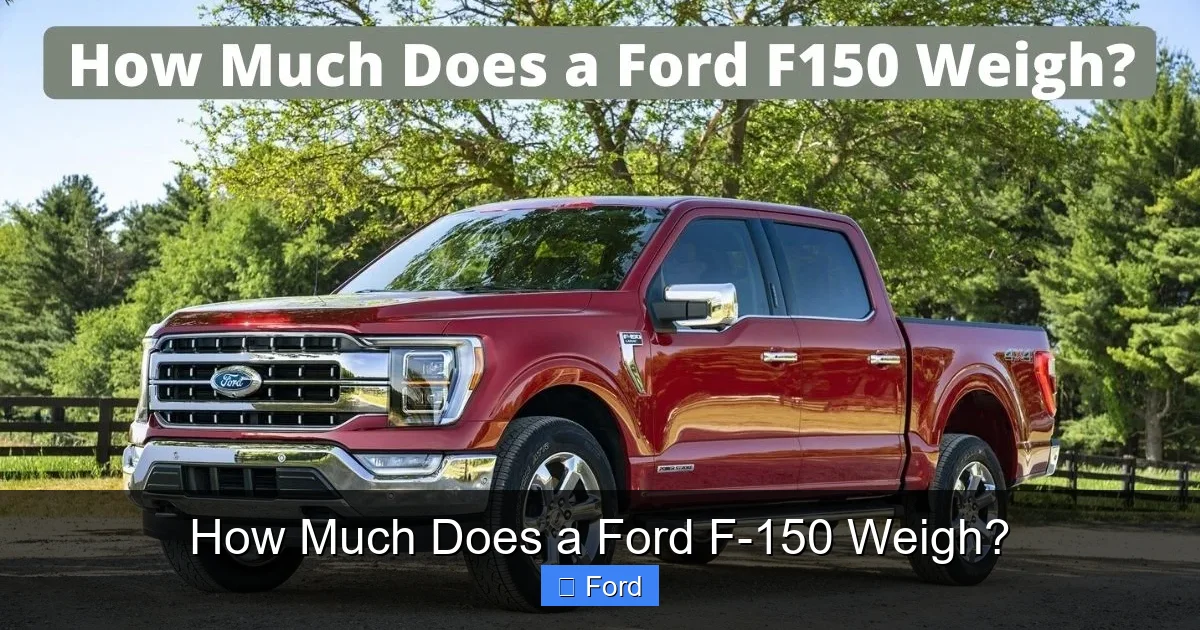
Visual guide about How Much Does a Ford F-150 Weigh?
Image source: vehicleanswers.com
The Gasoline Lineup
3.3L V6 (Base Engine): This is your starting point. It’s a port-injected, work-oriented engine. It’s relatively light and simple. Weight: ~4,000-4,300 lbs for a 4×2 Regular Cab.
2.7L EcoBoost V6: This twin-turbocharged marvel is incredibly popular for its blend of power and efficiency. Its all-aluminum construction and compact design keep weight reasonable, but the turbochargers and associated plumbing add some mass over the 3.3L. Expect an increase of ~100-150 lbs.
3.5L EcoBoost V6: The high-output workhorse for heavy-duty towing. The larger displacement, bigger turbos, and reinforced block make it notably heavier than the 2.7L. It adds roughly 150-250 lbs over the 2.7L.
5.0L V8 Coyote: The iconic naturally aspirated V8. Its cast-iron block and larger overall dimensions make it one of the heaviest gasoline options. It typically weighs 200-300 lbs more than the 3.3L V6 and about 50-100 lbs more than the 3.5L EcoBoost.
The Hybrid and Diesel Options
3.5L PowerBoost Hybrid: This is where weight climbs significantly. The system integrates a 47-hp electric motor into the 10-speed transmission, along with a lithium-ion battery pack located under the rear seat. All this hybrid hardware adds a substantial 300-450 lbs compared to the standard 3.5L EcoBoost V6.
3.0L Power Stroke V6 Turbo Diesel: Available on higher trims, this diesel is built for serious torque and maximum towing. Its heavy-duty internal components, turbo system, and emission control hardware make it the heaviest standard powertrain option, often rivaling or exceeding the weight of the PowerBoost hybrid.
Trim Levels and Packages: The “Extras” That Add Up
You’ve chosen your cab, bed, and engine. But the weight journey isn’t over. The trim level (XL, XLT, Lariat, King Ranch, Platinum, Limited, Raptor) and optional packages pile on the pounds through added hardware and features.
Visual guide about How Much Does a Ford F-150 Weigh?
Image source: vehicleanswers.com
Luxury vs. Off-Road: Two Paths to Heavier
Premium Trims (Lariat, King Ranch, Platinum, Limited): These add weight through features like larger wheels and all-terrain tires, sunroofs (a heavy glass panel), more advanced sound systems, additional interior sound-deadening materials, and heavier-duty suspension components. A move from an XLT to a Platinum can easily add 100-200 lbs.
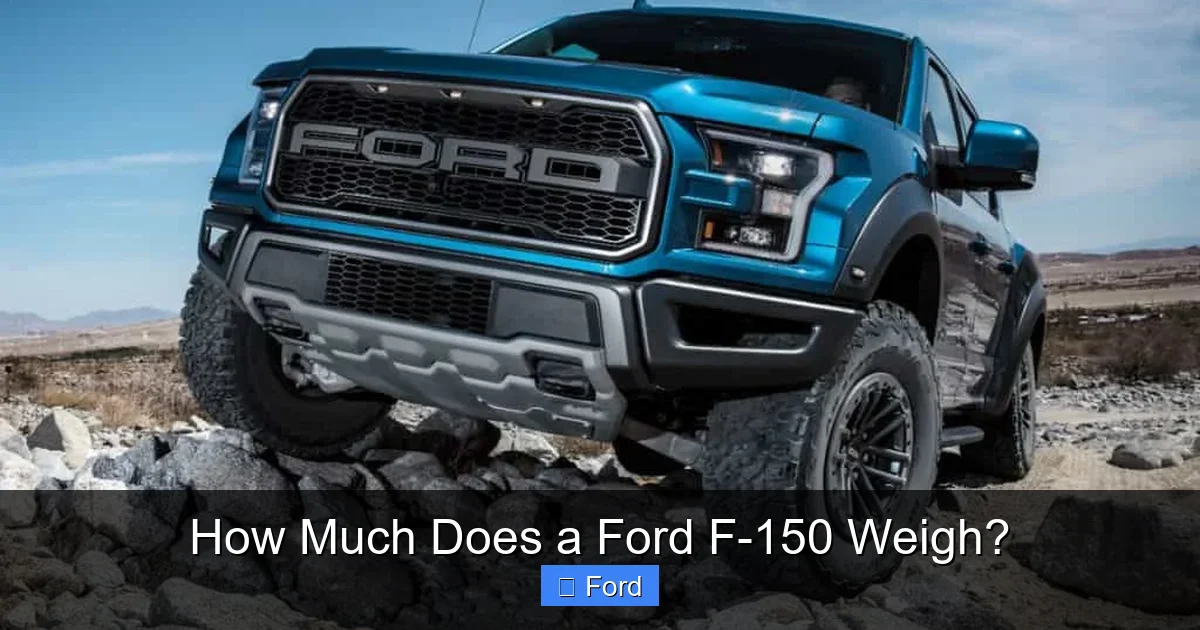
Off-Road Packages (Tremor, Raptor): These are weight-gain champions. The Tremor package adds skid plates, a rear locking differential, off-road-tuned suspension, and larger all-terrain tires, adding 150-250 lbs. The Raptor is a different beast entirely. It starts with a heavier-duty frame, adds a high-output engine, FOX racing shocks, massive wide-track suspension, aggressive tires, and reinforced components. A Raptor SuperCrew can weigh 5,500 lbs or more, easily 500-700 lbs heavier than a comparable XLT model.
Finding Your Exact Number: The Official Sources
So how do you find the precise curb weight for the exact F-150 you’re building or considering? You have two primary, reliable sources.
Visual guide about How Much Does a Ford F-150 Weigh?
Image source: vehiclerides.com
1. The Ford Build & Price Tool
This is your most accurate tool. Go to Ford’s official website and use the “Build & Price” configurator for the F-150. As you select your cab, bed, engine, drivetrain, and options, the tool dynamically updates the “Curb Weight” figure at the bottom of the summary page. This number is the truck’s weight as built, with all selected options, all necessary fluids, and a full tank of fuel. It’s the official number you should use for all your calculations. Be sure to select the exact model year, as specifications can change annually.
2. The Vehicle’s Door Jamb Sticker
For a used F-150, the definitive source is the tire information label on the driver’s side door jamb. This sticker lists the “GAWR” (Gross Axle Weight Rating) for the front and rear axles and the “GVWR.” While it doesn’t list curb weight directly, you can often find it in the owner’s manual or by searching your exact VIN. More importantly, the GVWR is your critical number. Your truck’s actual curb weight will always be less than the GVWR. The difference is your maximum available payload (passengers + cargo).
Why Weight Matters: Payload, Towing, and Real-World Impact
Knowing your F-150’s weight isn’t just a trivia question. It’s practical math that affects your truck’s performance and safety.
- Payload Capacity = GVWR – Curb Weight. If your truck’s curb weight is 5,000 lbs and its GVWR is 7,000 lbs, you have 2,000 lbs of payload for people, tools, firewood, and cargo in the bed. A heavier truck (from a big engine or luxury trim) has a lower payload for the same GVWR. A lighter truck (base engine, 4×2) can carry more.
- Towing & GCWR: The Gross Combined Weight Rating is the maximum total weight of the truck plus the trailer and its contents. A heavier truck “uses up” more of this GCWR before you even hook up a trailer. However, a heavier truck with a more powerful engine (like the 6.2L V8 in the Raptor R) will often have a much higher GCWR to compensate, allowing it to tow a very heavy trailer despite its own mass.
- Fuel Economy & Braking: More mass means more energy is needed to accelerate and climb hills, negatively impacting fuel economy. It also means more kinetic energy to dissipate when braking, leading to longer stopping distances and greater brake wear.
- Suspension Wear: A truck operating near its maximum payload will have a noticeably stiffer ride and will accelerate wear on suspension components, tires, and brakes. Knowing your weight helps you operate within the truck’s design limits.
For comparison, other full-size trucks like the Dodge Ram 1500 and GMC Sierra have similar weight ranges based on configuration, typically starting around 4,000 lbs for a base model and exceeding 5,500 lbs for top-tier, off-road versions. The Nissan Titan also competes in this heavyweight segment. Even some heavy-duty trucks, like certain versions of the Dodge 2500, start their weight spectrum where the F-150’s top end leaves off, highlighting the different design philosophies between ½-ton and ¾-ton trucks.
Practical Examples: Weight in Common Configurations
Let’s make this concrete with some real-world examples for the 2024 model year. These are approximate curb weights for 4×2 models to give you a clear baseline.
- XL Regular Cab, 6.5′ Bed, 3.3L V6: ~4,025 lbs. The lightest, most basic work truck. Maximizes payload.
- XLT SuperCab, 6.5′ Bed, 2.7L EcoBoost: ~4,550 lbs. A very popular, balanced configuration. Good power, decent payload.
- Lariat SuperCrew, 5.5′ Bed, 3.5L EcoBoost, 4×4: ~5,050 lbs. A common “family hauler with towing ability” setup. The 4×4 adds weight here.
- King Ranch SuperCrew, 6.5′ Bed, 5.0L V8, 4×4: ~5,300 lbs. Luxury and V8 power combine for a heavier, solid-feeling truck.
- Platinum SuperCrew, 5.5′ Bed, 3.5L PowerBoost Hybrid, 4×4: ~5,450 lbs. The hybrid system and premium features push weight to the top of the standard F-150 range.
- Raptor SuperCrew, 5.5′ Bed, 3.5L High-Output V6, 4×4: ~5,700 lbs+. The ultimate off-road package adds significant mass for durability and performance.
Pro Tip: When comparing trucks, always compare configurations as closely as possible—same cab, same bed, same 4×2 or 4×4. Only then does the engine and trim difference give you a true apples-to-apples weight comparison.
Frequently Asked Questions
Does the Ford F-150’s weight affect its fuel economy significantly?
Yes, weight is a major factor in fuel economy. A heavier truck requires more energy to accelerate and maintain speed, especially in city driving or hilly terrain. A base 4×2 Regular Cab with the 3.3L V6 will get the best MPG, while a heavy 4×4 SuperCrew with the 5.0L V8 or PowerBoost hybrid will see lower real-world MPG, despite the hybrid’s efficiency advantage in certain conditions.
How can I find the exact curb weight of my specific used F-150?
First, check the tire information sticker on the driver’s door jamb. It lists the GVWR and GAWRs. For the exact curb weight, you’ll need your Vehicle Identification Number (VIN). You can use a paid service like a Ford dealer’s parts department or some online VIN decoders to get the factory-specified curb weight for that exact VIN, including all installed options.
Is a heavier F-150 safer in a crash?
In a collision with a lighter vehicle, mass generally provides an advantage. However, modern safety depends far more on engineering—the frame’s crash zones, airbags, and electronic stability systems—than simple weight. The F-150’s extensive use of high-strength steel and advanced safety features is a bigger safety factor than its overall curb weight. A lighter, newer F-150 with modern safety tech is safer than an older, heavier one without it.
What’s the difference between curb weight and Gross Vehicle Weight Rating (GVWR)?
Curb weight is the truck’s weight as it sits ready to drive, with all standard equipment, all fluids, and a full tank of gas. GVWR is the maximum total weight the truck is safely designed to carry, including curb weight, passengers, cargo, and tongue weight from a trailer. Your truck’s actual loaded weight must never exceed its GVWR, which is found on the door jamb sticker.
Why does my F-150’s “sticker weight” from the dealer seem different from online specs?
Dealership “window stickers” (the Monroney label) list the vehicle’s weight as shipped from the factory, which may not include all dealer-installed accessories (like floor mats, running boards, or window tint). The “curb weight” in Ford’s Build & Price tool or official specs is the standard weight with all factory-installed options for that specific build. Always use the Build & Price figure for your exact configuration as the most accurate baseline.
If I add aftermarket accessories, do I need to recalculate my payload?
Absolutely. Every pound you add—a steel bumper, a heavier toolbox, a large aftermarket grill guard—reduces your available payload. If you add 100 lbs of accessories, your maximum safe cargo/passenger weight decreases by 100 lbs. It’s crucial to keep a running tally of added weight to ensure you don’t exceed your truck’s GVWR, which could lead to premature wear, poor handling, and unsafe braking.
