
How to Use 4 Wheel Drive Ford F150

Understanding your Ford F150’s 4 wheel drive system is crucial for safety and performance. This guide explains the different modes (4H, 4L, Auto), exactly how to engage and disengage them, and the perfect scenarios for each—from snowy highways to rocky trails. We’ll cover essential best practices, common mistakes to avoid, and basic maintenance to keep your system reliable. Using 4WD incorrectly can damage your truck; this article ensures you use it confidently and correctly every time.
Key Takeaways
- Know Your Modes: 4H (high range) is for slippery on-road surfaces; 4L (low range) multiplies torque for severe off-road obstacles; Auto mode seamlessly switches between 2WD and 4WD on-demand.
- Engage on Dry Pavement? No: Never use 4H or 4L on dry, high-traction pavement. It causes “wheel binding” or “crow hop,” damaging the transfer case and tires.
- Speed Matters: You can engage 4H while driving up to ~55 mph (check your manual). 4L requires the truck to be stopped or moving very slowly (<3 mph).
- Electronic vs. Manual: Newer F150s use a rotary knob or push buttons; older models may have a manual floor lever. The principles are the same, but the engagement process differs slightly.
- Maintenance is Key: The 4WD system needs regular fluid changes in the transfer case and front/rear differentials, especially if used frequently off-road.
- Towing & 4WD: Use 4H for trailer sway on slippery roads. For severe grades while towing, 4L can help, but know your truck’s Gross Combined Weight Rating (GCWR).
- Disengage Properly: After using 4L on pavement, drive a short distance straight ahead in 4H to let the transfer case unwind before returning to 2WD.
📑 Table of Contents
- Understanding Your Ford F150’s 4 Wheel Drive System
- How to Engage and Disengage 4H (Four High)
- How to Engage and Disengage 4L (Four Low)
- Using Auto Mode (On-Demand 4WD)
- 4WD Best Practices: On-Road vs. Off-Road
- 4WD and Towing: Maximizing Traction and Safety
- Maintaining Your F150’s 4WD System
- Troubleshooting Common 4WD Problems
Understanding Your Ford F150’s 4 Wheel Drive System
So, you own a Ford F150 with four-wheel drive. That’s a fantastic tool for tackling tough jobs and adventurous trails. But that system is only powerful if you know how to use it correctly. Using your F150’s 4WD improperly can lead to expensive damage, a scary driving experience, or getting stuck when you need traction most. Let’s break down exactly what’s under the hood of your truck’s capability.
First, it’s important to know that not all F150 4WD systems are identical. The core principle is the same: power sent to all four wheels. But the execution has evolved over the years. You’ll primarily encounter two types: the older, reliable manual system and the newer, convenient electronic system.
Part-Time vs. Full-Time & On-Demand Systems
Most Ford F150s use a part-time 4WD system. This is the classic setup. It means the truck is normally a rear-wheel drive vehicle. You manually select 4WD when you need extra traction. In 2WD mode, the front axle is disconnected, allowing normal driving on dry pavement. This is the system with the 4H and 4L positions.
Some higher-trim or specific-year models might feature a full-time 4WD system or an intelligent on-demand system (often labeled “Auto”). These systems have a center differential or a computer-controlled clutch pack that allows a degree of slippage between the front and rear axles. This lets you drive on dry pavement in 4WD without binding. For this guide, we’ll focus on the most common part-time systems, but we’ll touch on Auto mode operation.
Identifying Your F150’s 4WD System
Look at your cab. Do you have a floor-mounted lever with positions for 2WD, 4H, N (neutral), and 4L? That’s a manual part-time system, common on trucks from the 1990s through the early 2010s. Or do you have a rotary dial or a set of push buttons on the dashboard or center console with options for 2WD, 4H, 4L, and Auto? That’s an electronic shift-on-the-fly system, standard from the mid-2000s onward and nearly universal on recent models. Your owner’s manual is the final authority, but this visual check is your first step.
How to Engage and Disengage 4H (Four High)
4H is your workhorse mode. It locks the front and rear driveshafts together at a 1:1 ratio, sending equal power to all four wheels. It’s designed for slippery surfaces where you need constant traction—snow, ice, mud, sand, or wet roads. The key is that the wheels can still rotate at different speeds slightly due to tire slip, so it’s safe for pavement if that pavement is slippery.
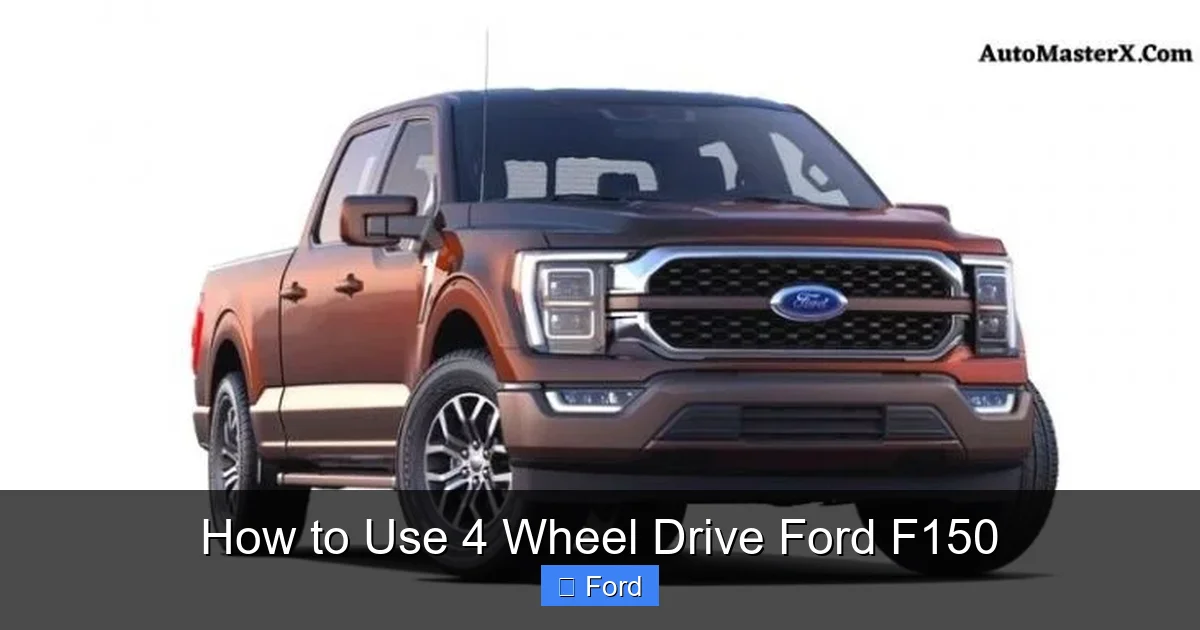
Visual guide about How to Use 4 Wheel Drive Ford F150
Image source: automasterx.com
Engaging 4H: Step-by-Step
The beauty of modern F150s is that you can often engage 4H while driving. This is called “shift-on-the-fly.” Here’s the general process, but always confirm in your manual:
- For Electronic Systems (Button/Dial): Simply press the “4H” button or turn the dial to “4H” while driving at a moderate speed (typically under 55 mph). You’ll often see a light on your gauge cluster illuminate (usually a “4WD” or “4×4” icon). You might feel a slight thud or hesitation as the front axle engages. That’s normal.
- For Manual Lever Systems: You usually need to slow down to a crawl (2-3 mph) and then move the lever from 2WD to 4H. Some later manual systems allow engagement at higher speeds, but slow and steady is the safest rule. Come to a complete stop if you’re unsure.
Pro Tip: Engage 4H before you get stuck. If you’re already spinning wheels in deep snow or mud, stop, shift into 4H, and then proceed slowly. This prevents excessive wheel spin that can dig you in deeper.
Disengaging 4H
Disengaging is just as easy. Press the “2WD” button or move the lever back to 2WD. You can do this while driving at moderate speeds for electronic systems. For manuals, it’s best to be moving slowly or stopped. The system will disengage, and you’ll return to normal rear-wheel drive operation. The 4WD light will go out.
How to Engage and Disengage 4L (Four Low)
This is where your F150 becomes an unstoppable off-road beast. 4L engages a low-range gear reduction in the transfer case. It doesn’t send more power; it sends the same power but at a much slower, more controlled rate. Think of it like switching from a regular bicycle gear to a very low gear for climbing a steep hill. It multiplies torque, giving you immense pulling power at the wheels at very low speeds.
Visual guide about How to Use 4 Wheel Drive Ford F150
Image source: f150insight.com
When to Use 4L: The Golden Rules
Use 4L for severe off-road conditions only. This includes:
- Rock crawling over large boulders.
- Deep, viscous mud or sand where you need slow, controlled momentum.
- Steep, slippery hill climbs or descents.
- Using a winch or plowing heavy snow at low speed.
Never use 4L on dry pavement at speed. You will not be able to turn the truck without severe binding, and you risk catastrophic damage to the transfer case and front axle components. It is a low-speed, high-traction mode.
Engaging 4L: The Critical Sequence
Engaging 4L is more involved than 4H because of the gear reduction. Your truck must be stopped or moving very slowly (under 3 mph). Here is the safe sequence:
- Come to a complete stop. Put the transmission in Neutral (N).
- For Electronic Systems: Press and hold the “4L” button for 3-5 seconds. You’ll see the indicator light blink, then stay solid. The truck will make a noticeable whirring or clunking sound as the low-range gears mesh. This is normal.
- For Manual Lever Systems: With the transmission in Neutral, move the lever from 4H (or 2WD) into the 4L position. You will likely need to apply some force. It may help to rock the truck slightly forward/backward.
- Once the 4L light is solid, you can shift back into Drive (D) or Reverse (R).
Disengaging 4L: The Unwind Step
This is the step everyone skips and causes problems. To get out of 4L:
- Come to a complete stop. Shift to Neutral.
- Shift the lever/button from 4L to 4H. Listen for the disengagement clunk.
- Drive straight ahead for 50-100 feet in 4H. This allows the transfer case and driveshafts to “unwind” and relieve any torsional stress built up while in 4L.
- Now you can shift from 4H to 2WD. This sequence protects your drivetrain.
Using Auto Mode (On-Demand 4WD)
Many newer F150s, especially those with the 4×4 package, have an “Auto” or “AWD” setting. This is not a full-time system like a Subaru’s. It’s an intelligent part-time system. The truck starts in 2WD. When it detects rear-wheel slip (via wheel speed sensors), it automatically and seamlessly sends power to the front wheels. It can transfer up to 100% of power to the front axle if needed.
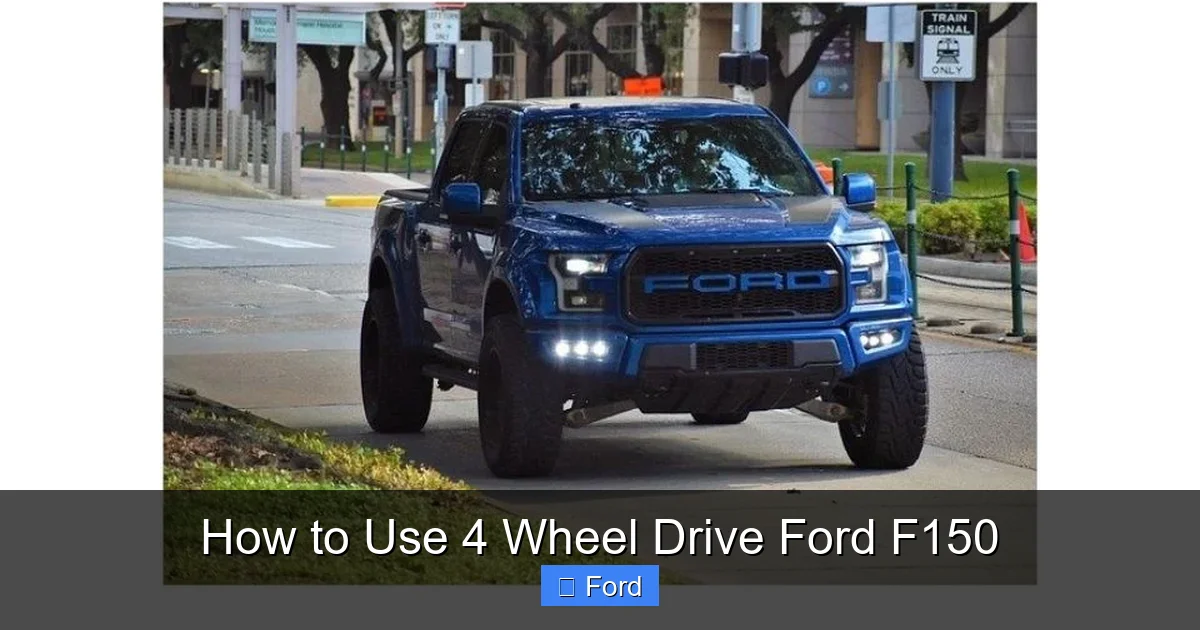
Visual guide about How to Use 4 Wheel Drive Ford F150
Image source: f150advisor.com
How Auto Mode Works
The computer is constantly monitoring. On a dry road, it stays in 2WD for maximum fuel efficiency. The moment your rear tires lose traction—like hitting a patch of ice or accelerating too hard on wet pavement—it engages the front axle within milliseconds. You often won’t even feel it happen, except for the 4WD light coming on. When traction is restored, it disengages.
Best Uses for Auto Mode
Auto mode is perfect for unpredictable conditions. It’s ideal for:
- Intermittent winter weather where roads are mostly clear but have icy spots.
- Rainy highways with occasional large puddles.
- Light-duty off-road like dirt roads or shallow mud where you don’t need the commitment of 4L.
- Daily driving in regions with sudden weather changes.
Important: Auto mode is not a substitute for 4L on severe rock crawls. It does not provide a low-range gear reduction. It’s also not meant for prolonged high-traction pavement driving in 4WD, though the system is designed to handle it better than a traditional part-time system. Still, for maximum fuel economy on long, dry highway drives, use 2WD.
4WD Best Practices: On-Road vs. Off-Road
Knowing the mechanics is one thing. Applying them wisely is another. Your driving style must change based on the mode you’re in and the surface beneath your tires.
Driving on Pavement (The Golden Rule)
The cardinal rule of a part-time 4WD system like most F150s: Do not use 4H or 4L on dry, high-traction pavement. Why? Because in 4H, the front and rear driveshafts are locked together. On a turning vehicle, the inside and outside wheels travel different distances. Since they can’t slip, the drivetrain is forced to twist. This is called “wheel binding” or “crow hop.” It feels like a jerking, hopping motion, stresses universal joints, and can eventually break a driveshaft or damage the transfer case. The only exception is if the pavement is completely covered in ice or deep snow, providing the necessary slip.
Off-Road Driving Techniques
Off-road, 4WD is your friend, but momentum and control are key.
- In 4H: Use for dirt roads, shallow water (up to the hubs), and loose surfaces. Maintain steady, moderate throttle. Avoid sudden acceleration or braking.
- In 4L: Use for the serious stuff. Go slow. Your speed might be 1-5 mph. Use gentle, steady throttle. This slow speed gives you time to react and prevents you from building up momentum that could lead to a rollover on a steep slope. Do not turn tightly in 4L on high-traction surfaces (like a rock with good grip), as it can still bind.
- Tire Pressure: For sand or deep mud, lowering your tire pressure (to around 15-20 PSI) increases the contact patch and helps the tire “float.” This is a critical off-road skill. Always re-inflate before returning to high-speed pavement.
- Approach Angles: Your F150’s 4WD doesn’t make it invincible. Know your truck’s approach, departure, and breakover angles. Use a spotter for tight obstacles.
If you’re interested in how other trucks handle off-road, you might read about Subaru’s X-Mode for a completely different AWD system designed for slippery conditions, not rock crawling.
4WD and Towing: Maximizing Traction and Safety
Hauling a boat, camper, or heavy trailer is where your F150’s 4WD truly shines. It’s not just about moving; it’s about control and safety.
When to Use 4WD While Towing
- Slippery Launch: When pulling a heavy load from a stop on wet grass, gravel, or snow, engage 4H. It prevents the rear wheels from spinning and helps you get moving smoothly.
- Trailer Sway: If you feel the trailer beginning to sway on a highway crosswind or while being passed, gently engage 4H. The added front-end traction helps stabilize the entire combo. Do not make sudden steering corrections.
- Mountain Driving: For steep, wet, or gravelly mountain passes, 4H provides extra confidence on both climbs and descents.
When to Avoid 4WD While Towing: On long, dry, straight highways, stay in 2WD. It reduces wear on your 4WD components and improves fuel economy. Also, never use 4L for normal towing on roads—it’s for extreme slow-speed maneuvers only, like backing a trailer up a steep, muddy hill.
Towing Weight and 4WD
Your F150’s towing capacity is a legal and mechanical limit. Engaging 4WD does not increase your Gross Combined Weight Rating (GCWR). It simply helps you manage the weight you’re already within spec to tow. Always check your door jamb sticker for your specific truck’s payload and towing ratings. Overloading is dangerous, 4WD or not.
Maintaining Your F150’s 4WD System
A neglected 4WD system will fail when you need it most. Basic maintenance is straightforward.
Fluids Are Lifeblood
The transfer case (the gearbox that splits power to front/rear) and both differentials (front and rear axles) require specific lubricants. Consult your owner’s manual for the correct fluid type and service intervals.
- Transfer Case Fluid: Typically changed every 50,000-100,000 miles. If you use your 4WD frequently off-road, shorten that interval.
- Differential Fluid: Also has a service interval. Severe use (off-road, towing) requires more frequent changes.
If you hear whining, grinding, or clunking from the drivetrain, have the fluid levels and condition checked immediately. Low or dirty fluid is a common cause of failure.
Electrical Components (Electronic Shift Systems)
The electronic actuators and sensors that engage your 4WD can fail. Symptoms include a 4WD light that won’t come on, a blinking light, or the system getting stuck in one mode. Sometimes, a simple system reset can help, similar to how you might reset the anti-theft system on your F150. However, persistent issues require a professional diagnosis with a scan tool that can communicate with the 4WD control module.
U-Joints and CV Axles
These are the moving parts that allow the driveshafts and front axles to bend with suspension movement. They wear out. Listen for a rhythmic clicking or squeaking when turning in 4WD. That’s often a CV joint. A vibration at certain speeds can indicate a U-joint. Inspect these during regular service, especially if you off-road often.
Troubleshooting Common 4WD Problems
Even with perfect maintenance, issues can arise. Here’s a guide to common symptoms.
“My 4WD Won’t Engage”
This is the most common complaint. For electronic systems:
- Check the fuse for the 4WD system (see owner’s manual).
- Ensure the truck is in the correct state (for 4L: stopped, in Neutral).
- Try cycling the ignition: go from Run to Off, then back to Run, and try again.
If it still doesn’t work, the transfer case motor, a faulty switch/button, or a wiring issue could be the culprit. For manual systems, it’s often a lack of lubrication in the transfer case or a misaligned linkage.
“My 4WD Light is Blinking”
A blinking light usually means the system tried to engage but failed. It’s a warning. Follow the steps above. If it continues, get it scanned. A diagnostic trouble code (DTC) will point the technician to the faulty sensor or motor. Don’t ignore this, as driving with a malfunctioning 4WD system can cause damage.
“I Feel a Vibration/Jerking in 4WD on Pavement”
This is the classic sign of using 4H on dry pavement. Immediately disengage to 2WD. If the vibration persists in 2WD, you may have an unbalanced tire, a bent driveshaft, or a worn U-joint—unrelated to the 4WD system itself. But if it only happens in 4H, you’re using the wrong mode for the surface.
Frequently Asked Questions
Can I switch from 2WD to 4H while driving my F150?
Yes, on most modern F150s with electronic shift-on-the-fly, you can engage 4H while driving at moderate speeds (usually up to 55 mph). For older manual lever systems, you typically need to slow to a crawl (2-3 mph) or stop. Always check your owner’s manual for your specific model year’s safe engagement speed.
What is the real difference between 4H and 4L?
4H (Four High) provides equal power to all four wheels at normal driving speeds. It’s for slippery surfaces like snow or mud. 4L (Four Low) adds a gear reduction in the transfer case, multiplying torque. This gives you massive pulling power at very low speeds (1-5 mph) for severe off-road obstacles like rocks or deep mud. 4L is for slow, controlled maneuvers only.
Do I need special tires for 4WD to work?
Your 4WD system will work with any tires, but its effectiveness is entirely dependent on tire quality. All-season tires are fine for light snow. For serious winter conditions or off-roading, dedicated winter tires or all-terrain/mud-terrain tires are essential. The best 4WD system cannot overcome a lack of traction from poor tires.
How often should I actually use my 4WD system?
It’s a good idea to engage 4WD at least once a month, even in good weather. Drive a few miles in a safe area (like a gravel lot). This helps lubricate the transfer case and front axle components, keeps the seals moist, and ensures the system is functional when you need it. It also prevents the internal clutch packs in electronic systems from sticking.
Why is my F150 stuck in 4WD and won’t return to 2WD?
This is often caused by a faulty 4WD switch/button, a failed transfer case motor, or a blown fuse. Sometimes, the internal shift motor can bind. A common trick is to drive forward and backward in 4H a few times while gently turning the wheel left and right to free it. If that fails, a dealer scan tool is usually needed to diagnose and/or manually override the system.
Can I use 4L on the highway to get more power?
Absolutely not. 4L is a low-range gear for slow-speed use only. Using it at highway speeds would destroy your engine (over-revving) and transfer case instantly. It provides no extra horsepower, only more torque at a very low speed. It is strictly for off-road or severe low-speed maneuvers like winching.
