
How to Reset Check Engine Light on a 2007 Toyota Camry

Before you reset your 2007 Toyota Camry’s check engine light, you must understand why it illuminated. Simply clearing the code without fixing the underlying issue is ineffective and potentially dangerous. The proper process involves diagnosing the problem with an OBD2 scanner, addressing necessary repairs, and then using one of several reset methods—like disconnecting the battery or using a scan tool—to clear the code. If the light flashes or returns immediately after a reset, seek professional mechanic help without delay.
That little amber light on your dashboard—the one that looks like an engine with an exclamation point—has a name. It’s the Malfunction Indicator Lamp (MIL), but we all know it as the check engine light. When it glows steadily on your 2007 Toyota Camry, it’s your car’s way of saying, “Hey, we need to talk about something under the hood.” Your first instinct might be to find out how to reset check engine light on 2007 Toyota Camry and make it go away. But before you grab the wrench or disconnect anything, take a breath. This guide will walk you through everything you need to know, from what that light really means to the safe, step-by-step methods to turn it off. We’ll emphasize why diagnosis is non-negotiable and help you understand when a simple reset is okay and when you need to call a pro.
Key Takeaways
- Never ignore the light: The check engine light signals an emissions-related problem. Ignoring it can cause expensive damage and failed inspections.
- Diagnose first, reset second: Always read the stored trouble code(s) with an OBD2 scanner to identify the specific issue before attempting any reset.
- Two primary reset methods: You can reset the light by disconnecting the car’s battery for a few minutes or by using an OBD2 scanner’s “Clear Codes” function.
- A reset is not a repair: Clearing the code only turns off the warning light. It does not fix the mechanical or electrical problem that triggered it.
- The light may return: If the original problem isn’t repaired, the car’s computer will detect it again and relight the check engine indicator, often after a short drive.
- Flashing light = emergency: A flashing check engine light indicates a severe problem, like a misfire that can damage the catalytic converter. Stop driving and get help immediately.
- Legal and emissions considerations: In many areas, you cannot pass a smog or emissions inspection with the check engine light on. Some regions also require that codes be cleared before testing.
📑 Table of Contents
- Understanding Your 2007 Camry’s Check Engine Light
- Safety First: Why You Must Diagnose Before You Reset
- Essential Tools for the Job
- Step-by-Step: How to Reset Check Engine Light on a 2007 Toyota Camry
- After the Reset: What to Expect and What to Do
- When to Absolutely See a Mechanic
- Conclusion: A Reset is a Tool, Not a Cure
Understanding Your 2007 Camry’s Check Engine Light
Your 2007 Toyota Camry is a sophisticated machine with a network of sensors and computers constantly monitoring its systems. The primary computer, called the Engine Control Unit (ECU) or Powertrain Control Module (PCM), watches data from dozens of sources—oxygen sensors, airflow sensors, ignition components, and more. If any of these readings fall outside the programmed “normal” range, the ECU stores a diagnostic trouble code (DTC) and illuminates the check engine light to alert you.
Not All Lights Are the Same
It’s critical to distinguish the check engine light from other dashboard indicators. The check engine light is typically yellow or amber and shaped like an engine. A maintenance required or service engine soon light is different; it’s a reminder for scheduled service like an oil change and is often a wrench icon. Resetting a maintenance light is a simple procedure unrelated to diagnostics. Our guide on resetting the maintenance required light on a Toyota covers that process. Similarly, an airbag light (SRS) or ABS light points to safety systems and requires specific, often professional, attention. For instance, resetting an airbag light on a Camry involves different protocols than the check engine light.
Common Triggers for a 2007 Camry
While the exact code tells you the problem, some issues are famously common on this model year. A loose or faulty gas cap is the #1 culprit—it allows fuel vapors to escape, tripping an evaporative emissions (EVAP) code. Failing oxygen sensors, a malfunctioning catalytic converter, or a bad mass airflow sensor are also frequent offenders. Spark plug or ignition coil issues can cause misfires. Sometimes, it’s something simple like a damaged hose or a sensor that’s just reached the end of its life. The key is: you won’t know which one it is until you read the code.
Safety First: Why You Must Diagnose Before You Reset
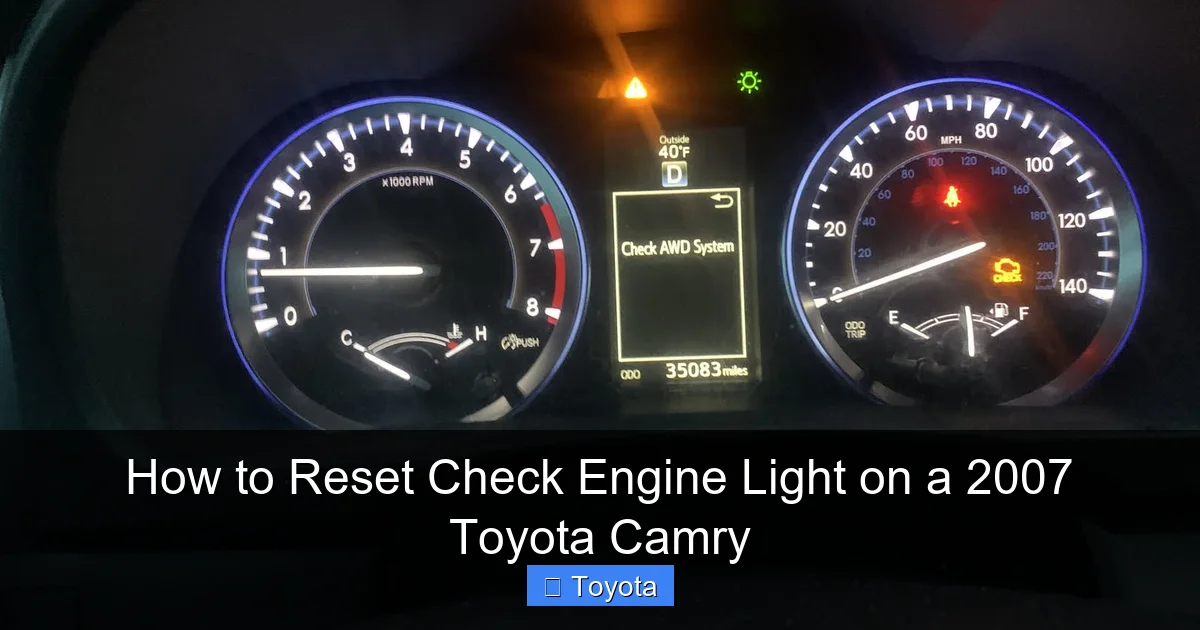
Resetting the light without addressing the root cause is like turning off a smoke alarm instead of putting out the fire. The light is a symptom, not the disease. Here’s why skipping diagnosis is a bad idea.
Visual guide about How to Reset Check Engine Light on a 2007 Toyota Camry
Image source: static.cargurus.com
The Risk of Costly Damage
Many engine problems, if left unchecked, lead to a cascade of damage. A misfiring cylinder (P0300 series code) can dump unburned fuel into the catalytic converter, overheating and destroying it. Replacing a catalytic converter on a Camry can cost $1,500 or more. A failing oxygen sensor reduces fuel economy and can eventually damage the converter. Ignoring an overheating condition (often signaled by other gauges) can warp the cylinder head. You reset the light, but the problem silently gets worse and more expensive.
Failed Emissions and Legal Issues
In most states and countries, a vehicle cannot pass a mandatory emissions (smog) test with the check engine light illuminated. The inspection station will simply fail you on the spot. Furthermore, some jurisdictions require that all stored emissions-related trouble codes be cleared before the test, and they have ways to detect if codes were recently cleared without a corresponding drive cycle completion. Simply disconnecting the battery might not be enough to fool a sophisticated test.
Safety Concerns
While many check engine light issues don’t immediately affect drivability, some can. A severe misfire (indicated by a flashing light) can cause the car to shake violently, lose power, and stall. This is dangerous in traffic. Sensors that control engine timing or fuel mixture can, in rare cases, cause unexpected behavior. Your safety and the safety of others on the road must come first.
Essential Tools for the Job
To reset the light correctly, you need the right tools. The good news is that for a 2007 Camry, you don’t need a $5,000 professional scan tool.
Visual guide about How to Reset Check Engine Light on a 2007 Toyota Camry
Image source: youcanic.com
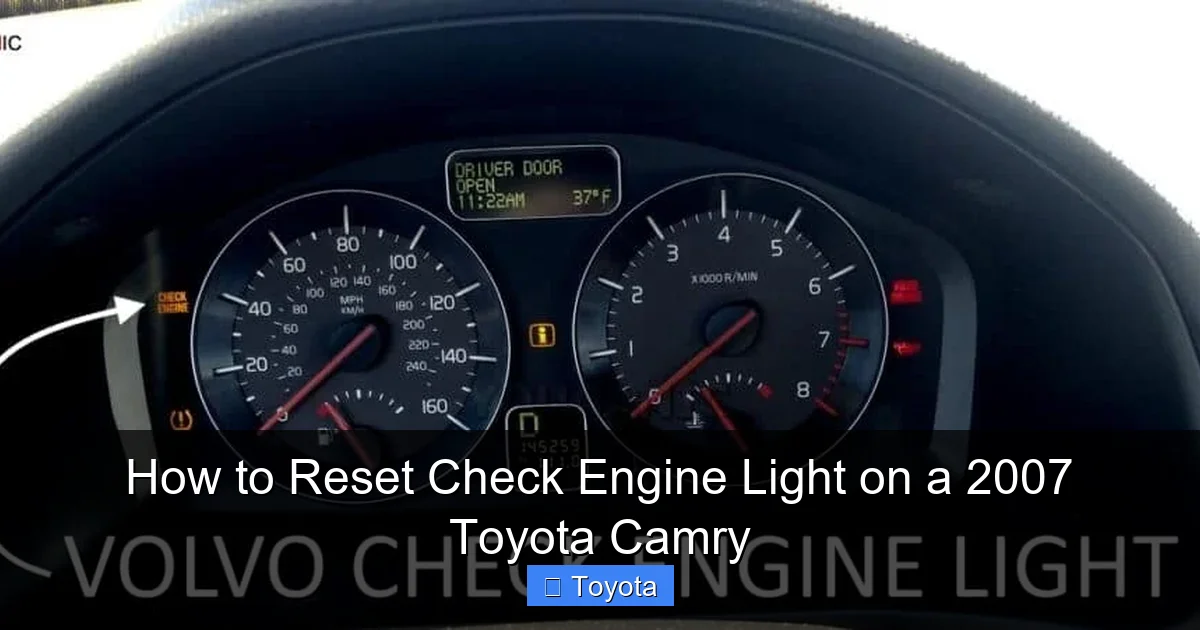
The Minimum: An OBD2 Scanner/Code Reader
Since 1996, all cars sold in the US have had an OBD2 (On-Board Diagnostics II) port. This is your direct line to the car’s computer. You’ll find the port under the dashboard, near the steering column. You need a device that plugs into this port. There are three main types:
- Basic Code Readers ($20-$50): These read and clear generic OBD2 codes (P0xxx, P2xxx, etc.). They are perfect for most common issues on your Camry. Brands like Autel, Ancel, and Innova offer reliable basic models.
- Enhanced/Professional Scan Tools ($100+): These read both generic and manufacturer-specific codes (P1xxx codes for Toyota), and often have more advanced data and bi-directional controls. Great for deeper diagnostics.
- Smartphone Adapters ($15-$30): Devices like the OBDLink MX+ or a generic ELM327 adapter plug into the OBD2 port and pair with an app on your phone (like Torque Pro). They offer a cost-effective way to read and clear codes.
Pro Tip: If you own other vehicles, consider a scanner that works across brands. Our guide on resetting the check engine light on a Toyota Highlander uses the same fundamental OBD2 process, so a good scanner is a versatile investment.
The Alternative: The Battery Disconnect Method
This method requires no special tools, just a basic wrench (usually 10mm or 13mm) for the battery terminal. However, it’s a blunt instrument with significant downsides, which we’ll cover in the next section. You should also have a memory saver (a small 9V battery with a plug) if you want to preserve radio presets and clock settings, but this is less critical on a 2007 model.
Step-by-Step: How to Reset Check Engine Light on a 2007 Toyota Camry
Now, let’s get to the procedures. We’ll start with the recommended method and then cover the alternative.
Method 1: The Proper Way – Using an OBD2 Scanner
This is the preferred, manufacturer-approved method. It’s clean, fast, and doesn’t mess with your car’s other electrical systems.
- Locate the OBD2 Port: It’s under the dashboard on the driver’s side, usually within arm’s reach of the steering wheel. It’s a trapezoidal-shaped 16-pin connector. You might need a flashlight.
- Connect Your Scanner: Plug the scanner’s cable firmly into the port. Make sure the car is OFF but the key is in the ON position (dashboard lights on, engine off). Some scanners power on from the car; others have their own battery.
- Turn On the Scanner and Read Codes: Follow the scanner’s menu. Select “Read Codes” or “Diagnose.” The tool will communicate with the Camry’s computer and pull out any stored trouble codes. Write these down! They will be something like “P0171” or “P0420.” This is the most important step—it tells you what’s wrong.
- Address the Problem: This is the part you cannot skip. Use the code(s) as a starting point for diagnosis. A P0440 code points to an EVAP system leak—start by checking the gas cap. A P0302 code means cylinder 2 is misfiring—inspect spark plugs and coils. If you’re not mechanically inclined, take the code to a trusted mechanic or use online resources for your specific code.
- Clear the Codes: Once the repair is made (or if you’re certain it was a transient issue like a loose gas cap), go back to your scanner’s menu. Select “Clear Codes” or “Erase DTCs.” Confirm the action.
- Verify the Reset: The check engine light should immediately go out. Turn the ignition off, wait a few seconds, and turn it back on. The light should remain off. Start the engine. It should stay off.
- Test Drive: Drive the car normally for 15-20 minutes, including some highway speeds. The light should stay off. If it comes back on, the problem was not fully fixed, or a new one has appeared. Re-read the codes.
Method 2: The “Old School” Battery Disconnect
This method works by removing power to the ECU, forcing it to forget its stored memory, including trouble codes. It’s less precise and has side effects.
- Gather Tools: You’ll need the correct size wrench (usually 10mm for the negative terminal on a 2007 Camry) and possibly a terminal puller. Safety glasses are a good idea.
- Park and Open Hood: Park on a level surface, set the parking brake, and open the hood. Locate the battery. It’s typically in the front right of the engine bay.
- Identify Terminals: The battery has two terminals: Positive (+) is usually red and has a plus sign. Negative (-) is usually black and has a minus sign. You will only disconnect the NEGATIVE (-) terminal.
- Disconnect the Negative Cable: Loosen the nut on the negative terminal clamp with your wrench. Once loose, carefully wiggle and lift the clamp off the terminal post. Tuck the cable away so it cannot accidentally touch the terminal.
- Wait: This is the reset. You must leave the battery disconnected for at least 5-10 minutes. Some sources recommend up to 15 minutes to ensure all residual power is drained from the ECU’s capacitors. This is the time the car’s computer “forgets” the codes.
- Reconnect: Reattach the negative clamp to the terminal post. Tighten the nut securely. Do not overtighten and risk stripping the bolt.
- Start the Car: You will likely need to reset your clock and radio presets. The car may idle a bit rough for the first minute as the ECU relearns fuel trim values—this is normal.
- Check the Light: The check engine light should be off. However, it may come back on if the problem persists, often within a few drive cycles.
Major Downsides of This Method: You will lose all radio presets, clock settings, and any learned data in the ECU (like transmission shift points). It can also cause issues with other modules (like the power window control) that need to be reinitialized. For these reasons, the OBD2 scanner method is strongly preferred.
After the Reset: What to Expect and What to Do
The light is off. Success? Not necessarily. Your job isn’t done until you’re sure the problem is resolved.
The Drive Cycle
The ECU doesn’t just clear a code and forget about it. It runs internal tests, called “readiness monitors,” to verify that the repaired system is functioning correctly. These tests (for EVAP, catalytic converter, oxygen sensors, etc.) must pass and be marked “Complete” before your car will pass an emissions test. A simple code clear starts these monitors in an “Incomplete” state. You must drive the car under specific conditions (a drive cycle) to get them to complete. A typical cycle includes:
- Cold start and idle for 2-3 minutes.
- Drive at 25-35 mph for 2-3 minutes.
- Accelerate to 55-60 mph and hold for several minutes.
- Coast down to 20 mph without braking.
- Repeat varied speeds and stops.
It can take 50-100 miles of normal driving for all monitors to set. You can check monitor status with your OBD2 scanner. If the light stays off but monitors are incomplete, you haven’t passed the test yet.
If the Light Comes Back On
This is the most common outcome when a reset is done without a proper repair. The ECU has detected the same fault again. The stored code will likely be the same one you just cleared. This is your definitive sign that the underlying problem still exists and needs professional diagnosis and repair. Do not keep resetting it. Driving with a persistent issue can cause the damage we discussed earlier.
When to Absolutely See a Mechanic
Some situations are beyond DIY. Here’s when you should put the wrench down and call for help.
The Flashing Check Engine Light
This is a severe, immediate warning. A flashing MIL indicates a misfire that is so severe it is likely to overheat and destroy your catalytic converter within minutes. You should:
- Reduce speed and avoid hard acceleration.
- Drive the car only if absolutely necessary to get it to a safe location or repair shop.
- Do not ignore it. Continuing to drive risks thousands in catalytic converter replacement.
Complex Codes or Multiple Codes
If your scanner shows multiple codes, especially across different systems (e.g., an oxygen sensor code and a transmission code), it can indicate a more complex issue, possibly a wiring problem or a faulty control module. Diagnosing these requires experience and advanced tools.
You’re Uncomfortable or Unsure
If reading the codes gives you a result you don’t understand (like a P1xxx Toyota-specific code), or if the repair involves critical systems like fuel delivery, ignition timing, or emissions components, it’s time to consult a pro. A misdiagnosis or improper repair can be dangerous and wasteful.
Conclusion: A Reset is a Tool, Not a Cure
Resetting the check engine light on your 2007 Toyota Camry is a straightforward process, but it’s only the final step in a responsible maintenance routine. The real work is in the diagnosis that comes before it. Remember: the light is your car’s cry for help. By using an OBD2 scanner to read the trouble code, you empower yourself with knowledge. You can then decide if it’s a simple fix like a tightened gas cap or a job for a qualified technician. The battery disconnect method is a last resort, with notable drawbacks. Always prioritize fixing the problem over merely silencing the warning. A healthy, code-free Camry will not only pass inspections but also run reliably, efficiently, and safely for years to come. Treat that check engine light as valuable information, not just an annoyance, and you’ll save yourself money, stress, and potential breakdowns on the road.
Frequently Asked Questions
Will disconnecting the battery reset other systems in my 2007 Camry?
Yes. Disconnecting the negative battery terminal will reset the ECU, clearing the check engine light. However, it will also erase memory for your radio presets, clock, and some adaptive learning data in the transmission and throttle systems. You’ll need to reprogram these settings after reconnecting.
How long does it take for the check engine light to reset after I fix the problem?
It’s almost instantaneous if you use an OBD2 scanner to clear the code. If you disconnect the battery, the light will be off when you restart the car, provided the problem is fixed. However, the car’s internal monitors may take 50-100 miles of driving to complete and verify the repair, which is necessary for passing an emissions test.
Can I drive my Camry with the check engine light on?
It depends. If the light is steady and the car is running normally (no strange noises, smoke, or performance issues), a short trip to a mechanic or auto parts store to read the code is generally safe. However, if the light is flashing, you must stop driving as soon as safely possible, as this indicates a severe misfire that can cause catastrophic damage.
What if the check engine light comes back on right after I reset it?
This means the original problem was not repaired. The car’s computer has detected the same fault again. Do not keep resetting it. You must re-read the diagnostic trouble codes, perform a proper diagnosis, and complete the necessary repairs before attempting another reset.
Do I absolutely need an OBD2 scanner to reset the light?
No, you can use the battery disconnect method. However, using an OBD2 scanner is the correct, recommended method because it specifically clears only the engine codes without affecting other vehicle systems. More importantly, a scanner allows you to read the code first, which is essential for knowing what needs to be fixed.
Is it illegal to reset the check engine light without repairing the issue?
It’s not illegal to reset the light itself. However, it is illegal in most jurisdictions to knowingly operate a vehicle that does not pass emissions standards, and a illuminated check engine light almost always means the car will fail an official smog or emissions inspection. Furthermore, attempting to cheat an inspection by resetting the light immediately before testing is considered fraud and can result in fines.
