
Does Toyota Factory Warranty Transfer to Second Owner

Yes, Toyota’s new vehicle factory warranties are generally transferable to subsequent private owners. The remaining coverage on the original bumper-to-bumper and powertrain warranties typically moves with the vehicle when sold, but specific conditions apply. You must provide proof of the original sale and subsequent ownership transfer to Toyota. Always verify the exact remaining coverage by checking the vehicle’s VIN with a Toyota dealer before purchasing a used Toyota.
Key Takeaways
- Transferability is Standard: Toyota’s New Vehicle Limited Warranties (bumper-to-bumper and powertrain) are designed to transfer to each new private owner for the remainder of the original term.
- Proof of Ownership is Required: To activate the warranty in a new owner’s name, Toyota requires documentation like the original window sticker, Bill of Sale, and a signed odometer disclosure.
- No Additional Fee: The transfer of the original factory warranty to a second owner is a free service provided by Toyota; there is no transfer fee.
- Hybrid-Specific Warranty Transfers: The unique hybrid system warranty (often 8 years/100,000 miles) also transfers, but its duration is based on whichever milestone (time or mileage) is reached first from the vehicle’s original sale date.
- Extended Warranties (Platinum) Have Different Rules: A separately purchased Vehicle Service Agreement (VSA), like the Toyota Platinum plan, is a contract that may have its own, often more restrictive, transfer policies and potential fees.
- Commercial Use Voids Transfer: If the vehicle was used commercially (e.g., as a taxi, delivery vehicle, or for ridesharing) during the first owner’s tenure, the factory warranty is typically void and will not transfer.
- Always Verify Before Buying: The only way to know a used Toyota’s exact, remaining factory warranty is to provide the VIN to a Toyota dealership for an official warranty status check.
📑 Table of Contents
- Introduction: The Big Question for Used Toyota Buyers
- How Toyota’s Factory Warranties Actually Work
- The Official Policy: Transfer to Second and Subsequent Owners
- The Essential Process: How to Actually Transfer the Warranty
- Important Limitations and Exclusions You Must Know
- Comparing Toyota’s Policy to Other Brands
- Smart Tips for the Second-Owner Toyota Buyer
Introduction: The Big Question for Used Toyota Buyers
You’ve found a gently used Toyota Camry with low miles. The price is fantastic, and the CarFax looks clean. But a critical question lingers in your mind: “Does the Toyota factory warranty still apply to me?” This isn’t just a minor detail; it’s a major factor that can protect your investment from unexpected repair costs for years to come. Understanding how Toyota’s warranties work is essential for any smart used car shopper. The short answer is reassuring: yes, Toyota’s factory warranties are transferable to second and subsequent private owners. However, the process isn’t always automatic, and important nuances dictate exactly what coverage you’ll receive. This comprehensive guide will walk you through every detail, from the basic rules to the specific paperwork you need, ensuring you can buy your next used Toyota with confidence and full knowledge of its protection status.
How Toyota’s Factory Warranties Actually Work
Before diving into transfer rules, we need a clear picture of what warranties Toyota provides on new vehicles. Think of it as two main layers of protection, each with its own clock.
Visual guide about Does Toyota Factory Warranty Transfer to Second Owner
Image source: carglassadvisor.com
The Two Core Warranties: Bumper-to-Bumper and Powertrain
Toyota’s standard New Vehicle Limited Warranty is split into two primary components. The first is the Bumper-to-Bumper Warranty, which covers most vehicle components against defects in materials or workmanship. This comprehensive coverage lasts for either 36 months or 36,000 miles, whichever comes first. It includes things like the audio system, electronics, climate control, and suspension components.
The second is the Powertrain Warranty. As the name suggests, this covers the engine, transmission, and drivetrain components (like the axles and transfer case). It’s designed to protect the most critical and expensive parts of the car. The powertrain warranty lasts significantly longer: 60 months or 60,000 miles, whichever comes first. For hybrids, an additional, separate warranty covers the hybrid battery and related components for 8 years or 100,000 miles in most states.
The Warranty “Clock” Starts at First Retail Sale
This is the most crucial concept to grasp. The warranty periods (time and mileage) are not reset when the car is sold. They are based on the vehicle’s original in-service date—the date the first owner took delivery from the dealership. The warranty expires when the vehicle reaches either the time limit (e.g., 5 years from first sale) OR the mileage limit (e.g., 60,000 miles), whichever event happens first. So, if you buy a 4-year-old Toyota with 30,000 miles, you likely have 1 year and 30,000 miles remaining on the bumper-to-bumper warranty, and 1 year and 30,000 miles on the powertrain. The coverage literally travels with the car’s history.
The Official Policy: Transfer to Second and Subsequent Owners
Toyota Motor Sales, U.S.A., Inc. explicitly states in its warranty documentation that the New Vehicle Limited Warranty is transferable to subsequent private owners at no additional charge. This is a significant consumer benefit and a point of pride for the brand, often cited as a reason for Toyota’s strong resale values. The warranty remains in effect for the remainder of the original warranty period, provided the vehicle continues to be used as intended for personal transportation.
Visual guide about Does Toyota Factory Warranty Transfer to Second Owner
Image source: factorywarrantylist.com
Who Qualifies as an “Owner” for Transfer?
The policy specifies “private owners.” This means the vehicle must be sold through a standard retail transaction. The warranty will transfer to an individual, a family trust, or a business that purchases the vehicle for its own use (like a company car for an employee). However, it will not transfer if the vehicle is sold to a dealership for resale (as a used car on their lot) or if it is used for commercial purposes. If a car is titled to a business like a florist or a plumber for daily deliveries, the factory warranty is considered void from the start and will not cover any subsequent owner.
What About Certified Pre-Owned (CPO) Vehicles?
This is a common point of confusion. When a Toyota dealer sells a vehicle as a Toyota Certified Used Vehicle, it comes with an additional, extended warranty from Toyota. This CPO warranty is built on top of any remaining original factory warranty. The original factory warranty still applies and transfers as described. The CPO program then adds its own coverage (often extending the bumper-to-bumper period to 1 year/12,000 miles with no mileage limit for powertrain, for example). The rules for the CPO warranty are separate and are part of the dealer’s certification process. If you buy a non-CPO used Toyota from a private party, you only have the remaining original factory warranty, not the added CPO layer. It’s also worth noting that some components, like the hybrid battery, might have their warranty status based on the original first sale date, not the CPO date.
The Essential Process: How to Actually Transfer the Warranty
The warranty doesn’t magically update itself in Toyota’s system the moment you sign the title. There is a formal, but straightforward, process to ensure the new owner is recognized and can make a claim. Failure to complete this process correctly can lead to denied warranty claims.
Visual guide about Does Toyota Factory Warranty Transfer to Second Owner
Image source: shunauto.com
Required Documentation: Your Paper Trail
Toyota requires specific documents to process a warranty transfer. As the new owner, you are responsible for submitting these. You will need:
- The original New Vehicle Limited Warranty booklet from the first owner. This is the physical proof of the original contract.
- A copy of the original new vehicle window sticker (Monroney label). This shows the vehicle’s original sale date and VIN.
- A completed and signed odometer disclosure statement (often part of the title or bill of sale).
- A copy of the bill of sale or title showing the transfer of ownership from the seller to you, with both signatures and the date.
- A completed “Warranty Transfer Request” form. This form is available from any Toyota dealer or through Toyota’s customer service website.
Step-by-Step: Your Action Plan After Purchase
1. Gather Documents: Immediately upon purchase, ask the seller for the original warranty booklet and window sticker. These are often tucked in the owner’s manual portfolio.
2. Complete the Form: Fill out the Warranty Transfer Request form with your name, address, and the vehicle’s VIN.
3. Visit a Dealer: Take all documents (form, booklet, sticker, bill of sale/title, odometer disclosure) to the service department of any Toyota dealership. They are the authorized agents to submit this package to Toyota Motor Sales.
4. Get Confirmation: The dealer will submit the package. Once processed, you should receive a letter or email from Toyota confirming the transfer and listing the remaining warranty terms. Keep this in your vehicle file.
5. Verify Before You Need It: Don’t wait until you have a problem. Call Toyota Customer Experience at 1-800-331-4331 with your VIN to confirm the transfer is complete and your coverage is active.
Important Limitations and Exclusions You Must Know
While transferable, the warranty is not a blanket guarantee for everything. Understanding what is not covered is just as important as knowing what is.
Normal Wear and Tear is Never Covered
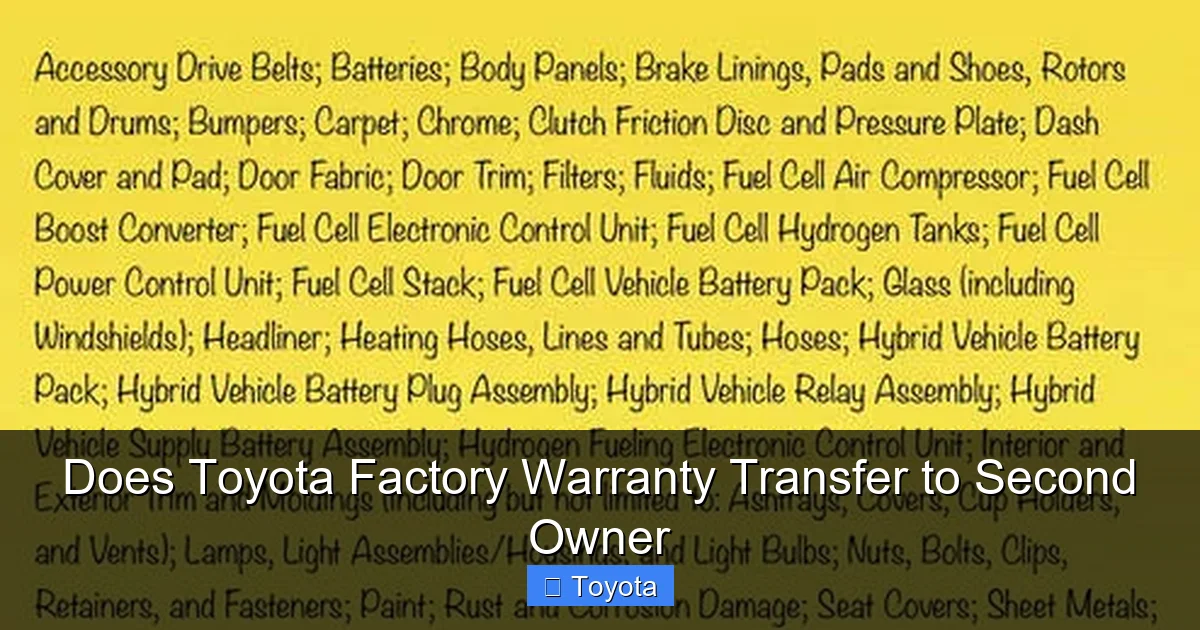
The warranty covers defects in materials or workmanship. It does not cover parts that wear out from normal use. This includes brake pads and rotors, wiper blades, tires, batteries (the 12V starting battery), and most fluids (oil, coolant, transmission fluid). These are considered maintenance items. This is a universal warranty exclusion. For tire-specific coverage, you would need to check if the original tires were covered by a separate manufacturer’s tire warranty, which also has its own terms. You can learn more about what Toyota’s tire warranty typically covers.
Damage from Lack of Maintenance or Misuse
If the vehicle’s required maintenance (as outlined in the owner’s manual) was not performed, or if the car was abused (racing, severe overloading, off-roading beyond its design), any resulting damage is not covered. This is why a thorough pre-purchase inspection is vital. An inspector can spot signs of neglect or hard use that could void future warranty claims. Modifications can also be a gray area. While a simple cosmetic change like new wheels usually doesn’t affect the powertrain warranty, a performance tune or lift kit that affects the engine or suspension could. You can read about how modifications like a lift kit can impact your warranty.
The “As-Is” Purchase from a Private Party
When you buy from a private seller, you generally buy the car “as-is” regarding any promises the seller made. The warranty you are getting is the remaining factory warranty from Toyota. The seller has no obligation to fix pre-existing problems unless they explicitly guaranteed the car’s condition in a written contract. Your protection comes from the factory warranty for future defects, not from the seller for current ones. This underscores the importance of an independent pre-purchase inspection.
Comparing Toyota’s Policy to Other Brands
Toyota’s transferable warranty is a industry-standard practice among major manufacturers, but details vary. Knowing the landscape helps you evaluate a used car from any brand.
Most Mainstream Brands Transfer
Like Toyota, brands such as Honda, Hyundai, Kia, Ford, and GM all offer transferable new vehicle warranties to second owners. The basic structure (bumper-to-bumper and powertrain) is similar, though the specific durations differ (e.g., Hyundai’s powertrain is 5 years/60,000 miles vs. Toyota’s 5 years/60,000 miles). The transfer process and required documentation are also very similar. For example, you can review Hyundai’s specific transfer policy to see the parallels and differences.
Luxury Brands Often Have Different Policies
Some luxury brands, like BMW, Mercedes-Benz, and Audi, traditionally have had warranties that are not transferable beyond the first owner. However, this is changing. Many now offer optional, paid warranty extensions that *are* transferable. It’s always critical to check the specific brand’s policy. The key takeaway is that Toyota’s standard, no-fee transfer policy is a strong value proposition in the mainstream market and simplifies the used car buying process.
Smart Tips for the Second-Owner Toyota Buyer
Armed with knowledge, you can now be a savvy shopper. Here is your actionable checklist.
Always, Always Verify the Warranty Status
Never take the seller’s word for it. A seller might honestly believe they have “2 years left” but not realize the original 3-year/36,000-mile bumper-to-bumper warranty expired at 36,000 miles, even if the car is only 2.5 years old. Get the VIN. Call a Toyota dealer’s service department. Ask them to run a “warranty status inquiry.” They can tell you the exact in-service date and the precise remaining miles/days on each warranty component. This is a free, 5-minute phone call that provides invaluable peace of mind.
Inspect for Signs of Neglect or Unapproved Mods
Look under the hood. Is the oil change sticker up to date? Is the engine bay clean or caked with grime? Check the tires for uneven wear, which could indicate poor alignment from an accident or curb impact. Look for any aftermarket parts, especially on the engine, suspension, or exhaust. If you see a bolt-on performance air intake or a lowered suspension, it’s wise to ask if any engine or suspension components were modified, as this could complicate future warranty claims for related parts.
Understand Your Post-Purchase Responsibilities
To keep your warranty intact, you must follow Toyota’s recommended maintenance schedule. You do not have to have this work done at a Toyota dealer, but you must keep detailed, dated receipts for all maintenance (oil changes, tire rotations, filter changes, etc.). In the event of a warranty claim, Toyota may request this proof. Using the correct oil (like 0W-16 for many newer models) and fluids is also mandatory. Using the wrong oil can void an engine warranty. Familiarize yourself with why specifications like 0W-16 are critical for modern Toyota engines.
Consider an Extended Service Plan for Extra Security
Once the original factory powertrain warranty expires, you are on your own for major repairs. If you plan to keep the car long-term, purchasing an extended warranty (Toyota Platinum or a third-party plan) can be a smart financial move. These plans can cover components after the factory warranty ends. However, understand that these are separate contracts with their own terms, deductibles, and transfer fees (unlike the free factory warranty transfer). Research thoroughly, as not all extended plans are created equal.
Frequently Asked Questions
Does the Toyota factory warranty transfer automatically when I buy a used car?
No, it does not transfer automatically. The new owner must actively submit a Warranty Transfer Request form along with required documents like the original warranty booklet and bill of sale to a Toyota dealer. Toyota then updates their system to recognize the new owner.
What happens to the hybrid battery warranty when a Toyota hybrid is sold?
The hybrid battery warranty (typically 8 years/100,000 miles) is part of the original factory warranty and transfers to the second owner. However, its expiration is fixed from the vehicle’s original in-service date. It does not get a new 8-year clock; it expires based on the original timeline, regardless of subsequent ownership changes.
Can I transfer a Toyota Platinum extended warranty I purchased separately?
Yes, but the rules are different from the factory warranty. A Toyota Platinum Vehicle Service Agreement (VSA) is a contract that can be transferred, but it often involves a transfer fee (typically around $50-$100) and must be done within a specific time window (e.g., 30 days) after the sale. The terms are outlined in your VSA contract, not the standard owner’s manual.
If I buy a used Toyota from a dealership, is the warranty already transferred?
If you buy a used Toyota from an authorized Toyota dealer, they are responsible for ensuring any remaining factory warranty is active and will provide you with the status. For a Certified Pre-Owned (CPO) vehicle, the additional CPO warranty is automatically applied. For a non-CPO used car on a dealer’s lot, you should still confirm the remaining factory warranty status with the dealer.
What specific documents are absolutely required to transfer the warranty?
You will need: 1) The original New Vehicle Limited Warranty booklet, 2) A copy of the original window sticker (Monroney label), 3) A completed and signed Warranty Transfer Request form, 4) A copy of the bill of sale or title showing the ownership transfer, and 5) A signed odometer disclosure statement. Submitting all these together to a dealer is the surest way to get the transfer processed.
My used Toyota has 50,000 miles on it. Is the factory warranty still valid?
It depends on the original in-service date and which warranty you’re asking about. The bumper-to-bumper warranty is 3 years/36,000 miles, so at 50,000 miles, it has almost certainly expired (unless the car was driven very little in 3 years). The powertrain warranty is 5 years/60,000 miles. If the car is less than 5 years old from its original sale date, you likely still have powertrain coverage. You must check the VIN with a dealer to know for certain.
