
What It’s Like to Drive a Ford F-150

Driving a Ford F-150 is a study in confident capability and refined comfort. It blends commanding visibility, a smooth yet powerful ride, and a versatile, tech-filled cabin that transitions seamlessly from a family hauler to a worksite hero. You feel secure in its construction and impressed by its modern amenities, all while knowing it can handle serious payloads and challenging terrain when needed.
Key Takeaways
- Commanding Presence: The high seating position and vast visibility create a feeling of control and safety on any road, making other vehicles seem smaller.
- Refined Power: Modern F-150 engines (especially the EcoBoost V6 and 5.0L V8) offer impressive, responsive power for passing and towing, paired with a transmission that shifts smoothly in daily driving.
- Surprisingly Civilized: Despite its size, the ride is compliant and quiet, especially with the independent rear suspension on newer models, making it comfortable for long commutes.
- Tech & Comfort Leader: The cabin is spacious, well-built, and packed with available tech like the massive SYNC 4 touchscreen, making it feel more like a premium SUV than a traditional work truck.
- Incredible Versatility: From the configurable tailgate and Pro Power Onboard generator to the multiple cab/bed options, it’s designed to adapt to nearly any lifestyle or job.
- Real-World Efficiency: The EcoBoost engines deliver surprisingly good fuel economy for a full-size truck, though heavy loads or aggressive driving will quickly reduce those numbers.
- Ownership Reality: It’s a major vehicle with significant costs (fuel, tires, insurance), but its durability, high resale value, and vast aftermarket support help justify the investment for many owners.
[FEATURED_IMAGE_PLACEHOLDER]
📑 Table of Contents
- First Impressions: The American Truck Icon
- The Daily Grind: Commuting and Running Errands
- Power and Towing: When Work Calls
- Comfort, Tech, and the Modern Cabin
- Off the Beaten Path: The Raptor and Beyond
- The Ownership Equation: Costs, Maintenance, and Long-Term Value
- Conclusion: More Than a Truck, a Tool for Your Life
First Impressions: The American Truck Icon
Slip behind the wheel of a Ford F-150, and the first thing that hits you is the view. You sit high, perched above traffic with a commanding vista of the road ahead. The hood stretches out, a long, broad expanse of steel that reminds you of the vehicle’s purpose. This isn’t a car that blends in; it’s a statement. But that initial impression of sheer size quickly gives way to a more nuanced reality. The modern F-150, particularly from the 2018 model year onward with its aluminum-intensive body and advanced powertrains, is a masterclass in redefining expectations.
You expect a bouncy, rough ride and a loud cabin. What you often get is a degree of refinement that shocks first-time drivers. The steering is weighted just right—not too light, not too heavy—providing a sense of connection without fatigue. The cabin, especially in trims like the Lariat, Platinum, or King Ranch, is a quiet, comfortable space swathed in soft-touch materials, available leather, and a dashboard dominated by a large, intuitive touchscreen. It feels substantial, solid, and surprisingly upscale. This is the truck that convinced millions that they didn’t have to choose between a usable, comfortable daily driver and a capable workhorse. You can have both, and the F-150 is the proof.
The Daily Grind: Commuting and Running Errands
A Smooth Operator in Traffic
Let’s be honest: most F-150s aren’t towing a boat every single day. They’re picking up kids from soccer practice, hauling groceries, and commuting to an office. In this role, the F-150 shines in a way that might surprise you. The independent rear suspension (IRS), now standard for over a decade, is the unsung hero here. It soaks up bumps and potholes that would send a solid-axle truck into a shimmy, keeping the cab serene. The engine note is a muted rumble, not a constant roar, and wind and road noise are well-suppressed.
Visual guide about What It’s Like to Drive a Ford F-150
Image source: i.ytimg.com
The size is the only real challenge in tight urban environments. Parking requires more planning, and you’ll think twice about narrow alleyways. But the available 360-degree camera systems on higher trims are a godsend, turning a daunting vehicle into a manageable one. The turning circle, while not sports-car tight, is better than you’d think for its class. The real joy in daily driving comes from the power on tap. Merging onto the highway? A gentle press of the accelerator in an EcoBoost-equipped truck and you’re smoothly, swiftly in your lane, the turbocharger spooling with a satisfying whine. There’s no anxiety, no lack of power. It’s confident, effortless progress.
Cabin Comfort and Practicality
The interior space is another daily win. The SuperCrew cab is a mini-van rival in rear-seat legroom. The rear seats often fold up for more cargo space or down for a flat load floor. The center console in the front is vast, capable of swallowing a laptop bag, purses, and snacks. Storage is everywhere—door pockets, under-seat bins, and a massive glovebox. For families, the available rear-seat entertainment system and multiple USB ports keep everyone powered and content on longer trips. The available heated and cooled seats, along with a heated steering wheel, make the cabin a four-season sanctuary. It’s a practical, comfortable command center that makes the mundane tasks of daily life feel a little more premium.
Power and Towing: When Work Calls
The Heart of the Beast: Engine Options
This is where the F-150’s reputation is forged. The lineup is a powerhouse buffet. The 3.5L EcoBoost V6 is the torque king, delivering massive low-end grunt that feels immediate and relentless. It’s the popular choice for serious towing because of that punch from a stop. The 5.0L V8 offers a more traditional, linear power delivery with a glorious V8 rumble that many truck purists adore. For those prioritizing maximum payload and trailer weight, the 6.2L V8 (in the Raptor and certain trims) or the hybrid PowerBoost V6 system add even more capability and, in the case of PowerBoost, a significant boost in fuel efficiency when under load.
Visual guide about What It’s Like to Drive a Ford F-150
Image source: img.youtube.com
Driving with a trailer is a study in the F-150’s engineering. The integrated trailer brake controller is simple to set up. The optional trailer sway control is a quiet guardian angel, automatically applying brakes to individual wheels to keep everything stable in crosswinds or during sudden maneuvers. The transmission—a 10-speed automatic—manages the massive power bands expertly, downshifting decisively when needed but staying in a high gear for quiet cruising when you’re not under load. The experience is less about white-knuckle struggle and more about managed, confident power. You never feel like the truck is being asked to do something it can’t handle.
Pro Power Onboard: A Worksite on Wheels
One of the most revolutionary features for the working professional is the available Pro Power Onboard system. It turns your F-150 into a mobile generator, offering up to 7.2 kW of AC power from outlets in the bed. For contractors at a remote jobsite, campers needing to power an RV, or anyone dealing with a power outage, this is a game-changer. It’s incredibly simple: you start the truck, flip a switch, and you have clean, stable power. It changes the utility equation entirely, adding a layer of practicality few competitors can match. It’s features like this that truly define what it’s like to drive and own a modern F-150.
Comfort, Tech, and the Modern Cabin
An Oasis of Technology
Gone are the days of spartan truck interiors (though base models are still very utilitarian). The F-150’s cabin, especially in mid-to-high trims, is a tech hub. The standard SYNC 4 system with a large, vertical 12-inch or horizontal 13.2-inch touchscreen is responsive, crisp, and feature-packed. It handles navigation, Apple CarPlay/Android Auto, and the truck’s myriad functions with ease. The available digital gauge cluster provides reconfigurable information, including trailer monitoring data. For the ultimate in connectivity, the built-in LTE Wi-Fi hotspot (with subscription) keeps you and your crew online anywhere.
Visual guide about What It’s Like to Drive a Ford F-150
Image source: professionalpickup.com
The sound system options, from the premium B&O Play to the incredible Revel Ultima 3D system, transform the cabin into a concert hall, easily overcoming road and wind noise. This level of in-cab entertainment was unthinkable in a work truck a decade ago. It speaks to Ford’s understanding that truck owners want the same comforts and conveniences as luxury car buyers.
Tailored for You
Beyond tech, the attention to comfort is notable. The seats in the King Ranch and Platinum are plush and supportive for long hauls. The available massaging front seats are a revelation on road trips. The dual-zone automatic climate control keeps everyone happy. The available panoramic sunroof floods the cabin with light, making the spacious interior feel even more open. It’s a space that works hard but also pampers. For those looking to personalize their space, exploring options like the best seat covers for Ford F-150 is a common next step, but the factory upholstery itself is a strong point in this generation.
Off the Beaten Path: The Raptor and Beyond
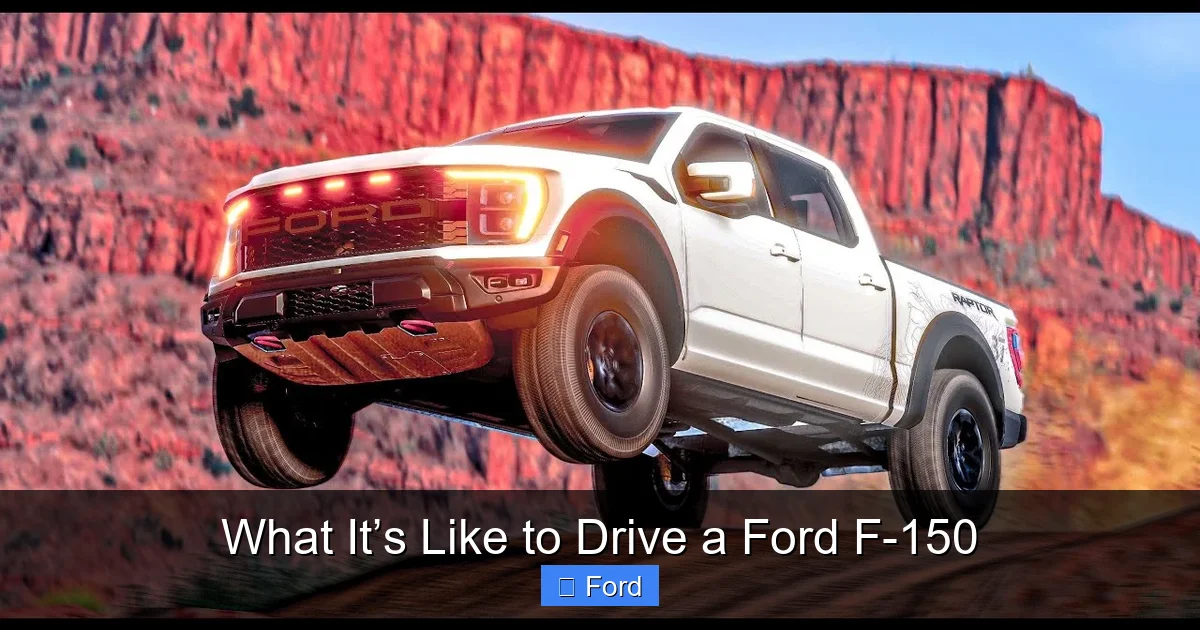
While the standard F-150 is a capable, comfortable road warrior, the Raptor variant is a different animal entirely. Driving a Raptor is an experience in controlled chaos. The long-travel, specially tuned suspension soaks up whoops and jumps that would destroy a standard truck. The high-output 3.5L EcoBoost V6 and 10-speed transmission are calibrated for desert runs and rock crawling. The availability of a Terrain Management System with modes like Baja and Rock Crawl means the truck actively manages throttle response, transmission shift points, and traction control for extreme conditions.
Even the standard F-150 with the 4×4 system and appropriate tires is more off-road capable than most owners will ever need. The system is intuitive, usually just a knob or button to engage 4-Hi or 4-Lo. The approach and departure angles are respectable, and the ground clearance is generous. The feeling of knowing your daily driver can confidently tackle a rutted forest service road or a snow-covered backcountry lane adds a profound layer of security and freedom to the ownership experience. For those who frequently face winter weather, looking into the best winter tires for Ford F-150 is not a suggestion; it’s a necessity to unlock the full potential of the 4×4 system.
The Ownership Equation: Costs, Maintenance, and Long-Term Value
Fuel, Tires, and Real-World Costs
Let’s talk numbers. Driving a full-size truck comes with costs. Fuel economy, while improved, is still a significant expense. The 2.7L and 3.5L EcoBoost engines are the efficiency leaders, often achieving 18-22 MPG combined in real-world mixed driving. The V8s and the Raptor drink more deeply. Tires are another major cost. The large, heavy-duty tires that come on many trims are expensive to replace. This is where research pays off. Understanding your driving needs—highway commuting vs. heavy towing vs. off-roading—will guide you to the right tire. For many, finding the best tires for Ford F-150 for their specific use case is a critical decision that impacts ride quality, noise, and capability.
Insurance premiums for an F-150 are typically higher than for a sedan. Maintenance costs are in line with other full-size trucks—oil changes are more expensive due to higher oil capacity, and brakes and tires will wear faster than on a lighter vehicle. However, the F-150’s parts are plentiful and the aftermarket is enormous, which helps keep repair costs competitive, especially when you consider its long-term durability.
Resale Value and Peace of Mind
This is where the F-150 truly justifies its footprint. It consistently holds some of the highest resale values in the automotive industry. Five years from now, your truck will be worth a significantly larger percentage of its original price than most other vehicles. This strong residual value is a direct result of its reputation for durability, its massive popularity, and the simple fact that people always need capable trucks. Ford’s commitment to a huge parts network and service infrastructure means you’re never far from a qualified technician or a needed component. From a battery replacement—where knowing the best battery for Ford F-150 for your model year is key—to major engine work, support is ubiquitous. This combination of strong ownership value and widespread support makes the total cost of ownership more palatable over the long run.
Conclusion: More Than a Truck, a Tool for Your Life
What it’s like to drive a Ford F-150 is a story of evolved expectations. It’s the story of a vehicle that has worked on farms and construction sites for decades but has also learned to be a comfortable, tech-savvy companion for the school run and a weekend adventure. It’s a truck that asks you to compromise very little. You trade some parking ease and fuel economy for unparalleled capability, space, and a sense of solid, confident security. The modern F-150 is not a crude tool; it’s a finely tuned, multi-purpose instrument. It’s the feeling of having a Swiss Army knife on wheels, ready for anything from hauling a load of lumber to taking the family on a cross-country trip. It’s the sound of a turbocharger spooling or a V8 idling, the sight of a vast, uncluttered dashboard, and the knowledge that whatever task you point it toward, it’s almost certainly up to the job. That is the enduring magic of the Ford F-150.
Frequently Asked Questions
Is the Ford F-150 a good daily driver?
Yes, absolutely. Modern F-150s, especially with the independent rear suspension and refined cabins, are exceptionally comfortable and manageable for daily commuting and errands. The high seating position and good visibility are major pluses for many drivers.
Which F-150 engine is best for towing?
The 3.5L EcoBoost V6 is generally considered the best for maximum towing capacity due to its high torque output at low RPMs. The 5.0L V8 is also excellent and offers a more traditional power feel. For the absolute highest numbers, look at the 6.2L V8 in the Raptor or specific trims, or the hybrid PowerBoost, which combines strong torque with improved efficiency.
How does the ride quality compare to older models?
It’s dramatically better. The switch to an independent rear suspension (IRS) starting with the 2015 model year was revolutionary. It eliminates the “bouncy” feeling of older solid-axle models, providing a much smoother, more car-like ride that absorbs bumps without compromising capability.
What is Pro Power Onboard and is it worth it?
Pro Power Onboard is an optional built-in generator system that provides up to 7.2 kW of AC power from outlets in the truck bed. It’s worth it if you regularly need tool power at a jobsite, want to run an RV, or need backup power for your home. For casual users, it’s an expensive option, but for the right person, it’s a transformative feature.
Are F-150s expensive to maintain?
Maintenance costs are typical for a full-size truck. Oil changes cost more due to larger oil capacity, and tires and brakes wear faster than on a smaller car. However, parts are plentiful and reasonably priced thanks to the F-150’s high volume. Long-term reliability is generally good, and strong resale values help offset ownership costs.
What are the biggest drawbacks of owning an F-150?
The main drawbacks are its size (parking, navigating tight spaces), fuel economy (even the best EcoBoost engines don’t match a sedan), and overall cost of ownership (fuel, tires, insurance). These are inherent trade-offs for the immense capability and space the truck provides.
