
How to Check Oil Level on Bmw

Checking your BMW’s oil level is a non-negotiable maintenance task that protects its high-performance engine from catastrophic wear. The method varies significantly by model year—older BMWs use a traditional dipstick, while most modern ones rely on the iDrive electronic system. Mastering this simple procedure ensures you always know your engine’s vital fluid status, preventing expensive repairs and maintaining peak performance. This guide walks you through both methods with clear, step-by-step instructions.
Key Takeaways
- Your BMW’s owner’s manual is the ultimate authority: It specifies the exact procedure, oil capacity, and grade for your specific model and year. Never guess.
- Engine warmth matters: For accurate readings, the engine should be warmed up and then turned off for 5-10 minutes, allowing oil to settle in the pan.
- Use only BMW-approved oil: The correct viscosity (like 0W-30 or 5W-30) and specification (BMW Longlife-04, etc.) are critical for engine longevity and warranty compliance.
- A low reading is a serious warning: Consistently low oil levels indicate leaks, burning oil, or other issues requiring immediate professional diagnosis.
- Electronic systems require patience: The iDrive oil level check can take 1-2 minutes as the system calculates the level; do not interrupt the process.
- Check for contamination: Clean oil is amber or light brown. Dark, gritty, or milky oil signals problems needing service.
- Regular checks prevent disasters: Make it a habit to check the oil at least once a month or before long trips.
📑 Table of Contents
- Why Checking Your BMW’s Oil Level is Absolutely Critical
- Understanding BMW’s Two Primary Oil Monitoring Systems
- Step-by-Step: Checking Oil with a Dipstick (For Applicable Models)
- Checking Oil Level via the iDrive System (For Modern Models)
- Common Mistakes That Lead to False Readings (And How to Avoid Them)
- When to Seek Professional Help: Beyond the Basic Check
- Conclusion: Empowerment Through Simple Maintenance
Why Checking Your BMW’s Oil Level is Absolutely Critical
Let’s be real. You didn’t buy a BMW for ordinary transportation. You bought it for the thrill of that inline-six roar, the precision of that steering wheel feedback, the sheer joy of piloting a machine engineered for excitement. But that engineering masterpiece, that high-revving, high-performance heart under your hood, has one fundamental, non-negotiable requirement: it must be bathed in the correct amount of pristine, high-quality oil at all times. Oil is its lifeblood. It lubricates, cools, cleans, seals, and protects against corrosion. Running an engine even slightly low on oil is like asking a world-class athlete to compete while severely dehydrated—it leads to rapid, catastrophic, and astronomically expensive damage.
This is where the simple act of checking your oil level comes in. It’s the single most important, quickest, and easiest piece of maintenance you can perform. For a BMW, it’s even more crucial due to the tight tolerances and high operating temperatures of modern German engineering. A consistent low reading isn’t just a “top it off” situation; it’s your car’s urgent SOS, telling you to investigate a leak, burn, or internal issue before your engine turns into a very expensive paperweight. Whether you drive a classic E30 or a brand-new G80 M3, knowing how to check oil level on BMW models is a core skill every owner must possess. It empowers you, saves you money, and ensures your driving pleasure remains uninterrupted.
Understanding BMW’s Two Primary Oil Monitoring Systems
Before you can check the oil, you need to know which system your BMW uses. BMW has evolved significantly over the decades, and this is reflected in how it monitors engine oil. There are two distinct camps: the traditional dipstick and the modern electronic system accessed via iDrive. Your model year and engine type are the deciding factors. Making a mistake here can lead to a false reading or even engine damage.
Visual guide about How to Check Oil Level on Bmw
Image source: i.ytimg.com
The Traditional Dipstick: A Tried-and-True Method
If you own an older BMW—generally models from the 1990s through the early-to-mid 2000s (like E36, E46, E39, early E60)—you almost certainly have a classic engine bay with a bright yellow or orange loop-handled dipstick. This is the simplest and most direct method. The dipstick is a calibrated metal rod that you physically insert into the oil pan. The oil clings to it, and the markings on the rod show you the level. It’s foolproof, instantaneous, and requires no electronics. Many enthusiasts prefer this method for its simplicity and tactile confirmation. However, BMW phased out the dipstick on most models starting around the mid-2000s in favor of a more “high-tech” electronic system, which we’ll cover next. If you’re unsure, a quick visual inspection of your engine bay will reveal a dipstick tube, usually near the front of the engine with a yellow cap.
The Electronic Oil Level Monitor via iDrive: The Modern Standard
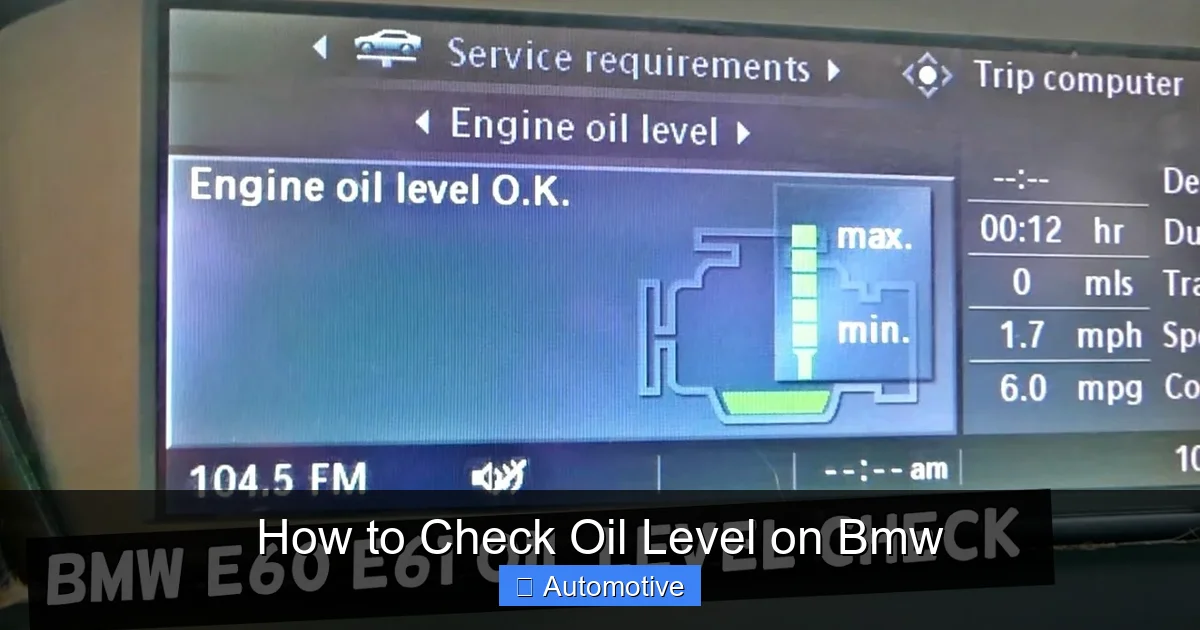
From the mid-2000s onward, BMW introduced a sensor-based electronic oil level monitoring system. This system uses a level sensor in the oil pan and calculates the exact volume based on engine tilt and temperature. The result is displayed on your vehicle’s central display screen, controlled via the iDrive knob (or iDrive 7/8 touch/controller in newer models). This is the system you’ll find on the vast majority of BMWs produced in the last 15 years, including all F-series (F30, F10, etc.) and G-series (G20, G30, G80, etc.) cars.
The process is menu-driven and takes about 60-90 seconds to complete. The car must be on level ground, and the engine must be at operating temperature for the most accurate reading. You navigate to the “Service” or “Vehicle Info” menu, select “Oil Level,” and the system will display a bar graph or a percentage, often with a “OK” or “Low” indicator. While it seems more complex, it’s actually very user-friendly once you know the path, and it eliminates the guesswork and potential mess of a dipstick. It is critically important to note: You cannot manually check the oil level on these models without the iDrive interface. There is no hidden dipstick. Attempting to find one will only lead to frustration.
Step-by-Step: Checking Oil with a Dipstick (For Applicable Models)
If your BMW has a dipstick, this is your method. It’s a physical, hands-on process that gives you immediate feedback. Accuracy depends entirely on following the steps precisely, especially regarding engine temperature and parking position.
Visual guide about How to Check Oil Level on Bmw
Image source: i.ytimg.com
Preparation: The Foundation of an Accurate Reading
The number one mistake people make is checking the oil when the engine is stone cold or immediately after a long drive. Both yield wildly inaccurate results. Oil needs to be warm (around 190-200°F / 88-93°C) to have the correct viscosity and have fully drained back into the oil pan. Here’s the perfect prep:
- Drive the car normally for at least 15-20 minutes. Get the engine up to full operating temperature. You’ll see the temperature gauge (if equipped) stabilize, and the coolant fan may cycle on.
- Park the car on a perfectly level surface. A slight incline can cause oil to pool to one side, giving a false high or low reading. A flat garage floor or driveway is ideal.
- Turn off the engine and wait 5-10 minutes. This is the crucial settling period. It allows the hot oil to drain completely from the upper engine galleries down into the oil pan where the dipstick measures it. Do not wait more than 20-30 minutes, as the oil may start to cool and contract slightly.
The Physical Check: A Detailed Walkthrough
Now, with your prepared car, it’s time to get your hands dirty—lightly.
- Locate the Dipstick: Open the hood. The dipstick is a long, thin metal rod with a loop or T-handle, usually colored bright yellow or orange for easy identification. It’s typically located near the front of the engine on the driver’s side (right side for LHD cars). If you’re unsure, your owner’s manual has a labeled engine bay diagram.
- Pull and Wipe: Pull the dipstick all the way out. Immediately wipe the entire end clean with a lint-free cloth or paper towel. You want a pristine surface for the next step.
- Reinsert Fully: Push the dipstick all the way back into its tube until it seats completely. Don’t just drop it; make sure it’s fully seated.
- Pull and Read: Pull the dipstick out again, this time holding it vertically. Look at the end, which will be coated with oil. There will be two notches, lines, or a cross-hatched area marked “MIN” (minimum) and “MAX” (maximum) or “F” (full) and “L” (low).
- Interpret the Level: The oil film should fall between these two marks. The ideal spot is right in the middle, but anywhere within the safe zone is acceptable. If the oil is below the MIN mark, you must add oil immediately. If it’s above MAX, you have too much oil, which can be just as damaging (causing aeration, foaming, and increased pressure). You’ll need to drain some.
Pro Tip: Always check the oil’s color and consistency at the same time. Clean BMW-approved oil should be a clear, amber or light golden brown. If it’s dark black, sludgy, or has a burnt smell, it’s overdue for a change. If it’s milky or looks like chocolate milk, you have a catastrophic coolant leak into the oil—stop the engine and call for a tow.
Checking Oil Level via the iDrive System (For Modern Models)
For the majority of BMWs on the road today, this is your only method. It’s a software-driven process that feels like you’re playing a video game, but the stakes are very real. The key is patience and following the on-screen prompts exactly.

Visual guide about How to Check Oil Level on Bmw
Image source: i.ytimg.com
Accessing the Oil Level Menu: The Correct Path
The exact menu path can vary slightly between iDrive generations (iDrive 6, 7, 8), but the logic is the same. You must perform this check with the engine warm, as described in the previous section.
- Start with the car on level ground, engine warm, and turned OFF. The ignition should be in the “ON” position (key in position 1 or press the start button without pressing the brake/clutch).
- Turn on the iDrive system. The central screen should light up.
- Navigate to the “Menu” or “Service” screen. This is often represented by a car icon or a wrench icon. On newer models, you might press the “MENU” button on the iDrive controller.
- Select “Vehicle Info” or “Service Indicators.”
- Find and select “Oil Level.” The system may now prompt you with instructions. It often says “Check oil level” or “Start check.”
- Press “OK” or “Start” to begin the measurement.
Important: During this 60-90 second check, do not press the accelerator, touch the brake, or turn off the ignition. The system needs the engine to be in a stable, idle state to calculate the level based on sensor data. Interrupting it will cause the check to fail or give an incorrect reading.
Decoding the Display: What You’ll See
Once the check completes, the screen will show you the oil level. The display varies:
- Bar Graph: A horizontal bar with “MIN” and “MAX” ends. The filled portion indicates your level. A green bar in the middle is good. A red or yellow bar near MIN is a warning.
- Percentage: Some models show a percentage (e.g., 85%). 100% is full. Below a certain threshold (often 70-80%), a warning may appear.
- Text Message: It may simply say “Oil level OK” or “Oil level low. Add 1.0 qt.” (or similar).
If the system indicates “Oil level low,” you must add the specified amount of the correct oil immediately. After adding oil, you will need to re-run the check to confirm the level is now within the safe zone. If the system shows “Oil level OK” but you suspect a problem (e.g., you see a leak), trust the system but investigate the leak anyway. If the system fails to complete the check or shows an implausible value, there may be a sensor fault, requiring a diagnostic scan by a professional.
Common Mistakes That Lead to False Readings (And How to Avoid Them)
Even with the right method, small errors can render your check useless or misleading. Here are the most frequent pitfalls and how to sidestep them.
Mistake 1: Checking on an Uneven Surface
This is a classic. Your garage floor might look level, but a slight slope toward a drain or a parked car on one side can skew the result. Oil is a fluid; it will flow to the lowest point of the pan. On a slope, the dipstick sensor (or the dipstick itself) will read the oil depth at its specific location, which will be lower if the car is tilted with that side downhill. Solution: Always use a known, perfectly level spot. If you’re on a hill, move to flatter ground before checking.
Mistake 2: Not Allowing Proper Settling Time
Impatience is the enemy of accuracy. Checking the oil right after shutting off a hot engine means oil is still distributed throughout the engine, not settled in the pan. The reading will be falsely low. Conversely, waiting too long (overnight) can cause the oil to cool and contract slightly, also giving a low reading. Solution: Stick to the 5-10 minute warm-engine-off window. This is the industry standard for a reason.
Mistake 3: Misreading the Dipstick Marks
Dipsticks can be confusing. Some have two separate holes, some have a cross-hatched area, some have “Add Oil” and “Full” lines. Wiping it poorly can leave a film that obscures the mark. Solution: Wipe the stick thoroughly and hold it against a white background (like your cloth) in good light. Read the top edge of the oil film, not the bottom. When in doubt, consult your manual’s diagram.
Mistake 4: Ignoring the “Service Indicator” or “Oil Life” Message
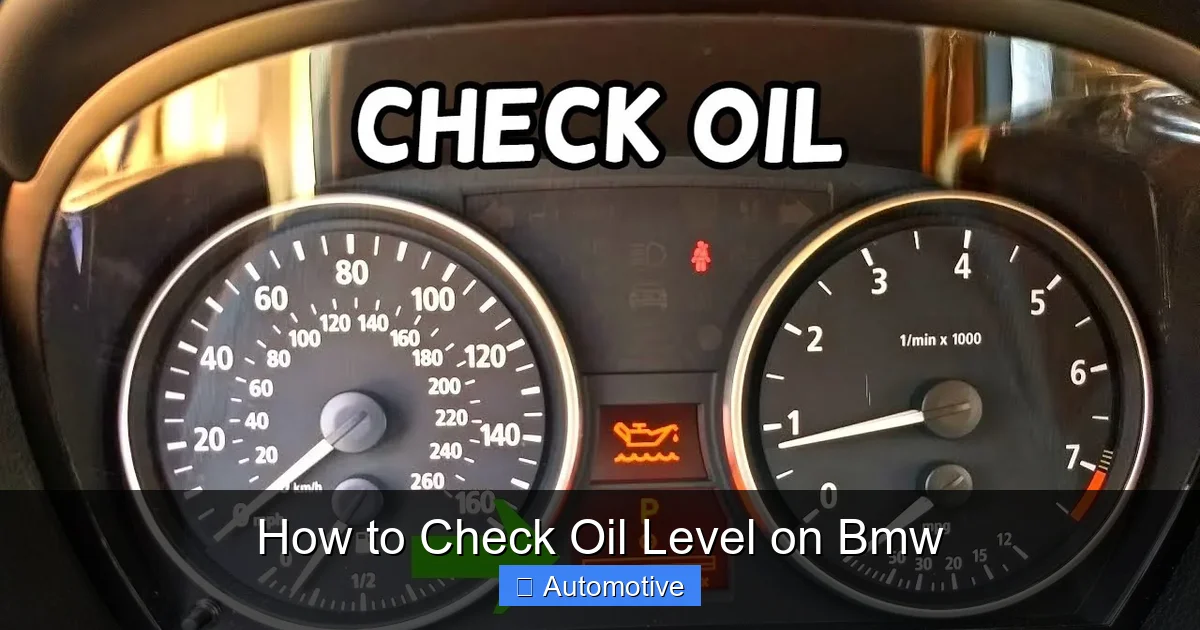
Many BMW drivers see the yellow oil service icon (a yellow oil can) on the dash and simply reset it without checking the actual level. This is a dangerous habit. The service indicator is a time/mileage reminder based on estimated oil life, not a direct oil level sensor. You could have a low oil level due to a leak and reset the light, lulling yourself into a false sense of security. Solution: Whenever the oil service light comes on, first check the actual oil level using the correct method. Only after confirming it’s full should you consider resetting the service interval after the oil change is performed. Understanding the difference between a low oil level warning and an oil service reminder is crucial for safe ownership.
When to Seek Professional Help: Beyond the Basic Check
Checking the oil level is diagnostic step one. What you find afterward dictates your next move. Not every situation is a DIY fix.
The Red Flags: What a Low or Contaminated Reading Means
If your check reveals a low oil level, your first step is to top it off with the correct oil to the MAX/full mark. This is an emergency measure to prevent damage. However, you must then address the root cause. Ask yourself:
- How fast is it consuming oil? If you added a quart and it’s low again in 500 miles, you have a significant problem.
- Is there an external leak? Look for fresh, wet oil spots under the car, around the valve cover gasket (a common BMW leak point), oil filter housing, or oil pan. A small drip might be a gasket; a large puddle is serious.
- Is the oil contaminated? Milky oil means coolant is mixing with it (head gasket failure, cracked block). Thick, sludge-like oil means it hasn’t been changed in ages and is breaking down. The smell of gasoline indicates a rich running condition or faulty injectors washing oil from cylinder walls.
Any of these signs, especially combined with low levels, means you need to get your BMW to a qualified specialist—preferably an independent shop familiar with German cars or a dealership—for a proper diagnosis. Driving with low or bad oil is a direct path to engine failure.
The Importance of Using the Correct Oil and Filter
This bears repeating because it’s so often ignored. BMW engines are designed for specific lubricants. Using the wrong weight (e.g., 10W-40 instead of 0W-30) or, worse, a generic oil without the BMW-required specifications (like BMW Longlife-04, LL-01, or LL-17 FE+) can cause premature wear, turbocharger damage, and even void your warranty. The “correct” oil is listed in your owner’s manual and on the oil cap. When you top off, use only what’s specified. For oil changes, insist on the correct filter (often a Mann, Mahle, or OEM BMW filter) and the correct oil quantity. A proper service is an investment in your engine’s health. If you’re unsure about the process, scheduling a professional oil change is always the safest bet.
Conclusion: Empowerment Through Simple Maintenance
Knowing how to check oil level on BMW is more than just a chore; it’s a fundamental act of ownership that connects you to your vehicle and safeguards your investment. It transforms you from a passive driver into an engaged caretaker of a precision machine. Whether you’re wielding a trusty dipstick on an E39 5-Series or navigating the iDrive menus on a brand-new X5, the principle is the same: confirm the lifeblood of your engine is at the proper level and in good condition. Make it a monthly ritual. Pair it with a quick coolant check—and if you ever need to learn about coolant leak repair costs for BMWs, that knowledge is just as vital. By mastering this simple check, you gain peace of mind, prevent thousand-dollar disasters, and ensure your BMW continues to deliver the driving experience you expect and deserve. Your engine will thank you with thousands of miles of reliable, exhilarating performance.
Frequently Asked Questions
Can I check my BMW’s oil level when the engine is completely cold?
No, for an accurate reading, the engine must be warmed up and then turned off for 5-10 minutes. A cold engine will show a falsely low level as oil hasn’t drained back into the pan.
How often should I check the oil in my BMW?
You should check the oil level at least once a month and before any long road trip. For high-performance driving or older models, checking every 1,000 miles is a wise precaution.
What does it mean if my BMW’s oil level is consistently low but there’s no visible leak?
This indicates the engine is burning oil, which is often a sign of internal wear like piston ring failure or valve guide seal issues. This requires immediate professional diagnosis to prevent severe engine damage.
My BMW doesn’t have a dipstick. Is the iDrive oil level reading reliable?
Yes, the electronic sensor system is very reliable when used correctly. Ensure the car is on level ground, the engine is warm, and you allow the full 60-90 second check to complete without interruption.
Can I use any 5W-30 oil in my BMW if I’m in a pinch?
No. You must use oil that meets BMW’s specific approvals (e.g., BMW Longlife-04, LL-01, LL-17 FE+). Using the wrong oil can damage sensitive components like turbochargers and catalytic converters. Always consult your owner’s manual.
I added oil because the iDrive showed it was low, but the light came back on after 500 miles. What now?
This confirms a significant oil consumption issue, likely from a leak or internal engine problem. Do not keep adding oil. Have the vehicle inspected by a BMW specialist immediately to find and repair the source of the loss.