
How Many Gallons of Gas Does a 2015 Toyota Camry Hold

The 2015 Toyota Camry comes equipped with a single, unified fuel tank capacity of 15.8 gallons across all its trim levels and engine options. This generous tank size is a key factor in its impressive driving range, often allowing for 400+ miles on a single fill-up under normal conditions. Understanding this capacity helps with trip planning, fuel budgeting, and knowing when that low fuel light truly means it’s time to find a pump.
Key Takeaways
- Universal Tank Size: Every 2015 Camry, from the base LE to the top-tier XSE V6, holds exactly 15.8 gallons of fuel.
- Range is King: With its combined EPA fuel economy ratings (up to 28 MPG combined), this tank provides a substantial driving range, typically between 350 and 450 miles.
- Reserve Fuel Exists: The “empty” indicator is not the absolute end; a small reserve (1-2 gallons) remains to prevent you from being stranded.
- Trim Doesn’t Change Capacity: Unlike some brands, Toyota does not offer different tank sizes for more powerful or luxurious Camry trims in this model year.
- Comparable to Rivals: Its tank size is very similar to main competitors like the Honda Civic and slightly larger than some, contributing to its family-sedan practicality.
- Maintenance Relevance: Knowing your tank capacity is useful for calculating accurate fuel additives or when diagnosing fuel system issues, much like knowing your oil capacity is for engine maintenance.
📑 Table of Contents
- The Simple Answer: It’s 15.8 Gallons
- Why Does a 15.8-Gallon Tank Matter? The Range Equation
- Factors That Change Your *Actual* “Miles to Empty”
- How It Compares: Camry vs. The Competition
- Practical Tips for Your 15.8-Gallon Camry
- Maintenance Connections: Why Tank Size is More Than a Number
- Conclusion: The Perfect Balance for a Family Sedan
The Simple Answer: It’s 15.8 Gallons
If you’re looking for a straight, no-fuss number, here it is: the 2015 Toyota Camry has a fuel tank capacity of 15.8 gallons. That’s it. There’s no need to check the VIN, no need to compare window stickers between different dealers, and certainly no need to guess based on the model year. For the entire 2015 lineup, whether you chose the fuel-efficient 4-cylinder or the more powerful V6, Toyota installed the exact same size fuel tank.
This consistency is a hallmark of Toyota’s engineering philosophy for this generation. They designed the Camry as a practical, no-surprises family sedan. A single tank size simplifies manufacturing, parts inventory, and—most importantly for you—owner expectations. You don’t have to wonder if the sportier SE or XSE trim has a smaller tank for packaging reasons; it doesn’t. The 15.8-gallon figure is the one and only answer for the 2015 model year in the United States.
Where Does This Number Come From?
This specification isn’t a marketing guess; it’s an exact engineering measurement. The “15.8 gallons” is the tank’s total capacity, meaning the absolute maximum volume of liquid it can hold when filled to the brim, including the filler neck and any vapor headspace. You’ll see this number in every official Toyota specification sheet, the owner’s manual, and on the fuel filler door itself (which often says “Capacity: Approx. 15.8 gal”).
It’s important to distinguish this from the usable fuel. Due to design tolerances, fuel pump placement, and the need for an expansion chamber, you will almost never be able to pump a full 15.8 gallons from “empty” to “full” at the pump. Typically, the usable capacity is about 0.5 to 1 gallon less. Your fuel gauge, which reads “F” to “E,” is calibrated to this usable range, not the absolute maximum.
Why Does a 15.8-Gallon Tank Matter? The Range Equation
Knowing the tank size is just the first piece of the puzzle. The real-world magic happens when you combine that capacity with the car’s fuel efficiency. This is where the 2015 Camry truly shines as a road-trip warrior. Let’s break down the math.

Visual guide about How Many Gallons of Gas Does a 2015 Toyota Camry Hold
Image source: appgecet.co.in
The 2015 Camry came with two primary engine choices:
- 2.5L 4-Cylinder (Most Common): EPA ratings are 25 MPG city / 35 MPG highway / 28 MPG combined.
- 3.5L V6: EPA ratings are 21 MPG city / 31 MPG highway / 25 MPG combined.
Using the conservative combined MPG figure and the full 15.8-gallon tank, here’s your theoretical maximum range:
- 4-Cylinder Model: 28 MPG combined x 15.8 gallons = ~442 miles.
- V6 Model: 25 MPG combined x 15.8 gallons = ~395 miles.
Important Reality Check: These are ideal, laboratory-style numbers. Real-world range depends heavily on your driving style, terrain, vehicle load, and weather. A more realistic, achievable range for daily driving is:
- 4-Cylinder: 350 – 400 miles per tank.
- V6: 320 – 370 miles per tank.
This substantial range means most drivers can go a full week or more without visiting a gas station, a huge convenience factor that families and commuters deeply appreciate. It also makes the Camry a strong contender for anyone comparing midsize sedans, where SUVs like the RAV4 might have a larger tank but a lower MPG, resulting in a similar overall range.
Factors That Change Your *Actual* “Miles to Empty”
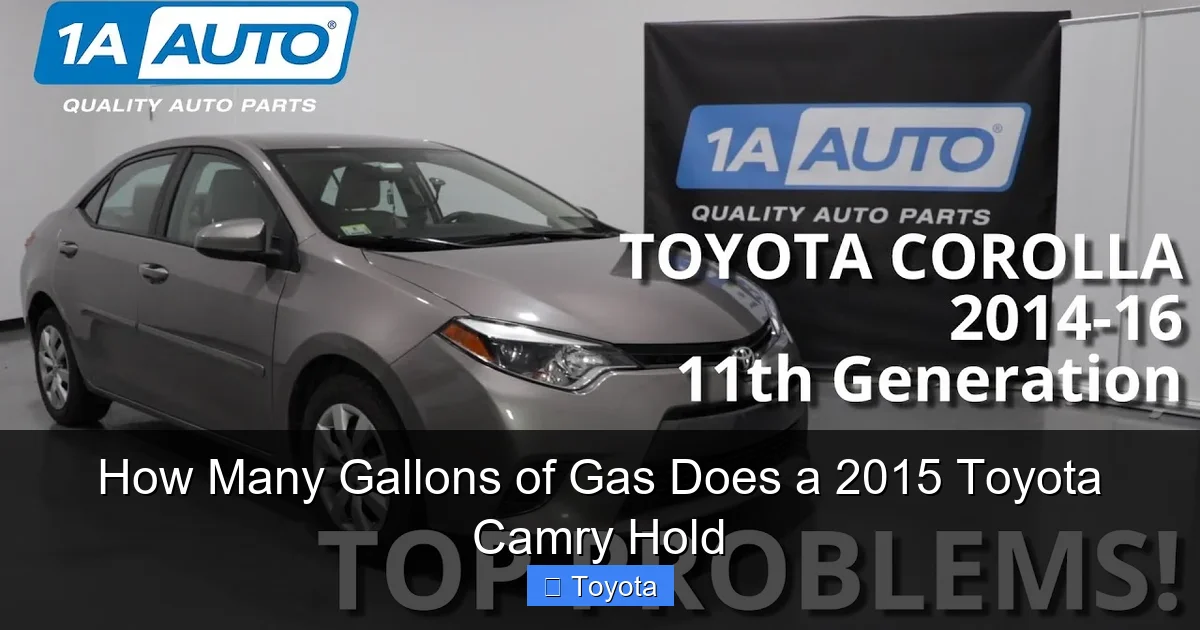
Your car’s computer displays a “Miles to Empty” estimate that constantly updates. This number is a dynamic calculation based on your recent driving history, not a fixed value based on the 15.8-gallon tank. Several factors cause this number to swing wildly from one fill-up to the next.
Visual guide about How Many Gallons of Gas Does a 2015 Toyota Camry Hold
Image source: i.ytimg.com
Driving Style: The #1 Influencer
Are you a gentle accelerator and braker, maintaining steady speeds on the highway? Your MPG—and thus your range—will be at its best. Are you quick off the line, speeding up to red lights, and driving 75 mph on the interstate? Your MPG can drop by 5-10% or more, significantly shrinking your effective range from the same 15.8 gallons. That gentle, anticipatory driving style is the single best way to maximize every drop in your Camry’s tank.
Terrain and Traffic: The Uncontrollables
Driving in the mountains? Constant uphill climbs will drink fuel much faster than flat highway cruising. Stuck in stop-and-go city traffic? The engine is working hard at low efficiency, and you’re burning fuel without covering many miles. Your “Miles to Empty” will plummet in these conditions. Conversely, a long, flat, open-road cruise is where the Camry’s efficiency soars and you get closest to that 400+ mile potential.
Vehicle Load and Accessories
Loading up the Camry with five people and a rooftop carrier full of luggage for a vacation? That extra weight increases rolling resistance and engine load, reducing fuel economy. Using the air conditioning on max in summer or the heater on high in winter also places an extra load on the engine, trimming your range by a few percent. It’s a small effect, but it adds up over a full tank.
The “Reserve” Mystery
When your low fuel light comes on, you’re not running on fumes. There is a deliberate reserve fuel supply. Toyota engineers this reserve (typically 1.5 to 2 gallons) to ensure you have enough fuel to safely reach a gas station after the warning, accounting for variations in fuel pump calibration and driving conditions. So, when the light illuminates, you likely still have 15-30 miles of driving left in the tank. However, it’s unwise to test this limit regularly, as running consistently low can overheat the in-tank fuel pump, which relies on gasoline for cooling and lubrication.
How It Compares: Camry vs. The Competition
In the midsize sedan segment, a 15-16 gallon tank is the sweet spot. Let’s see how the 2015 Camry’s 15.8-gallon tank stacks up against some key rivals and related vehicles.

Visual guide about How Many Gallons of Gas Does a 2015 Toyota Camry Hold
Image source: motortrend.com
Head-to-Head with the Honda Civic
The 2015 Honda Civic, a direct competitor in the popular compact/midsize overlap, had a fuel tank capacity of 12.4 gallons for most trims. This is a significant 3.4-gallon difference. While the Civic often achieves slightly higher MPG figures (especially with its efficient 4-cylinder), the Camry’s much larger tank gives it a decisive edge in total driving range. You’d be stopping for gas more frequently in the Civic on a long cross-country trip. This size difference highlights the Camry’s positioning as a larger, more road-trip-oriented family car.
Within the Toyota Family
Looking at other Toyotas, the tank size varies greatly by vehicle class and purpose. The compact Toyota Corolla of the same era held about 13.2 gallons. The midsize SUV Toyota RAV4 had a 14.5-gallon tank. The larger Toyota Highlander SUV holds a massive 17.2 gallons. The Camry’s 15.8-gallon tank sits perfectly between its compact siblings and its larger SUV cousins, optimized for the sedan’s blend of passenger space and efficiency.
Why the Difference? It’s All About Packaging
Why does a Highlander need 17+ gallons while a Camry needs 15.8? It comes down to vehicle architecture. SUVs have a larger, more square-shaped underbody that can accommodate a bigger, flatter tank. They also have significantly worse fuel economy, so a larger tank is necessary to achieve a competitive range. The Camry’s tank is shaped to fit within the sedan’s floor plan, often running along the center tunnel under the rear seats, without compromising cabin or trunk space. That 15.8-gallon size is the result of careful engineering to balance range, weight, cost, and interior packaging.
Practical Tips for Your 15.8-Gallon Camry
Knowing your tank is 15.8 gallons is useful information. Here’s how to apply it in everyday life.
1. Master the “Trip Odometer” Method for Accurate MPG
Don’t rely solely on the car’s average MPG display, which can be optimistic. For a true picture, do this: Fill the tank completely (until the pump clicks off). Reset your trip odometer to zero. Drive normally until the tank is nearly empty (or you need to refill). At the next fill-up, note how many gallons it took to refill the tank. Divide the miles on your trip odometer by the gallons added. This is your real-world MPG. Now, multiply that by 15.8 to get your personal, accurate driving range. You’ll be amazed at the difference between the EPA number and your own results based on your driving habits.
2. Calculate Your Cost Per Fill-Up and Per Mile
This is simple but powerful for budgeting. At $3.50 per gallon, a full tank of 15.8 gallons costs about $55.30. If your real-world MPG is 28, your cost per mile is $3.50 / 28 = about 12.5 cents per mile. This calculation helps you understand the true cost of any trip and compare it to other vehicles or transportation options.
3. Plan Long Trips with Confidence (and a Safety Margin)
On a highway trip, your Camry’s range is its superpower. If your navigation shows a 350-mile stretch with few services, you can likely make it on one tank. However, always plan to refuel when you have about 1/4 of a tank remaining (roughly 4 gallons left). This gives you a 100+ mile buffer for unexpected detours, traffic jams, or a gas station that’s out of order. It also protects your fuel pump from overheating.
4. Understand What “Miles to Empty” Really Means
That number is a predictor, not a guarantee. It’s based on your last 15-20 minutes of driving. If you’ve been stuck in city traffic, it will be low. If you just got onto a flat highway, it will jump up. Use it as a general guide, but always use the fuel gauge itself (the needle or bars) as your primary indicator. When it’s hovering at or below the 1/4 mark, start looking for a station.
5. Don’t “Top Off” for Better Mileage
After the pump clicks off initially, adding more fuel by slowly squeezing the handle (“topping off”) is not recommended. Modern cars have evaporative emission systems designed to handle a specific volume. Forcing extra fuel can damage the charcoal canister and cause check engine lights. It also doesn’t give you meaningful extra range—you’re just filling vapor space that the system expects to be there. Trust the pump’s automatic shut-off.
Maintenance Connections: Why Tank Size is More Than a Number
Your fuel tank isn’t an isolated component; it’s part of a system. Knowing its capacity helps in understanding related maintenance and troubleshooting.
The In-Tank Fuel Pump: Cooled by Fuel
The electric fuel pump is submerged in gasoline at the bottom of your 15.8-gallon tank. This is intentional—the gasoline acts as a coolant and lubricant for the pump. This is why consistently driving with less than 1/4 tank of fuel is discouraged. It can cause the pump to overheat and fail prematurely, leading to a costly replacement that involves dropping the tank. Keeping a reasonable amount of fuel in your tank protects this critical component.
Fuel Quality and Additives
When using fuel system cleaners or additives, the dosage instructions are often based on tank size. For a 15.8-gallon tank, you’ll typically use one full bottle of a standard concentrated additive. Pouring in a product meant for a 20-gallon tank won’t make it work better; it could potentially cause sensor issues. Conversely, using a “large tank” formula in your Camry might not provide the full intended concentration of cleaning agents.
Diagnosing Fuel Delivery Issues
If you experience sputtering, hesitation, or difficulty starting, a technician might ask about your fuel level habits. They might also perform a “fuel volume test,” where they measure exactly how much fuel the pump can deliver in a set time. Knowing the tank’s total and usable capacity provides a baseline for such diagnostics. It’s similar to how knowing your engine’s oil capacity is crucial for a proper oil change.
Conclusion: The Perfect Balance for a Family Sedan
The 2015 Toyota Camry’s 15.8-gallon fuel tank is more than just a specification—it’s a core component of its identity as a dependable, hassle-free family car. It represents a carefully engineered balance. It’s large enough to provide excellent range and minimize gas station stops, a feature families on road trips and commuters with long drives truly value. Yet, it’s not so large that it adds excessive weight or compromises the sedan’s sleek design and interior space.
This single, universal tank size across all trims simplifies ownership. There are no surprises or special cases. Whether your Camry is a base model commuter or a V6-powered touring sedan, you fill it up the same way and expect the same fundamental range. By understanding this capacity, calculating your real-world MPG, and following smart driving and maintenance habits, you can maximize the utility and efficiency of every single one of those 15.8 gallons. It’s this kind of thoughtful, user-focused engineering—paired with legendary Toyota reliability—that has made the Camry a perennial best-seller. So the next time you pull up to the pump, you’ll know exactly what you’re putting in and just how far it’s likely to take you.
Frequently Asked Questions
Does the 2015 Camry have a different tank size for the 4-cylinder and V6 models?
No. For the 2015 model year, all Camry trims—including both the 2.5L 4-cylinder and the 3.5L V6—use the exact same 15.8-gallon fuel tank. The tank size is not dependent on the engine choice.
How far can I really drive after the low fuel light comes on?
You should not make a habit of this. When the low fuel light illuminates, you typically have a reserve of about 1.5 to 2 gallons remaining, which translates to roughly 30-50 miles of driving under normal conditions. However, this is a safety margin, not a suggestion. Consistently driving with a very low tank can overheat and damage the in-tank fuel pump.
Is it bad to fill the tank all the way to 15.8 gallons every time?
No, it’s not bad. Filling the tank completely is fine and ensures you get the maximum range. However, you should stop filling when the pump automatically clicks off the first time. “Topping off” by continuing to squeeze the handle can force fuel into the evaporative emission system, potentially causing damage and check engine lights.
How does the Camry’s tank size compare to the 2015 Honda Accord?
The 2015 Honda Accord had a fuel tank capacity of 17.2 gallons for most 4-cylinder models and 17.3 gallons for V6 models. This is about 1.4 gallons larger than the Camry’s tank. However, the Camry’s slightly higher EPA highway MPG (35 vs. Accord’s 33 for 4-cylinders) means their overall highway range is very similar.
Why does my “Miles to Empty” display change so much even with a full tank?
The “Miles to Empty” is a real-time prediction based on your recent average MPG. If you just drove 50 miles on a flat highway, your recent MPG will be high, and the estimate will be long. If you then get stuck in city traffic for 20 miles, your recent MPG drops, and the estimate will decrease rapidly, even though you have the same amount of fuel in your 15.8-gallon tank.
Can I use the same fuel tank capacity information for a 2014 or 2016 Camry?
Yes, with high confidence. The 2014, 2015, and 2016 model years of the current-generation (XV50) Camry all share the same platform and body design. They all use the identical 15.8-gallon fuel tank. This consistency extends back to the 2012 model year and forward to the 2017 model year for this generation.
