
What Is Covered in a Jeep Powertrain Warranty

A Jeep powertrain warranty covers the core components that make your vehicle move: the engine, transmission, and drivetrain (like axles and differentials). It typically does not cover wear-and-tear parts, routine maintenance, or damage from misuse. Coverage length varies by model year and whether you have a new or certified pre-owned Jeep. Always read your specific warranty booklet for exact terms.
Key Takeaways
- Core Components: The warranty covers the engine, transmission/transfer case, and drive system (axles, differentials, prop shafts).
- What’s NOT Covered: Wear items (brakes, tires, belts), maintenance services, and damage from neglect, accidents, or improper use are excluded.
- Duration Varies: New Jeep warranties typically offer 5 years/60,000 miles. Certified Pre-Owned (CPO) warranties are often shorter, like 7 years/100,000 miles from original sale.
- Maintenance is Key: Failing to follow the recommended maintenance schedule in your owner’s manual can void your powertrain warranty coverage.
- Transferable: The basic powertrain warranty on a new Jeep transfers to subsequent private owners, but CPO warranties often do not.
- Compare Brands: Warranty lengths and coverages differ significantly between brands; for example, Nissan’s powertrain warranty may have different terms than Jeep’s.
- Know Your Limits: There is almost always a deductible per repair visit, and some components have different warranty periods (e.g., emissions parts).
📑 Table of Contents
- Introduction: The Heart of Your Jeep’s Protection
- What Exactly is the Powertrain? Defining Covered Components
- The Critical “What’s NOT Covered” List: Avoiding Costly Surprises
- How Long Does Coverage Last? New vs. Certified Pre-Owned
- Making a Claim: The Process and Your Responsibilities
- Maximizing Your Warranty: Proactive Tips for Jeep Owners
- Conclusion: Your Peace of Mind on the Road
Introduction: The Heart of Your Jeep’s Protection
So, you’ve got a Jeep. Maybe it’s a new Grand Cherokee L, a rugged Wrangler Rubicon, or a reliable Compass. You love its capability, its style, and its freedom. But like any complex machine, it has parts that work incredibly hard. The powertrain—the system that generates power and delivers it to the wheels—is the absolute heart of your Jeep’s performance. When something goes wrong there, it’s not just an inconvenience; it can be a major, wallet-draining repair.
This is where the Jeep powertrain warranty comes in. It’s your manufacturer’s promise to stand behind those critical, expensive components for a defined period. But what exactly does “powertrain” mean? What’s included? And perhaps more importantly, what’s left out? Many Jeep owners assume it covers everything under the hood, but that’s a costly misconception. Understanding the precise scope of this warranty is crucial for making informed decisions about maintenance, repairs, and even your next vehicle purchase. This guide will break it down, piece by piece, in plain language.
Think of this article as your decoder ring. We’ll explore the fine print, highlight common exclusions that surprise people, and give you actionable tips to keep your warranty valid and your Jeep running strong. Whether you’re a new owner reviewing your paperwork or a seasoned driver wondering about coverage on an older model, this comprehensive look at the Jeep powertrain warranty will equip you with the knowledge you need.
What Exactly is the Powertrain? Defining Covered Components
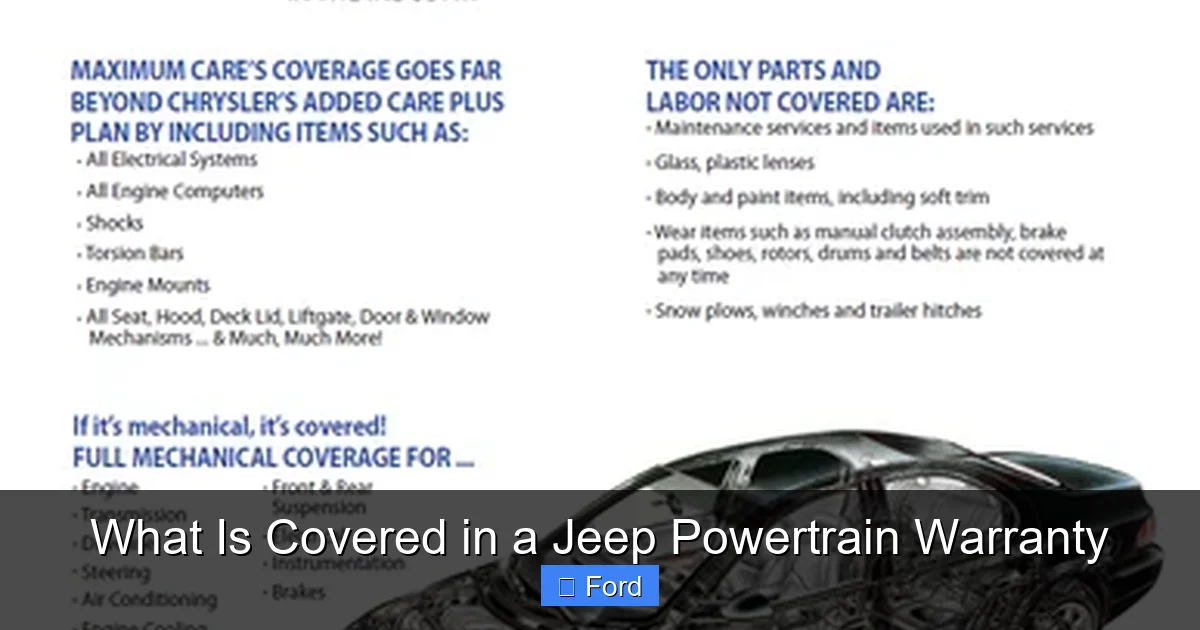
Before we talk about what’s covered, we must be crystal clear on what “powertrain” means in the context of a factory warranty. It’s not the entire car. It’s the core propulsion system. For a Jeep, this universally includes three major assemblies and everything directly attached to them that transmits power. Let’s pop the hood and the undercarriage to see what’s inside the warranty bubble.
Visual guide about What Is Covered in a Jeep Powertrain Warranty
Image source: factorywarrantylist.com
The Engine: More Than Just a Block
The engine is the powerhouse. Under the Jeep powertrain warranty, coverage extends to all of its internally lubricated parts. This means:
- Engine Block and Cylinder Heads: The main casting and its critical components.
- Internal Parts: Pistons, rings, rods, bearings, camshaft, crankshaft, valves, and valve springs.
- Timing System: The timing chain or belt (if not considered a maintenance item), tensioners, and gears.
- Oil Pump, Water Pump, and Fuel Pump: These essential circulation pumps are covered.
- Engine Mounts: The parts that secure the engine to the frame.
- Manifolds: Exhaust and intake manifolds.
- Turbocharger/Supercharger: If your Jeep is equipped with one (like the 2.0L turbo in many Wrangler 4xe models), it is part of the engine assembly and is covered.
Important Note: While the water pump is covered, the coolant itself and the hoses connecting it are typically considered maintenance items and are not covered. Similarly, the engine oil and filter are your responsibility.
The Transmission and Transfer Case: Shifting Power
This is where power gets managed and sent on its journey. Coverage includes:
- Transmission Case and Internal Parts: All gears, shafts, bearings, clutches, torque converter (in automatics), and the valve body.
- Transfer Case (4×4 Models): This is critical for Jeeps. The entire transfer case assembly, including its chains, gears, and shift mechanism, is covered as part of the drivetrain. This is what engages 4WD.
- Transmission and Transfer Case Mounts: Like engine mounts, these are included.
For manual transmissions, the clutch disc and pressure plate are a gray area. They are often considered wear items and may have a shorter warranty period or be excluded from the basic powertrain warranty. Always check your specific booklet. For automatics, the software that controls shifting is also covered.
The Drivetrain: Getting Power to the Ground
This is the final leg of the journey, from the transfer case to the wheels. It includes:
- Front and Rear Axles (Axle Housings): The main housing units.
- Differentials (Front & Rear): All internal gears, bearings, and spider gears within the differential carrier.
- Drive Shafts (Prop Shafts): The spinning shafts that connect the transfer case to the front and rear differentials.
- Constant Velocity (CV) Joints and U-Joints: These flexible joints that allow for suspension movement are covered, but the boots that protect them are often considered wear/maintenance items. A torn CV boot leading to joint failure might not be covered if it’s deemed a result of neglected maintenance.
- Four-Wheel Drive / All-Wheel Drive Components: This includes the clutch packs and actuators in systems like Jeep’s Quadra-Trac or Rock-Trac.
A Quick Comparison: While this structure is standard for most American manufacturers, specifics can differ. For instance, you might want to see how Nissan’s powertrain warranty outlines its coverage for similar components on its trucks and SUVs to understand industry norms.
The Critical “What’s NOT Covered” List: Avoiding Costly Surprises
Knowing what’s included is only half the battle. The other half is understanding the exclusions. The Jeep powertrain warranty is not a blanket policy for everything mechanical. It has clear boundaries. Voiding your warranty through misunderstanding is a common and expensive mistake. Here’s what you almost certainly cannot claim under this warranty.
Visual guide about What Is Covered in a Jeep Powertrain Warranty
Image source: chrysler-factory-warranty.com
Wear and Tear Items: The Obvious (and Not-So-Obvious)
These are parts designed to wear out over time and require periodic replacement. They are explicitly excluded. This list includes:
- Brake Pads, Rotors, Calipers: Entire braking system.
- Tires and Wheels.
- Batteries.
- Wiper Blades and Refills.
- Bulbs (Headlights, Taillights, etc.).
- Clutch Disc and Pressure Plate (in manual transmissions, often a separate limited warranty).
- CV and U-Joint Boots (as mentioned earlier).
- Belts and Hoses (serpentine, coolant, heater, etc.).
- Shock Absorbers and Struts.
- Steering Components: Tie rod ends, ball joints, etc., are part of the suspension/steering system, not the powertrain.
The logic is sound—these are consumables. But the line can blur. For example, a failed engine mount is covered. But if that failure is caused by a severely neglected oil change leading to engine damage, the entire claim could be denied. Cause and effect matter.
Maintenance and Services: Your Responsibility
The warranty does not cover the services needed to keep the powertrain healthy. This is your ongoing duty. Skipping these is the #1 way to void your warranty. Excluded services include:
- Oil Changes and Filter Replacements.
- Tire Rotations.
- Fluid Changes: Transmission fluid, differential fluid, transfer case fluid, coolant, and brake fluid.
- Spark Plugs and Ignition Coils.
- Air Filter and Cabin Filter Replacements.
Pro Tip: Keep every single maintenance receipt, no matter where you get the work done (dealership, independent shop, or yourself with documented parts). In the event of a dispute, your service records are your primary evidence that you upheld your end of the warranty bargain. Use a simple spreadsheet or folder.
Damage from Misuse, Neglect, or Alteration
This is a broad exclusion that protects the manufacturer from paying for driver-inflicted damage. It includes:
- Overheating: From a broken radiator hose, failed thermostat, or towing beyond capacity.
- Contaminated Fluids: Using the wrong fluid, or fluids that have become severely degraded due to lack of service.
- Flood or Water Damage.
- Racing or Competitive Use.
- Aftermarket Modifications: This is huge for Jeep owners. Installing a performance chip/tuner, a lift kit that changes driveline angles, larger tires without proper gearing/recalibration, or a non-stock engine can void your powertrain warranty on affected components. The dealer must prove the modification directly caused the failure, but it’s a major risk.
- Accidents and Collisions: These are covered by your auto insurance, not the warranty.
For example, if you install a 4-inch lift and 37-inch tires on your Wrangler and then suffer a driveshaft vibration that cracks the transfer case, Stellantis (Jeep’s parent company) will likely deny the claim, citing the modification as the cause.
How Long Does Coverage Last? New vs. Certified Pre-Owned
Duration is not one-size-fits-all. It depends entirely on whether you’re looking at a brand-new Jeep from a dealership or a Certified Pre-Owned (CPO) vehicle. The clock and mileage start from a different point in each scenario.
Visual guide about What Is Covered in a Jeep Powertrain Warranty
Image source: d217qqw9cv4mkx.cloudfront.net
New Jeep Powertrain Warranty: The Baseline
For all new 2024 (and recent model year) Jeep vehicles sold in the United States, the basic powertrain warranty is:
5 Years / 60,000 Miles, whichever comes first.
This is a limited warranty. It begins on the date the vehicle is first sold to a retail customer. So, if you buy a new Jeep in January 2024, your powertrain coverage expires in January 2029 or when the odometer hits 60,000 miles, whichever milestone is reached first. This is the standard across the Stellantis portfolio (Chrysler, Dodge, Ram, Jeep).
Important Nuance: Certain components may have different coverage periods. For example, federal emissions-related powertrain parts (like the catalytic converter) are often warrantied for 8 years/80,000 miles. Always check your warranty guide for these specifics.
Jeep Certified Pre-Owned (CPO) Warranty: The Extension
When you buy a Jeep that has been certified through the official Jeep CPO program, you’re getting an additional layer of protection. The CPO program includes a limited powertrain warranty that supplements any remaining new car warranty.
The standard Jeep CPO Powertrain Limited Warranty is:
7 Years / 100,000 Miles from the original in-service date of the vehicle.
Let’s break that down with an example. You’re looking at a 2022 Jeep Grand Cherokee that was first sold new in June 2022 and has 30,000 miles on it today. The original new car powertrain warranty would expire in June 2027 or at 60,000 miles. By buying it as a CPO vehicle, the powertrain warranty is now extended to run until June 2029 (7 years from original sale) or 100,000 miles—giving you an extra 40,000 miles of coverage beyond the original term.
Key CPO Requirements: The vehicle must pass a rigorous 150+ point inspection, be less than 7 model years old with under 70,000 miles, and include a vehicle history report. The CPO warranty is also transferable to subsequent private owners for a fee, which can boost resale value.
Transferability: Does It Stay With the Jeep?
Yes, with a catch. The basic new car powertrain warranty on a Jeep automatically transfers to any subsequent private owner without charge. If you sell your 2020 Gladiator with 40,000 miles, the new owner gets the remaining 20,000 miles of powertrain coverage.
The CPO powertrain warranty is also transferable, but typically requires a fee and paperwork to be completed by the new owner within a short window (e.g., 30 days) after the sale. This is a valuable selling point.
Making a Claim: The Process and Your Responsibilities
So, you suspect a covered powertrain failure. Your engine is making a knocking sound, or your transmission is slipping. What now? The claims process is straightforward but requires your active participation.
Step 1: Immediate Action and Diagnosis
At the first sign of trouble, stop driving the vehicle if it’s safe to do so. Continuing to operate a vehicle with a known mechanical issue can cause further, non-covered damage. Have the vehicle towed to an authorized Jeep dealership. This is critical. Having a dealership technician diagnose the problem creates a direct link to the manufacturer. An independent shop’s diagnosis might be questioned later.
The dealership will run diagnostic codes, perform inspections, and determine the likely cause of failure. They will then contact Stellantis (via their warranty portal) to get approval for the repair. This is called a “warranty authorization.”
Step 2: Understanding the Deductible
For the basic Jeep powertrain warranty, there is no customer deductible for covered repairs. The manufacturer pays the full authorized labor and parts cost. This is a major benefit compared to some extended warranties or other brands’ basic warranties which may have a deductible. However, always confirm this in your specific contract, as terms can change.
For the CPO warranty, there is also typically no deductible for powertrain repairs. The main cost to you would be any non-covered services performed at the same time (like an oil change) or a diagnostic fee if the problem is found to be non-warranty related.
Step 3: Disputes and Denials
If a claim is denied, the dealership will receive a “warranty denial code” with a reason. Common reasons include “lack of maintenance,” “outside influence” (like aftermarket parts), or “wear item.” You have the right to appeal. Your service records are your best weapon here. If you can prove the required maintenance was performed on schedule, you can challenge a “neglect” denial. It’s also wise to request, in writing, the specific evidence the dealer or manufacturer used to reach the denial conclusion.
Remember, the warranty is a legal contract. The burden of proof for denial often lies with the manufacturer to show that the failure was caused by an excluded event.
Maximizing Your Warranty: Proactive Tips for Jeep Owners
A warranty is a safety net, not a license to ignore your vehicle. Proactive care ensures the net is there when you need it and helps you avoid disputes.
1. Be a Documentation Master
As emphasized before, keep every receipt. Create a digital folder on your phone or computer. Scan paper receipts. Note the date, mileage, service performed, and shop name. For DIY oil changes, keep the dated receipts for the oil, filter, and any parts used. A well-organized record is your strongest defense against a “failure to maintain” claim.
2. Follow the Manufacturer’s Schedule, Religiousy
Your Jeep’s owner’s manual is the bible for warranty compliance. It lists the exact maintenance intervals for engine oil, transmission fluid, differential fluid, etc. Use genuine MOPAR fluids or their exact equivalents as specified. Do not “stretch” intervals. The “Severe Duty” schedule (for mostly short trips, dusty conditions, extreme temps) is often the more prudent one to follow, even if you don’t think your driving is “severe.”
3. Think Twice Before You Modify
This is the biggest pitfall for the Jeep community, which loves to customize. Before installing any performance part, lift kit, or larger tire, research its potential impact on warranty coverage. The Magnuson-Moss Warranty Act (a federal law) states that a dealer must prove the modification caused the failure to deny a claim. So, if you put on bigger tires and your radio stops working, that’s likely unrelated and still covered. But if those bigger tires cause premature failure of the front axle shaft due to increased stress and changed angles, that claim will probably be denied. When in doubt, consult with a knowledgeable service manager at your dealership before modifying.
4. Address TSBs and Known Issues
Manufacturers issue Technical Service Bulletins (TSBs) when they identify a recurring, non-safety-related problem with a component. These are not recalls; they’re suggested repair procedures. Often, a TSB-related repair will be covered under warranty even if the vehicle is out of the standard bumper-to-bumper warranty, as long as it’s within the powertrain warranty period. Use online Jeep forums or NHTSA.gov to see if your specific model year and engine have any common TSBs. Knowing this can help you advocate for a covered repair.
5. Understand the “As-Is” Nature of Used CPO Vehicles
When buying a CPO Jeep, remember you’re buying a used car with a warranty, not a new one. The inspection is good, but not infallible. Get an independent pre-purchase inspection (PPI) by a trusted mechanic in addition to relying on the CPO certification. They might find issues the dealer’s inspector missed. Also, review the CPO warranty’s specific exclusions—they can sometimes be slightly different from the new car warranty.
Conclusion: Your Peace of Mind on the Road
The Jeep powertrain warranty is a valuable piece of the ownership puzzle. It shields you from the most catastrophic and expensive repairs to the engine, transmission, and driveline—the very systems that define a Jeep’s capability and value. For the average owner who follows the maintenance schedule and avoids extreme modifications, it provides significant peace of mind for the first five years or 60,000 miles of ownership, and potentially much longer through the CPO program.
However, this peace of mind is an active partnership between you and the manufacturer. It requires you to be informed, to keep meticulous records, and to use your Jeep within its intended design parameters. The excitement of a new lift kit or a performance tune is real, but it must be weighed against the very real risk of voiding the protection on your investment.
Ultimately, your best strategy is simple: read your actual warranty booklet from front to back. It is the final authority. Supplement that knowledge with the guidelines here, keep your service records flawless, and enjoy your Jeep with the confidence that comes from truly understanding your coverage. When you do that, you’re not just a driver—you’re a savvy owner, ready for both the highway and the trail.
Frequently Asked Questions
Is a timing belt or chain covered under the Jeep powertrain warranty?
Yes, the timing chain or belt component itself is covered if it fails due to a defect. However, if the failure is caused by a lack of oil changes leading to oil sludge, or if the belt/chain is considered a regular maintenance item (some manufacturers list it as such), the claim may be denied. The associated labor for replacement is covered if the part itself is a warranted failure.
Does the Jeep powertrain warranty cover a cracked engine block or cylinder head?
Yes, these are covered components. A crack due to a manufacturing defect (such as a sand pocket or casting flaw) would be a warranted repair. However, a crack caused by severe overheating from a failed thermostat, coolant leak, or improper towing would be denied as damage from neglect or misuse.
What about the transfer case on my 4×4 Wrangler? Is that fully covered?
Absolutely. The entire transfer case assembly, including its internal gears, chains, and shift mechanism, is a core part of the powertrain and is covered for the full 5-year/60,000-mile term on a new vehicle. This is a key benefit for Jeep’s off-road capability.
I bought a used Jeep with a remaining powertrain warranty. Can I take it to any repair shop?
While you can have repairs done at an independent shop, it is highly risky. For a warranty claim to be approved, the repair must be authorized by the manufacturer. Dealerships have direct access to the warranty authorization system. An independent shop’s diagnosis and repair order may be rejected, leaving you with the bill. For any major powertrain issue under warranty, always have the vehicle towed to an authorized Jeep dealership.
Does the powertrain warranty cover the CV joints and axles on my Jeep?
Yes, the CV joints (or U-joints) themselves are covered as part of the drivetrain. However, the rubber boots that protect them are considered wear items. If a CV joint fails because its boot tore open and dirt/water contaminated it, and you didn’t replace the boot when it tore (a known, inexpensive maintenance item), the warranty claim for the joint could be denied due to lack of maintenance.
If I modify my Jeep with a lift kit and bigger tires, will my powertrain warranty be completely void?
Not automatically. Under federal law, the manufacturer must prove that your modification directly caused the specific failure to deny that particular claim. Bigger tires increase rotational mass and stress on axles, differentials, and the transmission. If an axle shaft breaks, they could argue the lift/tire combo was the cause. However, if your radio fails, that’s unrelated and still covered. The risk is highest for drivetrain components. Always disclose modifications to the dealer service advisor upfront.
