
Is the Toyota Corolla the Best-selling Car of All Time?

The Toyota Corolla holds the undisputed title of the best-selling single-model car in history, with over 50 million units sold globally across 12 generations. Its unparalleled success is built on a foundation of exceptional reliability, remarkable fuel efficiency, and universal affordability. From its humble 1966 beginnings to today’s advanced hybrids, the Corolla’s consistent evolution and global adaptability have cemented its status as the world’s most trusted and popular automobile.
Key Takeaways
- Unmatched Sales Record: With over 50 million units sold, the Corolla is the best-selling single-model car line in history, far surpassing competitors like the Honda Civic and Ford F-Series (which is a vehicle line, not a single model).
- Global Market Dominance: Sold in more than 150 countries, the Corolla’s success is not confined to one region; it consistently ranks as a top seller in diverse markets from Japan and the US to Southeast Asia and Europe.
- Legendary Reliability & Low Cost of Ownership: Its reputation for bulletproof engineering, low maintenance costs, and high resale value are primary drivers of its consumer appeal and repeat purchases.
- Strategic, Consistent Evolution: Toyota has meticulously evolved the Corolla through 12 generations, balancing innovation with core values of efficiency and practicality, never straying from its mission as an accessible people-mover.
- Facing the EV Transition: While its dominance is built on internal combustion engines, Toyota is adapting with hybrid and electric versions (like the bZ4X) to meet future regulations and shifting consumer preferences.
- More Than a Car, a Cultural Icon: The Corolla transcends its appliance-like reputation; it’s a symbol of dependability, a first car for millions, and a ubiquitous part of the global automotive landscape.
📑 Table of Contents
- Is the Toyota Corolla the Best-Selling Car of All Time?
- A Legend Forged in 1966: The Historical Context
- By the Numbers: Deconstructing the 50-Million-Car Story
- Why Does the World Keep Choosing the Corolla? The Core Pillars of Success
- The Competition: Who Has Come Close?
- The Road Ahead: Can Anything Dethrone the King?
- Conclusion: More Than a Sales Figure
Is the Toyota Corolla the Best-Selling Car of All Time?
Drive down any major street in any country, and you’ll see them. A white one, a silver one, maybe a blue one. They’re in every parking lot, on every highway, and lining suburban driveways. The Toyota Corolla isn’t just a car; it’s a global constant. But is it truly the best-selling car of all time? The answer is a resounding yes, and the story behind that number is a masterclass in automotive strategy, engineering pragmatism, and understanding what the world really needs from a car.
Before we dive into the numbers and the “why,” let’s clarify what we mean by “best-selling car.” We’re talking about a single, specific model nameplate—the Corolla—not a vehicle family or brand. This distinction is crucial. While the Ford F-Series trucks are often called the best-selling *vehicle line* in the United States, that figure combines F-150s, F-250s, and others under one umbrella. The Corolla’s record is for one coherent model that has evolved continuously since 1966. So, when we ask if the Toyota Corolla is the best-selling car of all time, we are asking if any other single car model, like the Volkswagen Beetle, Honda Civic, or Ford Model T, has outsold it over the entirety of its production run. The evidence points overwhelmingly to the Corolla.
The Proof is in the Production Numbers
Toyota officially announced in 2021 that cumulative global sales of the Corolla had surpassed 50 million units. To put that staggering figure into perspective, that’s roughly equivalent to the population of South Korea getting behind the wheel of a new Corolla. It has outsold the legendary Volkswagen Beetle (approximately 21.5 million) and the Honda Civic (over 25 million as of 2023) by a massive margin. Its closest rival in the single-model race is arguably its own sibling, the Toyota Camry, which has sold over 20 million, but the Corolla’s lead is insurmountable.
This isn’t a recent phenomenon. The Corolla has been the world’s best-selling car annually for much of the 21st century. In peak years, like 2013 and 2014, it sold over 1.3 million units globally in a single year. That’s more cars than many entire brands sell. This consistent, high-volume success over nearly six decades is what truly defines its “best-selling” status—it’s not a flash in the pan, but a sustained, global phenomenon.
A Legend Forged in 1966: The Historical Context
To understand the Corolla’s supremacy, we must travel back to post-war Japan. In the 1960s, Toyota was a rising star, but the domestic market was crowded. The company’s strategy, led by visionary engineer Eiji Toyoda, was to create a car for the *global* masses. They envisioned a “people’s car”—affordable, reliable, and economical. The first-generation Corolla (E10) launched in 1966 was precisely that: a simple, rear-wheel-drive sedan with a modest 1.1-liter engine. It wasn’t fast, luxurious, or particularly stylish. But it was cheap to buy, cheap to run, and incredibly durable.

Visual guide about Is the Toyota Corolla the Best-selling Car of All Time?
Image source: motortrend.com
The “Kei Car” Philosophy on a Global Scale
While Japan had its “kei car” regulations for tiny, tax-advantaged vehicles, the Corolla was designed with a similar ethos of efficiency but scaled for international markets. It offered maximum utility with minimal fuss. This philosophy of “just enough” became its superpower. While European and American manufacturers often added complexity and cost with each new model, Toyota’s engineers focused on eliminating waste and perfecting core components. The result was a car that felt less like a collection of parts and more like a single, cohesive tool for getting you from point A to point B, reliably, for decades.
The early Corolla’s success in Japan was rapid. It became the country’s best-seller within a few years. But its true destiny was abroad. In the 1970s, as oil crises reshaped the world, Toyota aggressively pushed exports. The Corolla’s stellar fuel economy and reputation for not breaking down made it the perfect antidote to gas-guzzling, unreliable domestic cars in the United States and Europe. It was the right car, at the right time, from the right company.
By the Numbers: Deconstructing the 50-Million-Car Story
Saying “over 50 million” is one thing. Understanding *how* and *where* those cars were sold tells the real story of the Corolla’s genius.

Visual guide about Is the Toyota Corolla the Best-selling Car of All Time?
Image source: wallpaperaccess.com
Generation by Generation: A Steady Climb
The Corolla’s sales trajectory wasn’t a straight line up. Each of its 12 generations (as of 2023) had a specific mission and market impact.
- Generations 1-4 (1966-1983): Established the blueprint. Simple, rear-wheel-drive, and increasingly refined. This era built the global reputation for reliability.
- Generations 5-7 (1983-1991): The front-wheel-drive revolution. These models became truly global, with production spreading to North America, Europe, and Asia. They were ubiquitous, affordable, and defined the “Corolla look” of the 80s.
- Generations 8-10 (1991-2006): Peak globalization. The Corolla became a truly world car, with minor regional variations. This period saw its highest annual volumes, cementing its status as the default compact sedan.
- Generations 11-12 (2006-Present): The modern era. Responding to market shifts, Toyota introduced the Corolla as a distinct model from the platform-sharing Toyota Matrix and later the Corolla iM. The current 12th generation (2018+) is a watershed, standardizing the model globally and finally bringing a hatchback back to the US as the Corolla Cross SUV and GR Corolla performance variant.
Geographic Breakdown: A Truly Global Car
Unlike some models that are regional hits (e.g., the Ford F-150 in the US), the Corolla’s sales are remarkably balanced:
- Asia-Pacific: Historically its strongest market, especially Japan, Indonesia, Thailand, and Malaysia. Here, it often competes with other small sedans and is a staple for taxis and fleet vehicles.
- North America: The US and Canada are massive markets. For decades, it was the perennial best-selling compact car, fighting the Honda Civic for the top spot. Its reputation for low cost of ownership is a huge selling point.
- Europe: While facing stiffer competition from European brands and a preference for hatchbacks, the Corolla has always been a strong, if not always dominant, player, especially as a hybrid.
- Middle East & Africa: A popular choice due to its durability in harsh conditions and relatively simple mechanics for easy repairs.
This geographic diversity insulates it from regional economic downturns. A slump in one market can be offset by strength in another.
Why Does the World Keep Choosing the Corolla? The Core Pillars of Success
Selling 50 million of anything is no accident. It requires a product that consistently meets a fundamental human need better than the alternatives. For the Corolla, that need is simple, reliable, and economical transportation. Its success rests on four unshakable pillars.
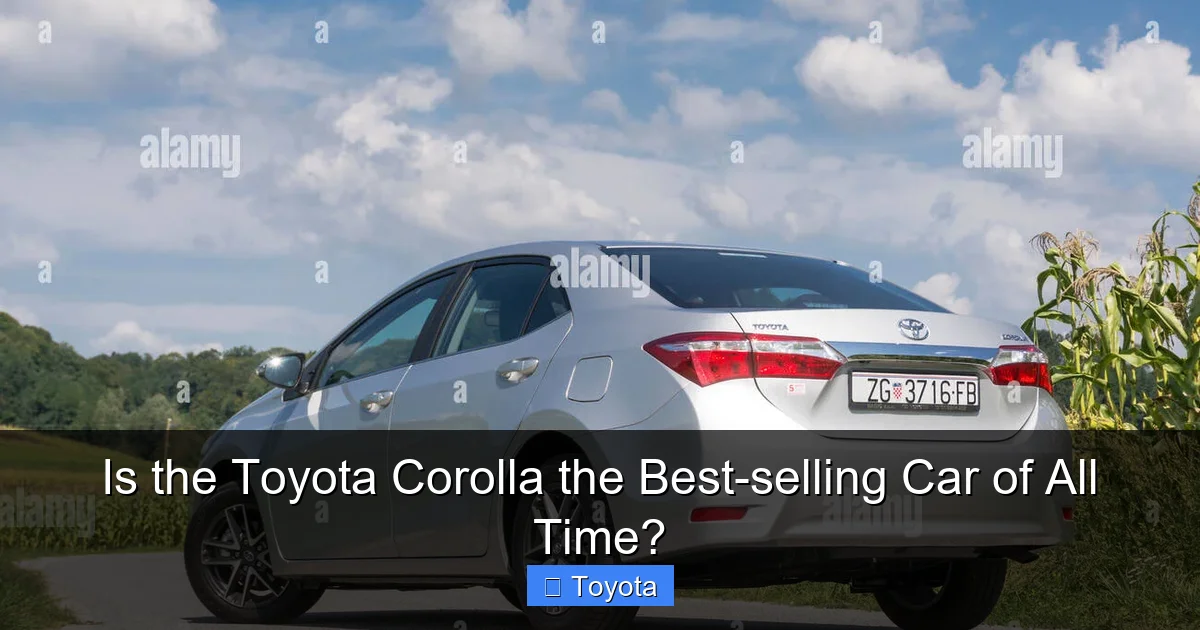
Visual guide about Is the Toyota Corolla the Best-selling Car of All Time?
Image source: c8.alamy.com
1. Unrivaled Reliability and Low Cost of Ownership
This is the cornerstone. Corollas are famous for racking up 200,000, 300,000, and even 500,000 miles with basic maintenance. Consumer Reports and J.D. Power have consistently rated it at or near the top for predicted reliability. This isn’t just marketing hype; it’s engineered into the car.
How does this translate? For a family on a budget, a Corolla means fewer unexpected repair bills. For a commuter, it means a car that starts every morning. For a first-time buyer, it means a safe, predictable investment. The financial peace of mind is immense. This reputation is so powerful that it creates a self-fulfilling cycle: high reliability leads to high resale value, which makes buying a used Corolla a smart choice, further boosting demand for new ones from owners who want that same certainty.
2. Exceptional Fuel Efficiency
From its early days, the Corolla was designed to sip fuel. In the 1970s, this was a revolutionary selling point. Today, with hybrid powertrains standard in many markets, the Corolla achieves EPA ratings of up to 50 mpg combined. For the millions who drive for a living or have long commutes, this translates directly into thousands of dollars saved at the pump over the car’s lifetime. It’s a tangible, daily benefit that competitors often struggle to match without a hybrid penalty in price or performance.
3. Pragmatic, No-Nonsense Design
The Corolla has never been the car that turns heads. Its styling is often described as inoffensive, anonymous, or “appliance-like.” But this is a strategic masterstroke. It means the car doesn’t feel outdated quickly. A 2015 Corolla still looks reasonably like a 2023 Corolla. More importantly, the interior layout is logical, controls are intuitive, and visibility is excellent. It’s a tool that gets out of your way. There’s no learning curve, no frustrating quirks. You get in, you drive, you arrive. For the vast majority of car buyers who see a car as a utility, this is perfect.
4. Remarkable Value Proposition
The base Corolla always starts at a price point that undercuts many competitors while offering more standard features. You’re not paying for a prestigious badge or sporty handling you’ll never use. You’re paying for a well-built, efficient, and reliable vehicle. When you factor in the total cost of ownership—purchase price, fuel, insurance, maintenance, and repairs—the Corolla consistently ranks at the top for value. It’s the financially intelligent choice, and in a world of rising costs, that’s a powerful message.
The Competition: Who Has Come Close?
No best-seller exists in a vacuum. The Corolla’s throne has been constantly challenged. Understanding these rivals highlights why the Corolla ultimately prevailed.
The Honda Civic: The Arch-Nemesis
The Civic is the Corolla’s closest and most consistent rival. For years in the US, they swapped the #1 compact car title annually. The Civic has often been the more engaging drive, with sportier styling and available performance variants (Si, Type R). However, the Corolla has typically held an edge in two critical areas: ultimate reliability (Honda has had some notable engine issues in recent years) and, more importantly, hybrid availability. The Civic only recently offered a hybrid in the US, while the Corolla Hybrid has been available for years. In the global market, where hybrids are king, this gave Toyota a massive advantage. The Civic’s sales are immense—over 25 million—but still well short of the Corolla’s tally.
The Ford F-Series: A Different Category
The Ford F-Series is frequently cited as the “best-selling vehicle in America.” This is true, but it’s a different category. The “F-Series” includes the F-150, F-250, F-350, and more, spanning light-duty trucks to heavy-duty workhorses. It’s a *family* of vehicles. The Corolla is one single model. If we compared the entire Toyota truck/SUV lineup (Tacoma, Tundra, 4Runner, RAV4, etc.) to the F-Series, Ford would likely still win in the US, but globally, Toyota’s volume is far higher. The F-Series’s success is a testament to the American love affair with trucks, but it doesn’t dethrone the Corolla’s single-model record.
The Volkswagen Beetle: A Historical Icon
The Beetle was the first “people’s car” and held the single-model sales record for decades, with about 21.5 million sold. Its story is one of post-war revival and iconic design. However, its production ended in 2003 (with a brief, unsuccessful revival). The Corolla, in contrast, is a relentlessly updated, never-out-of-production juggernaut. The Beetle’s sales were concentrated in specific eras; the Corolla’s are perpetual and growing.
The Road Ahead: Can Anything Dethrone the King?
For the Corolla to be the best-selling car *of all time*, it must remain in production and continue selling. The biggest challenge is the global automotive industry’s seismic shift toward electric vehicles (EVs). Sedans, the Corolla’s traditional segment, are declining in some markets as consumers flock to SUVs and crossovers. Toyota’s response has been two-pronged.
The SUV Strategy: Corolla Cross
Recognizing the sedan’s decline in key markets like the US, Toyota brilliantly leveraged the Corolla nameplate for a compact SUV, the Corolla Cross. This isn’t just a rebadge; it’s a strategic move to transplant the Corolla’s reputation for reliability and value into the hottest vehicle segment on earth. The Corolla Cross is already a massive global seller, ensuring the “Corolla” name remains dominant even as the traditional sedan form factor fades. This adaptability is a key strength.
The Electrification Strategy: Hybrids and Beyond
Toyota is the hybrid pioneer, and the Corolla Hybrid is a huge part of its sales in Europe and Japan. It’s the default, rational choice. For the full EV future, Toyota has launched the bZ4X, an electric SUV built on a new platform. While not a “Corolla” in name, it represents the technological evolution that will eventually power the Corolla’s successors. The challenge is whether Toyota can translate its hybrid/ICE reputation into EV trust as quickly as Tesla or BYD have built their brands. The Corolla’s future success may depend on how seamlessly it can become an EV while retaining its core identity of affordable reliability.
Conclusion: More Than a Sales Figure
So, is the Toyota Corolla the best-selling car of all time? By the cold, hard metrics of cumulative production, absolutely. Over 50 million is a number that may never be surpassed by a single model in the modern, fragmented global market. But its status is about more than a record. It’s a testament to a philosophy: that the greatest car isn’t the fastest, the prettiest, or the most advanced. It’s the one that works, every single day, for the longest time, at the lowest cost. It’s the car that gets you to your job, your family, your life, without drama. In an era of ever-increasing complexity, the Corolla’s simple, steadfast promise has never been more valuable. It is, and likely will remain, the world’s car.
For anyone considering a Corolla, understanding its legendary reliability is key. If you’re looking at a used model, you’ll want to know the best car seat options for a Toyota Corolla if it’s for family use, as its spacious interior is a major perk. Smart shoppers also always research when is the best time to buy a car to maximize value on a purchase this practical. And once you own one, basic maintenance is simple—knowing how to open the hood of a Toyota Corolla for oil checks is a fundamental skill that helps maintain its famed longevity.
Frequently Asked Questions
Is the Toyota Corolla really the best-selling car in the world?
Yes. With over 50 million units sold since 1966, the Toyota Corolla is the best-selling single-model car line in automotive history. It surpasses other iconic models like the Volkswagen Beetle and Honda Civic by a significant margin.
How many Toyota Corollas have been sold?
As of 2023, cumulative global sales have exceeded 50 million units across its 12 generations. It has frequently been the world’s best-selling car annually for the past two decades.
Why is the Toyota Corolla so popular worldwide?
Its popularity stems from a combination of exceptional reliability, outstanding fuel efficiency (including hybrid options), low cost of ownership, and practical, no-fuss design. It consistently meets the fundamental need for affordable, dependable transportation across diverse global markets.
Is the Toyota Corolla a reliable car?
Extremely. The Corolla has a decades-long reputation for bulletproof reliability. It consistently ranks at the top of dependability studies from J.D. Power, Consumer Reports, and other automotive authorities, with many examples easily surpassing 200,000 miles with proper maintenance.
Will electric cars make the Corolla obsolete?
Not likely. Toyota is adapting by offering the Corolla with a highly efficient hybrid powertrain globally and has introduced the Corolla Cross SUV to meet the shift toward crossovers. While a fully electric Corolla-badged sedan isn’t yet on the horizon, Toyota’s new bZ electric platform will eventually underpin its future small car offerings, ensuring the “Corolla philosophy” of accessible mobility continues in the EV era.
What’s the difference between a Toyota Corolla and a Toyota Camry?
The Corolla is a compact sedan/hatchback, positioned as an efficient, affordable commuter car. The Camry is a midsize sedan, offering more space, power, and upscale features. The Corolla is smaller, more fuel-efficient, and typically less expensive, while the Camry provides a more comfortable, powerful ride for families and those wanting more room and refinement.
