
Can You Go to Jail for Keying a Car?

Yes, you can absolutely go to jail for keying a car. This act is legally defined as criminal mischief or vandalism, which is a crime in every state. While a first-time, minor offense might result in fines and probation, keying a car can escalate to a felony with potential jail time, especially if the damage is costly, you have prior convictions, or the act is motivated by hate. The severity of the penalty depends on the dollar amount of damage, your criminal history, and specific state laws. It is not a harmless prank; it is a property crime with serious, long-lasting legal and financial repercussions.
Key Takeaways
- Keying a car is a crime: It constitutes criminal mischief/vandalism, not a minor dispute.
- Jail time is possible: Misdemeanor charges can bring up to a year in jail; felonies can mean years in state prison.
- Damage amount is critical: The dollar value of the repaint or repair often determines if charges are a misdemeanor or felony.
- Restitution is mandatory: Courts will order you to pay the vehicle owner for all damages, on top of any fines.
- Long-term consequences: A criminal record affects employment, housing, and professional licenses far beyond any jail sentence.
- Legal help is essential: An experienced criminal defense attorney can negotiate charges, reduce penalties, or explore diversion programs.
📑 Table of Contents
- Understanding Vandalism and Criminal Mischief Laws
- The Degrees of Criminal Mischief: Misdemeanor vs. Felony
- Factors That Influence Charges and Jail Time
- The Real Financial Cost: Beyond Just Repair Bills
- The Legal Process: From Arrest to Sentencing
- What To Do If You Are Charged (or Accused)
- Strong Conclusion: The Real Price of a Moment of Anger
Understanding Vandalism and Criminal Mischief Laws
Let’s cut right to the chase. Keying a car is not a silly, victimless prank. It is a deliberate act of property destruction that falls under legal statutes commonly called “vandalism” or “criminal mischief.” Every state in the U.S. has laws against this exact behavior. The core principle is simple: you are intentionally damaging someone else’s personal property without their permission. The law doesn’t care if you were angry about a parking dispute, jealous of a neighbor’s new ride, or just acting out in a moment of poor judgment. The act itself triggers legal consequences.
These laws exist to protect private property and maintain public order. When you key a car, you are causing financial harm and emotional distress. The vehicle owner now faces unexpected repair bills, loss of their car’s value, and the hassle of dealing with insurance claims and body shops. The legal system treats this seriously because it violates another person’s rights and security. So, the short answer to “can you go to jail for keying a car?” is a resounding yes. The more complex question is how likely you are to go to jail, and that depends on a web of factors we’ll break down.
What Exactly Constitutes “Keying” a Car?
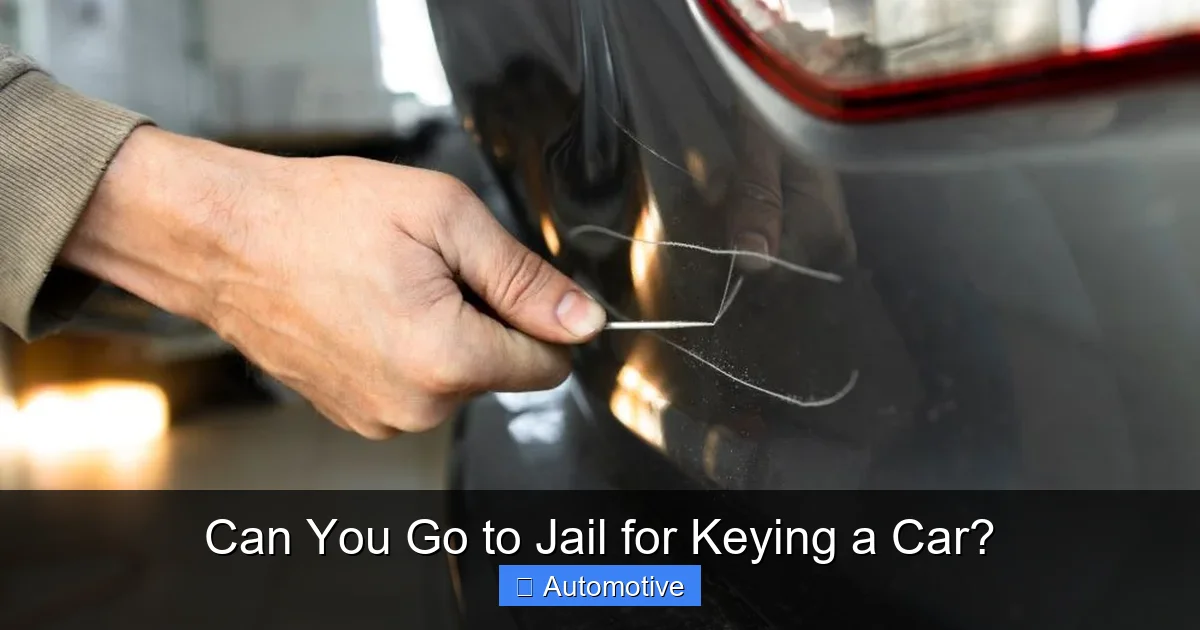
Legally, “keying” is just one specific method of committing criminal mischief. It involves using a key, or any other sharp, hard object like a knife, screw, or rock, to scratch the paint, dent the body panel, or otherwise deface a vehicle. The charge isn’t “keying”; it’s the broader offense of damaging property. Prosecutors will look at the evidence: deep gouges that penetrate to the primer or metal, long scratches across multiple panels, or any damage that requires more than a simple buffing. A single, light scratch might be hard to prove and may not meet the monetary threshold for criminal charges, but it could still lead to a civil lawsuit for damages.
The Degrees of Criminal Mischief: Misdemeanor vs. Felony
This is the most critical factor in determining jail time. States classify criminal mischief based primarily on the monetary value of the damage. There are almost always two levels: a lower-level misdemeanor and a more serious felony. The threshold dollar amount that separates them varies dramatically by state. For example, in one state, causing $500 or more in damage might be a felony, while in another, the threshold could be $1,000 or even $2,500. You must know your specific state’s statutes.
Visual guide about Can You Go to Jail for Keying a Car?
Image source: blgwins.com
Misdemeanor Criminal Mischief
If the damage is relatively minor—say, a few scratches that cost $300 to $800 to fix—you’ll likely face a misdemeanor charge. Penalties for a misdemeanor can include:
- Jail time: Up to one year in a county or local jail.
- Fines: Typically ranging from $250 to $2,000 or more.
- Probation: Supervised release with conditions like no further offenses, community service, and anger management classes.
- Restitution: Court-ordered payment directly to the victim for the full cost of repairs.
For a first-time offender with minimal damage, a prosecutor might offer a “diversion program” or a plea deal that avoids jail time, especially if you pay restitution promptly. But jail is always on the table for a misdemeanor conviction, and judges have discretion.
Felony Criminal Mischief
Once the damage exceeds your state’s felony threshold, the stakes skyrocket. Felony charges mean you are facing state prison time (over one year), not just local jail. Felony penalties are much harsher:
- Prison sentences: Can range from 16 months to 3 years, or even longer for “aggravated” or “gross” misdemeanor/felony levels in some states.
- Significant fines: Often $5,000, $10,000, or more.
- Probation/Parole: Long periods of supervised release after prison.
- Permanent criminal record: A felony conviction is life-altering, stripping voting rights in many states and severely limiting job prospects.
Keying a luxury car like a BMW, Mercedes, or Tesla can easily exceed felony thresholds with a few deep scratches. A full repaint of a single panel on these vehicles can cost thousands. If you key multiple panels or a classic car, you are very likely looking at felony charges.
Factors That Influence Charges and Jail Time
Damage amount is the primary metric, but it’s not the only one. Prosecutors and judges consider a matrix of other factors that can push a case from a fine to a jail cell.
Visual guide about Can You Go to Jail for Keying a Car?
Image source: villages-news.com
Your Criminal History
Prior convictions, especially for property crimes or acts of violence, are a huge red flag. A first-time offender with no record has a much better chance of getting probation or a deferred sentence. A repeat offender, even if the current damage is modest, will be treated harshly. The law sees you as a continuing threat to property, and judges will use jail time to “teach you a lesson” and protect the public.
Hate Crime Enhancements
This is a major aggravating factor. If there is any evidence that the keying was motivated by the victim’s race, religion, national origin, sexual orientation, gender identity, or other protected class, prosecutors can seek hate crime enhancements. This doesn’t just increase the penalty; it can elevate a misdemeanor to a felony and add significant prison time. Many states have specific statutes that double the potential sentence for a hate-motivated vandalism act. Graffiti or slurs keyed into the car alongside the scratches are clear indicators.
Probation or Parole Status
If you are already on probation or parole for another offense, keying a car is a violation of your release conditions. This is one of the fastest routes to jail. The probation officer will file a violation report, and you will likely be taken into custody without bail, facing not only new charges for the keying but also a hearing for the violation, which can revoke your probation and send you back to prison for the original sentence.
Age of the Offender
Juveniles (typically under 18) are usually processed in the juvenile justice system, which focuses more on rehabilitation than punishment. However, for serious felony-level damage, a juvenile can be charged as an adult, meaning they face the same prison sentences as an adult. Even in juvenile court, consequences can include detention in a youth facility, extensive community service, restitution, and a permanent record that can follow them.
The Real Financial Cost: Beyond Just Repair Bills
When people ask about jail time, they often fixate on the criminal penalty. But the financial fallout from keying a car is brutal and immediate, and it’s a core part of the legal consequence. You will be held financially responsible.
Visual guide about Can You Go to Jail for Keying a Car?
Image source: villages-news.com
Direct Repair Costs
A simple scratch on a door might cost $300-$800 to buff out. But deep scratches that go through the clear coat and into the paint require a full repaint of that panel. For a common sedan, a single panel repaint can be $800-$1,500. For a luxury or SUV, it’s $1,500-$3,000+ per panel. If you keyed the whole side, you’re looking at $3,000-$6,000+ easily. Classic car repairs are even more expensive due to specialty paints and labor.
Diminished Value
Here’s the kicker that many offenders don’t consider. Even after a perfect, factory-quality repaint, a car’s resale value is permanently diminished. Carfax and AutoCheck reports will list the accident/repair history. Savvy buyers will pay less for a car with a repainted panel, assuming there was underlying damage. The vehicle owner can sue you for this “diminished value” in civil court, separate from the criminal case. This can add thousands to your liability. If you’re wondering about the scrap value of a severely damaged car, you can read more about how much you can get for scrapping a car, but note that a vandalized car is rarely totaled by an insurer unless the damage is extreme.
Rental Car and Other Incidental Costs
While their car is in the shop for a week or more, the victim may need a rental car. These costs are also recoverable as part of restitution. Towing fees, storage fees if the car is undrivable, and even the cost of obtaining a police report can be included in the total restitution amount the court will order you to pay.
The Legal Process: From Arrest to Sentencing
Understanding the journey helps clarify where jail time becomes a real possibility. It’s not an instant sentence after the act.
Reporting and Investigation
The victim reports the vandalism to the police. Officers will take a report, photograph the damage, and may look for surveillance footage from nearby homes or businesses (ring doorbells are goldmines for evidence). They will ask the victim for any suspect information. If there’s a witness or video identifying you, police will seek to question you or obtain an arrest warrant.
Arrest and Booking
If police have probable cause (evidence you did it), they will arrest you. You will be handcuffed, transported to jail, booked (fingerprinted, photographed, inventory of belongings), and held until you can post bail or see a judge. For a misdemeanor, bail might be reasonable (e.g., $1,000-$5,000). For a felony, it will be much higher. If you can’t pay, you will sit in jail until your court date, which could be weeks or months.
Arraignment and Plea Bargaining
Your first court appearance is the arraignment, where the formal charges are read. You enter a plea of guilty or not guilty. The vast majority of criminal cases (over 90%) are resolved through plea bargaining. Your attorney will negotiate with the prosecutor. They might agree to reduce a felony to a misdemeanor, or recommend probation instead of jail, in exchange for a guilty plea. This is often the best outcome to avoid the risk of a harsher sentence after trial.
Sentencing
If you plead guilty or are found guilty at trial, the judge will impose a sentence. The judge has a sentencing range based on the charge (misdemeanor/felony) but also considers aggravating and mitigating factors. Your attorney will present mitigating factors: no prior record, remorse, payment of restitution, employment, family support. The prosecutor will present aggravating factors: high damage, hate motivation, prior record. The judge then decides: jail, probation, fines, community service, restitution. Jail time is a common outcome for significant damage or a bad record.
What To Do If You Are Charged (or Accused)
If you find yourself facing a criminal mischief charge for keying a car, your actions in the first 72 hours are critical.
Do Not Talk to Police or the Victim
Exercise your right to remain silent. Do not make statements, apologize in a way that sounds like an admission, or try to “make a deal” with the victim directly. Anything you say can and will be used against you. Politely say, “I wish to speak to an attorney before answering any questions.”
Secure Legal Representation Immediately
Hire a criminal defense attorney now. If you cannot afford one, the court will appoint a public defender. An experienced local attorney knows the specific judges, prosecutors, and sentencing norms in your jurisdiction. They can evaluate the evidence, challenge weak points (like questionable damage estimates), negotiate the best possible plea deal, and advocate for alternatives to jail like community service or a restitution-only plan. They might even get the charges dropped if evidence is insufficient. Do not try to navigate this alone; a misdemeanor on your record can cost you future jobs.
Consider Making Restitution Early
If possible, and with your attorney’s advice, proactively paying the victim for the full cost of repairs can be a powerful mitigating factor. It shows remorse, makes the victim “whole,” and gives your attorney a strong argument for probation instead of jail. Get a detailed, itemized repair estimate from a reputable body shop to ensure the amount is fair. You might also explore if your renter’s or homeowner’s insurance has a personal liability coverage that could respond, though many policies exclude intentional criminal acts.
Strong Conclusion: The Real Price of a Moment of Anger
So, can you go to jail for keying a car? The answer is a definitive and sobering yes. What might feel like a fleeting moment of anger or revenge can cascade into a criminal case with the very real prospect of jail time, thousands of dollars in fines and restitution, and a permanent mark on your record that will shadow you for years. The legal system does not view this as a private matter between neighbors; it is a prosecutable offense against the state and the victim.
The path to jail is paved with the severity of the damage, your past actions, and the specific laws of your state. A deep scratch on a luxury car can be a felony. A hate-filled message carved into the paint can double your sentence. A prior conviction can remove any chance of leniency. The financial cost alone—repairs, diminished value, rental cars—can be staggering and is almost always ordered by the court.
If you are feeling wronged or angry, keying a car is the worst possible choice. It escalates conflict, victimizes an innocent person, and turns you into the criminal. The only winning move is to walk away. If you’ve already made a terrible mistake, the next best move is to stop talking and hire a lawyer immediately. Your future—your freedom, your finances, your reputation—depends on it. This isn’t a scare tactic; it’s the legal reality for thousands of people every year who thought they were just scratching a car and ended up with a rap sheet.
Frequently Asked Questions
Is keying a car a misdemeanor or a felony?
It can be either. It depends on your state’s dollar threshold for property damage. Minor scratches costing a few hundred dollars are typically a misdemeanor. Damage exceeding the state’s threshold (often $500-$2,500) becomes a felony, which carries prison time.
What if I pay for the damages before the police catch me?
Paying for damages is a positive step and may influence the prosecutor’s decision on charges or the judge’s sentence, but it does not automatically erase the crime. The act of keying was still committed. The victim or police can still pursue criminal charges, though restitution may help you avoid jail.
Can I get my criminal record expunged for a keying conviction?
Possibly, but it’s difficult and varies by state. Misdemeanor convictions are sometimes eligible for expungement after a waiting period (e.g., 5 years) with no new offenses. Felony convictions are much harder to expunge, often requiring a governor’s pardon. An attorney can advise on your state’s specific laws.
What if it was my first offense and I’m a teenager?
First-time juvenile offenders are often diverted to programs like community service, restitution, and counseling instead of jail. However, for felony-level damage, the juvenile could be charged as an adult and face adult penalties. The court’s primary goal for juveniles is rehabilitation, but serious crimes have serious consequences.
Will my auto insurance go up if I’m the victim of keying?
No, as the victim, your insurance premiums should not increase because of a not-at-fault vandalism claim. However, if you file a comprehensive claim, you may lose a “no claims” discount if your policy doesn’t offer a “forgiveness” clause for this type of incident. The at-fault party’s insurance (if they have any) would ideally cover it, but most intentional acts are uninsured.
What if the car was already damaged before I keyed it?
You are only responsible for the new damage you caused. A good attorney would challenge the victim’s repair estimate, arguing it includes pre-existing damage. You might need your own expert to assess the damage and separate the old from the new. This can reduce the dollar amount of damage, potentially lowering the charge from a felony to a misdemeanor.
