
How Do I Know If My Mazda Has I-eloop

Determining if your Mazda has the i-ELOOP regenerative braking system is straightforward with a few key checks. You can identify it by looking for specific dashboard indicators, checking your owner’s manual or window sticker, and knowing which model years and trims included it as standard or optional equipment. This system captures braking energy to power the car’s electronics, improving fuel economy without compromising performance.
So, you’ve heard about Mazda’s clever i-ELOOP system and its fuel-saving benefits, but you’re staring at your own car wondering, “How do I know if my Mazda has i-ELOOP?” It’s a great question. Unlike some features that are obvious, like a sunroof or leather seats, a regenerative braking system works silently in the background. You can’t see the parts from the driver’s seat. But don’t worry, you don’t need to be a mechanic to figure it out. This guide will walk you through several simple, practical methods to confirm whether your Mazda is equipped with this intelligent energy-recovery technology. We’ll cover everything from quick visual checks in your cabin to understanding which model years and trims were likely to have it. By the end, you’ll know exactly how to check your own vehicle.
Key Takeaways
- Understanding How Do I Know If My Mazda Has i-ELOOP: Provides essential knowledge
📑 Table of Contents
- What Exactly is i-ELOOP? (A Quick Refresher)
- Method 1: The Dashboard Detective – Finding the i-ELOOP Gauge
- Method 2: The Paper Trail – Owner’s Manual and Window Sticker
- Method 3: Model Year and Trim Level Sleuthing
- Method 4: The Physical and Auditory Clues (Less Reliable, But Helpful)
- Method 5: The Professional Confirmation
- Why Does It Matter If I Have i-ELOOP?
- Conclusion: Your Simple Checklist
What Exactly is i-ELOOP? (A Quick Refresher)
Before we dive into detection methods, let’s quickly clarify what we’re looking for. i-ELOOP stands for “Intelligent Energy Loop.” It’s Mazda’s name for its regenerative braking system. Here’s the simple version: when you brake or coast, your car’s wheels are still spinning. Normally, that kinetic energy just turns into waste heat at the brake rotors. i-ELOOP captures some of that energy. It uses a variable-voltage alternator (a special generator) to convert the spinning motion into electricity. This electricity is stored in a high-capacity capacitor (not the main 12V battery) and then used to power the car’s electrical systems—lights, infotainment, climate control fan, etc.
Why does this matter? The engine typically has to work harder to spin the alternator and generate all that electricity. By taking that electrical load off the engine, i-ELOOP helps improve fuel economy, sometimes by a noticeable 1-2 MPG in city driving. It’s a clever way to boost efficiency without changing how the car feels to drive. Now, onto the detective work.
The Core Principle: It’s All About the Gauge
The single most reliable and easiest way to identify i-ELOOP is to find its dedicated display on your dashboard. Mazda designed the system to be visible to the driver as a feedback mechanism. When the system is active and generating electricity, you should see an indicator light up or a gauge move.
Method 1: The Dashboard Detective – Finding the i-ELOOP Gauge
This is your first and best line of investigation. Get in the driver’s seat and start your engine. Look at your instrument cluster—the area behind the steering wheel with the speedometer, tachometer, and other warning lights.
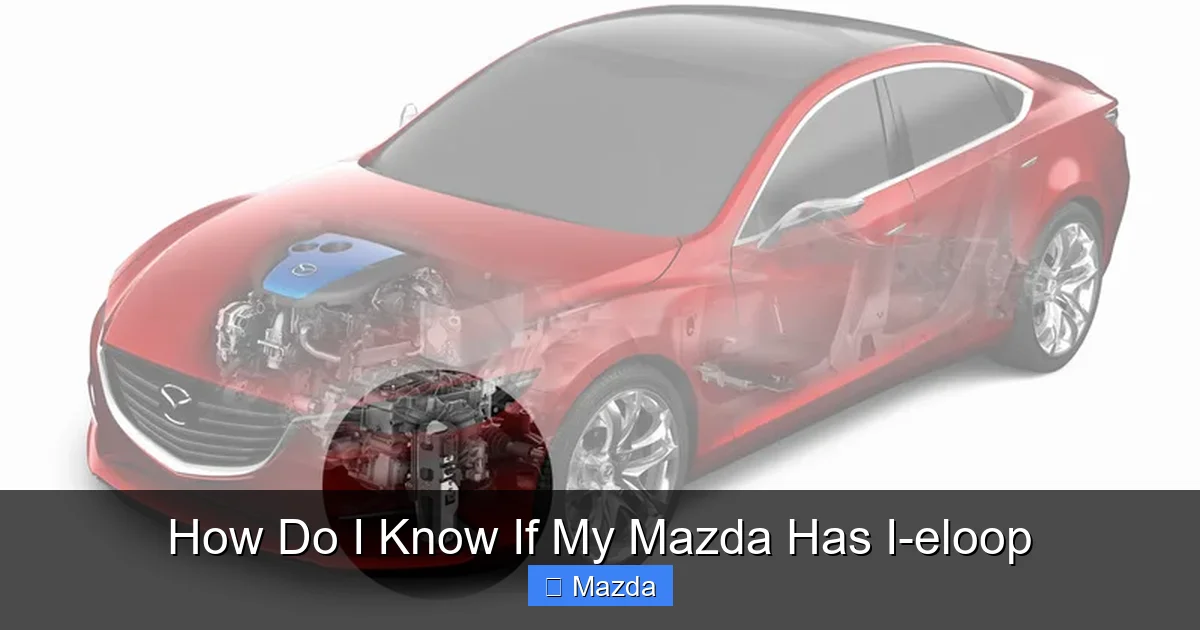
Visual guide about How Do I Know If My Mazda Has I-eloop
Image source: mazdaspeed.pl
What to Look For
You’re searching for a specific icon or text. The display varies slightly by model year and trim:
- The Word “i-ELOOP”: On many Mazda3 and Mazda6 models from the mid-2010s, there is a small digital display area, often between the speedometer and tachometer or in the center of the cluster. When you start the car, it may briefly flash “i-ELOOP” or “i-ELOOP READY.”
- A Spinning Generator or Lightning Bolt Icon: Some models use a graphic. Think of a small circle with curved arrows inside (like a recycling symbol or a spinning rotor) or a lightning bolt. This icon will illuminate or animate when the system is actively generating power.
- An Energy Flow Display: On higher-trim models with more advanced trip computers, there might be a dedicated screen showing energy flow. You’ll see arrows indicating power going from the wheels to the capacitor (during braking/coasting) or from the capacitor to the electrical systems.
- A Battery Charge Indicator: Some models integrate a small bar graph or LED array that shows the state of charge in the capacitor. It might be labeled “Capacitor” or just show a battery icon that fills up as you drive and brake.
How to Test It: Find a safe, quiet stretch of road. Accelerate to about 30-40 mph, then take your foot off the gas pedal completely and let the car coast. Do not press the brake pedal yet. Watch your instrument cluster intently. You should see the i-ELOOP indicator light up or the gauge move within a second or two as the variable alternator engages and starts harvesting energy from the coasting wheels. Then, gently press the brake pedal. The indicator should remain active or become even more pronounced. If you see this clear, repeatable response, you have i-ELOOP.
Method 2: The Paper Trail – Owner’s Manual and Window Sticker
If the gauge is elusive or you want absolute confirmation, turn to the documentation.
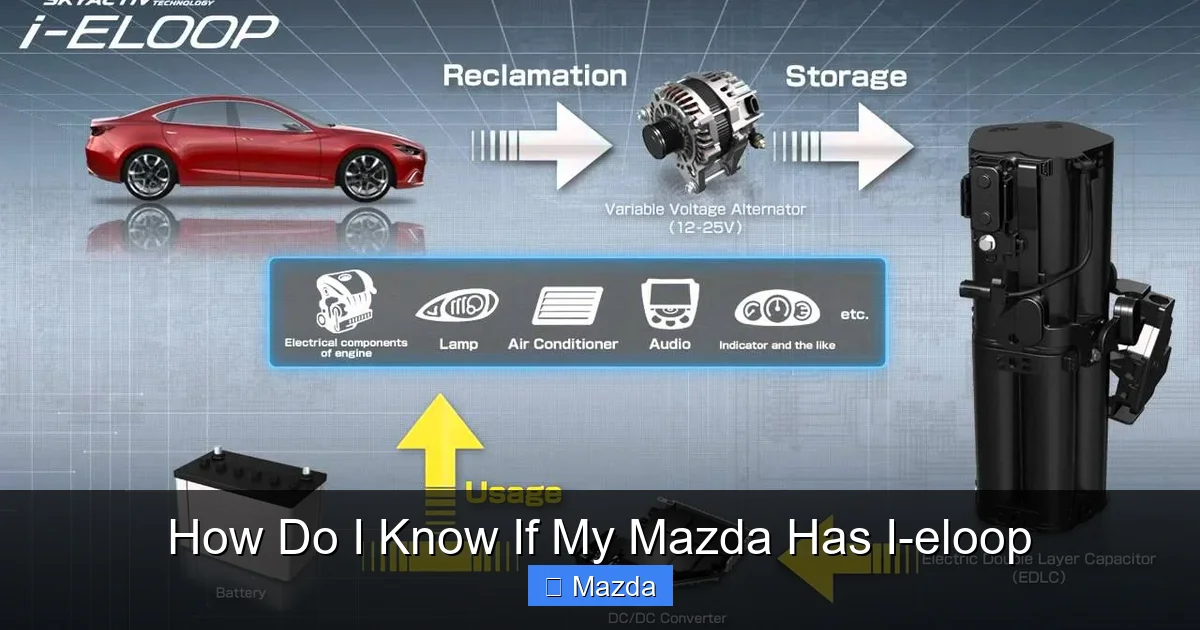
Visual guide about How Do I Know If My Mazda Has I-eloop
Image source: cdn.shopify.com
Consulting the Owner’s Manual
Your owner’s manual is the definitive source of truth for your specific vehicle. Go to the index and look for “i-ELOOP,” “regenerative braking,” or “energy recovery system.” There will be a dedicated section explaining how it works and showing pictures of the dashboard displays. If the manual has a section on it, your car is equipped with it. If you can’t find any mention of it in the index or table of contents, it’s highly unlikely your vehicle has the system. The manual will also tell you if there are any specific maintenance considerations, which is useful knowledge.
The Gold Standard: The Monroney (Window) Sticker
Do you still have the original window sticker from when the car was new? This is the ultimate proof. The sticker lists all standard and optional equipment. Scan the list of features for “i-ELOOP Regenerative Braking System” or similar phrasing. If it’s listed under your VIN’s specific build, it came with the car. If you don’t have the physical sticker, sometimes dealerships can pull up a digital copy using your VIN, or you might find a photo of it in the car’s original sales paperwork.
Method 3: Model Year and Trim Level Sleuthing
i-ELOOP was not standard on all Mazdas. Its availability was selective. Knowing the general pattern can give you a very strong clue before you even start the physical checks.
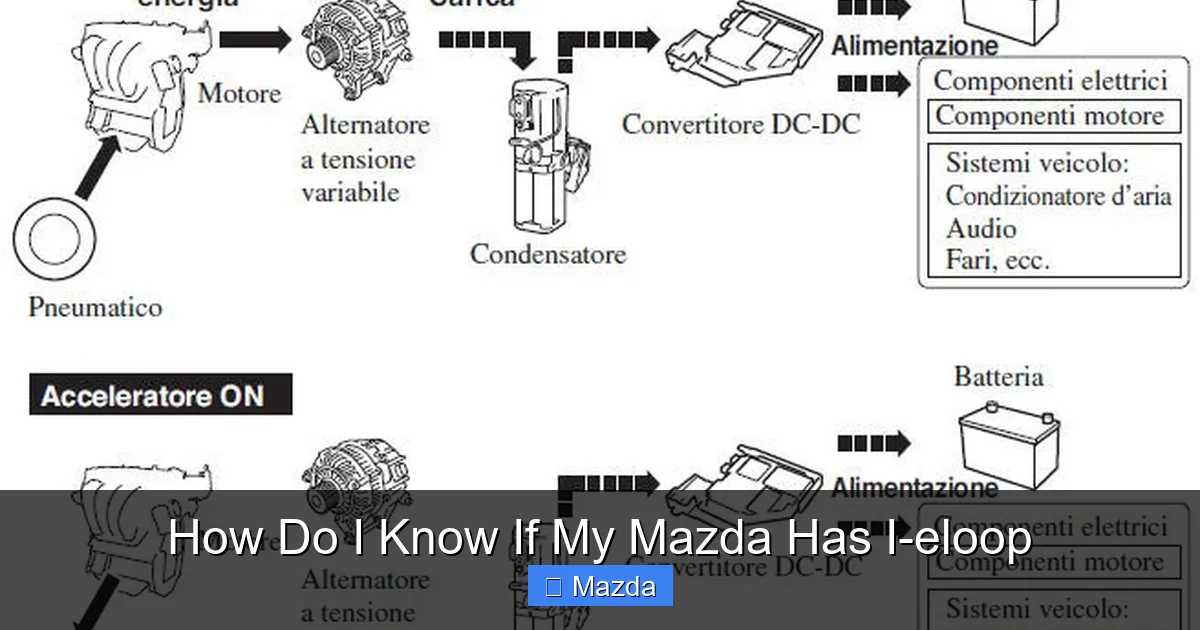
Visual guide about How Do I Know If My Mazda Has I-eloop
Image source: veicolidtec.org
The Timeline: When Was i-ELOOP Offered?
The system debuted for the 2014 model year. Its availability peaked around 2016-2018 and began being phased out in newer generations as Mazda pursued other efficiency technologies like cylinder deactivation (which you can learn more about in our guide on how to tell if a Mazda has cylinder deactivation). By the 2021 model year and beyond, i-ELOOP was largely discontinued in favor of other systems.
Typical Model Year Range: 2014 – 2020 (with declining availability post-2019).
Which Models Likely Had It?
- Mazda3: Very common on 2014-2018 models, especially on Touring and Grand Touring trims. It was often bundled with the “Technology Package” or similar.
- Mazda6: Frequently standard on Grand Touring trims and optional on Touring models from 2014-2018.
- CX-5: A popular application. Often found on 2014-2018 Touring and Grand Touring trims. Sometimes it was part of the “Premium Package.”
- MX-5 Miata (ND): Available on certain higher-trim ND models (2015-2018), though less ubiquitous than in the sedans/SUVs.
- CX-9, CX-3, Mazda2: Rare or not available. The larger CX-9 and smaller CX-3/Mazda2 typically did not receive i-ELOOP.
Trim Level is Key: On most models, i-ELOOP was NOT standard on the base “Sport” or “i-ACTIVSENSE” trims. You usually needed to step up to at least the mid-level “Touring” trim and often the top “Grand Touring” trim to get it, either as standard equipment or part of a package. If you have a very basic, no-frills model from this era, it probably doesn’t have i-ELOOP. If you have a fully loaded Grand Touring model, it very likely does.
Method 4: The Physical and Auditory Clues (Less Reliable, But Helpful)
While not as definitive as the gauge or paperwork, your senses can offer supporting evidence.
Listen Under the Hood
The i-ELOOP system’s heart is a variable-voltage alternator, which is different from a conventional fixed-output alternator. With the engine running, have a helper rev the engine slightly (to about 2000 RPM) while you listen carefully from the engine bay with the hood open. In a car with i-ELOOP, you might hear a distinct, high-pitched whirring or electric-motor-like sound that changes pitch with the RPM. This is the alternator/regenerator unit adjusting its output. A standard alternator typically has a more consistent, belt-driven whine that doesn’t change character as dramatically with small RPM changes. Note: This is subtle and requires a quiet environment. Many modern engines are well-insulated, so you might not hear anything distinctive.
Check the 12V Battery Location and Type
This is a very weak indicator, but sometimes a pattern exists. In many i-ELOOP equipped Mazdas, the 12V battery (the one that starts the car) is located in the trunk or under the rear floor, not in the engine bay. This is because the front engine bay is busier with the i-ELOOP components. Additionally, some sources suggest these models might use an Absorbent Glass Mat (AGM) battery more frequently due to the higher electrical demands and cycling. However, many non-i-ELOOP Mazdas also have trunk-mounted batteries and AGM batteries, so you cannot use this as a positive identification method—only as a small piece of a larger puzzle that might fit.
Method 5: The Professional Confirmation
When all else fails, or you want 100% certainty for peace of mind or a sale, go to the experts.
Ask Your Mazda Dealership
Call the service department. Give them your Vehicle Identification Number (VIN). They can look up the exact build sheet for your car and tell you definitively whether it left the factory with i-ELOOP. This is the most authoritative answer you can get. There may be a small fee for this service, or they might do it for free as a customer courtesy.
Use an Independent Repair Shop or Mobile Mechanic
A qualified technician with a good OBD-II scanner can often see if the i-ELOOP control module is present and active. They can look for related fault codes (even if none are currently lit on your dash) and see system parameters. This is a more affordable option than a dealership and can be done during a routine oil change or inspection. You could also mention the need to check for car battery health at the same time, as i-ELOOP interacts with the electrical system.
Why Does It Matter If I Have i-ELOOP?
Knowing whether your Mazda has this system isn’t just trivia. It has practical implications.
- For Fuel Economy Expectations: If you’re trying to maximize MPG, understanding that your car has this efficiency aid helps you use it to its potential. Smooth, anticipatory driving that maximizes coasting and regenerative braking will yield the best results.
- For Maintenance and Repairs: The system has unique components: the variable alternator, the DC-DC converter, and the capacitor (often called the “i-ELOOP capacitor” or “energy storage device”). If you have electrical gremlins or a charging system warning, a mechanic needs to know to check these specific parts. Replacing a standard alternator is different from replacing an i-ELOOP unit.
- For Troubleshooting: If your fuel economy seems to have dropped significantly, a malfunctioning i-ELOOP system could be a culprit. The engine might be working harder than necessary if the capacitor isn’t capturing energy.
- When Selling Your Car: It’s a selling point! You can confidently list it as a feature. Conversely, if a buyer asks, you can give a knowledgeable answer.
It’s also worth noting that while i-ELOOP is sophisticated, it doesn’t require special driver maintenance. Just keep your regular 12V battery in good condition, as the system relies on it for startup. If you ever need to jump-start your car, the procedure is the same, but you might want to review how to reset a car computer after battery replacement for any Mazda, as disconnecting the battery can sometimes require a steering wheel angle sensor recalibration.
Conclusion: Your Simple Checklist
So, how do you know if your Mazda has i-ELOOP? Start with the easiest step: turn on your car and watch the dashboard for a unique i-ELOOP indicator that activates when you coast or brake. If you see it, you’re done. If not, grab your owner’s manual and search the index. No luck there? Identify your exact model, year, and trim. If it’s a 2014-2018 Mazda3, Mazda6, or CX-5 in a Touring or Grand Touring trim, the odds are high it has the system. Finally, for absolute proof, use your VIN to get a build sheet from a dealer. This layered approach—from quick visual to professional verification—ensures you’ll get a confident answer. Understanding your car’s features, especially hidden efficiency tech like i-ELOOP, makes you a more informed owner and helps you get the most enjoyment and value from your Mazda.
Frequently Asked Questions
Will my car’s fuel economy suffer if the i-ELOOP system fails?
Yes, a failed i-ELOOP system will typically cause a drop in fuel economy, often by 1-2 MPG, because the engine will have to work harder to power all electrical accessories via the standard alternator. You might also see a dashboard warning light.
Is the i-ELOOP capacitor the same as the 12V car battery?
No, they are completely separate components. The i-ELOOP system uses a high-capacity, fast-charging capacitor (or in some models, a small auxiliary battery) to store the recovered energy. Your standard 12V lead-acid or AGM battery is still present and is used for starting the engine and as a backup power source.
Can I disable the i-ELOOP system?
No, there is no user-controlled on/off switch for i-ELOOP. It’s a fully automatic system that engages whenever you decelerate. It’s designed to work seamlessly in the background without any driver input.
Does i-ELOOP affect how I should brake?
For maximum efficiency, try to brake smoothly and anticipate stops so you can coast first. The system harvests the most energy during light to moderate deceleration, especially when you lift off the accelerator. Hard, panic braking relies mostly on the friction brakes and generates less recoverable energy.
If I replace my 12V battery, do I need to do anything special for i-ELOOP?
Generally, no special procedure is needed for the i-ELOOP system itself when replacing the main 12V battery. However, disconnecting the battery can cause your vehicle’s computer systems to lose memory. You may need to reset clock and radio presets, and on some models, a steering angle sensor calibration might be required, which a dealer can perform.
My car has the i-ELOOP gauge, but it never lights up. Is something wrong?
Not necessarily. The gauge only activates when the system is generating electricity—primarily during deceleration (coasting or braking). If you are only driving at a steady speed on the highway, it may stay off. Test it by finding a safe spot to coast from 40 mph down to 20 mph without touching the brake. The gauge should illuminate during that maneuver. If it never lights up under these conditions, there could be a fault, and a diagnostic check is recommended.
