
How Many Miles Is a Full Tank on a 2015 Toyota Camry?

A 2015 Toyota Camry with a 15.8-gallon fuel tank typically delivers a combined range of 448 to 576 miles on a full tank, depending on engine choice and driving conditions. The efficient 2.5L 4-cylinder averages 28 MPG combined, while the more powerful 3.5L V6 gets 25 MPG combined. Real-world range is heavily influenced by driving style, terrain, weather, and vehicle maintenance, with the low-fuel warning light usually activating with 30-50 miles remaining.
Key Takeaways
- Tank Capacity: All 2015 Camry models use a 15.8-gallon (59.8-liter) fuel tank, providing a consistent physical capacity regardless of trim.
- EPA MPG Ratings: The 2.5L 4-cylinder is rated at 25 city/35 highway MPG (28 combined), while the 3.5L V6 is rated at 21 city/31 highway MPG (25 combined).
- Highway Advantage: Steady highway cruising at or near the speed limit maximizes range, often delivering 35+ MPG in the 4-cylinder and 31+ in the V6.
- Real-World Variables: Aggressive driving, heavy loads, extreme temperatures, and poorly maintained tires or engines can reduce actual MPG by 15-25% from EPA estimates.
- Gas Light Reserve: The low-fuel warning typically illuminates with 1.5-2.5 gallons remaining, offering a safety buffer of approximately 30-50 miles before empty.
- Maintenance is Key: Regular oil changes, clean air filters, and correctly inflated tires are critical to achieving the upper end of the Camry’s advertised fuel economy.
- Calculation Formula: To estimate your personal range, multiply your real-world average MPG by 15.8 gallons. For example, 28 MPG x 15.8 = 442 miles.
📑 Table of Contents
- Introduction: The Eternal Road Trip Question
- Understanding the Fuel Tank: Size Matters
- Decoding the EPA MPG Ratings: 4-Cylinder vs. V6
- Real-World vs. EPA: Why Your Numbers Will Differ
- The Gas Light: Your Final Warning Beacon
- Maximizing Your Camry’s Range: Practical Tips
- Conclusion: Your Personal Range Equation
Introduction: The Eternal Road Trip Question
Let’s be real for a second. That little voice in your head that whispers “Should I stop for gas now or can I make it to the next town?” is a universal driver’s dilemma. For owners of a 2015 Toyota Camry—a car legendary for its reliability and comfort—this question is especially poignant. You’ve chosen a vehicle known for going the distance, but just how far is that distance? Pinpointing the exact “miles to empty” on a full tank isn’t as simple as a single number, because your Camry’s range is a chameleon, changing with your engine, your foot, and the world around you. This guide will peel back the layers, giving you not just the textbook answers from the EPA, but the real-world, practical knowledge you need to plan your next trip with confidence. We’ll dive into the fuel tank specs, decode the MPG ratings, explore what really sips or guzzles gas, and even tackle that nerve-wracking moment the gas light flickers on.
Understanding the Fuel Tank: Size Matters
Before we talk miles, we must talk gallons. The physical container holding your fuel is the starting point for all range calculations. For the 2015 model year, Toyota was consistent across the entire Camry lineup.
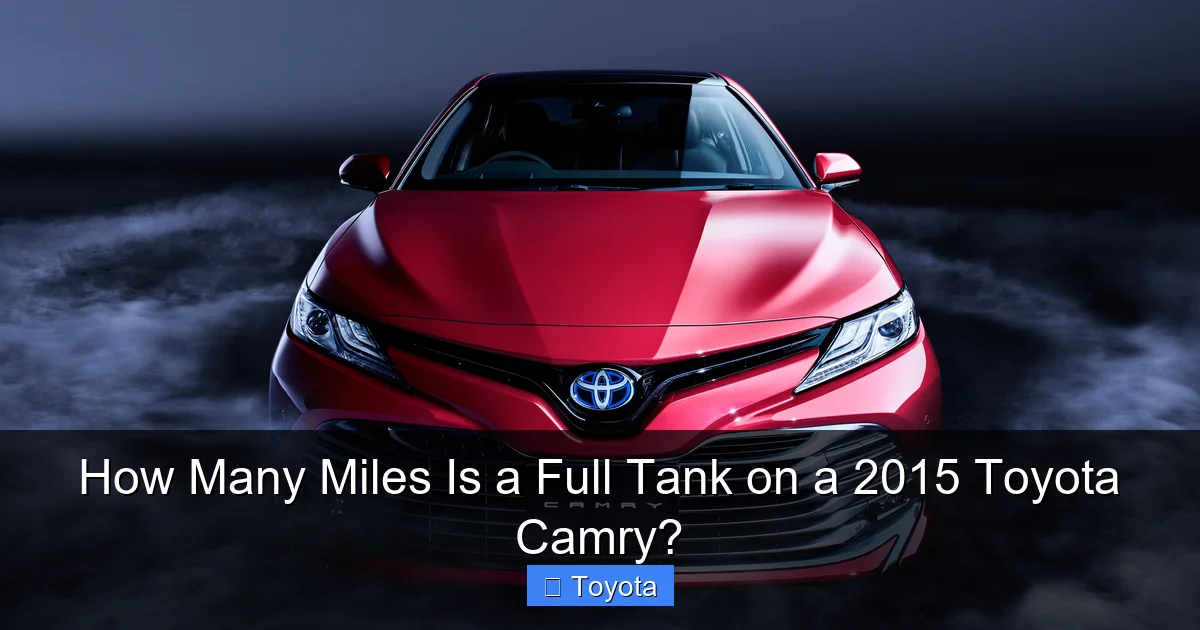
Visual guide about How Many Miles Is a Full Tank on a 2015 Toyota Camry?
Image source: hdcarwallpapers.com
The Official Capacity: 15.8 Gallons
Every single 2015 Toyota Camry, from the base L trim to the top-tier XSE V6, comes equipped with a fuel tank that holds 15.8 U.S. gallons (approximately 59.8 liters). This is a key piece of data. Unlike some manufacturers who vary tank size by trim or drivetrain (FWD vs. AWD), Toyota kept it uniform. This means the potential maximum range difference between a basic commuter Camry and a sportier V6 model comes down almost entirely to one thing: fuel efficiency (MPG), not tank volume. If you’ve ever wondered how big is the gas tank on a Toyota Camry, the answer for this specific year is a straightforward 15.8 gallons. This generous capacity is part of the Camry’s “go anywhere” appeal, reducing the frequency of fill-ups compared to smaller compact sedans.
Usable Fuel vs. Rated Capacity
Here’s a crucial nuance: the “15.8-gallon” figure is the rated total capacity. However, you’ll never be able to put all 15.8 gallons into an empty tank. Why? The filler neck and evaporative emissions system design leave a small “ullage” space. More importantly, your fuel pump, which lives inside the tank, needs to be submerged in fuel for cooling and lubrication. Therefore, the usable fuel—the amount you can actually burn before the engine starves—is slightly less, usually by about 0.5 to 1 gallon. This is a standard industry practice and not something to worry about; your car’s computer (and the gas gauge) is calibrated to account for this unusable sliver at the bottom.
Decoding the EPA MPG Ratings: 4-Cylinder vs. V6
Now for the magic number that turns gallons into miles: Miles Per Gallon (MPG). The Environmental Protection Agency (EPA) tests every vehicle on a standardized cycle to provide city, highway, and combined estimates. For 2015, the Camry offered two distinct powertrains, each with its own personality and efficiency profile.
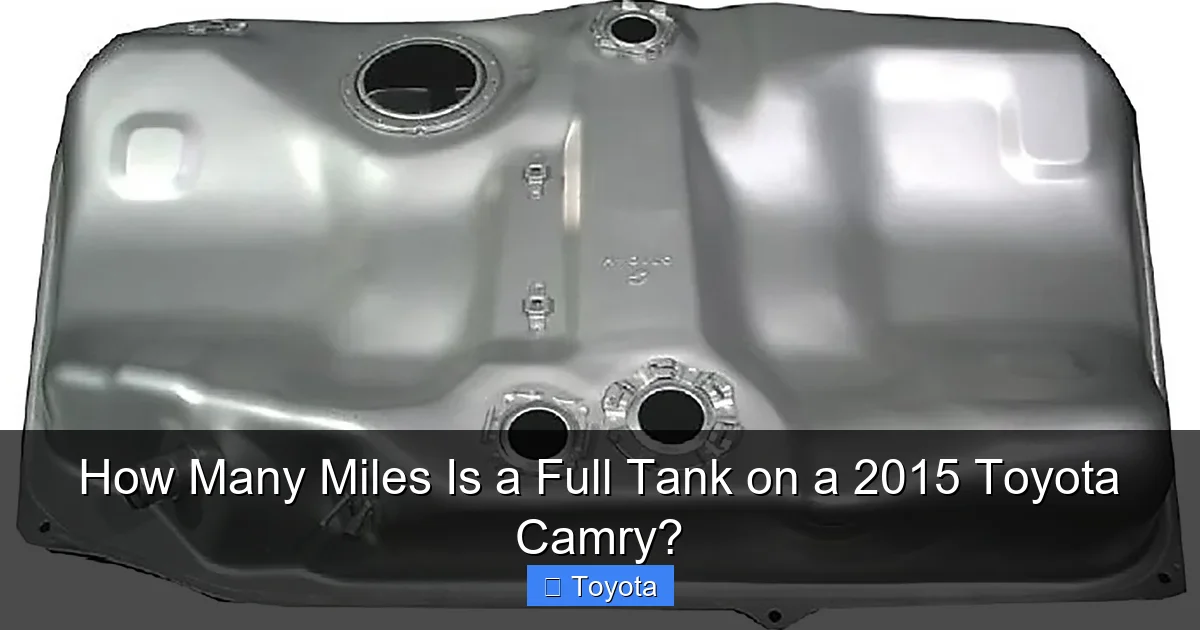
Visual guide about How Many Miles Is a Full Tank on a 2015 Toyota Camry?
Image source: cld.partsimg.com
The Efficient Workhorse: 2.5L 4-Cylinder Engine
The vast majority of 2015 Camrys on the road are powered by the 2.5-liter 4-cylinder engine (2AR-FE), paired with a smooth 6-speed automatic transmission. This is the efficiency champion. Its EPA ratings are:
- City: 25 MPG
- Highway: 35 MPG
- Combined: 28 MPG
Using the simple formula Range = Tank Capacity x MPG, we get our first set of theoretical maximums:
- City Range: 15.8 gal x 25 MPG = 395 miles
- Highway Range: 15.8 gal x 35 MPG = 553 miles
- Combined Range: 15.8 gal x 28 MPG = 442 miles
Notice the dramatic difference between city and highway. This is because city driving involves constant acceleration, braking, and idling—all fuel-intensive activities. The highway number is where the Camry’s aerodynamic shape and efficient gearing truly shine.
The Powerful Alternative: 3.5L V6 Engine
For those who prioritize acceleration and passing power, the 3.5-liter V6 (2GR-FE) was available. It delivers 268 horsepower versus the 4-cylinder’s 178 hp, but this comes at a cost to fuel economy. Its EPA ratings are:
- City: 21 MPG
- Highway: 31 MPG
- Combined: 25 MPG
Applying the same formula:
- City Range: 15.8 gal x 21 MPG = 332 miles
- Highway Range: 15.8 gal x 31 MPG = 490 miles
- Combined Range: 15.8 gal x 25 MPG = 395 miles
As expected, the V6’s range is shorter across the board, with the gap being most pronounced in stop-and-go traffic. The combined range of 395 miles is a solid figure, but it’s 47 miles less than the 4-cylinder’s combined estimate. Your choice of engine is the single biggest factor determining your Camry’s ultimate range.
Real-World vs. EPA: Why Your Numbers Will Differ
Here’s the most important section. The EPA numbers are a fantastic benchmark, but they are achieved in a lab under ideal, consistent conditions. Your real-world driving is a wild card. You should expect your actual MPG—and therefore your range—to be lower than the sticker, especially in mixed driving. Let’s break down the major variables.
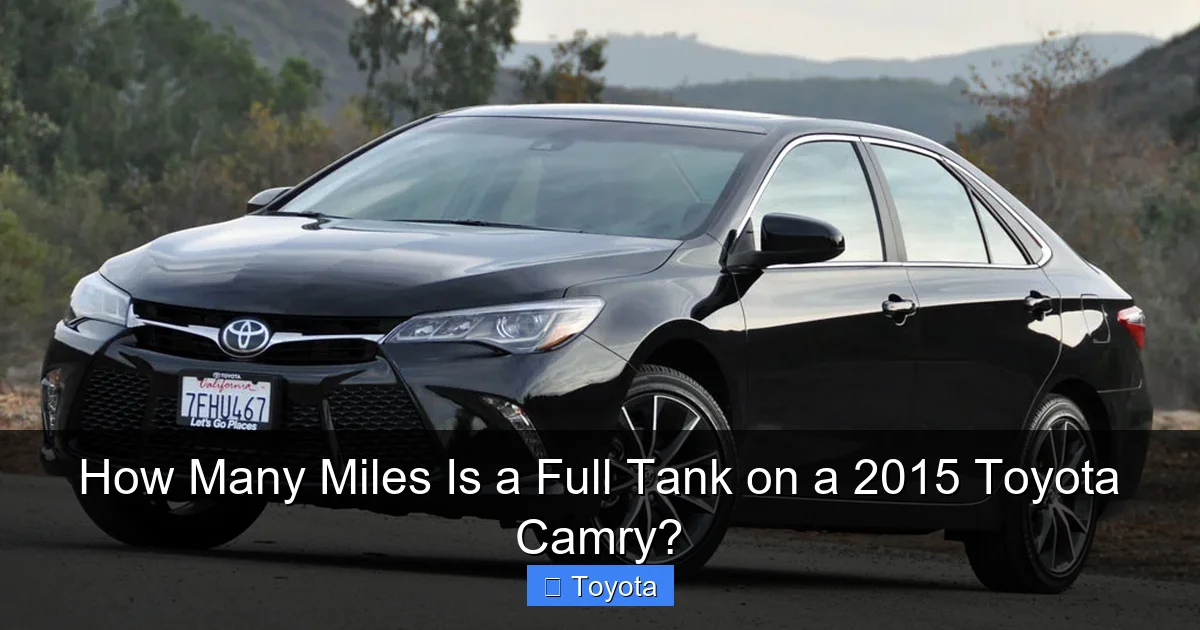
Visual guide about How Many Miles Is a Full Tank on a 2015 Toyota Camry?
Image source: static.cargurus.com
Driving Style: The Footprint Factor
Your right foot is the most powerful fuel economy tool (or weapon). Aggressive driving—rapid acceleration, hard braking, and speeding—is the number one killer of MPG. It can slash your efficiency by 20-30% in city driving. Conversely, smooth, anticipatory driving—gentle acceleration, early braking, and maintaining steady speeds—can often help you meet or even slightly exceed the EPA highway number in real-world cruising. Think of it like this: every time you rocket from 0 to 45 mph, you’re burning a concentrated packet of fuel. Dragging that acceleration out over 6 seconds instead of 3 saves a surprising amount.
Environment and Load: The Uncontrollables
You can’t control the weather or your passengers, but they control your fuel bill.
- Temperature: Cold starts are inefficient. The engine runs richer until warm. Using the heater and defroster adds electrical load. In extreme cold, MPG can drop 10-15%. Very hot weather means constant A/C use, which can sap 5-10% of your power and efficiency.
- Wind: A strong headwind is like driving uphill constantly. It dramatically increases aerodynamic drag, hurting highway MPG. A tailwind does the opposite.
- Terrain: Living in the mountains? All those inclines require more fuel to climb. While you regain some energy on downhill coasts (with modern fuel-injected cars, you often use zero fuel on a long descent), the net effect is lower average MPG.
- Vehicle Load: Every 100 pounds of extra weight—passengers, cargo, roof racks—reduces MPG by about 1-2%. A fully loaded Camry on a family road trip will have a noticeably shorter range than a solo driver.
Vehicle Health: The Maintenance Multiplier
A well-maintained Camry will perform as intended. A neglected one will not. Key items that directly impact fuel economy:
- Tire Pressure: This is huge. Under-inflated tires increase rolling resistance. For every 1 PSI below the recommended door-jamb pressure, you lose about 0.3% MPG. Check them monthly!
- Engine Air Filter: A clogged filter starves the engine of air, forcing it to work harder and burn more fuel. A simple, cheap fix.
- Oil Quality & Weight: Using the correct, modern oil (like 0W-20 for the 2015 Camry) ensures optimal engine lubrication and efficiency. Old, sludgy oil creates internal drag.
- Spark Plugs & Sensors: Worn plugs or faulty oxygen (O2) sensors can cause incomplete combustion and poor fuel mixture, wrecking MPG.
The Gas Light: Your Final Warning Beacon
That moment the low-fuel warning light—usually a yellow gas pump icon—glows on your dashboard is a universal spike of anxiety. How far can you *really* go? The answer is: don’t push it, but you have a buffer.
How Much is Left When the Light Comes On?
Automakers design the warning system to activate with a safe reserve. For the 2015 Camry, most owner reports and technical data suggest the light comes on when there are approximately 1.5 to 2.5 gallons of fuel remaining in the tank. The exact trigger point can vary slightly by model year and even individual vehicle calibration. This reserve is not for daily use; it’s a “get to a station” margin of safety that protects you from being stranded due to a miscalculation or a closed gas station.
Calculating the Reserve Range
To find your potential “miles after gas light” range, you multiply your current real-world MPG by your estimated reserve gallons.
- For a 4-cylinder owner getting a realistic 30 MPG on the highway: 30 MPG x 2 gallons reserve = ~60 miles.
- For a V6 owner getting 28 MPG in mixed driving: 28 MPG x 1.8 gallons reserve = ~50 miles.
In heavy city traffic with lower MPG, that number drops quickly. It’s critical to understand this is a highly variable estimate. The safest practice is to treat the gas light as a “please refuel within the next 30 miles” alert. For a deeper dive into this specific safety buffer, you can read our detailed analysis of how many miles you can drive when the gas light comes on in a Toyota Camry. It’s also interesting to compare with other Toyotas; for instance, the range after the light in a Corolla can differ due to a smaller tank but similar efficiency—check out the data on how many miles can you drive after the gas light comes on in a Toyota Corolla.
Maximizing Your Camry’s Range: Practical Tips
Want to squeeze every last mile from your 15.8 gallons? It’s a game of small, consistent habits. You don’t need to hypermile; just be mindful.
Driving Techniques That Pay Off
- Use Cruise Control on Flat Highways: Maintaining a constant speed is far more efficient than the tiny speed fluctuations of your right foot. Set it at or slightly below the posted limit.
- Plan Your Acceleration: See a red light ahead? Start slowing down earlier. Coast in gear (modern cars cut fuel injection when coasting) instead of braking at the last second.
- Minimize Idling: If you’re stopped for more than 30-60 seconds (not in traffic), turn the engine off. An idling car gets 0 MPG.
- Reduce Drag at Speed: Remove roof racks or cargo boxes when not in use. At highway speeds, they create significant drag.
Pre-Trip & Maintenance Checklist
- Check Tire Pressure: Inflate to the PSI listed on the driver’s door jamb sticker, not the max on the tire sidewall. Do this when tires are cold.
- Use the Recommended Oil: Stick to 0W-20 synthetic oil as specified. It’s designed for low friction.
- Replace Air Filter: A clean filter is a cheap performance and economy mod.
- Plan Your Route: Use a GPS that offers an “eco” or “fuel-efficient” route option, which often avoids stop-and-go traffic and hills.
- Lighten the Load: Before a long trip, clear out unnecessary items from the trunk and back seat.
Conclusion: Your Personal Range Equation
So, how many miles is a full tank on a 2015 Toyota Camry? The textbook answer is a range of roughly 395 to 553 miles for the 4-cylinder and 332 to 490 miles for the V6, based on EPA ratings and a 15.8-gallon tank. But your personal, real-world number is what truly matters. It’s a living equation: (Your Real-World Average MPG) x (15.8 Gallons) = Your Actual Range. That average MPG is a reflection of your engine choice, your driving style, your environment, and your car’s health.
The beauty of the Camry is its predictability and reliability. By understanding these factors—knowing your tank size, respecting the gas light reserve, and practicing a few fuel-conscious habits—you transform that little voice of doubt into one of confident planning. You’ll know exactly when you need to refuel for your next adventure, whether it’s a cross-country trek or just the weekly grind. The 2015 Camry isn’t just a point-A-to-point-B car; it’s a testament to thoughtful engineering that, with a little knowledge, can take you very, very far on a single tank. Now, go fill up, reset your trip meter, and see what your Camry can really do.
Frequently Asked Questions
Does the 2015 Camry have different tank sizes for different trims?
No. All 2015 Toyota Camry models, regardless of trim level (L, LE, SE, XSE, XLE) or engine (2.5L 4-cylinder or 3.5L V6), use the same 15.8-gallon fuel tank. The range difference comes from engine efficiency, not tank size.
How accurate is the “Miles to Empty” display on the dash?
It’s a useful estimate but not a precise measurement. The computer calculates it based on recent driving MPG and fuel level. It can be thrown off by driving style changes, hills, or a recently filled tank. It’s best used as a relative trend, not an exact countdown. Always have a 30-50 mile buffer after the gas light comes on.
Should I use regular or premium gas in my 2015 Camry?
All 2015 Camry engines are designed to run on regular unleaded gasoline with a 87 octane rating. Using premium is not required and will not improve fuel economy or performance. The V6 model explicitly states “Regular Unleaded” on the fuel door.
Does towing or using a bike/cargo roof rack significantly reduce range?
Yes, significantly. Adding a roof rack or cargo carrier increases aerodynamic drag, which hurts highway MPG the most. Towing a trailer adds immense weight and drag, potentially reducing your overall range by 25% or more. Always account for this extra load when planning trips.
Why is my Camry getting worse MPG in the winter?
Cold weather affects fuel economy in several ways: engines run longer to warm up, fuel blends are less energy-dense, tire pressure drops (increasing rolling resistance), and the use of heaters, defrosters, and heated seats increases electrical load. A 10-20% drop in MPG during very cold months is normal.
What is the single best thing I can do to improve my Camry’s fuel range?
Maintain proper tire pressure. Under-inflated tires are a stealthy fuel thief, increasing rolling resistance and wear. Checking and adjusting your tires to the manufacturer’s specified PSI (found on the driver’s door jamb sticker) once a month is the most effective, easiest, and cheapest way to ensure you’re getting the MPG your Camry is capable of.
