
How Much Is Transmission Fluid for a 2012 Toyota Camry?

Figuring out the cost of transmission fluid for your 2012 Toyota Camry involves more than just the price of the liquid itself. The total expense typically ranges from $100 to $250 for a professional fluid change, or $30 to $60 for the fluid if you do it yourself. The final price depends heavily on whether you use genuine Toyota fluid or a quality equivalent, if you perform a simple drain-and-fill or a full flush, and your geographic location. Always consult your owner’s manual for the specific fluid type and capacity to ensure you’re protecting your transmission.
Key Takeaways
- Fluid Type is Critical: Your 2012 Camry requires Toyota Genuine ATF WS (World Standard) or an equivalent Dexron-VI/Aisin AW specification fluid. Using the wrong type can cause serious damage.
- Capacity Varies by Method: A simple drain-and-fill replaces about 40-45% of the old fluid (roughly 4-5 quarts). A complete flush through the cooler lines can require 8-12 quarts to fully exchange the system.
- DIY Costs vs. Professional: Doing it yourself costs only for the fluid ($30-$60 for 5-6 quarts). Professional service adds labor ($70-$150) and often uses a machine for a more thorough flush, raising the total to $100-$250.
- Location & Shop Type Affects Price: Dealerships are typically the most expensive ($150-$250+), while independent mechanics and quick-lube shops offer lower prices ($100-$180), but confirm they use the correct fluid.
- Maintenance Interval: Toyota’s recommendation for “severe” driving conditions is every 60,000 miles. For normal driving, many experts suggest a drain-and-fill every 30,000-50,000 miles as preventative maintenance.
- Neglecting This Service is Costly: Old, degraded transmission fluid loses its lubricating and cooling properties, leading to premature wear, slipping, harsh shifts, and ultimately, a very expensive transmission rebuild or replacement.
- Check Your Level Regularly: The transmission should be checked with the engine warm and running, in park. Low fluid or fluid that smells burnt is a red flag requiring immediate attention from a professional.
📑 Table of Contents
- Understanding Your 2012 Toyota Camry’s Transmission Fluid
- The Specifics: What Fluid Does a 2012 Camry Need?
- How Much Fluid Do You Actually Need?
- Breaking Down the Costs: DIY vs. Professional Service
- Factors That Influence the Final Price
- Proactive Maintenance: Your Best Financial Strategy
- Common Pitfalls and Mistakes to Avoid
- Conclusion: Protecting Your Investment
Understanding Your 2012 Toyota Camry’s Transmission Fluid
Let’s talk about something that doesn’t get nearly enough attention but is absolutely vital to your car’s health: transmission fluid. If you own a 2012 Toyota Camry, you’ve got a reliable sedan that’s known for longevity. But that longevity hinges on proper maintenance, and transmission fluid is a big piece of that puzzle. Thinking about it can be confusing. Is it expensive? What kind do I need? How often should I change it? Can I do it myself? We’re going to break it all down, from the exact fluid specification to a full cost analysis, so you know exactly what you’re looking at for your specific vehicle.
First, a quick reality check. The 2012 Camry came with two main engine options: the 2.5L 4-cylinder and the 3.5L V6. Both were paired with a 6-speed automatic transmission. The good news is, both transmissions use the exact same fluid. That simplifies things! The fluid isn’t just a simple lubricant; it’s a hydraulic fluid that creates pressure to shift gears, a coolant that keeps the transmission from overheating, and a cleanser that carries away metal shavings and debris. Over time, this fluid breaks down, gets contaminated, and loses its magical properties. When that happens, your transmission starts to suffer silently until major problems surface.
The Specifics: What Fluid Does a 2012 Camry Need?
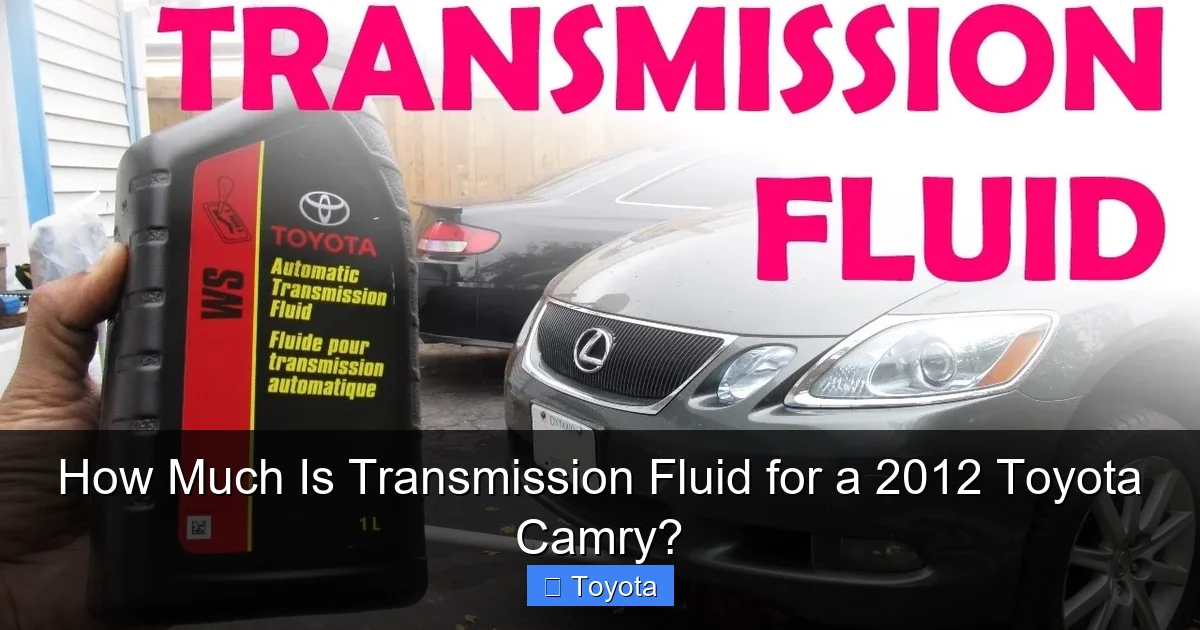
This is the most important question you can ask. Using the wrong transmission fluid is like using dish soap in your engine—it’s a recipe for disaster. For your 2012 Camry, Toyota specifies Toyota Genuine ATF WS (World Standard). This is a synthetic fluid designed for superior performance in modern, electronically controlled transmissions.
Visual guide about How Much Is Transmission Fluid for a 2012 Toyota Camry?
Image source: i.ytimg.com
What Does “WS” Mean?
WS stands for “World Standard.” It’s Toyota’s proprietary formulation that meets or exceeds several industry specifications. The key thing to know is that it’s not the same as the older Type T-IV fluid used in some pre-2006 models. It’s also different from Dexron or Mercon fluids from years past. It’s a low-viscosity, highly stable fluid.
Can I Use an Aftermarket or Equivalent Fluid?
Yes, but you must be careful. Many reputable aftermarket brands produce fluids that are explicitly formulated to meet Toyota’s ATF WS specification. Look for labels that state “Dexron-VI” or “Aisin AW” specification, as these are often compatible, but the safest bet is to find a product that directly says “for Toyota ATF WS” or “meets Toyota WS specification.” Brands like Valvoline, Pennzoil, and Red Line offer compatible products. When in doubt, spend the extra few dollars on the genuine Toyota fluid from the dealership or a trusted online retailer. It’s cheap insurance for a multi-thousand-dollar component.
How Much Fluid Do You Actually Need?
This is where it gets interesting, and the answer isn’t a single number. The total capacity of the transmission system is about 8.5 to 9.5 quarts (depending on whether it’s a 4-cylinder or V6 model). However, you never get all the old fluid out in a simple service. The fluid lives in the torque converter, the valve body, and every nook and cranny of the transmission.
Visual guide about How Much Is Transmission Fluid for a 2012 Toyota Camry?
Image source: dummies.com
The “Drain-and-Fill” Method
This is the most common DIY and basic shop procedure. You remove the transmission pan, let the fluid drain, replace the filter and gasket, and refill. This typically replaces about 40-45% of the total fluid. You’ll need approximately 4 to 5 quarts for this procedure. It’s an effective way to introduce fresh fluid and remove the dirtiest portion, but it leaves a significant amount of old fluid mixed in.
The “Full Flush” or “Transmission Fluid Exchange”
This is a more thorough process. Specialized equipment connects to the transmission cooler lines. The machine pumps new fluid in as it simultaneously draws old fluid out, eventually running nearly the entire system’s capacity through the transmission. This method can require 8 to 12 quarts of fluid to complete, as the machine’s lines and internal reservoir need to be primed and purged as well. A true flush is more effective at removing all old fluid and contaminants but is typically more expensive and is almost always done by a professional.
Breaking Down the Costs: DIY vs. Professional Service
Now, the number you’ve been waiting for: How much is transmission fluid for a 2012 Toyota Camry? Let’s separate the cost of the fluid from the cost of the service.
Visual guide about How Much Is Transmission Fluid for a 2012 Toyota Camry?
Image source: i.ytimg.com
Cost of the Fluid Itself
If you’re just buying the fluid, here’s what you’ll pay:
- Genuine Toyota ATF WS (1 Quart): $12 – $18 per quart at a dealership or online.
- Aftermarket Equivalent (1 Quart): $8 – $15 per quart at an auto parts store.
For a drain-and-fill (4-5 quarts), your fluid cost will be $32 to $90. For a full flush (8-12 quarts), the fluid alone will be $64 to $180. Buying in larger containers (like a 5-quart jug) usually offers a slight discount per quart.
Cost of Professional Service
This is where labor, equipment, and markup come into play. Here is a typical price breakdown:
- Quick-Lube Shop (e.g., Valvoline, Jiffy Lube): $99 – $149 for a fluid exchange (machine flush). They often use a high-quality aftermarket fluid. Always call and ask “Do you use fluid that meets Toyota’s ATF WS specification?” If they say no or don’t know, walk away.
- Independent Mechanic / Garage: $120 – $200 for a drain-and-fill or exchange. They are more likely to use the correct fluid, especially if they specialize in Japanese cars. This is often the best value for quality work.
- Toyota Dealership: $180 – $280+ for a transmission fluid service. You are paying for the genuine Toyota fluid, factory-trained technicians, and the highest guarantee of correctness. This is the “gold standard” but comes at a premium.
Bottom Line: For a proper service with the right fluid, budget $100 to $250. The low end is a basic drain-and-fill at an independent shop using aftermarket fluid. The high end is a full dealership service with genuine parts and a flush.
Can You Do It Yourself? The DIY Path
Yes, a drain-and-fill is a very achievable DIY project for someone with basic mechanical skills and the right tools (socket set, fluid pump or squeeze bottle, drain pan, torque wrench). It will take about an hour. You’ll spend money on fluid ($40-$60), a new pan gasket/filter kit ($15-$30), and maybe a shop towel or two. Your total cost: $55 to $90. The major savings is on labor. However, you must be meticulous about checking the fluid level correctly with the car running and in park, and not overfilling. Overfilling is just as bad as underfilling.
Factors That Influence the Final Price
Why is there such a wide range in cost? Several factors come into play that will push your final bill up or down.
1. Your Geographic Location
Labor rates vary wildly. A transmission fluid change in New York City or San Francisco will cost significantly more than in a small town in the Midwest. Always get local quotes.
2. The Type of Service Performed
As covered, a simple drain-and-fill is cheaper than a full power flush. A flush is more comprehensive but uses more fluid and requires more expensive equipment. Some shops may also offer a “transmission service” that includes cleaning the pan, replacing the filter, and adjusting bands (on older models), which adds cost.
3. The Fluid Brand Used
Genuine Toyota fluid is the most expensive. A high-quality aftermarket equivalent is cheaper. Some discount shops may use a generic ” Dexron-VI” fluid that meets the spec but isn’t specifically branded for Toyota. This is usually fine, but it’s a point of price variation.
4. Additional Services & “Upsells”
Be aware of the upsell. A shop might look at your old fluid and say, “Your pan is full of metal shavings, you need a transmission filter kit,” adding $25-$50. Or they might recommend a “transmission conditioner” additive. These can sometimes be legitimate, but often they are profit centers. A filter and gasket should be replaced with every drain-and-fill on this model, so that cost is usually included in a reputable quote.
5. Shop Type and Overhead
Dealerships have the highest overhead (facility, training, parts inventory). Independent shops have lower overhead. Big chain quick-lubes have volume but may have higher standardized pricing. Your local, trusted independent mechanic is often the sweet spot for price and quality.
Proactive Maintenance: Your Best Financial Strategy
Let’s shift from cost to value. Spending $150-$200 every 60,000 miles on a transmission fluid service is one of the best investments you can make in your Camry. A transmission rebuild or replacement for this model can easily run $3,000 to $5,000+. That’s 15 to 30 fluid changes. The math is simple: regular fluid maintenance prevents catastrophic failure.
What’s the Correct Interval?
This is a point of some debate. Toyota’s official “maintenance minder” system for the 2012 Camry does not have a specific alert for transmission fluid under “normal” driving. Their recommendation for “severe” driving (frequent short trips, extreme temps, heavy loads, towing, mountainous areas) is every 60,000 miles. However, many transmission specialists and mechanics, seeing the age of these vehicles on the road today, recommend a more proactive approach. A drain-and-fill every 30,000 to 50,000 miles is a smart, inexpensive insurance policy, especially if you plan to keep the car past 150,000 miles. If you’ve never had the fluid changed and you’re at 120,000 miles, it’s not too late. Start now and plan for a second drain-and-fill in 30,000 miles to get most of the old fluid out.
How to Check Your Fluid Yourself
You should check your transmission fluid level at least once every few months. Here’s how for your 2012 Camry:
- Drive the car for at least 15-20 minutes to get the transmission fully warmed up.
- Park on level ground, leave the engine running, and set the parking brake.
- Move the shifter through all the gears (P, R, N, D, 4, 3, 2, 1) and hold each for a few seconds, then return to Park.
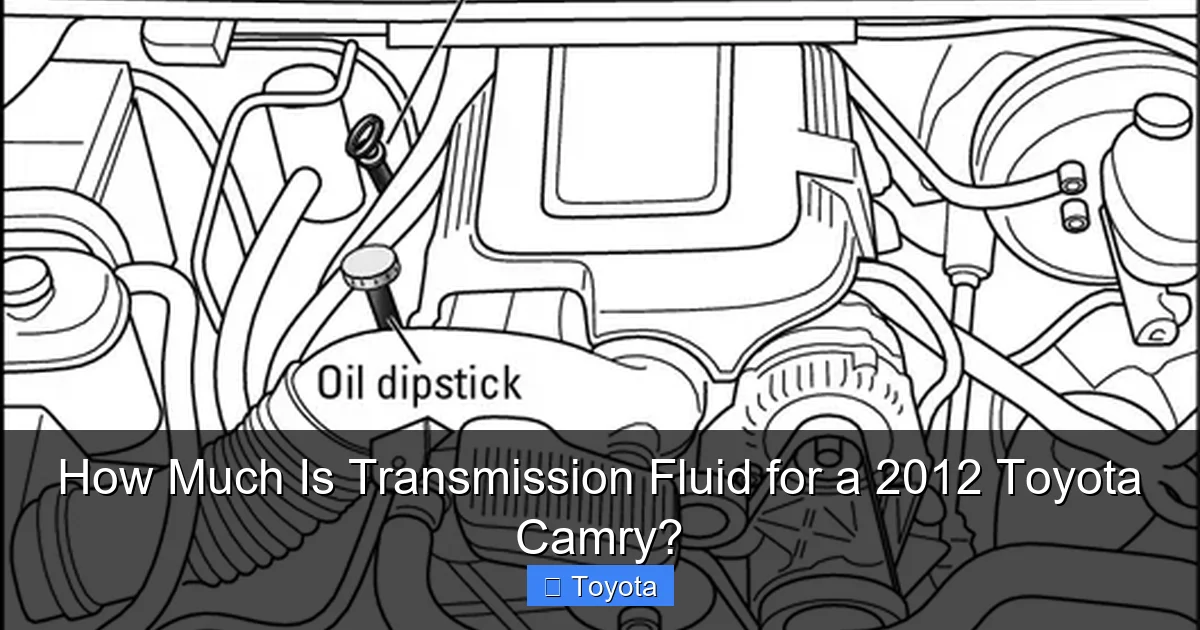
- Pull the dipstick (it’s red-handled, near the back of the engine bay, labeled “ATF”). Wipe it clean.
- Reinsert it fully, then pull it out and read the level. It should be between the “HOT” marks. The fluid should be a clear, reddish-pink color. If it’s dark brown or black, or smells burnt, it’s overdue for a change.
If the level is low, add the correct fluid a little at a time. A chronic low fluid level indicates a leak that must be found and fixed.
Common Pitfalls and Mistakes to Avoid
Whether you’re DIYing or hiring someone, be aware of these critical errors.
Using the Wrong Fluid
We’ve said it before, but it bears repeating. This is the #1 mistake. Do not use old-school Dexron III, Mercon, or Type F fluid. It will not shift properly and will damage seals and internal components over time. Always confirm the shop will use ATF WS or an exact equivalent.
Overfilling or Underfilling
This is a delicate procedure. The transmission must be at operating temperature, and the engine must be running in Park to get an accurate reading. Underfilling causes slipping and overheating. Overfilling causes aeration (foaming), which leads to erratic shifts, slippage, and can damage the pump. Add fluid slowly and re-check frequently.
Skipping the Filter and Gasket
On a drain-and-fill, you’re dropping the pan. You should always replace the crush washer/gasket on the pan drain plug and, more importantly, the transmission filter. The old filter is full of gunk and will immediately contaminate your new fluid. The filter kit is inexpensive and essential.
Ignoring a Problem
A fluid change is a maintenance item. It is not a cure for a failing transmission. If your Camry is already slipping, shuddering, refusing to shift, or has a Check Engine Light with transmission-related codes (P07xx, P17xx series), a fluid change is too late. It may provide a temporary improvement, but the underlying mechanical or electronic failure needs diagnosis and repair. A fluid change on a dying transmission is like putting new oil in an engine with a thrown rod—a waste of money.
Conclusion: Protecting Your Investment
So, how much is transmission fluid for a 2012 Toyota Camry? In the simplest terms, the fluid itself costs between $30 and $60 for enough to do a basic service. The service itself, when done professionally, adds another $70 to $190 to the tab. Your total out-the-door cost will land somewhere between $100 and $250.
The real answer, however, is that the cost is an investment. It’s a small, predictable expense designed to prevent a massive, unpredictable one. Your 2012 Camry’s transmission is a robust unit, but it’s not indestructible. It relies on that special red fluid to do its job smoothly and coolly for hundreds of thousands of miles. By using the correct Toyota ATF WS fluid, adhering to a sensible maintenance interval (every 30k-60k miles), and choosing a reputable shop or learning to do it carefully yourself, you are directly contributing to the legendary reliability your Camry is known for. Don’t wait for symptoms to appear. Be proactive. Check your fluid today, note its color and level, and make a plan to service it. Your future self, and your wallet, will thank you when your Camry is still shifting smoothly at 200,000 miles.
Frequently Asked Questions
Can I use Valvoline MaxLife ATF in my 2012 Toyota Camry?
Yes, Valvoline MaxLife ATF is explicitly formulated to meet or exceed the Toyota ATF WS (World Standard) specification. It is a high-quality, widely available aftermarket equivalent and is perfectly suitable for your Camry’s transmission.
What happens if I accidentally put the wrong transmission fluid in my Camry?
Using the wrong fluid (like Dexron III or Mercon) can cause immediate or gradual problems. You may experience harsh or slipping shifts, and the fluid can degrade seals and clutch materials over time, leading to internal transmission damage. If you’ve added the wrong fluid, do not start the engine. Have it drained and refilled with the correct ATF WS immediately by a professional.
Is a “transmission flush” necessary for my 2012 Camry?
A full machine flush is more thorough than a drain-and-fill, replacing up to 90% of the old fluid versus about 40%. It’s a good service, especially if the fluid has never been changed or is very dirty. However, a properly done drain-and-fill with filter replacement is also effective maintenance. The key is using the correct fluid and doing it regularly. A flush is not “necessary” but is a more complete service option.
My 2012 Camry has 150,000 miles and the fluid has never been changed. Should I do it now?
Absolutely yes, but with caution. At this high mileage, the transmission seals and internal components are likely conditioned to the old, degraded fluid. Abruptly introducing fresh, different viscosity fluid can sometimes cause shifting changes or, in rare cases, reveal existing wear. The best approach is to have a shop perform a drain-and-fill now, then plan to do another one in 20,000-30,000 miles. This staged approach is safer than a single full flush on an unknown history transmission.
How can I tell if my transmission fluid is bad?
Check it with the dipstick when the engine is warm and running. Good fluid is a clear, bright red or pinkish color and smells slightly sweet. Bad fluid is dark brown or black, opaque, and has a strong, burnt odor. You may also notice the car shifting harshly, slipping between gears, or experiencing a shudder when accelerating. Any of these signs indicate the fluid is degraded and needs service.
Does the 2012 Camry have a transmission filter that needs replacing?
Yes. The 6-speed automatic transmission in the 2012 Camry has an internal filter that is accessed by dropping the transmission pan. This filter should be replaced every time you perform a drain-and-fill service. It traps metal shavings and debris, and reusing a clogged filter will immediately contaminate your new fluid. A reputable service will always include a new filter and pan gasket in their quote.
