
Why Is My Odometer Blinking on My Jeep Cherokee?

If your Jeep Cherokee’s odometer is blinking, it’s not the odometer itself but a warning from your vehicle’s computer about a serious issue. This usually points to problems with the ABS, speed sensors, or PCM. Do not ignore it—get a diagnostic scan immediately to identify the fault code and address the underlying problem to ensure your safety.
Key Takeaways
- Safety First: A blinking odometer is a serious warning light, not a minor inconvenience. It often indicates a fault that can affect critical safety systems like ABS and traction control.
- It’s a Message, Not the Odometer: The blinking display is your vehicle’s way of communicating a stored diagnostic trouble code (DTC) from a control module, typically the Powertrain Control Module (PCM) or Body Control Module (BCM).
- Common Culprits: The most frequent causes are faulty wheel speed sensors, damaged wiring harnesses, or communication errors between the PCM and other modules like the ABS controller.
- Diagnosis is Essential: You cannot guess the fix. A professional-grade OBD2 scanner is required to read the specific manufacturer-specific code that is causing the odometer to blink.
- Repair Costs Vary Widely: Fixes can range from a simple $50 sensor replacement to a complex and expensive $1,000+ PCM reprogramming or replacement, depending on the root cause.
- Do Not Reset It Yourself: Simply clearing the code without repairing the underlying problem will cause the light to return, often immediately, and you may permanently disable a safety system.
- Professional Help Recommended: Due to the complexity of Jeep’s integrated systems and the need for proprietary diagnostic tools, a qualified technician with Jeep experience is strongly advised.
📑 Table of Contents
- Introduction: That Unsettling Blink
- What Does a Blinking Odometer Actually Mean?
- The Most Common Causes of a Blinking Odometer in a Jeep Cherokee
- How to Diagnose the Problem: A Step-by-Step Guide
- Fixes and Repairs: From Simple to Complex
- Why This is a Safety Issue, Not Just an Annoyance
- Conclusion: Don’t Ignore the Signal
Introduction: That Unsettling Blink
You’re driving your trusty Jeep Cherokee, maybe on a routine commute or an exciting off-road adventure, and you glance at the dash. Everything looks normal until you notice it: the numbers on your odometer are blinking. Not a steady glow, but a repetitive, urgent flash. Your heart might skip a beat. What does it mean? Is your Jeep broken? Is it safe to drive?
First, take a breath. A blinking odometer on a Jeep Cherokee, especially models from the early 2000s through the 2020s, is a very specific and intentional warning from your vehicle’s computer network. It is not a random glitch or a dying bulb in the instrument cluster. This blinking is your Cherokee’s way of shouting, “Hey! I have a stored trouble code that you need to check!” It is a telltale sign of a communication fault or a sensor failure within one of the vehicle’s critical systems.
Understanding this signal is the first step to getting your Jeep back to its reliable, adventurous self. This guide will walk you through exactly what that blinking means, the most common reasons it happens, how to properly diagnose it, and what your repair options are. We’ll cut through the mystery and give you the clear, actionable information you need.
What Does a Blinking Odometer Actually Mean?
Let’s clarify a common misconception right away: the blinking is almost never a problem with the odometer mechanism itself. In modern vehicles like the Jeep Cherokee, the numbers you see are part of a digital display controlled by the Body Control Module (BCM) or the Powertrain Control Module (PCM). When one of these computers detects a significant fault, it commands the instrument cluster to blink the odometer as a universal “service required” indicator.
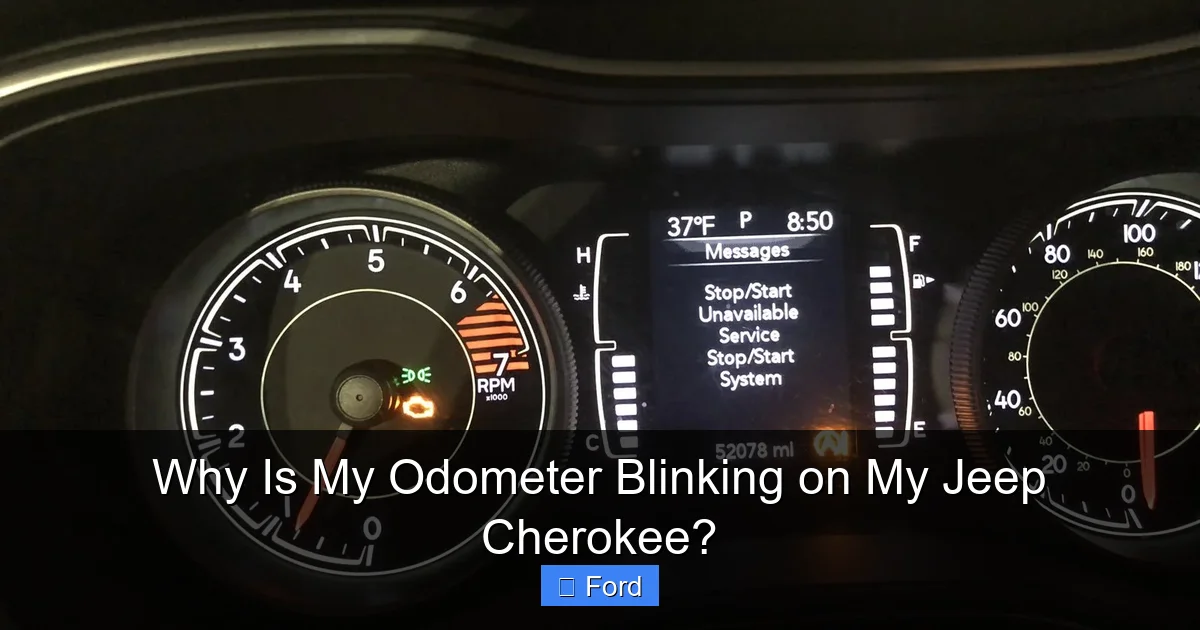
Visual guide about Why Is My Odometer Blinking on My Jeep Cherokee?
Image source: static.cargurus.com
The “Secret Code” in the Blink
That blinking pattern is often more than just a generic warning. In many Jeep models, the blink sequence can actually correspond to a specific diagnostic trouble code (DTC). For example, a series of blinks, a pause, and then more blinks might be the instrument cluster trying to display a code like “P0500” (Vehicle Speed Sensor) or “C0200” (ABS Wheel Speed Sensor). However, this manual code-reading method is unreliable and inconsistent. The only surefire way to know the exact code is to use a proper scan tool.
When you connect a diagnostic scanner to your Cherokee’s OBD2 port (usually under the dash, near the steering column), it will communicate with the PCM and BCM. One of the stored codes will have a status like “Active” or “History” and will be accompanied by a description. This code is the direct cause of the blinking odometer. Without reading this code, you are diagnosing in the dark.
The Most Common Causes of a Blinking Odometer in a Jeep Cherokee
While the exact code will tell you the precise issue, decades of mechanic experience and Jeep owner forums point to a handful of usual suspects. The problems typically revolve around speed sensing and module communication, as the vehicle’s speed is a fundamental data point used by countless systems.
Visual guide about Why Is My Odometer Blinking on My Jeep Cherokee?
Image source: cartireinflator.com
Faulty Wheel Speed Sensor (ABS Sensor)
This is the number one culprit. Your Jeep Cherokee has a wheel speed sensor at each wheel that feeds data to the Anti-lock Braking System (ABS) module. If one sensor fails, gets damaged by road debris, or has a corroded connector, the ABS module loses that data. It flags an error, which often propagates to the PCM/BCM, triggering the blinking odometer. You might also notice the ABS light is on, and your traction control system may be disabled. This is a very common issue across all Jeep models, and even a tire pressure monitoring system (TPMS) fault can sometimes be related, as many systems share sensor data.
Failed Vehicle Speed Sensor (VSS)
The VSS, often located on the transmission or transfer case, tells the PCM how fast the vehicle is moving. A failing VSS will cause erratic speedometer readings, harsh or delayed shifting in automatic transmissions, and will almost certainly set a code that makes the odometer blink. In a Cherokee, a bad VSS can also affect the behavior of the 4WD system.
Damaged Wiring or Corroded Connectors
Jeep Cherokees, especially those used for off-roading or in regions with heavy road salt, are notorious for wiring issues. The wiring harnesses for the wheel speed sensors run along the wheel wells and undercarriage, where they are exposed to the elements. A frayed wire, a broken connector, or corrosion can interrupt the signal. This is a classic case where a visual inspection is crucial after a code points to a specific sensor circuit.
PCM/BCM Communication Failure
Sometimes the problem is not a sensor but the “brain” itself. The various control modules in your Cherokee (PCM, BCM, ABS module, TCM) constantly talk to each other over a network called the CAN bus. If the BCM, which controls the instrument cluster, loses communication with the PCM, it may trigger the blink. This could be due to a failing BCM, a software glitch that needs a reflash, or a problem with the network wiring. These issues are more complex to diagnose.
Aftermarket Accessory Interference
Did you recently install a new stereo, remote starter, lighting system, or dash cam? Improperly wired aftermarket accessories can introduce electrical noise or “load” on the vehicle’s circuits, confusing the sensitive sensor circuits and causing false codes. Always have accessories installed by professionals who understand CAN bus systems.
How to Diagnose the Problem: A Step-by-Step Guide
You now know the likely causes. But how do you confirm which one is affecting your Cherokee? Follow this logical diagnostic path.
Visual guide about Why Is My Odometer Blinking on My Jeep Cherokee?
Image source: fourwheeltrends.com
Step 1: The Essential Scan
This is non-negotiable. You must retrieve the stored codes. You have two main options:
- Basic OBD2 Scanner: A simple code reader from an auto parts store will read generic powertrain (P) codes. This is a good start and might give you a code like P0500 (Vehicle Speed Sensor). However, it will often miss body (B) and ABS (C) chassis codes, which are frequently the source of the blink. For a Cherokee, you need more.
- Advanced/Professional Scanner: Tools like the Autel MaxiCOM, Launch X431, or a dealer-level scan tool (CDR, WiTech) can access all modules in the Jeep, including the ABS and BCM. This is the only way to see the full picture. If you don’t own one, this is the primary reason to take your vehicle to a qualified shop or a mechanic who specializes in Jeeps. The cost of a professional diagnostic is usually far less than guessing and replacing the wrong part.
Step 2: Interpret the Code(s)
Once you have the code, look it up. For example:
- C0200 – Front/Rear Wheel Speed Sensor Circuit: Points directly to a wheel speed sensor or its wiring.
- P0500 – Vehicle Speed Sensor: Points to the transmission-mounted sensor.
- U0140 – Lost Communication with Body Module: Points to a BCM or network issue.
Note that there may be multiple codes. Always diagnose the first code that set, as it can be the root cause of others.
Step 3: Visual and Physical Inspection
Armed with a code, you can perform a targeted inspection. For a wheel speed sensor code:
- Safely lift the vehicle and locate the sensor (behind the brake rotor).
- Check for obvious damage: broken plastic housing, chewed wiring, heavy corrosion on the connector.
- Inspect the toothed reluctor ring (the tone wheel) behind the sensor for cracks or missing teeth.
- Check the sensor’s electrical resistance with a multimeter (consult a service manual for specs).
For a VSS code, inspect the sensor on the transmission and its wiring. For communication codes, the diagnosis becomes more electronic and often requires a professional.
Fixes and Repairs: From Simple to Complex
Your repair path is 100% determined by your diagnostic findings. Here is a breakdown of common fixes based on the cause.
Replacing a Wheel Speed Sensor
This is the most common and straightforward fix. A sensor typically costs $30-$80 for an aftermarket part or $60-$120 for an OEM Mopar part. Labor can take 0.5 to 1 hour per wheel, depending on the model year and whether the sensor is mounted on the knuckle or the rear differential housing. It’s a mechanical job involving removing the brake caliper and rotor (for front sensors). While a skilled DIYer can do this, proper torque on the sensor and brake components is critical for safety.
Repairing Wiring or Connectors
If the sensor is good but the wire is broken, you need to repair the harness. This involves splicing in new wire, using heat-shrink tubing, and ensuring the repair is sealed from moisture. This is often more time-consuming than a sensor replacement but much cheaper in parts.
Replacing the Vehicle Speed Sensor (VSS)
This is a more involved job as the sensor is on the transmission. It may require dropping the transmission pan or accessing it from the side. Labor time can be 2-4 hours. If your Cherokee has over 150,000 miles and you have a VSS code, it’s a classic wear item.
Addressing Module/Communication Issues
This is where things get expensive and complex:
- BCM or PCM Reprogramming: Sometimes a software update from the dealer can resolve communication bugs. This is the first, least expensive step if a module is suspected.
- Module Replacement: If a module is physically failed, it must be replaced. A new PCM/BCM from the dealer can cost $800-$1,500+ and must be programmed to your vehicle’s VIN and security system. This is not a DIY job.
- CAN Bus Wiring Repair: A break or short in the main communication wiring requires tracing and repairing the network, which is intricate work.
For these complex issues, consulting a specialist is not just recommended; it’s necessary. They have the proprietary software and experience that general mechanics may lack.
Why This is a Safety Issue, Not Just an Annoyance
It cannot be stressed enough: a blinking odometer is a safety-related warning. The systems that report to it—primarily ABS and speed sensing—are integral to your vehicle’s safe operation.
- Disabled ABS: You will lose anti-lock braking capability. In a panic stop on wet or icy roads, your wheels will lock up, leading to a skid and loss of steering control.
- Disabled Traction/Stability Control: Your Cherokee’s electronic stability systems will be offline, increasing the risk of spinouts during hard cornering or acceleration on slippery surfaces.
- Inaccurate Speedometer: Your speed reading may be wrong, leading to unintentional speeding or unsafe driving decisions.
- Transmission Issues: A bad VSS can cause your automatic transmission to shift harshly, not shift at all, or get stuck in a single gear, which is dangerous in traffic.
Driving with these systems disabled, especially in poor weather or heavy traffic, puts you and others at significant risk. The blinking light is your Cherokee’s final, unambiguous plea for attention before a system completely fails.
Conclusion: Don’t Ignore the Signal
That blinking odometer on your Jeep Cherokee is a direct line of communication from your vehicle’s most important computers. It is telling you that a critical sensor has failed or a vital communication link has been broken. The fix could be a simple, inexpensive sensor swap, or it could point to a complex electrical gremlin requiring expert diagnosis.
The universal first step is the same for all cases: retrieve the diagnostic trouble codes with a capable scanner. Do not guess. Do not reset the light and hope it goes away. The light will return, and you will have wasted time and money while disabling your safety systems. By understanding the common causes—wheel speed sensors, wiring, VSS, and module communication—you can have an informed conversation with your mechanic and ensure your Cherokee gets the correct repair the first time. Your safety, and the longevity of your vehicle, depends on listening to what your dashboard is trying to tell you.
Frequently Asked Questions
Is it safe to drive my Jeep Cherokee with a blinking odometer?
No, it is not safe. The blink indicates a failure in a system like ABS or the speed sensor, which means your anti-lock brakes and possibly traction control are disabled. You also risk inaccurate speed readings and transmission problems. Have it diagnosed and repaired before driving normally.
What is the most common cause of this problem?
The most frequent cause is a faulty wheel speed sensor (ABS sensor). These sensors are exposed to the elements and road debris and wear out over time. A failed sensor will set a code that triggers the blinking odometer display.
How much will it cost to fix?
Cost varies dramatically. A single wheel speed sensor replacement typically costs $150-$300 in parts and labor. A vehicle speed sensor (VSS) can be $300-$700. If the issue is a faulty BCM or PCM requiring replacement and reprogramming, costs can exceed $1,000. A diagnostic scan fee is usually $80-$150 and is essential to determine the exact cost.
Can I clear the blinking light myself with a code reader?
You can clear the code, but you should not without first repairing the underlying problem. The light will simply return, often within minutes or after the next key cycle. More importantly, you will have done nothing to fix the disabled safety system, and you may have erased valuable diagnostic data a technician needs.
Will a blinking odometer fix itself?
No. The blinking is a persistent warning for a stored, active fault code. The problem will not resolve on its own. In rare cases, a loose connector might re-seat itself, but this is not something to count on. The fault must be identified and corrected.
Can I replace the wheel speed sensor myself?
If you are mechanically inclined with the right tools (sockets, torque wrench, jack stands), you can replace a front wheel speed sensor. It involves removing the wheel, brake caliper, and rotor. However, you must properly torque the sensor and brake components. Rear sensors can be more difficult. If you are unsure, professional installation is highly recommended for safety reasons.
