
Can Passengers Drink Alcohol in a Car?

The answer to whether passengers can drink alcohol in a car is not a simple yes or no—it depends entirely on where you are. While the driver is almost universally prohibited from consuming alcohol, passenger laws differ dramatically from state to state. Some states allow passengers to drink in moving vehicles, while others enforce strict “open container” laws that apply to everyone. Understanding these variations is crucial to avoid legal trouble and ensure everyone’s safety on the road.
Key Takeaways
- The driver is always prohibited from drinking: Federal law and all state laws make it illegal for the driver of a moving vehicle to have any measurable blood alcohol content (BAC).
- Passenger laws are state-specific: There is no national rule for passengers. Some states permit it, others ban it, and many have nuanced rules based on vehicle type.
- “Open container” laws are key: These laws often dictate whether an open alcoholic beverage can exist in the passenger area of a vehicle, directly impacting passenger drinking.
- Special vehicles have different rules: RVs, limousines, and party buses often have exemptions, but only if they meet specific criteria like having a divided passenger compartment.
- Safety and liability extend beyond the law: Even if legal, an intoxicated passenger can create dangerous distractions for the driver and lead to other charges like public intoxication.
- Local ordinances can be stricter: Cities or counties may have rules that are more restrictive than their state’s overall law.
[FEATURED_IMAGE_PLACEHOLDER]
📑 Table of Contents
- The Short Answer: It’s Complicated, and Location is Everything
- Understanding the Two Pillars: Driver Laws vs. Passenger “Open Container” Laws
- State-by-State Breakdown: The Three Main Categories
- Special Vehicles and Common Exceptions
- Risks and Liabilities That Go Beyond the Letter of the Law
- How to Stay Informed and Avoid Trouble: A Practical Guide
- Conclusion: Safety and Legality Must Come First
The Short Answer: It’s Complicated, and Location is Everything
So, you’re on a road trip, or maybe heading to a tailgate party. The cooler is in the backseat, and a friend asks, “Hey, can I crack open a beer?” What do you say? The instinct might be to think, “As long as the driver isn’t drinking, we’re fine.” But that instinct could be dangerously wrong, depending on your location.
The simple, frustrating truth is that there is no single, nationwide answer to the question, “Can passengers drink alcohol in a car?” The United States does not have a federal law governing passenger alcohol consumption in vehicles. Instead, this is a patchwork of state statutes, and sometimes even local city ordinances, that create a confusing landscape for travelers. What’s perfectly legal on one side of a state border could be a ticketable offense on the other.
This article is your comprehensive guide to navigating this legal maze. We’ll break down the core concepts like “open container” laws, dive into the major categories of state regulations, explore exceptions for RVs and party buses, and discuss the very real safety risks that exist even in states where it’s technically legal. Our goal is to equip you with the knowledge to make smart, safe, and legal decisions every time you and your friends pile into a car.
Understanding the Two Pillars: Driver Laws vs. Passenger “Open Container” Laws
To make sense of this topic, you must separate two distinct but related legal concepts: driving under the influence (DUI) laws and open container laws.
Visual guide about Can Passengers Drink Alcohol in a Car?
Image source: lawsuitlegit.com
The Absolute Zero-Tolerance Rule for Drivers
Every single state in the union has a per se DUI law. This means it is illegal for a person to operate a motor vehicle with a blood alcohol concentration (BAC) at or above 0.08%. For commercial drivers, the limit is often 0.04%, and for drivers under 21, it’s typically zero tolerance (0.01% or 0.02%, depending on the state). There is no exception for a driver having “just one” or drinking slowly. If you are behind the wheel and have been drinking, you are breaking the law. This is the universal, non-negotiable baseline.
The Variable World of Open Container Laws
This is where the passenger question comes in. An “open container” is any bottle, can, or other receptacle of an alcoholic beverage that has been opened, has a broken seal, or the contents of which have been partially removed. Open container laws regulate where these containers can be present in a vehicle.
These laws generally apply to the “passenger area” of the vehicle—the area designed for the driver and passengers to sit. This typically includes the front and back seats but often excludes a locked glove compartment, the trunk, or the area behind the last upright seat in a van or SUV (if that area is not readily accessible to the driver or passengers while driving).
The critical distinction for our purposes is this: In some states, open container laws apply only to the driver. This means a passenger can possess and consume an open alcoholic beverage, as long as it remains in a zone that is not accessible to the driver (like the back seat of a sedan). In other states, the open container law applies to all occupants, making it illegal for anyone to have an open container in the passenger compartment of a moving vehicle. This is the fundamental split that creates the “it depends” answer.
State-by-State Breakdown: The Three Main Categories
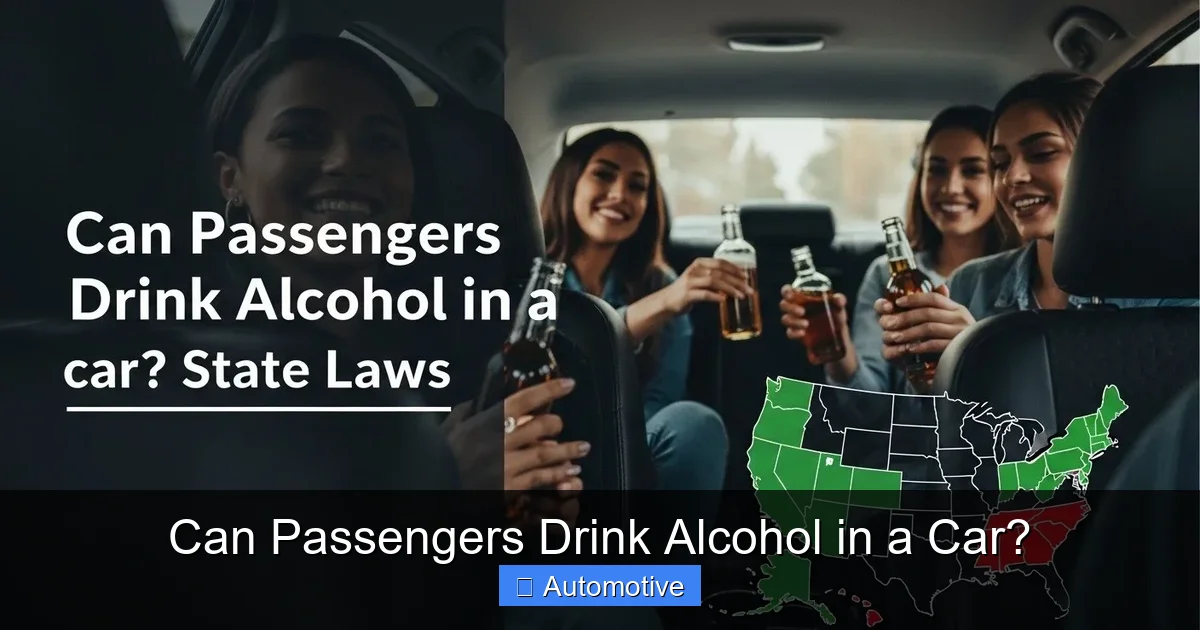
When you group the 50 states, you’ll find they generally fall into one of three categories regarding passenger drinking in a moving vehicle. Let’s explore them.
Visual guide about Can Passengers Drink Alcohol in a Car?
Image source: lawsuitlegit.com
1. States Where It’s Generally Legal for Passengers to Drink
These states have open container laws that primarily target the driver’s area. The statutes are written to prohibit the driver from having an open container or consuming alcohol, but they do not extend that prohibition to passengers in the rear seating areas. The logic is that a sober driver is in control, and a drinking passenger in the back does not directly impair the driving operation.
Practical Application: In these states, you could have a passenger in the back seat of a standard sedan or SUV drinking a beer, while the driver remains completely sober and the front seat remains alcohol-free. The open container must typically be kept in the rear area, away from the driver’s immediate reach. It’s still crucial to ensure the drinking passenger does not become so intoxicated as to distract or interfere with the driver.
Examples: States like Missouri and West Virginia follow this model. For instance, in Missouri, the law prohibits any person from possessing an open container in the “living area” of a motor vehicle, but this is interpreted to mean the area normally occupied by the driver. Passengers in the back are not covered by this statute. You can learn more about the specific nuances in Missouri’s regulations on passenger alcohol consumption.
2. States Where It’s Illegal for All Occupants (Strict Open Container Laws)
This is the more restrictive camp. These states have enacted open container laws that apply to any person in the motor vehicle. If there is an open container anywhere in the passenger compartment (the area designed for seating), it is a violation, regardless of who is drinking or who is driving. The rationale is that the presence of alcohol in the vehicle creates an environment that encourages the driver to drink and is a general safety hazard.
Practical Application: In these states, having an open beer can in the cupholder of the back seat, even if the back-seat passenger is the only one drinking it, is illegal. The entire passenger compartment must be free of open alcohol containers. This means any drinking must occur before entering the vehicle, or the vehicle must be a type with a truly separate compartment (like a limousine).
Examples: A significant bloc of states, including Virginia, Florida, and Tennessee, have such laws. In Virginia, for example, it is unlawful for any person to possess an alcoholic beverage in the passenger area of a motor vehicle on a public highway. The law makes no distinction between driver and passenger. The specifics of penalties and definitions can vary, so understanding Virginia’s specific regulations on passenger alcohol consumption is essential if you’re driving there. Similarly, Florida’s open container laws are strict and apply to all occupants. Tennessee’s approach also falls into this category, prohibiting open containers for everyone in the front and back seats of a standard vehicle.
3. States with Mixed or Nuanced Rules
Some states have laws that don’t fit neatly into the two boxes above. They may have exceptions for certain vehicle types, or their laws might be written in a way that leads to conflicting interpretations by law enforcement.
Examples:
- Exceptions for Living Quarters: States like California and New York have open container laws that apply to the driver and the passenger area, but they include an explicit exception for the “living quarters” of a motorhome or camper. This means in a properly equipped RV, passengers can drink in the living area that is separate from the driver’s compartment.
- Local Override: Some states allow counties or municipalities to enact their own open container ordinances that are stricter than the state law. This means you might drive through one county where it’s legal for a backseat passenger to drink, only to enter a neighboring county where it is not.
- Rideshare/Taxi Ambiguity: The laws are often silent on the specific status of vehicles-for-hire like taxis and Uber/Lyft. Most states treat these as standard passenger vehicles, meaning in a “strict” state, an open container would be illegal for all occupants. However, some states have no enforcement history in this area, creating a gray zone. It’s always safest to assume standard passenger vehicle rules apply unless you’re in a clearly marked limousine with a partition.
Special Vehicles and Common Exceptions
The rules change significantly when you’re not in a standard family sedan. Certain vehicle types are carved out of standard open container laws due to their design and intended use.
Visual guide about Can Passengers Drink Alcohol in a Car?
Image source: carxplorer.com
Limousines and Party Buses
These are the classic exceptions. Most states explicitly exempt limousines and charter buses/party buses from open container laws. The key requirement is almost always the presence of a fixed, physical barrier (like a partition) that separates the driver’s compartment from the passenger compartment. This barrier must be permanent and substantial—a simple curtain or rope might not suffice in the eyes of the law. The driver must have no access to the passenger area where alcohol is being consumed. If these conditions are met, passengers in the rear compartment can typically drink legally, even while the vehicle is in motion on public roads. Always confirm with the specific company’s policy, as they may have their own rules that are stricter than the law.
Recreational Vehicles (RVs) and Motorhomes
The rules for RVs are a common point of confusion. The general principle is that the “living quarters” of a motorhome are exempt from open container laws. What constitutes “living quarters”? This typically means the area behind the driver’s seat that is equipped as a permanent living space—with a bed, kitchen facilities, and often a bathroom. The driver’s immediate area (the front seats and dashboard) must remain free of open containers. If the RV has a dinette table or lounge area in the back, passengers can usually drink there while the vehicle is moving, provided the driver remains sober and the open container stays in that defined living area. It does not apply to a simple camper van where the entire interior is one open cabin with no physical separation.
The “Trunk Exception”
Many state open container laws include an important practical exception: containers that are out of reach and not accessible to the driver or passengers are often legal. This means a sealed case of beer or bottles of liquor stored in the trunk of a car (or the cargo area of an SUV that is not accessible from the passenger compartment) are not considered “open containers” and are perfectly legal to transport. The key is that they must be in a locked compartment or an area that you cannot access from inside the car while driving. A cooler on the back seat floor is accessible; a cooler in the closed trunk is not.
Risks and Liabilities That Go Beyond the Letter of the Law
Even if you are in a state where passenger drinking is technically legal, you are not free from significant risks and potential legal consequences. Choosing to drink as a passenger is not a risk-free choice.
The Distraction and Impaired Judgment Danger
The primary legal justification for strict open container laws is safety. An intoxicated passenger, even in the back seat, poses a real danger to the driver. They can be a major distraction—arguing, being loud, spilling drinks, or physically interfering. Their impaired judgment can lead them to encourage the driver to drink (“Come on, have just one!”), create stressful situations, or even engage in physical altercations. If an accident occurs, investigators will look at all factors. A drinking passenger who was rowdy or distracting could be cited for contributing to the incident, and the driver could face enhanced penalties if it’s shown the drinking environment contributed to their impairment or negligence.
Public Intoxication and Disorderly Conduct
Being intoxicated in public is a crime in most jurisdictions. While a car is arguably a private space, courts have consistently ruled that the interior of a motor vehicle on a public roadway is a public place for the purposes of public intoxication statutes. If a passenger becomes so intoxicated that they are unable to care for themselves, create a nuisance, or refuse to leave the vehicle when asked by an officer, they can be arrested for public intoxication or disorderly conduct, regardless of whether open container laws were violated.
The “Constructive Possession” Problem
This is a legal concept that can trip up innocent passengers. If an open container is found in the vehicle, the officer may not be able to determine who was drinking it. In states with strict laws applying to all occupants, all occupants can be cited. The legal theory is “constructive possession”—everyone in the vehicle had the ability to control the container. Even in a “passenger-legal” state, if the open container is in the front passenger area or within the driver’s reach, the driver will likely be cited, and the passenger may also be charged if they claim responsibility. The burden of proof often falls on the individuals to show the container belonged to a specific person.
How to Stay Informed and Avoid Trouble: A Practical Guide
So, what’s a responsible person to do? Here is a step-by-step checklist for your next trip.
1. Know Your State’s Law (and the States You’re Traveling Through)
This is the most important step. Before you even pack the cooler, look up the open container law for your home state. More importantly, if your road trip crosses state lines—which it almost certainly will—you must know the laws of every state you’ll be driving in. You are subject to the laws of the state you are currently in, not your home state. A quick online search for “[State Name] open container law” will usually lead you to the official state statutes or a reliable summary from a legal aid site or DMV. Pay attention to whether the law applies to “the driver” or “any person.” This is the critical distinction.
2. When in Doubt, Assume It’s Illegal
If you are unsure about a specific state’s law, the safest course of action is to assume that no one in the vehicle should have an open container. It is far easier to wait until you reach your destination (a restaurant, a park, a friend’s house) than to risk a ticket, court appearance, and fine. The cost of a citation can easily exceed $100, and it often comes with court costs and points on your license. Is that beer really worth it?
3. The Trunk is Your Friend
Regardless of the state, unopened containers of alcohol in the trunk or a locked cargo area are almost always legal to transport. This is the safest way to bring alcohol from point A to point B. If you have a hatchback or SUV without a separate trunk, use a locked container in the very back, out of reach from the passenger seats. Do not store open containers there if they are accessible from inside the cabin.
4. For RVs and Limos, Verify the Setup
If you’re renting an RV or booking a limo/party bus, ask the rental company explicitly: “Does this vehicle have a partition that legally exempts it from open container laws?” Get it in writing if possible. For RVs, confirm what area is considered the “living quarters.” Do not assume a simple curtain in a van makes it a legal party vehicle—it likely does not.
5. Never, Ever Let the Driver Drink
This should be a non-negotiable rule for any group. The driver’s job is to drive safely. Any amount of alcohol impairs judgment and reaction time. Designate a driver before you go, and that person must remain completely sober. No exceptions. This is the single most effective way to prevent a DUI, which carries far more severe penalties (license suspension, jail time, massive fines, ignition interlock devices) than any open container ticket.
6. Respect the Vehicle Owner and Insurance
Even if passenger drinking is legal in your state, the owner of the vehicle can set their own rules. They may not want alcohol in their car due to smell, spills, or personal preference. Furthermore, if an accident occurs and it’s discovered that passengers were drinking, the driver’s and owner’s auto insurance could attempt to deny coverage or increase premiums based on “material misrepresentation” or increased risk. It’s a potential financial risk for everyone involved.
Conclusion: Safety and Legality Must Come First
The question “Can passengers drink alcohol in a car?” exposes a complex and often counterintuitive corner of American traffic law. The foundational rule is clear: the driver must never drink. Beyond that, the landscape is a state-by-state checkerboard of permissions and prohibitions. Some states treat the car as a private space for passengers, while others treat any open alcohol in the cabin as a public safety threat.
Your responsibility as a traveler is to be informed. Before you let anyone pop a top, take five minutes to verify the open container law for your current location. When in doubt, choose the safe and legal path: keep all alcohol sealed and in the trunk until you reach your destination. Remember that legal does not always mean smart—an intoxicated passenger is a distraction and a liability. The ultimate goal is to arrive at your destination safely, without a ticket, and without putting anyone at risk. That’s a win for everyone on the road.
Frequently Asked Questions
Can a passenger drink alcohol in a moving car if the driver is sober?
It depends entirely on the state you are in. In some states, like Missouri, this is legal for passengers in the rear seat. In many others, like Virginia and Florida, it is illegal for any occupant to have an open container in the passenger area. You must know the specific open container law for your location.
What exactly is an “open container”?
An open container is any bottle, can, or receptacle of alcohol that has been opened, has a broken seal, or has had its contents partially removed. This includes a can with a pull-tab that’s been opened, a bottle with a missing cap, or a partially full cup containing alcohol. It does not include factory-sealed bottles in their original packaging.
Are there any federal laws about drinking in cars?
No. There is no federal law governing the possession or consumption of alcohol by passengers in motor vehicles. This is entirely a matter of state and local law. However, federal law does strictly prohibit drinking in national parks and on certain federal lands, which would apply to vehicles within those boundaries.
Can passengers drink in an Uber or Lyft?
This is a gray area. Most states treat rideshare vehicles like standard passenger cars. Therefore, in a state with strict open container laws applying to all occupants, it would be illegal for a passenger to have an open drink. In passenger-legal states, it might be permitted if the drink is kept in the back. However, both Uber and Lyft have company policies that prohibit open containers in vehicles, and drivers can refuse service or report you. You should always assume it’s not allowed.
Can a passenger be charged with a DUI?
Almost never. DUI/DWI laws are specifically written for the person “operating” or “in actual physical control” of a vehicle. A passenger is not driving. However, a passenger can be charged with other crimes like public intoxication, disorderly conduct, or possession of an open container (in states where that law applies to all occupants). If a passenger physically interferes with the driver, they could face more serious charges like interference with the driver.
What about drinking in a parked car on a public street?
Open container laws typically apply to motor vehicles on a public highway or right-of-way. This includes being parked on a public street. If you are in a parked car on a public road with an open container, you can be cited. The laws generally do not apply to private property (like your driveway). However, if you are intoxicated in the parked car on a public street, you could still be charged with public intoxication.
