
What Should Mazda Cx-5 Tire Pressure Be

Maintaining the correct tire pressure in your Mazda CX-5 is non-negotiable for safety, performance, and fuel economy. For all 2026 CX-5 models, the standard recommended pressure is 33 PSI (227 kPa) for all four tires when the vehicle is at its normal cargo capacity. This figure is found on the driver’s side door jamb placard, not on the tire sidewall. Always check pressures when tires are cold for an accurate reading, and adjust for heavy loads or extreme temperatures as needed. Ignoring proper pressure leads to uneven wear, poor handling, and increased risk of a blowout.
Let’s talk about something that sits between your Mazda CX-5 and the road, yet gets vastly overlooked until there’s a problem: tire pressure. It’s not glamorous. It’s not about horsepower or infotainment screens. But get this wrong, and you’re compromising everything—from the sharp, confident handling Mazda is famous for, to your safety, your wallet at the gas pump, and the lifespan of your expensive rubber. For the 2026 CX-5, nailing the correct PSI is more important than ever, with continued refinements in suspension tuning and efficiency. This guide will cut through the noise and give you the definitive, actionable answers you need. Think of it as your friendly, expert cheat sheet for keeping your SUV perfectly planted and performing.
Key Takeaways
- The standard cold tire pressure for a 2026 Mazda CX-5 is 33 PSI. This applies to all trims and engine variants under normal driving conditions and is listed on the driver’s door jamb placard.
- Never use the pressure on the tire’s sidewall as your fill target. That number is the maximum pressure the tire can hold, not the vehicle manufacturer’s recommended operating pressure.
- Temperature changes tire pressure. For every 10°F (5.5°C) drop in temperature, tire pressure can decrease by about 1-2 PSI. Check and adjust more frequently in winter.
- The Tire Pressure Monitoring System (TPMS) is a warning tool, not a maintenance substitute. The low-pressure light illuminates only after a significant drop (usually 25% below spec), so manual monthly checks are still essential.
- Increase pressure for heavy loads or highway driving. If your CX-5 is fully loaded with passengers and cargo, consult your owner’s manual for the “maximum load” pressure, which may be 35-38 PSI.
- Your spare tire has its own pressure requirement. The compact temporary spare typically requires 60 PSI, a figure also found on the spare tire itself or the door jamb placard. Under-inflating it is a common mistake.
- Always check tire pressure when “cold.” This means before driving or at least three hours after driving. Driving heats tires and falsely increases pressure readings.
📑 Table of Contents
- Why Tire Pressure is Your CX-5’s Silent Performance Partner
- The Official Mazda CX-5 Tire Pressure Specifications (2026 Models)
- How Temperature and Seasons Play the Pressure Game
- Understanding and Responding to Your CX-5’s TPMS
- Adjusting Pressure for Load and Driving Conditions
- How to Properly Check and Adjust Your CX-5’s Tire Pressure
- Common Mistakes and Pro Tips for Perfection
- Conclusion: Your Simple Path to a Better CX-5
Why Tire Pressure is Your CX-5’s Silent Performance Partner
Before we dive into the numbers, let’s understand the “why.” Proper inflation is the fundamental triad of tire health: safety, performance, and economy. It’s the unsung hero of your driving experience.
The Safety Triangle: Grip, Braking, and Stability
Under-inflated tires are floppy. They have more sidewall flex, which makes the steering feel vague and sloppy. In an emergency maneuver—like swerving to avoid debris—your CX-5’s response will be delayed and unpredictable. The tire’s contact patch (the part touching the road) becomes distorted and smaller, drastically reducing grip. Braking distances lengthen, sometimes by several feet. Over-inflated tires, conversely, become rigid and bouncy. They ride on a tiny, overly rounded center section of the tread, reducing the overall contact patch. This leads to a skittish, nervous ride and a harsh, noisy cabin experience. Both conditions increase the risk of a blowout, especially at highway speeds or in hot weather. For a vehicle like the CX-5, which is celebrated for its car-like driving dynamics, correct pressure is what makes that “Zoom-Zoom” feel secure and connected.
The Economics of Air: Fuel Economy and Tire Longevity
Rolling resistance is the enemy of fuel economy. An under-inflated tire has to work harder to roll, dragging your engine down and forcing it to burn more fuel. The U.S. Department of Energy estimates that for every 1 PSI drop below the recommended pressure, fuel efficiency decreases by about 0.2%. That might not sound like much, but over thousands of miles, it adds up to significant, wasted money at the pump. On the flip side, over-inflation causes the center of the tread to bear all the load, leading to premature, uneven wear. You’ll be replacing tires far sooner than their designed lifespan, which is a cost nobody wants. Properly inflated tires wear evenly across the entire tread face, maximizing your investment. If you’re looking to maximize your CX-5’s impressive fuel economy ratings, this is the easiest, cheapest thing you can do.
The Official Mazda CX-5 Tire Pressure Specifications (2026 Models)
Alright, the moment you’ve been waiting for. What should the gauge actually read? For all 2026 Mazda CX-5 models—whether it’s the efficient Sport, the premium Carbon Edition, or the top-tier Signature—the standard recommended cold tire pressure is 33 PSI (pounds per square inch) or 227 kPa (kilopascals) for all four tires.
Visual guide about What Should Mazda Cx-5 Tire Pressure Be
Image source: i.redd.it
Where to Find Your Vehicle’s Exact Placard
This number is not a guess; it’s a specific engineering calculation for your vehicle’s weight, suspension geometry, and intended use. You will always find the definitive source on your vehicle itself. Open the driver’s side door and look at the door jamb—the frame you latch the door to. There you will find a yellow and white sticker, the “Tire and Loading Information” placard. It lists the exact recommended pressures for the original equipment tire sizes for both normal load and maximum load conditions. This placard is your gospel. It may also specify a slightly higher pressure (e.g., 35 PSI) for the front or rear tires when the vehicle is fully loaded with five passengers and cargo. Always follow this label over any generic advice. The number molded into the tire’s sidewall is the maximum pressure that tire can safely hold, which is almost always higher than what your CX-5 needs. Using it as your fill target is a common and dangerous error.
Factory Fill vs. Recommended Service Pressure
When your CX-5 rolls off the assembly line, its tires are inflated to a pressure optimized for shipping and initial display, which is often higher than the service pressure. Don’t be alarmed if your new SUV’s tires read 38-40 PSI at the dealership. The service department will adjust them to the correct 33 PSI during the pre-delivery inspection. However, it’s always a good idea to verify this yourself when you take delivery. This also applies to vehicles that have just had a tire service. A shop might inflate to 35 PSI to seat the bead or for a short test drive, but the final, correct setting is 33 PSI.
How Temperature and Seasons Play the Pressure Game
Air is a gas, and gases expand when warm and contract when cold. This simple physics principle has a direct, daily impact on your tire pressure. The 33 PSI recommendation is for cold tires.
Visual guide about What Should Mazda Cx-5 Tire Pressure Be
Image source: i.ytimg.com
The Winter Drop: A Natural and Expected Phenomenon
When the temperature plummets overnight, the air inside your tires condenses, and the pressure drops. A rule of thumb is that for every 10°F (5.5°C) decrease in temperature, your tire pressure will drop by about 1-2 PSI. So, if you set your tires to 33 PSI on a 70°F afternoon and the next morning it’s 20°F, you could wake up to a reading of 29-31 PSI. This is perfectly normal and expected. Your TPMS light may even illuminate on very cold mornings. The solution is not to ignore it, but to add air to bring the pressure back up to the 33 PSI target when the tires are cold. Many drivers in colder climates find they need to add a pound or two of air once a week during the deep winter months.
Summer Rise and the Dangers of Over-Inflation
The reverse happens in summer. Driving heats the tires, and a hot tire can read 3-5 PSI higher than a cold one. This is why you should never let air out of a hot tire to reach the “correct” pressure. You’ll end up with a dangerously under-inflated tire once it cools. The correct procedure is to check and adjust pressures in the morning or before driving, when tires are cold. If you live in a region with extreme summer heat (consistently above 95°F), it’s wise to check pressures more frequently, as the constant high ambient temperature can lead to a slow, steady rise that, combined with hot driving, can push pressure into the over-inflation danger zone.
Understanding and Responding to Your CX-5’s TPMS
Since 2007, all vehicles, including your CX-5, have been required to have a Tire Pressure Monitoring System (TPMS). It’s a great safety feature, but it’s crucial to understand its limitations. The system uses sensors in each valve stem to radio the tire pressure to your vehicle’s computer.
Visual guide about What Should Mazda Cx-5 Tire Pressure Be
Image source: m.media-amazon.com
How TPMS Works and Its Limitations
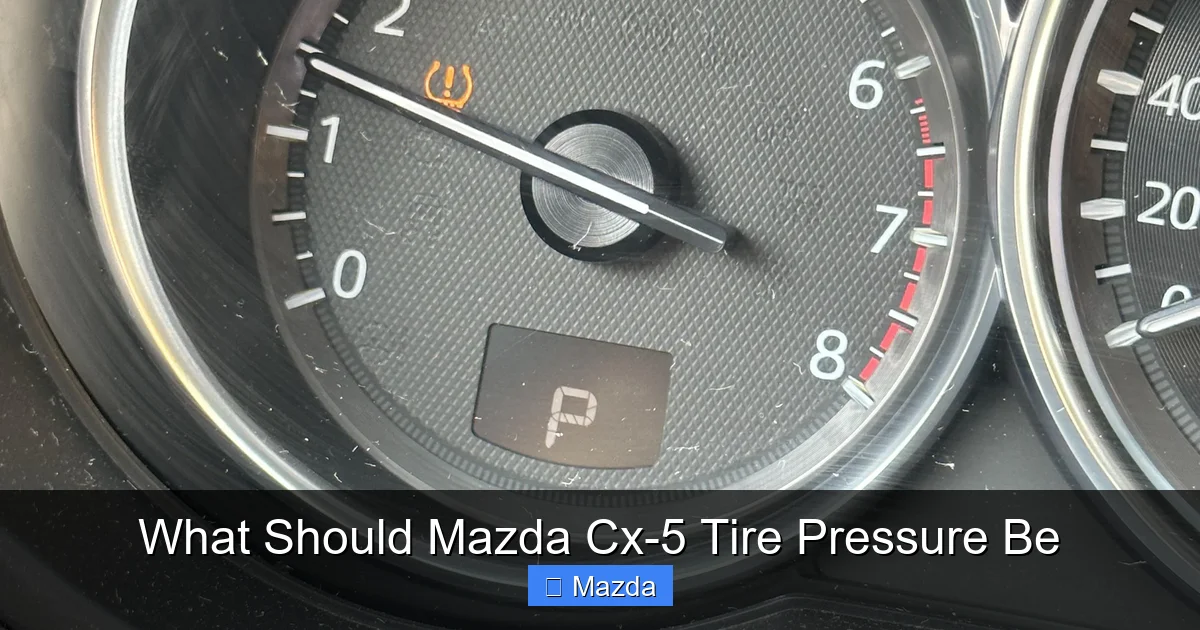
The TPMS warning light (a yellow horseshoe with an exclamation point) is designed to illuminate when one or more tires is 25% or more below the recommended pressure. That means if your spec is 33 PSI, the light won’t come on until a tire drops to about 25 PSI. At that point, the tire is severely under-inflated, and you’ve already compromised safety, fuel economy, and tire health. The system is a last-resort warning, not a daily maintenance tool. It also does not tell you which tire is low on most Mazda systems; you must check all four. Furthermore, TPMS sensors have batteries that last 7-10 years. When the battery dies, the sensor fails and will trigger a constant light, requiring replacement. A failed sensor won’t tell you your tire is going flat; it will just give you a false warning.
What to Do When the TPMS Light Comes On
If that light illuminates, treat it as an urgent message. First, safely pull over and visually inspect all four tires for obvious damage, nails, or severe deflation. If a tire is visibly flat or damaged, do not drive. Call for roadside assistance. If all tires look normal but one or more is simply low, use a reliable gauge to check the pressure. Inflate the tire(s) to the correct 33 PSI (or the load-adjusted pressure if you’re carrying a heavy cargo). The light should go off within a few miles of driving after the pressure is corrected. If it does not, you may have a slow leak or a faulty sensor that needs diagnosis by a professional. For specific reset procedures on your 2026 model, always consult your owner’s manual, as the process can vary slightly by trim level and infotainment system generation. Understanding the tire pressure sign is the first step, but knowing how to react is what keeps you safe.
Adjusting Pressure for Load and Driving Conditions
The 33 PSI figure is for your CX-5 with a normal occupant and cargo load (typically up to 4-5 people and some luggage). Life isn’t always normal, and Mazda provides guidance for when it isn’t.
The “Maximum Load” or “Full Load” Pressure
If you’re embarking on a family road trip with the SUV packed to the roof, or you’re using your CX-5 to haul a significant amount of gear, you need more air. Check your door jamb placard again. It will list a “maximum load” or “full load” pressure, which is often 35 PSI or sometimes 38 PSI. This higher pressure compensates for the extra weight, ensuring the tires don’t overheat and wear prematurely under the increased stress. It also helps maintain proper handling and braking performance when the vehicle is heavily burdened. For the 2026 CX-5, this is typically 35 PSI for the front and rear, but your placard is the final authority. Remember to let air out back down to the standard 33 PSI once you’ve unloaded the vehicle. Driving around with over-inflated tires on normal loads is just as bad as being under-inflated.
Off-Pavement and Severe Duty Considerations
While the CX-5 is a capable light SUV, it’s not a hardcore off-roader. For occasional gravel or dirt road use, some drivers choose to lower pressure slightly (by 2-3 PSI) to increase the tire’s contact patch and improve traction on soft surfaces. This is a technique used by more serious off-roaders, but it comes with risks: increased risk of bead unseating and damage to the wheel from impacts. For the vast majority of CX-5 owners, sticking to the manufacturer’s on-road recommendations is the safest and most effective strategy. If you do venture off-road, know your route and carry a portable air compressor to reinflate to highway pressures before returning to pavement.
How to Properly Check and Adjust Your CX-5’s Tire Pressure
Knowing the number is useless if you don’t know how to check and adjust it correctly. This is a simple skill that pays huge dividends.
The Right Tools and the “Cold Tire” Rule
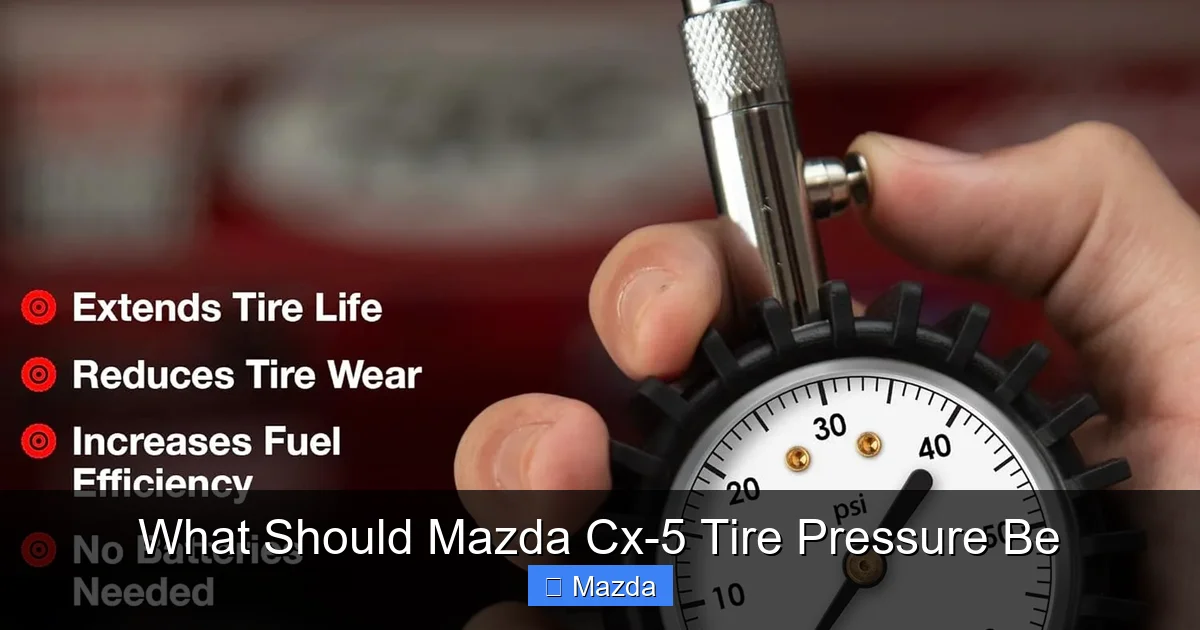
First, get a good quality digital tire pressure gauge. The pencil-style gauges are cheap but notoriously inaccurate. A $20-$40 digital gauge will last for years and give you precise readings. The “cold tire” rule is absolute: check and adjust pressure when the tires have not been driven on for at least three hours or have been driven less than one mile. Driving even a short distance heats the air inside, giving a falsely high reading. So, the best time is first thing in the morning before you go anywhere.
Step-by-Step: Checking and Inflating
- Remove the valve stem cap. Keep it in a clean place so it doesn’t get dirty.
- Press the gauge firmly onto the valve stem. You should hear a brief hiss of air. Hold it steady until the reading stabilizes.
- Read the pressure. Compare it to your target 33 PSI (or your load-adjusted pressure).
- Add air if low. Use a quality air compressor (at home or at a gas station). Add air in short bursts, rechecking with your gauge frequently. It’s easy to over-inflate.
- Release air if over-inflated. Press the small metal nipple in the center of the valve stem briefly with the gauge or a tool. You’ll hear air escape. Recheck.
- Replace the valve stem cap securely. It keeps dirt and moisture out, which can cause slow leaks.
Don’t forget the spare! Your CX-5’s compact temporary spare has a much higher recommended pressure, typically 60 PSI. This is because it’s a small, stiff tire designed for short-distance, low-speed use only. It needs to be very firm to carry the vehicle’s weight. Check its pressure annually, as it can lose air over time even when stored. If you need to use it, you’ll be glad it’s ready. For more detailed procedures on specific models, resources like how to check tire pressure on a Honda Civic can offer universal techniques that apply to any vehicle, including your Mazda.
Common Mistakes and Pro Tips for Perfection
Let’s wrap up the practical know-how with some pitfalls to avoid and insider advice.
Mistake: Relying Solely on the TPMS Light
As mentioned, the light is a last-resort warning. By the time it comes on, your tires are significantly under-inflated, and damage may have already started. Adopt a monthly manual check routine. It takes two minutes and gives you complete control and peace of mind. Think of the TPMS as your seatbelt warning—it’s there for emergencies, but you should always be buckled up proactively.
Mistake: Ignoring the Spare Tire
That donut in the trunk is easy to forget. It’s sitting there, slowly losing pressure. When you have a flat, the last thing you want is a flat spare. Check its pressure at least once a year and top it off to the specified 60 PSI. Also, remember its severe limitations: it’s for temporary use only (usually 50 miles max, 50 mph max). Drive to a repair shop immediately after installing it.
Pro Tip: Seasonal Reset and Record Keeping
When you adjust your pressures for the big seasonal temperature swing (spring and fall), take a moment to clean the valve stems with a cloth. It prevents dirt from working its way in when you check pressure. Some drivers keep a small notebook in the glove compartment to record the date and pressures at each check. It’s not necessary, but it can help you spot a slow leak on one tire that’s consistently losing more pressure than the others.
Pro Tip: The Nitrogen Question
You may have heard about filling tires with pure nitrogen instead of regular air. The theory is that nitrogen molecules are larger, so they seep through the rubber more slowly, leading to more stable pressure over time. This is technically true, but the effect is minimal for the average driver. Regular air is about 78% nitrogen anyway. The main benefit of nitrogen is for racing or aircraft applications where temperature swings are extreme. For your daily-driven CX-5, using free air from a gas station compressor is perfectly effective, provided you check it regularly. Don’t pay extra for nitrogen “top-offs” at a shop; it’s not a worthwhile investment for this application.
Conclusion: Your Simple Path to a Better CX-5
So, what should your Mazda CX-5 tire pressure be? The answer is beautifully simple: 33 PSI when cold, for normal loads, as indicated on your driver’s door jamb placard. Everything else—seasonal adjustments, load considerations, spare tire care—flows from that single, core number. Making this a monthly habit is one of the highest-impact, lowest-effort maintenance tasks you can perform. It protects your safety, sharpens your CX-5’s celebrated driving feel, saves you money on fuel and tires, and reduces your environmental footprint. It’s a five-minute investment that pays dividends every single mile you drive. Your Mazda is designed to be a joy to drive. Give it the correct foundation it deserves, and it will reward you with years of confident, efficient, and safe adventures. Keep that gauge handy and check those pressures!
Frequently Asked Questions
How do I reset the TPMS light on my 2026 Mazda CX-5 after inflating the tires?
After correcting the pressure, drive the vehicle above 30 mph for several minutes. The system usually auto-relearns and the light will turn off. If it persists, consult your owner’s manual for the specific reset procedure, which may involve a button on the steering wheel or a menu in the infotainment system.
What should the pressure be for the spare tire on a Mazda CX-5?
The compact temporary spare tire (the “donut” in the trunk) requires a significantly higher pressure, typically 60 PSI. This pressure is usually printed on the sidewall of the spare tire itself or listed on your door jamb placard. Always check it annually.
What happens if I over-inflate my CX-5’s tires?
Over-inflation makes the tire’s center tread bulge out, reducing the contact patch with the road. This leads to a harsh, noisy ride, poor handling (a “bouncy” feel), and uneven, accelerated wear in the center of the tire. It also increases the risk of a blowout from impacts like potholes.
How much does low tire pressure affect fuel economy in my CX-5?
For every 1 PSI that all four tires are under-inflated, fuel economy drops by approximately 0.2%. If your tires are 5 PSI low, you could be wasting 1% of your fuel, which adds up to dozens of gallons and significant cost over a year of driving.
Can I check tire pressure when the tires are warm or hot?
You can check pressure at any time, but you must only adjust pressure when tires are cold. A hot tire will read 3-5 PSI higher than its cold pressure. Adding air to a hot tire to reach 33 PSI will result in a dangerously under-inflated tire (around 28-30 PSI) once it cools down.
Should my front and rear tires have different pressures?
For the 2026 CX-5 under normal load conditions, no. Mazda specifies the same 33 PSI for both front and rear tires. Only when the vehicle is at its maximum load capacity might the placard recommend a higher, equal pressure for all tires (e.g., 35 PSI). Do not stagger pressures front-to-rear unless specifically instructed by Mazda for your model year and trim.
