
How to Increase Towing Capacity on a Jeep Wrangler

Increasing your Jeep Wrangler’s towing capacity isn’t about a single magic part. It requires a holistic approach, focusing on the vehicle’s weakest links. Key upgrades include strengthening the axles and differentials, enhancing the braking system, improving the suspension for stability, and ensuring your engine and transmission can handle the extra load. Always prioritize safety and legality over raw numbers, as improper modifications can be dangerous and void warranties. The goal is a balanced, reliable tow vehicle, not just a higher number on paper.
So, you’ve got a trusty Jeep Wrangler. It’s your adventure mobile, your weekend warrior, and your daily driver. But maybe you’ve got a jet ski, a small camper, or a decent-sized utility trailer that’s just out of its reach. You look at the factory tow rating on the door jamb sticker—maybe 3,500 pounds for a standard Sport, or 7,000 pounds for a Rubicon—and you wonder, “Can I safely make it pull more?” The short answer is yes, you can increase towing capacity on a Jeep Wrangler, but it’s a serious engineering project, not a simple bolt-on. This isn’t about finding a “tow package” in a catalog; it’s about identifying and reinforcing the weakest links in your rig’s chain. We’re going to break down exactly what that means, step by step, so you can build a Wrangler that tows confidently and safely.
First, a crucial reality check. The factory towing capacity is a legally defined number set by the manufacturer after extensive testing. It accounts for the engine’s power, transmission strength, axle ratings, braking ability, and frame integrity. When you increase capacity, you are accepting responsibility for that extra load. Improper modifications can lead to brake fade on a downgrade, overheating transmissions, broken axle shafts, or terrifying trailer sway. The goal of this guide is to help you navigate those risks by understanding which components must be upgraded to handle increased stress. Think of it as a ladder: you must strengthen every rung, or the whole structure fails.
Key Takeaways
- Factory ratings are legal limits: Your Wrangler’s tow rating is a calculated safety limit, not a suggestion. Exceeding it risks catastrophic failure and liability.
- Upgrade the drivetrain first: The axle shafts and differentials are often the first point of failure. Stronger axles (like Dana 44 or 60 swaps) and lower gears are foundational.
- Brakes are non-negotiable: Increasing mass requires exponentially more stopping power. Upgrade to heavy-duty brake pads, larger rotors, and consider a brake controller for trailers.
- Suspension must manage sway: A stiffer, better-tuned suspension with proper shocks and anti-sway bars is critical for control and tire contact when towing.
- Gearing is everything: Lower axle gear ratios (numerically higher, e.g., 4.10) give the engine more mechanical advantage, reducing strain and improving power for hills.
- Consider your engine & transmission: The V8-powered Rubicon and 4XE models have more reserve power. Automatic transmissions generally handle heat better than manuals for heavy towing.
- Legal and safe setup is paramount: All modifications must be professionally installed and rated. Your final setup must include a properly rated hitch, wiring, and safety chains.
📑 Table of Contents
Understanding Your Wrangler’s Factory Limitations
Before buying a single part, you need to diagnose your specific Wrangler’s starting point. A 2020 Jeep Wrangler Sport with a 2.0L turbo 4-cylinder and an automatic transmission has a different baseline than a 2018 Rubicon with the 3.6L V6 and a manual. The first number to know is your Gross Combined Weight Rating (GCWR). This is the maximum allowable weight of your loaded Wrangler plus your loaded trailer. Your target increased towing capacity must still fall under this GCWR. You can find your GCWR on the same door jamb sticker as your vehicle’s curb weight and GVWR.
Engine and Transmission: The Heart of the Matter
The powertrain is your first consideration. The 3.6L Pentastar V6 found in most Wranglers has decent torque (260 lb-ft) but is tuned for off-road low-end grunt, not sustained highway hauling. The 2.0L turbo 4-cylinder makes similar torque but at lower RPMs, which can feel strained when maintaining speed uphill with a heavy trailer. The king for towing is the 6.4L Hemi V8 in the Rubicon 392, with its 470 lb-ft of torque. However, even the V8’s potential is limited by the transmission behind it. The factory 8-speed automatic is robust, but the manual transmission (if equipped) is a significant weak link for heavy, sustained towing due to heat buildup and clutch wear. If you’re serious about towing, an automatic is strongly preferred. You must also consider cooling. An auxiliary transmission cooler is one of the single most effective and important upgrades you can make, regardless of engine choice. It keeps transmission fluid temperatures in check, preventing premature failure. Engine oil coolers are also wise for long grades.
The Axles: Where Things Usually Break First
This is the most critical and expensive area to address. The standard front and rear axles in most Wranglers are Dana 30s (front) and Dana 44s (rear). Their factory axle shaft and differential gear ratings have limits. When you add a heavy trailer, you’re not just adding weight; you’re adding dynamic forces. The torque multiplication from the engine, especially when starting from a stop or climbing, puts immense shear stress on axle shafts and differential internals (ring and pinion gears, carrier). A common failure point is a broken axle shaft. To safely increase capacity, you must upgrade to stronger axles. The most popular path is a pair of Dana 44s (front and rear) with heavy-duty axle shafts (like Chromoly) and posi-traction or electronic locking differentials. For maximum capacity, a Dana 60 front and rear swap is the gold standard, but it’s a major fabrication project involving new control arms, steering linkages, and brakes. The axle gear ratio is equally important. Factory gears (like 3.21 or 3.73) are for acceleration and off-crawl. For towing, you want lower gears (4.10, 4.56, or even 5.13). This gives the engine more mechanical advantage, allowing it to operate in a healthier RPM range while pulling a load, reducing strain and heat.
Essential Suspension and Handling Upgrades
Adding a heavy tongue weight (the downward force on the hitch) and the “push” from a trailer dramatically changes your Wrangler’s handling. The stock suspension is soft to absorb off-road impacts, which is terrible for towing stability. You need a suspension that is firm, controlled, and keeps all four tires firmly planted.
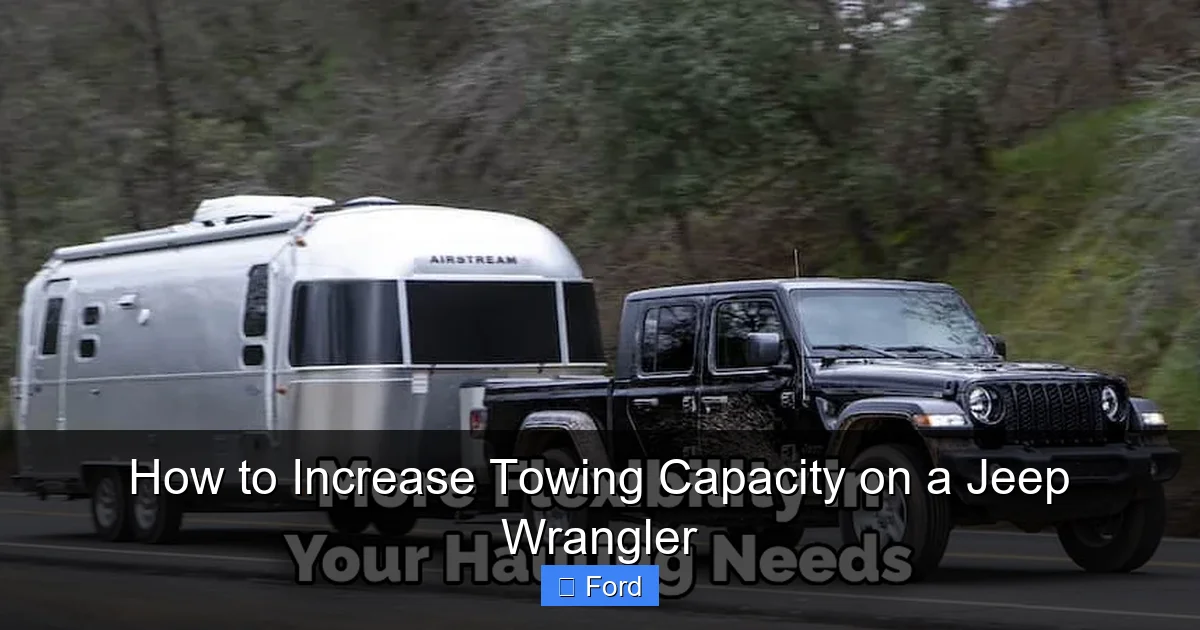
Visual guide about How to Increase Towing Capacity on a Jeep Wrangler
Image source: jeepfixes.com
Springs, Shocks, and Sway Bars
The first upgrade is often stiffer springs. Lift kits designed for “heavy duty” or “towing” applications typically include heavier rate coils or leaf springs. This prevents the rear from sagging excessively under tongue weight, which would otherwise cause headlights to aim at the sky, reduce front tire traction, and induce dangerous sway. Next, you need shocks that can control this stiffer spring. Look for heavy-duty, monotube shocks with larger pistons. They manage the rebound and compression better, preventing the “bouncy” feeling. The single most important handling mod for towing is a robust rear anti-sway bar (also called a stabilizer bar). It connects the left and right rear wheels, resisting body roll during cornering and when a crosswind hits the trailer. A thicker, adjustable rear sway bar is a must. Some enthusiasts even add a front sway bar disconnect system for off-road but must remember to reconnect it for any towing duty.
Weight Distribution and Hitch Systems
You cannot discuss suspension without discussing the hitch. For loads over a few hundred pounds of tongue weight, a simple receiver hitch is insufficient. You need a weight distributing hitch (WDH). This system uses spring bars that bridge the trailer and the tow vehicle. It “distributes” a portion of the trailer’s weight to the front axle of the Wrangler and the trailer’s own axles. This restores proper front-end steering and braking geometry, dramatically reducing sag and sway. The WDH must be properly rated for your trailer’s weight and correctly adjusted. Furthermore, for trailers over a certain weight (often 3,500-5,000 lbs depending on state), you will also need a sway control device, which can be integrated into the WDH or added as an independent friction-based or hydraulic system. These devices apply resistance to any lateral movement between the tow vehicle and trailer, killing sway before it starts. Always ensure your hitch is professionally installed and rated for your target weight. The hitch itself must be bolted to the frame, not just the bumper.
Braking System Overhaul: Stopping Power is Everything
Physics is unforgiving: doubling your mass more than doubles your stopping distance. Your Wrangler’s factory brakes are designed to stop the vehicle’s curb weight plus a small margin for its factory tow rating. When you increase that mass, the stock brakes will fade quickly, overheat, and fail. This is the most dangerous area of neglect.
Visual guide about How to Increase Towing Capacity on a Jeep Wrangler
Image source: autoauxiliary.com
Upgrading All Four Corners
A complete brake upgrade is required. Start with high-quality, aggressive brake pads designed for heavy-duty use. Brands like Power Stop, EBC, or Hawk offer pads with higher friction coefficients and better heat dissipation. Pair these with new, high-quality brake fluid (DOT 4 or higher) and stainless steel braided brake lines for a firmer pedal feel. The next step is larger rotors. Bigger rotors provide more surface area for the pads to grab and act as a larger heat sink. Slotted or drilled rotors help with gas and heat dissipation. You can often find “big brake kit” upgrades that include larger calipers with more pistons, which clamp the pads more evenly and forcefully. Don’t forget the rear brakes—they are just as important. An often-overlooked upgrade is a brake controller for your trailer. This device is mounted in the cab and activates the trailer’s electric brakes in proportion to your tow vehicle’s brake application. It is essential for any trailer with electric brakes and is required by law in many states for trailers over a certain weight. A proportional (or “time-delay”) controller is the best type for smooth, confident stops.
Tires, Wheels, and Gear Ratios: The Final Link
Your tires are the only contact point with the road. Under increased load, they work harder, generate more heat, and are more prone to failure. The right tire and wheel combination is vital for safe towing.
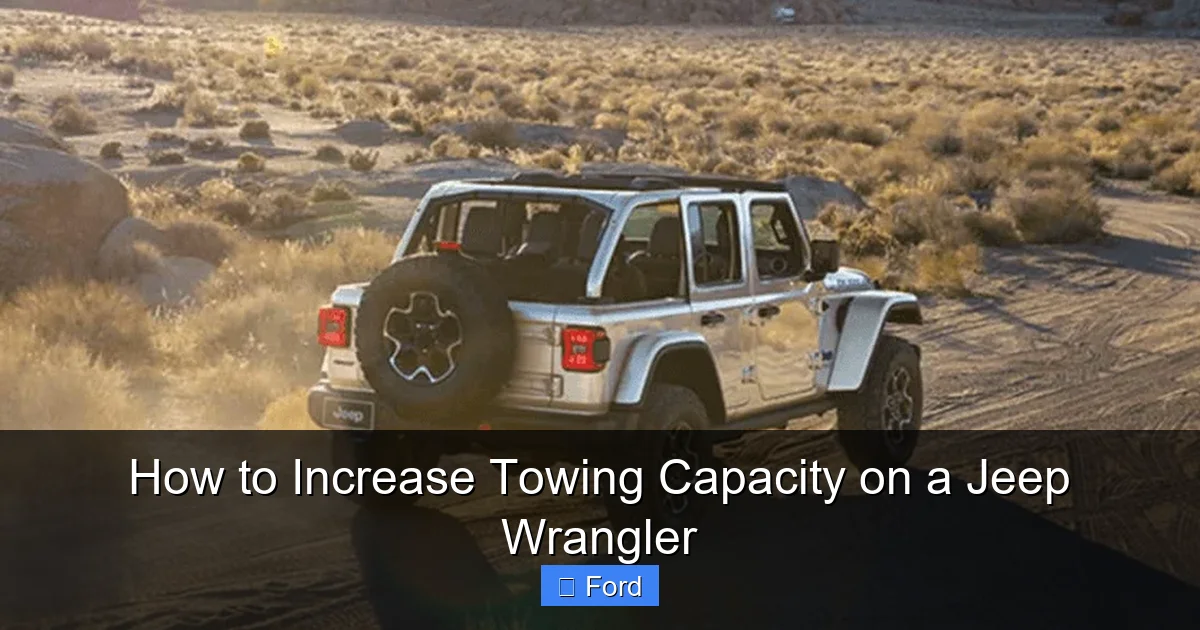
Visual guide about How to Increase Towing Capacity on a Jeep Wrangler
Image source: automotivetowingguide.com
Load Range and Pressure
You must use tires with a sufficient load rating. Look for “Load Range E” tires (often marked as “10-ply” equivalent, though not actually 10 plies). These have stiffer sidewalls to handle the extra weight without excessive bulging. The load rating is found on the tire’s sidewall. Equally important is maintaining proper inflation. When towing, you will often need to run a higher PSI than your door jamb sticker’s “normal” pressure. Consult the tire manufacturer’s load inflation chart for your specific tire. Higher pressure supports more weight but can reduce traction on loose surfaces; find the correct balance for your typical load and road conditions. Never exceed the tire’s maximum cold inflation pressure.
The Importance of Axle Gearing (Revisited)
We mentioned gearing in the axle section, but it bears repeating as a standalone topic. Your engine has a power band—an RPM range where it makes its best power and efficiency. Factory gears often keep your Wrangler in this band for light driving. Add a heavy trailer, and the engine is constantly downshifting or revving high to maintain speed. This causes excessive fuel consumption, heat, and wear. Re-gearing both axles to a lower ratio (e.g., 4.56 or 5.13) is a mechanical advantage. It lets the engine turn slower while the wheels turn at the same speed, meaning more torque at the wheels and less strain on the engine and transmission. The trade-off is lower top-end speed and reduced fuel economy when *not* towing. For a dedicated tow rig, it’s a worthy sacrifice. A professional shop can calculate the ideal ratio based on your tire size, engine, and typical trailer weight.
Legal, Safety, and Practical Considerations
You’ve upgraded axles, brakes, suspension, and gears. Your Wrangler is now a mechanical beast capable of pulling more. But is it legal? Is it safe? Is it even a good idea?
Warranty, Insurance, and Legality
Any major modification will almost certainly void related portions of your factory warranty. If your upgraded axle fails, Jeep will not cover it. Inform your insurance company of major modifications, though they may not change your premium. More importantly, know your state’s laws. Some states have specific requirements for trailers over a certain weight (brakes, safety chains, breakaway systems). You must also ensure your driver’s license is valid for the combined weight. Finally, and most critically, your insurance policy may not cover an accident if it’s determined you were towing over your vehicle’s *manufacturer-stated* GCWR, even if your modifications are rated higher. This is a major legal grey area. The safest path is to have all modifications documented with receipts and professional installation notes, and to ensure your final, loaded trailer weight is within your vehicle’s *original* GCWR. Pushing beyond that is a significant risk you assume.
Driving Technique and Realistic Expectations
A modified Wrangler will tow better, but it’s still a short-wheelbase, high-center-of-gravity vehicle. It will never tow like a long-bed pickup. You must adapt your driving. Allow much more stopping distance. Anticipate hills—downshift before you start losing speed on an upgrade. Be hyper-aware of crosswinds and the “push” from passing trucks. Use your Tow/Haul mode (if equipped) to help the transmission hold gears. Plan your routes to avoid steep, prolonged grades if possible. Remember, the goal is safe, controlled towing, not drag racing with a trailer. The increased capacity should be used for necessary headroom, not to constantly max out the rig. A well-modified Wrangler towing at 80% of its *new, safe* capacity will be far more reliable and safe than one towing at 100% of its stock rating with a trailer that’s slightly overweight.
If you’re considering a Wrangler for towing, also think about the total cost of ownership. The upgrades listed here can easily exceed $10,000 in parts and labor. Sometimes, the most practical solution for frequent heavy towing is a different vehicle. However, if you’re committed to the Wrangler lifestyle and need that extra capability, this roadmap provides the technical path. Always consult with reputable, experienced shops that specialize in Wrangler modifications. They can help you select the right combination of parts for your specific model year, engine, and towing goals, ensuring the final product is not just powerful, but fundamentally safe and reliable. The open road is calling, but responsibility must ride shotgun.
Frequently Asked Questions
Can I just install a bigger hitch to increase my Wrangler’s towing capacity?
No. The hitch is just one component. The factory tow rating is based on the entire vehicle’s weakest link, usually the axles, brakes, or transmission. A bigger hitch alone does nothing to strengthen those critical systems and can be extremely dangerous if the underlying vehicle cannot handle the load.
What is the single most important upgrade for towing with a Jeep Wrangler?
While all upgrades are important, a transmission cooler is arguably the most critical and cost-effective first step. It directly addresses the #1 failure point for modified Wranglers towing: automatic transmission overheating, which leads to premature wear and catastrophic failure.
Will lifting my Wrangler increase its towing capacity?
Generally, no. A lift kit designed for aesthetics or off-road clearance often uses softer springs and can actually reduce stability when towing. You need a lift or suspension kit specifically engineered for “heavy duty” or towing applications, which includes stiffer springs, appropriate shocks, and a rear anti-sway bar.
Is a manual transmission bad for towing in a Jeep Wrangler?
For light to occasional towing within factory limits, it can be acceptable. For any serious increase in capacity or frequent towing, the manual is a significant weak link. Clutch slippage and heat buildup are real concerns, and the manual lacks the cooling and torque converter benefits of an automatic. An automatic transmission is highly recommended for modified towing setups.
Do I need to re-gear my axles if I want to tow more?
Almost certainly, yes. Lower (numerically higher) gear ratios are essential. They give your engine a mechanical advantage, reducing strain, lowering operating RPMs, and improving acceleration with a load. Without re-gearing, your engine will be screaming on the highway and struggling on hills, leading to poor fuel economy, excessive heat, and reduced component life.
Can my Jeep Wrangler’s frame handle a much higher tow load?
The factory frame is generally robust, but it is designed for a specific load. Extremely high tow ratings (e.g., trying to tow 10,000+ lbs) can introduce frame stress over time, especially at the hitch mounting points. For moderate increases (e.g., from 3,500 to 5,000 lbs), the factory frame is typically adequate if all other systems are properly upgraded. For massive jumps, frame reinforcement or a custom subframe may be considered by experts, but this is rare and complex.
