
What Is the Maintenance Schedule for a Toyota Tacoma?

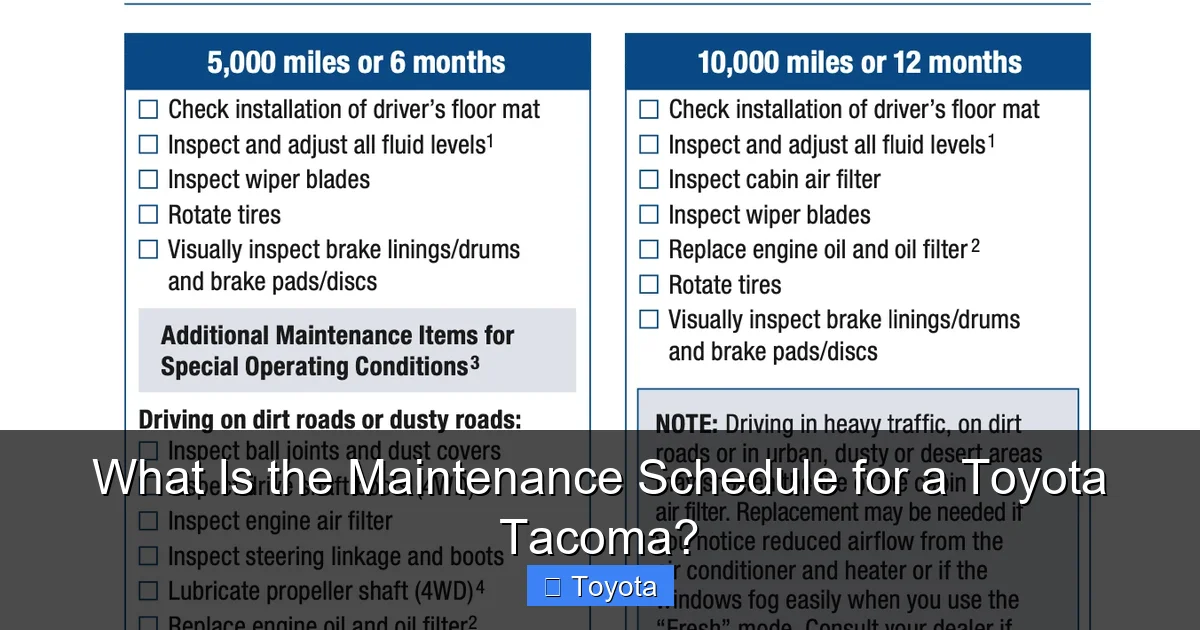
Sticking to your Toyota Tacoma’s maintenance schedule is the single most important thing you can do to ensure its legendary reliability, avoid costly repairs, and maintain its resale value. The schedule is split into two main categories: standard and severe driving conditions, with the latter requiring more frequent service. Key services include regular oil changes, tire rotations, multi-point inspections, and scheduled replacements for items like spark plugs, coolant, and transmission fluid. Understanding and following this schedule, found in your owner’s manual, protects your investment and keeps your Tacoma ready for any adventure.
Key Takeaways
- Two Schedules Exist: Your Tacoma has both a “Standard” and a “Severe” maintenance schedule; most drivers should follow the Severe schedule for optimal protection.
- Oil Changes Are Foundational: Oil and filter changes are the most frequent and critical service, with intervals ranging from 5,000 to 10,000 miles depending on oil type and driving conditions.
- Tire Rotation Is Essential: Rotate your tires every 5,000 to 7,500 miles to promote even wear, extend tire life, and maintain safe handling—this is often done with an oil change.
- Multi-Point Inspections Catch Problems Early: At every service interval, a thorough inspection of brakes, suspension, fluids, belts, and hoses can identify small issues before they become major, expensive repairs.
- Major Services Have Milestones: At specific mileage markers (30k, 60k, 90k, etc.), your Tacoma requires more in-depth services like spark plug replacement, fluid flushes, and belt inspections/replacements.
- DIY vs. Professional: Simple tasks like oil changes and air filter swaps are DIY-friendly, but complex services involving brakes, transmission, or differential fluids are best left to certified technicians.
- The Maintenance Light Is Your Friend: The “MAINT REQUIRED” light on your dashboard is a simple mileage-based reminder system; resetting it after service is a key part of the process.
📑 Table of Contents
- Why Following a Schedule Isn’t Just a Suggestion—It’s Essential
- Decoding the Schedule: Standard vs. Severe Driving
- The Heartbeat: Oil & Filter Changes Explained
- The Rolling Foundation: Tires, Brakes, and Suspension
- Critical Fluid Flushes and Replacements at Key Milestones
- The Major Service Milestones: 30k, 60k, 90k, and Beyond
- DIY vs. Professional Service: Knowing Your Limits
- Special Considerations for Your Tacoma’s Lifestyle
- The Conclusion: Your Tacoma’s Longevity Is in Your Hands
Why Following a Schedule Isn’t Just a Suggestion—It’s Essential
Let’s be real. When you buy a Toyota Tacoma, you’re not just buying a truck; you’re buying a promise. A promise of capability, adventure, and, above all, reliability. Tacomas are famous for racking up hundreds of thousands of miles with minimal fuss. But that reputation isn’t magic—it’s earned through disciplined, consistent maintenance. Think of your maintenance schedule as the ultimate playbook for your truck’s long-term health. Ignoring it is like expecting a star athlete to perform without training, rest, or proper nutrition. Eventually, something will give.
Following the schedule protects your investment in two major ways. First, it prevents catastrophic failures. A failing timing belt or a neglected transmission fluid change can lead to repairs that cost thousands, often exceeding the truck’s value. Second, a well-documented service history is a goldmine when it’s time to sell or trade-in. Potential buyers pay a premium for a truck with a complete, consistent maintenance record because it provides undeniable proof of a life well-cared-for. It’s an investment that pays you back, not the other way around.
Decoding the Schedule: Standard vs. Severe Driving
Open your owner’s manual, and you’ll likely see two columns: one for “Normal” or “Standard” driving and one for “Severe” driving. Many owners glance at the “Standard” column and think, “Perfect! That’s me.” But the definition of “Standard” is surprisingly narrow. In reality, the vast majority of Tacoma owners should follow the “Severe” schedule. Why? Because “Severe” conditions aren’t just about extreme off-roading or blizzards; they encompass many common, everyday driving scenarios.

Visual guide about What Is the Maintenance Schedule for a Toyota Tacoma?
Image source: maintenanceschedule.com
What Qualifies as “Severe” Driving?
The “Severe” schedule applies if you frequently encounter any of the following conditions:
- Short Trips: Driving less than 5-10 miles in normal temperatures, or less than 10 miles in freezing conditions. The engine and drivetrain never fully warm up, allowing condensation and fuel dilution to contaminate fluids.
- Stop-and-Go Traffic: Extensive idling and low-speed operation in heavy traffic creates excessive heat and wear on engine and driveline components.
- Extreme Temperatures: Consistently driving in very hot (above 90°F) or very cold (below 10°F) climates.
- Towing or Hauling: Regularly using your Tacoma to pull a trailer or carry heavy loads in the bed. This puts maximum stress on the engine, transmission, and brakes.
- Dusty or Sandy Conditions: Driving on unpaved roads, in construction zones, or in areas with high dust/sand content. These abrasive particles can contaminate air filters and infiltrate seals.
- Muddy or Icy Roads: Conditions that cause constant wheel slip, putting unusual stress on the drivetrain and traction systems.
If you recognize yourself in even one or two of these categories—and most of us do—use the Severe Duty schedule. It calls for more frequent oil changes, inspections, and fluid replacements, providing a crucial safety margin that protects your truck from the accelerated wear these conditions cause. The small extra cost in service is insignificant compared to the cost of a major repair down the road.
The Heartbeat: Oil & Filter Changes Explained
If there’s one service that deserves the title of “most important,” it’s the oil change. Engine oil is the lifeblood of your Tacoma’s engine. It lubricates thousands of moving parts, reduces friction, carries away heat, and suspends harmful combustion byproducts. Over time, oil breaks down and becomes contaminated, losing its protective properties. Sticking to the correct oil change interval is non-negotiable for engine longevity.
Visual guide about What Is the Maintenance Schedule for a Toyota Tacoma?
Image source: maintenanceschedule.com
Determining Your Interval
The interval depends heavily on your driving schedule (Standard vs. Severe) and the type of oil you use:
- Conventional Oil: Typically every 3,000-5,000 miles (Severe schedule).
- Synthetic Blend: Typically every 5,000-7,500 miles.
- Full Synthetic Oil: Typically every 7,500-10,000 miles (and sometimes longer, per manufacturer specs).
Pro Tip: Modern Tacomas (especially 2016+) often come with Toyota’s innovative Oil Maintenance Reminder system. This isn’t just a simple mileage counter; it’s an algorithm that monitors engine revolutions, temperature, and driving patterns to calculate oil life. When it displays “MAINT REQUIRED,” it’s time for service. However, even with this system, you should still adhere to the Severe/Standard schedule guidelines as a maximum cap. If you do a lot of severe driving, you may need to change your oil before the reminder even comes on.
Oil Filter and the Oil Pan Connection
Every oil change must include a new oil filter. The filter traps metal shavings and other contaminants, preventing them from circulating in your engine. A clogged filter restricts oil flow, causing wear. While changing oil, it’s also a perfect time to visually inspect the oil pan and its drain plug for any signs of leaks or damage. The oil pan is the reservoir at the bottom of your engine; a dent or a stripped drain plug can lead to a rapid, catastrophic loss of oil. If you’re doing a DIY oil change and are unsure about the process, you can find detailed guides on where the oil filter is located on a Toyota Tacoma for your specific model year, as placement can vary between engine types (like the 2.7L 4-cylinder vs. the 3.5L V6).
The Rolling Foundation: Tires, Brakes, and Suspension
Your Tacoma’s connection to the road is through its tires, and its ability to stop safely is through its brakes. These systems wear with use and require diligent attention. The maintenance schedule interlinks these services with mileage and time intervals.

Visual guide about What Is the Maintenance Schedule for a Toyota Tacoma?
Image source: maintenanceschedule.com
Tire Rotation and Pressure
Tire rotation is the great equalizer. Due to weight distribution, drivetrain layout (4WD vs. 2WD), and driving habits, tires wear unevenly. Rotating them—typically in a specific pattern like front-to-rear or a cross-pattern—ensures all four tires wear evenly, maximizing tread life and maintaining predictable handling. The rule of thumb is to rotate your tires with every oil change, or at least every 5,000 to 7,500 miles.
Equally critical is proper tire inflation. Under-inflated tires create excess heat, wear the outer edges prematurely, and reduce fuel economy. Over-inflated tires wear the center of the tread and provide a harsh, unsafe ride. Check your pressure monthly and before long trips. The correct pressure is on a sticker inside the driver’s door jamb—not the number on the tire sidewall. For those who use their Tacoma for towing, correct pressure is even more vital for stability and load capacity.
Brake System Inspection and Service
Brakes are your primary safety system. At every service, your technician should inspect:
- Brake Pads and Shoes: Measure thickness. Worn pads will squeal or grind.
- Rotors and Drums: Check for scoring, warping, or excessive thickness variation.
- Brake Fluid: This fluid is hygroscopic, meaning it absorbs moisture from the air over time. Moisture lowers the boiling point of the fluid, which can lead to brake fade or failure under hard use. The schedule typically calls for a brake fluid flush every 2-3 years, regardless of mileage.
- Brake Lines and Hoses: Look for cracks, leaks, or bulges.
If you tow a trailer, your brakes work much harder. Consider upgrading to high-performance pads and rotors and be prepared for more frequent inspections.
Suspension and Steering Check
The Tacoma’s solid rear axle and front independent suspension are built for durability, but components still wear. During inspections, mechanics check:
- Shocks/Struts for leaks and damping ability.
- Tie rod ends, ball joints, and control arm bushings for play or deterioration.
- Power steering fluid level and condition (if equipped).
- Wheel bearings for play or noise.
Worn suspension parts lead to poor handling, uneven tire wear, and a rough ride. A clunk over bumps is a clear sign to get it checked immediately.
Critical Fluid Flushes and Replacements at Key Milestones
Beyond engine oil, your Tacoma relies on several other specialized fluids that degrade over time. The maintenance schedule outlines specific mileage/age milestones for these services. Treat these as critical appointments.
Engine Coolant (Antifreeze)
Coolant does more than prevent freezing; it raises the boiling point of the cooling system and contains corrosion inhibitors that protect the radiator, water pump, and engine passages. These inhibitors deplete over time. The schedule typically calls for a coolant change every 100,000 miles or 10 years (for extended-life coolants), but check your manual. A coolant flush involves completely draining the old fluid, flushing the system, and refilling with the correct Toyota Super Long Life Coolant (or equivalent). Never mix different colored coolants. A failing water pump or a clogged radiator from old, corroded coolant can lead to overheating and a destroyed engine.
Transmission and Transfer Case Fluid
This is a big one. Transmission fluid lubricates, cools, and transmits hydraulic pressure for gear shifts. For manual transmissions, it lubricates the gears and synchronizers. For automatics, its condition is paramount. The schedule for Tacomas often lists a transmission fluid change at every 30,000 to 60,000 miles for severe service. Don’t wait for problems—preventive changes are far cheaper than a rebuilt transmission. Similarly, the transfer case fluid (in 4WD models) should be changed at the same interval. This fluid handles the high pressure and heat of the 4WD system. If you frequently use 4WD, this service is even more critical.
Differential Fluid (Front and Rear)
The differentials are gearboxes that allow your wheels to rotate at different speeds when turning. They contain heavy gear oil that withstands extreme pressure. The maintenance schedule calls for changing this fluid, typically at 60,000-mile intervals. Old, depleted differential fluid can lead to gear whine and, ultimately, differential failure. If you tow heavy loads or off-road aggressively, consider doing this service more frequently.
Other Key Fluids
- Windshield Washer Fluid: Top off regularly, especially in winter. Use fluid with antifreeze properties in cold climates.
- Brake Fluid: As mentioned, flush every 2-3 years.
- Power Steering Fluid: Check level and condition at each service if your model has a hydraulic system (newer models often have electric power steering).
The Major Service Milestones: 30k, 60k, 90k, and Beyond
Think of your Tacoma’s life in stages. At specific mileage points, a “major service” is due. These are comprehensive check-ups that go beyond the routine oil change and rotation. They involve replacing wear items, inspecting major systems, and resetting the truck for the next 30,000 miles. Here’s a generalized breakdown (always defer to your specific year/model manual):
The 30,000-Mile Service
This is a significant checkpoint. It typically includes:
- All items from the 15k/20k service (oil change, rotation, inspection).
- Replace engine air filter. A clogged air filter starves your engine of air, reducing power and fuel economy. It’s an easy, inexpensive DIY.
- Cabin air filter replacement. This filters the air you breathe inside the truck. A must for allergy sufferers.
- Inspect and possibly replace spark plugs (on some models/engines). Worn plugs cause misfires, poor fuel economy, and hard starts.
- Check and adjust valve clearance if specified (some models require this periodically).
- Inspect all belts and hoses for cracks, fraying, or leaks.
The 60,000-Mile Service
This is a major overhaul point. It includes all previous items, plus:
- Transmission fluid change. This is arguably the most important item on this list.
- Differential fluid change.
- Transfer case fluid change (4WD models).
- Coolant system flush.
- Comprehensive brake system inspection, potentially including pad/shoe replacement if worn.
- Detailed inspection of the entire suspension and steering linkage.
- Potential fuel filter replacement (if equipped).
The 90,000-Mile Service
Building on the 60k, this service often includes:
- Another transmission/differential fluid service (if the interval is 30k).
- Spark plug replacement (if not done at 30k). This is critical for performance.
- Inspect and potentially replace the accessory drive belt (serpentine belt). A broken belt can disable your power steering, alternator, and water pump.
- Inspect all hoses again; rubber degrades with age and heat.
- Brake fluid flush if not done recently.
- Thorough inspection of the entire exhaust system for rust and leaks.
These milestones repeat in pattern. At 120k, you’re looking at another major round of fluid services and a very deep inspection of every component. The key is consistency.
DIY vs. Professional Service: Knowing Your Limits
The beauty of the Tacoma is its relative simplicity, which makes many maintenance tasks accessible to competent DIYers with basic tools. Doing your own work builds a deeper connection to your truck and can save significant labor costs. However, knowing what you can and cannot safely tackle is crucial for your safety and the truck’s well-being.
Great DIY Projects
- Oil & Filter Change: The quintessential DIY job. Just be meticulous about torqueing the drain plug and filter, and disposing of old oil properly.
- Air Filter Replacement: Usually just a few clips or screws. Do this every 15,000 miles.
- Cabin Air Filter: Often located behind the glovebox; slightly more involved but still very DIY-friendly.
- Wiper Blades: Simple snap-on replacement.
- Battery Terminal Cleaning/Replacement: Important for reliable starting.
- Basic Inspections: Checking fluid levels, tire pressure, and looking for leaks.
Leave It to the Pros
- Any Brake Work: Beyond pad replacement, which still requires proper bedding and caliper lubrication, any work on rotors, calipers, or brake lines should be done by a pro. Brakes are a zero-failure system.
- Transmission, Differential, or Transfer Case Fluid Services: While the drain-and-fill method is straightforward, getting a true “flush” requires specialized machines. More importantly, using the wrong fluid or incorrect fill procedure can destroy these expensive components.
- Coolant System Flush: Requires proper bleeding to remove air pockets, which can cause overheating.
- Timing Belt/Chain Service: On 4-cylinder models with a timing belt (pre-2010-ish), this is an intermediate-level job but has zero room for error. A mistake means engine destruction. V6 models have timing chains, which are generally “lifetime” but still require inspection at high miles.
- Suspension/Steering Repairs: Requires specialty tools (ball joint separators, torque wrenches) and knowledge of alignment specs.
- Any work involving SRS (airbag) systems.
A good middle ground is to purchase your own quality parts (filters, fluids, spark plugs) and have a trusted independent shop or dealer perform the labor. This ensures professional installation with OEM-spec parts at a lower cost than full dealer pricing.
Special Considerations for Your Tacoma’s Lifestyle
Your Tacoma is a tool. How you use it should directly inform your maintenance habits. The factory schedule is a baseline; you must adjust it for your real-world use.
The Off-Roader
If you regularly hit the trails, you’re exposing your truck to abrasive dust, mud, and water fording. This accelerates wear on:
- Differential and transfer case seals (risk of fluid contamination).
- CV joints and boots (risk of grease loss and dirt ingress).
- Undercarriage components (risk of rust and impact damage).
Action: After every major off-road adventure, hose off the undercarriage. Inspect CV boots for tears. Consider more frequent differential fluid changes (e.g., every 30k miles).
The Towing and Hauling Workhorse
Towing is the ultimate severe duty condition. It creates immense heat in the engine, transmission, and differentials and places extreme strain on brakes and tires.
Action: Be religious about transmission and differential fluid changes. Use the Severe Duty schedule. Consider upgrading to high-capacity radiators and transmission coolers. Inspect brakes twice as often. Check your tire pressure before every trip when loaded. Also, ensure your trailer brakes are properly synchronized with your Tacoma’s system. A poorly adjusted trailer can overwork your truck’s brakes.
The Daily Driver & Commuter
Even if you never leave pavement, if your daily drive is short and filled with stop-and-go traffic, you are in the Severe category. The engine rarely reaches optimal temperature, leading to fuel dilution in the oil and excessive condensation in the exhaust system.
Action: Follow the Severe schedule. Consider using a high-quality full synthetic oil to help combat the effects of short trips. Get a long drive in once a week on the highway if possible to fully warm things up and clear out the system.
For all Tacoma owners, keeping a detailed log—either in the owner’s manual or a digital app—of every service performed, with mileage, date, and what was done, is invaluable. This is your truck’s medical history.
The Conclusion: Your Tacoma’s Longevity Is in Your Hands
The Toyota Tacoma’s reputation for 300,000+ mile reliability is not a happy accident. It is the direct result of owners who respected the engineering by adhering to a disciplined maintenance regimen. That maintenance schedule in your glovebox isn’t just a booklet of suggestions; it’s the result of thousands of hours of engineering, testing, and failure analysis by Toyota. It’s the map to your truck’s long, healthy life.
Don’t be intimidated by the milestones. Break them down into manageable chunks. Think in terms of the 5,000-mile “tune-up” (oil, rotate, inspect) and the 30,000-mile “major service.” Build a relationship with a trusted mechanic or service advisor who understands your truck’s specific needs. Ask questions. Use genuine Toyota parts or high-quality equivalents for critical wear items. And most importantly, be proactive. Don’t wait for a noise, a light, or a breakdown. Follow the schedule, and your Tacoma will reward you with years of dependable, capable service, whether you’re commuting to work, towing a boat, or conquering backcountry trails. It’s the simplest, smartest investment you can make in your truck.
Frequently Asked Questions
What is the most important maintenance for a Toyota Tacoma?
Regular oil and filter changes using the correct oil type and interval are the single most critical maintenance task for any engine. Following the severe duty schedule for these changes is key for Tacoma longevity, especially if you tow, off-road, or do mostly short trips.
How often should I rotate my Tacoma’s tires?
You should rotate your Tacoma’s tires every 5,000 to 7,500 miles. This is often conveniently done at the same time as an oil change. Regular rotation ensures even tire wear, extends tire life, and maintains safe handling characteristics.
When does my Tacoma need a transmission fluid change?
For most model years, Toyota recommends changing the automatic transmission fluid every 60,000 miles under severe driving conditions. If you tow frequently, off-road, or drive in extreme heat, consider doing it every 30,000-40,000 miles as an extra precaution. Manual transmission fluid intervals may differ.
What triggers the “MAINT REQUIRED” light on a Tacoma?
The light is triggered by the vehicle’s onboard computer after it has calculated that a preset mileage interval (typically 5,000 miles) has been reached since the last reset. It’s a simple reminder for an oil change and general inspection. You must manually reset it after the service is completed.
Is it better to follow the standard or severe maintenance schedule?
For the vast majority of drivers, the severe schedule is the correct choice. Conditions like short trips, stop-and-go traffic, towing, dusty roads, and extreme temperatures all qualify as “severe.” Following this more frequent schedule provides a crucial safety margin and better protects your truck’s components.
Can I reset the maintenance required light myself?
Yes, you can reset the maintenance required light on a Toyota Tacoma yourself with a simple procedure using the odometer/trip meter button, typically done after an oil change. The exact steps vary slightly by model year, so consulting your owner’s manual or a reliable online guide for your specific year is recommended.
