
Does a 2006 Ford F150 Have a Cabin Air Filter

The 2006 Ford F150 did not come with a factory-installed cabin air filter. This was common for trucks of that era. However, you can install an aftermarket cabin filter kit yourself. Adding one will filter out pollen, dust, and pollutants, significantly improving your truck’s interior air quality and protecting your HVAC system.
Key Takeaways
- No Factory Filter: The 2006 Ford F150 was not equipped with a cabin air filter from the factory, a common trait for many trucks of its generation.
- Aftermarket Kits Available: Universal and model-specific aftermarket kits exist to add cabin filtration to your F150, typically installing behind the glovebox or under the dash.
- Health & Comfort Benefit: An added filter traps allergens, dust, and pollutants, creating a healthier and more comfortable cabin environment for you and your passengers.
- DIY Installation: Installation is a moderate DIY task requiring basic tools. The process involves accessing the HVAC housing and securing the filter, similar in principle to filter changes in many sedans.
- Regular Maintenance Required: Aftermarket filters must be checked and replaced every 12,000 to 15,000 miles, or annually, to maintain effectiveness and prevent airflow restriction.
- HVAC System Protection: The filter also shields your truck’s heating and cooling system from accumulating debris, which can cause damage and reduce efficiency over time.
- Model Year Specific: Ford did not begin offering a factory-installed cabin air filter in the F150 until the 2009 model year, making the 2006 a filter-less truck by design.
📑 Table of Contents
- Introduction: The Clear-Cut Answer to a Common Question
- The History of Cabin Filters: Why Your 2006 F150 Missed Out
- The Real Consequences of Driving Without a Cabin Filter
- Your Solution: Aftermarket Cabin Air Filter Kits
- Step-by-Step: Installing an Aftermarket Cabin Filter in Your 2006 F150
- Maintenance, Benefits, and Long-Term Care
- How the 2006 F150 Compares to Other Trucks and SUVs
- Conclusion: A Simple, Smart Upgrade for Your Trusted Truck
Introduction: The Clear-Cut Answer to a Common Question
If you’re a proud owner of a 2006 Ford F150, you might have wondered about that mysterious little compartment behind your glovebox. You’ve heard about cabin air filters in modern cars and trucks, filtering the air you breathe inside your vehicle. The simple, direct answer is: No, your 2006 Ford F150 did not come with a factory-installed cabin air filter. It’s a fact that surprises many owners, especially when they start experiencing dustier cabins or reduced HVAC airflow. But don’t worry—this doesn’t mean you’re stuck breathing unfiltered air. The absence of a factory filter is a legacy of early-2000s truck design, and the aftermarket industry has a perfect solution. In this complete guide, we’ll dive deep into why your truck lacks this component, why you should seriously consider adding one, and exactly how you can do it yourself. We’ll separate myth from fact and give you the practical steps to enjoy cleaner, healthier air in your trusted F150.
The History of Cabin Filters: Why Your 2006 F150 Missed Out
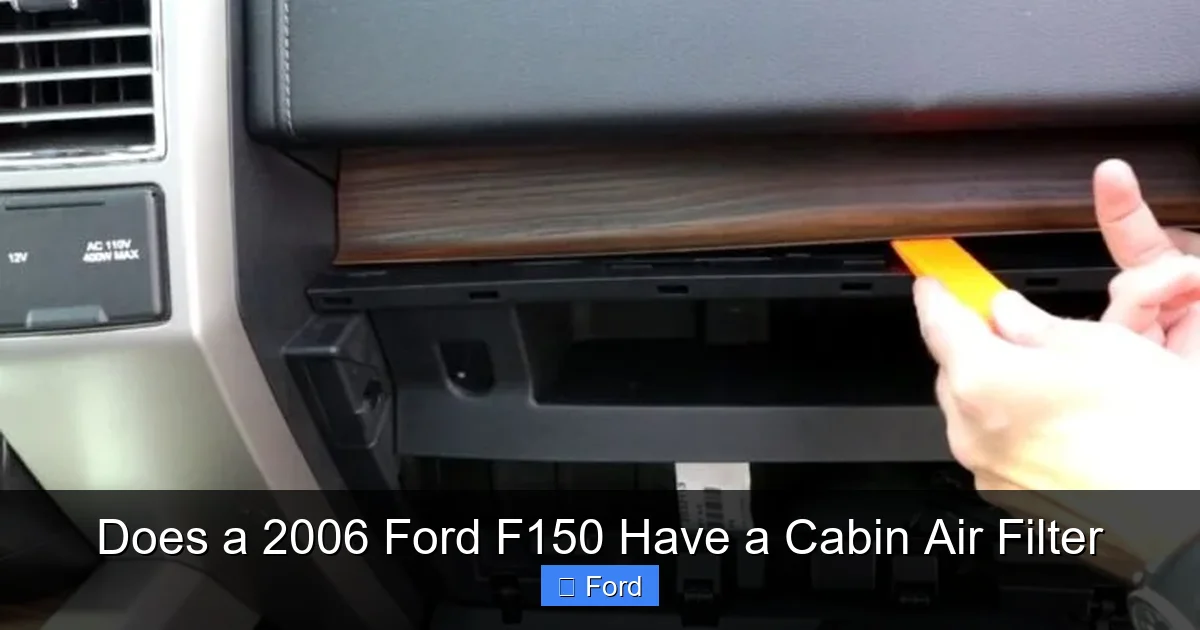
To understand why your truck doesn’t have a filter, we need a quick history lesson. The cabin air filter, also called a pollen filter or HVAC filter, became standard in most passenger cars throughout the 1990s and early 2000s. Its primary job is to stop airborne contaminants like pollen, dust, soot, and road debris from entering your vehicle’s HVAC (Heating, Ventilation, and Air Conditioning) system and, ultimately, your lungs.
Visual guide about Does a 2006 Ford F150 Have a Cabin Air Filter
Image source: trucksauthority.com
A Focus on Trucks and Utility
However, full-size pickup trucks like the Ford F150 were a different story. In the mid-2000s, manufacturers prioritized raw capability, cost-saving, and simplicity. Trucks were seen as workhorses first, luxury loungers second. Adding a cabin filter meant extra parts, more complex HVAC ducting, and an additional maintenance item for owners. For Ford, in the 2004-2008 generation of the F150, the cost-benefit analysis didn’t justify including a cabin filter as standard equipment. The HVAC system was designed to be robust and simple, pulling air directly from outside without a dedicated filtration stage. This meant whatever was in the air outside—dust from a dirt road, pollen from a field, or construction debris—could circulate into your cab.
The Shift to Standard Equipment
The tide began to turn around the 2009 model year. As consumer demand for comfort and air quality grew, and as cabin air quality became a bigger selling point, Ford finally integrated a cabin air filter into the F150’s design. So, if you have a 2009 or newer F150, you likely have a factory filter location (usually behind the glovebox). But for you 2004-2008 owners, your truck was built in the pre-filter era. This historical context is crucial because it explains why you won’t find a filter housing or slot in your truck’s HVAC system without modification.
The Real Consequences of Driving Without a Cabin Filter
So, your truck came without one. Is it really a big deal? Absolutely. Driving for years without any dedicated cabin filtration has tangible, negative effects on both your health and your truck’s HVAC system.
Visual guide about Does a 2006 Ford F150 Have a Cabin Air Filter
Image source: cdn.thedailyautomotive.com
For Your Health and Comfort
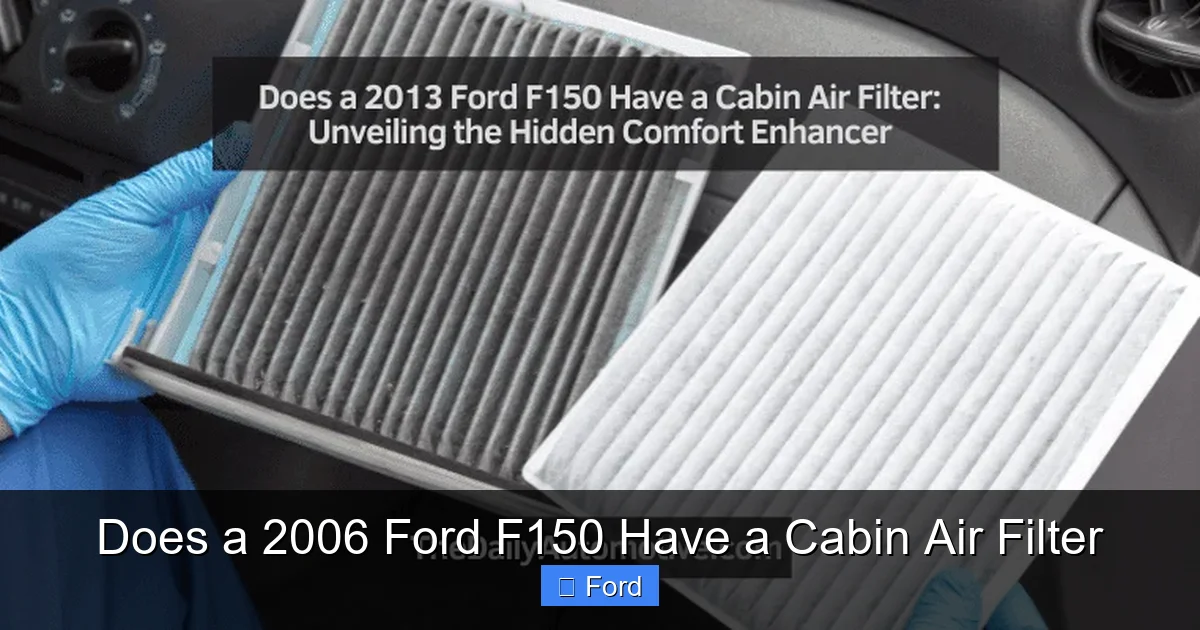
Think about the air you breathe while driving. On a high-pollen day, that pollen is blowing directly into your vents. On a dusty backroad, fine particulate matter fills your cabin. For anyone with allergies, asthma, or respiratory sensitivities, this is a direct path to sneezing, itchy eyes, and breathing difficulty. Even for healthy drivers, constant exposure to fine dust and pollutants can lead to long-term irritation. Your truck’s interior will also get dusty much faster, with a fine layer coating the dashboard, seats, and electronics. Without a filter, the air you circulate is essentially the same as the air outside, minus the cooling or heating effect.
For Your Truck’s HVAC System
The damage isn’t just to you. Your truck’s HVAC system suffers silently. All that dust, pollen, and debris gets sucked into the blower motor housing and onto the evaporator and heater cores. Over time, this grime builds up like gunk on an old computer fan. It restricts airflow, forcing your blower motor to work harder and reducing the efficiency of your A/C and heater. You might notice weaker airflow from your vents, strange musty odors (from trapped organic matter), and eventually, costly repairs. A clogged evaporator can’t cool as well, and a coated heater core won’t warm you up on a cold morning. In essence, no cabin filter is a false economy—you save a few dollars upfront but risk thousands in HVAC repairs down the line.
Your Solution: Aftermarket Cabin Air Filter Kits
The great news for 2006 F150 owners is that the aftermarket industry has filled the void. Several companies design and sell cabin filter retrofit kits specifically for your truck. These kits are not just a filter; they’re a complete solution that includes the filter media and the custom-made housing or bracket needed to secure it inside your HVAC air intake duct.
Visual guide about Does a 2006 Ford F150 Have a Cabin Air Filter
Image source: i.ytimg.com
How These Kits Work
For the 2006 F150, the most common installation point is within the HVAC housing located behind the glovebox. The aftermarket kit provides a custom-cut filter (usually a rectangular panel filter) and a plastic bracket or frame that fits into the air intake tract. You’ll remove some interior trim pieces and the glovebox to access the HVAC housing. The kit’s bracket is then secured in place, and the filter is inserted. It’s a precision-fit job designed for your specific truck model and year. The filter media itself is typically a pleated, electrostatically charged material that captures particles as small as a few microns. Higher-end kits offer activated carbon filtration to also absorb odors and volatile organic compounds (VOCs) like exhaust fumes.
Choosing the Right Kit
When shopping, look for kits from reputable brands like K&N, Fram, or Bosch. Ensure the listing explicitly states compatibility with 2004-2008 Ford F150 (not the 2009+ models). Pay attention to the filter’s MERV (Minimum Efficiency Reporting Value) rating. A MERV 8 is standard for trapping most pollen and dust. For superior allergen and fine particulate protection, look for a MERV 11 or higher. Kits with activated carbon are excellent for those who drive in heavy traffic or want to neutralize smells. Prices typically range from $25 to $60 for the kit, making it a very affordable upgrade.
Step-by-Step: Installing an Aftermarket Cabin Filter in Your 2006 F150
Now for the hands-on part. While we can’t cover every single bolt for your specific trim (SuperCab vs. Crew Cab, XL vs. Lariat), the general process is the same and is considered a moderate DIY project. You will need basic tools like screwdrivers (Phillips and flathead), socket wrenches, and possibly trim removal tools. Always consult the instructions that come with your specific kit.
1. Accessing the HVAC Housing
The filter is installed inside the HVAC housing on the passenger side. To get there, you must remove the glovebox. Start by emptying the glovebox and disconnecting any light bulbs. There are typically two or three screws or bolts along the bottom edge of the glovebox that hold it to the dash. Remove these. Then, carefully pull the glovebox down. You may need to disconnect the glovebox latch cable or rod. Once the glovebox is hanging down, you’ll see the front of the HVAC housing—a large plastic box with several duct connections.
2. Opening the Housing and Installing the Bracket
The HVAC housing is held together by multiple screws and plastic clips. You need to separate the front half of the housing from the rear half. This is the trickiest part, as plastic clips can break if forced. Work slowly around the perimeter, releasing clips and removing screws. Once open, you’ll see the blower motor and the evaporator/heater core fins. Your kit’s bracket is designed to fit into the specific air intake duct within this housing. Position the bracket exactly as shown in the kit’s diagram. It usually screws into existing holes or clips into place. Ensure it is secure and doesn’t obstruct any moving parts like the blower motor wheel.
3. Inserting the Filter and Reassembly
With the bracket in place, slide your new cabin filter into the bracket’s slot. Most filters have an “Air Flow” arrow printed on the frame; point this arrow toward the blower motor (the direction air flows into the HVAC system). Double-check the fit—it should be snug but not forced. Now, carefully reattach the two halves of the HVAC housing. Reinstall all screws and re-engage every plastic clip. It’s easy to miss a clip, which can cause air leaks or squeaks. Finally, rehang the glovebox and reinstall all its screws. Reconnect any electrical connectors.
Pro Tip: The general principles of accessing a vehicle’s HVAC housing are similar across many models. If you get stuck, referencing a guide for a different vehicle, like our detailed article on how to change the cabin air filter on a Honda Civic, can provide helpful visual cues for working with plastic dash components and HVAC housings, even if the exact locations differ.
Maintenance, Benefits, and Long-Term Care
Your installation is complete! You’ve taken a major step toward a cleaner cabin and a healthier HVAC system. But the job isn’t over. Like any filter, your new aftermarket cabin filter requires regular maintenance to stay effective.
Replacement Intervals
Plan to inspect your filter every 12,000 to 15,000 miles, or at least once a year. If you drive in severe conditions—frequent dusty roads, high-pollen areas, or heavy urban traffic—you may need to change it every 6-12 months. To check it, you’ll need to repeat part of the installation process to remove the glovebox and open the HVAC housing. A clogged filter will look dirty and gray, and you may not be able to see light through it. A severely clogged filter will cause a noticeable drop in airflow from your vents. Never try to clean and reuse a standard pleated cabin filter; they are designed for one-time use. Simply discard the old one and install the new one in the same orientation.
The Tangible Benefits You’ll Notice
Once your new filter is in place, you should notice improvements. First, cabin air quality will be noticeably better. Dust accumulation on the dash and seats will slow dramatically. Allergy sufferers will experience fewer symptoms while driving. Second, and perhaps more importantly, your HVAC system will be protected. You’ll maintain strong, consistent airflow from all vents. Your A/C will feel colder, and your heater will feel warmer because the evaporator and heater cores stay cleaner. This protection can extend the life of these expensive components by years. Finally, any lingering “old car” or musty odors from trapped debris in the system should diminish, especially if you choose a filter with activated carbon.
How the 2006 F150 Compares to Other Trucks and SUVs
Is the F150 an outlier? Not really. The mid-2000s was a transitional period for cabin filters across all automakers, especially in the truck and SUV segment. Many popular models from that era also lacked factory cabin filtration.
The Toyota Tundra Example
For instance, its primary competitor, the Toyota Tundra, also had a complicated history. While some sources and model years are debated, the general consensus is that the 2006 Toyota Tundra did not have a standard cabin air filter across all trims, much like the F150. The availability became more consistent in later model years. This makes the 2004-2008 F150 part of a larger group of late-model vehicles that missed out on this now-standard feature. If you’re curious about the specifics for a Tundra from the same period, you can find detailed information in our article on whether a 2006 Toyota Tundra has a cabin air filter.
The Modern Standard
Jump to a 2024 model, and you’d be hard-pressed to find a new car, truck, or SUV without a cabin air filter. It’s now considered essential equipment, mandated by consumer expectation and air quality regulations in many regions. Your 2006 F150 is a relic of a simpler, less filtered time. Adding an aftermarket filter is the perfect way to bring your truck’s comfort and health standards up to modern levels without the cost of a new vehicle.
Conclusion: A Simple, Smart Upgrade for Your Trusted Truck
Your 2006 Ford F150 is a fantastic, capable machine. It got you where you needed to go for nearly two decades without the luxury of a cabin air filter. But you don’t have to accept the dust, pollen, and debris any longer. The absence of a factory filter is not a permanent sentence. By investing in a quality aftermarket cabin filter kit and dedicating a few hours to a DIY installation, you can dramatically improve the air you breathe, protect your truck’s vital HVAC components, and enhance your overall driving comfort. It’s one of the most cost-effective and impactful upgrades you can make to an older vehicle. Don’t let a missing filter from 2006 dictate the air quality in your truck today. Take control, install a filter, and breathe easy on every journey, whether it’s to the job site or the weekend getaway. Your lungs—and your F150’s HVAC system—will thank you for years to come.
Frequently Asked Questions
Will adding an aftermarket cabin filter affect my truck’s warranty?
No. Your 2006 F150’s factory warranty has long expired. Aftermarket modifications like this do not impact any remaining coverage on a vehicle of this age and are considered a non-invasive upgrade.
Can I use a universal filter without a kit?
It’s not recommended. While you could try to wedge a universal filter into the HVAC housing, it won’t seal properly. Air will bypass the filter, rendering it useless. The custom bracket in a model-specific kit is essential for a correct, sealed fit.
What’s the difference between a cabin filter and an engine air filter?
They serve completely different purposes. The engine air filter sits in your engine bay and filters air going into the engine for combustion. The cabin air filter is inside the dashboard and filters air going into your passenger compartment for breathing. They are not interchangeable.
My A/C airflow is weak. Could a missing filter be the cause?
Indirectly, yes. Without a filter, debris has likely built up on your evaporator and blower motor over the years, restricting airflow. Installing a new filter will stop further buildup, but you may also need to have the evaporator cleaned to restore full airflow.
Is installation really a DIY job?
For most mechanically inclined owners, yes. It requires patience, the right tools, and careful handling of plastic dash components. If you’re uncomfortable removing interior trim, a trusted mechanic or auto shop can install the kit for an additional labor fee.
Do I need a special tool to reset any service light after changing the filter?
No. Unlike some engine or oil service lights, there is no maintenance reminder for the cabin air filter on a 2006 F150, especially since it didn’t have one from the factory. You’ll need to track your replacement schedule manually.
