
How Many Catalytic Converters Does a Toyota Tundra Have?

The number of catalytic converters in a Toyota Tundra depends on its model year and engine type. Most modern Tundras (2007-2021) with the V8 engine have four catalytic converters, while earlier models (1999-2006) typically have two. The hybrid model has a unique setup. Knowing your specific configuration is crucial for maintenance, repairs, and understanding theft risks.
Key Takeaways
- Model Year is Key: The 1999-2006 Tundras generally have 2 converters. The 2007-2021 V8 models almost always have 4. The 2022+ hybrid has a complex system including a converter near the battery.
- “Dual” vs. “Quad” Setup: Modern Tundras use a “quad catalytic converter” system with two converters per exhaust bank (front and rear) for stricter emissions standards.
- It’s Different from Competitors: A Dodge Ram 1500 often has 2 converters, while a Toyota Tacoma’s count varies by year. The Tundra’s quad setup is a key mechanical difference.
- High Theft Target: The high precious metal content in Tundra converters, especially on 2007-2021 models, makes them a prime target for thieves. Anti-theft plates are a wise investment.
- Replacement is Expensive: Replacing all four converters on a modern Tundra can cost $3,000 – $6,000+ for parts and labor, depending on the use of OEM or aftermarket parts.
- Location Matters: Converters are located in the exhaust system, with two near the engine (manifold/downpipe) and two further back (mid-pipe/underbody). The rear ones are most commonly stolen.
- Check Your VIN: For absolute certainty about your specific truck’s emissions equipment, use your Vehicle Identification Number (VIN) to consult a Toyota dealership or a trusted mechanic.
📑 Table of Contents
- Unmasking the Exhaust Mystery: Why Catalytic Converter Count Matters
- The Evolution: How Model Years Dictate Converter Count
- Finding Them: A Tour of Your Tundra’s Exhaust System
- Why So Many? The Emissions Arms Race
- The Staggering Cost of Replacement & Theft Epidemic
- Beyond the Count: Signs of Failure and Legal Realities
- Conclusion: Knowledge is Power (and Money Saved)
Unmasking the Exhaust Mystery: Why Catalytic Converter Count Matters
So, you own a Toyota Tundra. It’s a mighty, reliable truck that’s built to work and last. But have you ever glanced under your truck and wondered about those big, metal canisters bolted to the exhaust pipes? Those are your catalytic converters, and understanding how many your Tundra has isn’t just automotive trivia—it’s practical knowledge that can save you thousands of dollars and a major headache.
These unassuming components are the silent guardians of your truck’s emissions system. They transform harmful pollutants like carbon monoxide and nitrogen oxides into less harmful gases before they exit your tailpipe. But their importance goes beyond clean air. Their value, due to the precious metals inside (platinum, palladium, rhodium), makes them a target for thieves. Their number and location directly impact your repair costs if they fail or get stolen. Let’s pop the hood, and then crawl under, to get the full story on your Tundra’s catalytic converters.
The Evolution: How Model Years Dictate Converter Count
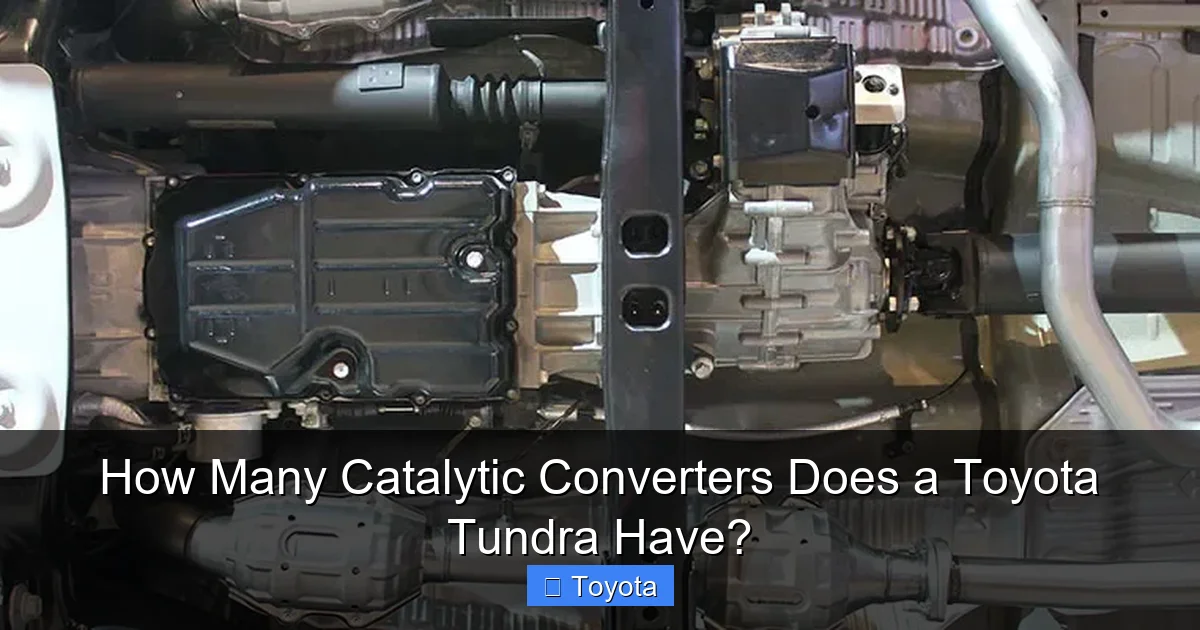
The Toyota Tundra has undergone significant changes since its 1999 debut. The evolution of federal emissions standards (Tier 2, LEV, ULEV, etc.) is the primary reason for the change in catalytic converter count. More stringent standards required cleaner exhaust, which often meant more converters or more advanced, efficient designs.
Visual guide about How Many Catalytic Converters Does a Toyota Tundra Have?
Image source: moparmax.com
First Generation (1999-2006): The Dual-Converter Era
For the first generation Tundra, which shared its platform with the Toyota Tacoma of the era, the emissions system was simpler by today’s standards. These trucks, powered by the 4.7L V8 (2UZ-FE) engine, are equipped with a total of two catalytic converters.
These are typically configured as a “dual” system. You’ll find one converter on each side of the exhaust manifold, often integrated into the exhaust manifold itself on some early models or as a “manifold converter” immediately after the manifold. This setup was sufficient for the emissions standards of the late 1990s and early 2000s. If you have a 1999-2006 Tundra, you’re looking at a two-converter setup. This is a critical fact when sourcing replacement parts or assessing theft risk, as these older converters generally contain less precious metal and are less frequently targeted than their modern counterparts.
Second Generation (2007-2021): The Quad-Converter Standard
This is where things get interesting and where the common misconception of “two converters” for all Tundras falls apart. For the vast majority of the second generation Tundra’s long run (2007-2021 model years), with its standard 4.6L or optional 5.7L V8 engines (1UR-FE, 3UR-FE), Toyota implemented a four-catalytic converter system.
Why four? To meet the much stricter Tier 2 Bin 5 and later LEV II/ULEV II standards. The system is split into two stages per exhaust bank (left and right).
- Front/Close-Coupled Converters: Two converters are mounted directly to the exhaust manifolds. They handle the bulk of the conversion work when the engine is cold and the exhaust is hottest.
- Rear/Underbody Converters: Two additional converters are located further downstream, typically under the truck’s cabin or bed area. They polish the exhaust gases after the front converters have done their job, ensuring emissions are within spec during all driving conditions.
This “quad” setup is the standard for most 2007-2021 V8 Tundras. It’s a major reason why replacement costs for these models are so high—you’re often replacing all four. The rear converters are the ones most commonly stolen because they are more accessible from underneath the vehicle. If you own a Tundra from this era, you have four catalytic converters. This is a key differentiator when comparing your truck to, say, a Dodge Ram 1500 from a similar period, which often uses a two-converter system.
The Hybrid Exception (2022+): A New, Complex Configuration
With the introduction of the all-new Tundra for the 2022 model year, Toyota brought its i-FORCE MAX hybrid powertrain. This system, pairing a twin-turbo 3.5L V6 with an electric motor/generator, necessitated a rethinking of the exhaust and emissions system.
The hybrid Tundra does not follow the simple quad-catalyst pattern. It features a more complex system with at least three major catalyst components. The primary catalytic converter is integrated into the exhaust manifold as usual. However, the system also includes a separate catalyst for the hybrid system’s exhaust gas recirculation (EGR) cooler and another component near the hybrid battery in the truck bed. The exact count and naming can be intricate, but the takeaway is this: the hybrid model does not have the traditional four-cat setup. Its configuration is unique and must be diagnosed with the specific hybrid system in mind. For precise details on your hybrid Tundra, consulting a dealership or a hybrid-specialist mechanic is essential.
Finding Them: A Tour of Your Tundra’s Exhaust System
Knowing the count is one thing; knowing where to look is another. If you’re inspecting for damage or theft, here’s a roadmap. Always ensure the truck is parked on level ground, cooled down, and safely supported if you plan to get underneath.
Visual guide about How Many Catalytic Converters Does a Toyota Tundra Have?
Image source: moparmax.com
The Front Line: Manifold & Downpipe Converters
Start your search at the engine. You’ll see the exhaust manifolds bolted to the cylinder heads. On V8 models from 2007-2021, you will see a converter unit bolted directly to each manifold. These are the first two in the sequence. They are sometimes called “manifold cats” or “close-coupled cats.” They are relatively well-protected by the engine bay but are still vulnerable to impact from road debris or, in a theft scenario, to cutting if a thief reaches in from the wheel well.
The Rear Guard: Underbody Mid-Pipe Converters
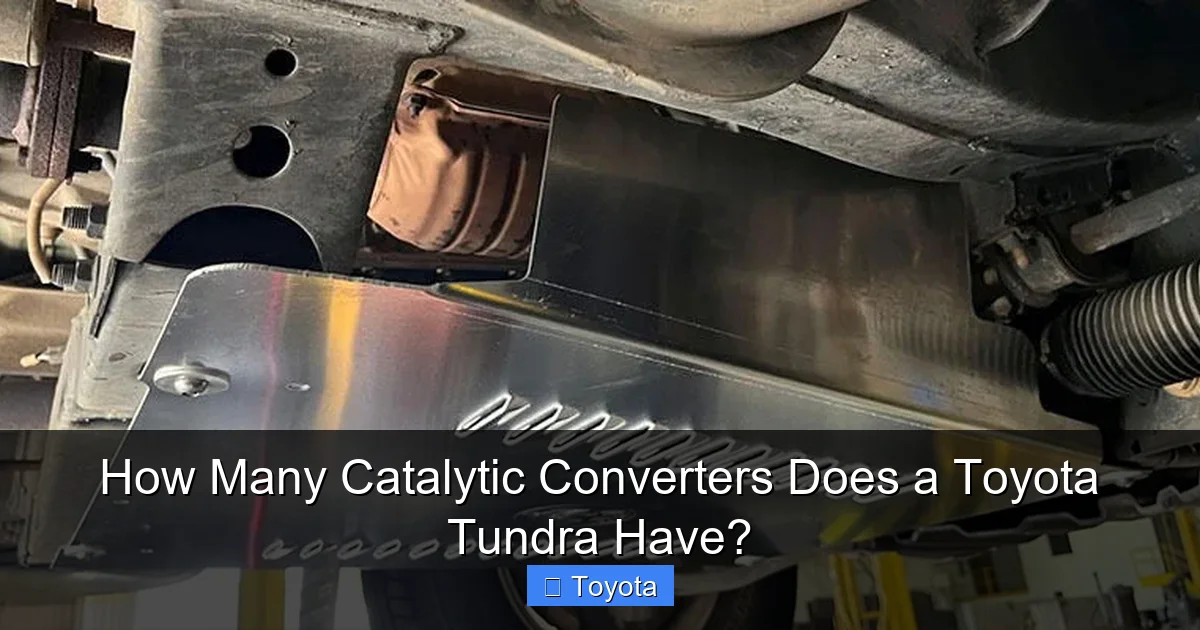
Follow the exhaust pipes back from the manifolds. They will join into a single pipe (the front pipe) after the front converters. This pipe runs under the truck, typically passing under the passenger and driver doors. On quad-cat systems, you will find two more converters bolted to this mid-pipe section, one on each side of the truck, roughly beneath the cab or the rear of the cab.
This is the prime theft zone. These converters are more accessible. Thieves can easily slide under the truck from the side and use a reciprocating saw to cut the pipes before and after the converter, stealing it in under two minutes. You can often identify a stolen rear converter by the clean-cut pipes hanging down or by a loud, aggressive exhaust note after starting the truck.
Why So Many? The Emissions Arms Race
To truly understand the Tundra’s converter count, you must understand the “why.” It’s all about the ever-tightening federal and state emissions regulations. The Environmental Protection Agency (EPA) and California Air Resources Board (CARB) set standards that automakers must meet.
A single, large catalytic converter might work for a basic standard. But as standards dropped from “Low Emission Vehicle” (LEV) to “Ultra Low Emission Vehicle” (ULEV) and beyond, engineers needed a multi-stage approach. The front converters handle the high-temperature, high-volume gases right out of the engine, efficiently converting a large percentage of pollutants. The rear converters then act as a “polishing” stage, catching what the front ones might have missed, especially during cold starts or specific engine loads.
This staged approach is more effective and allows the engine to be tuned for performance without violating emissions limits. The move from two to four converters in the 2007 Tundra was a direct engineering response to these new standards. It’s a trend seen across many full-size trucks and SUVs of that era. If you’re curious about how this compares to another popular Toyota truck, the number in a Toyota Tacoma varies significantly by its own generation and engine size, often aligning more with the older Tundra’s two-cat setup in its earlier years.
The Staggering Cost of Replacement & Theft Epidemic
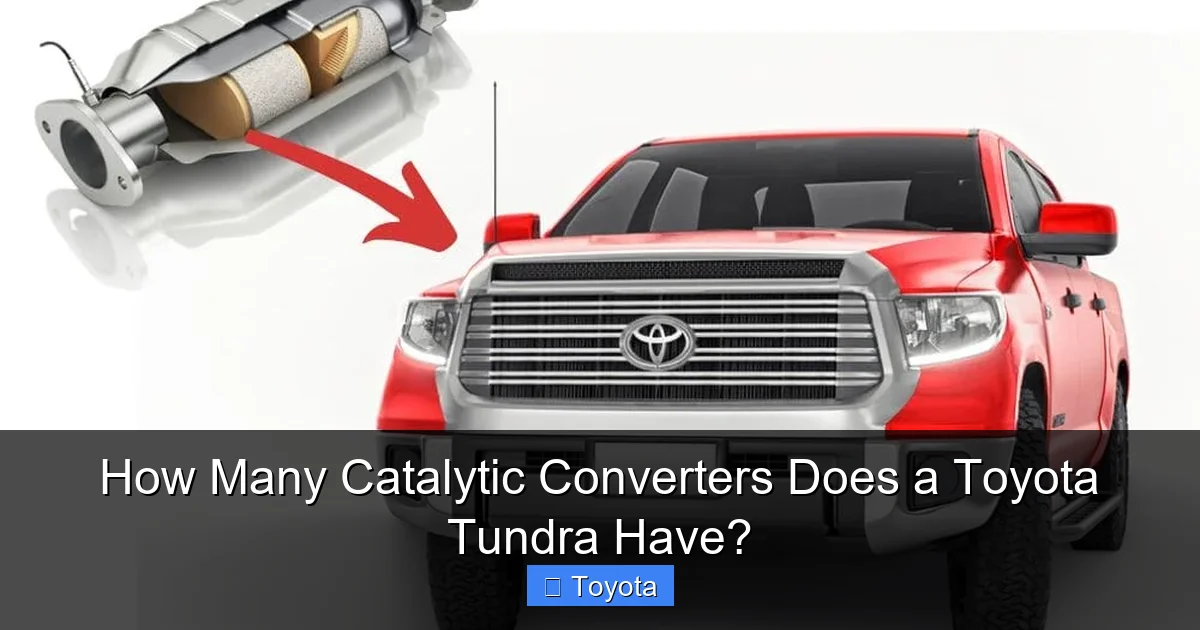
This is where the theoretical knowledge becomes painfully real for Tundra owners. Replacing a catalytic converter is not like replacing a muffler. It’s a major exhaust component containing thousands of dollars worth of precious metals.
Visual guide about How Many Catalytic Converters Does a Toyota Tundra Have?
Image source: vehiclefreak.com
Breaking Down the Bill
For a 2007-2021 V8 Tundra with the quad-cat system, you are almost certainly replacing all four. While it’s possible for just one to fail, the age and conditions that cause one to fail often affect the others. Here’s a rough cost breakdown:
- Parts (OEM): $2,500 – $4,500+. This is the biggest variable. An OEM Toyota catalytic converter is expensive because it uses a high precious metal loading to guarantee emissions compliance for 120,000+ miles.
- Parts (Aftermarket): $1,200 – $2,500+. High-quality aftermarket “direct-fit” or “universal” converters are cheaper but may have lower precious metal content, potentially triggering a check engine light (P0420 code) and failing a smog test. California and some other states have strict rules on aftermarket cat approval.
- Labor: $800 – $1,500+. This is a complex, time-consuming job. It involves lifting the truck, unbolting multiple exhaust hangers, cutting and welding (if using universal cats), and ensuring proper clearances and torque specs.
Total Realistic Range: $3,000 to $6,000+ for a full quad-cat replacement on a standard V8 Tundra. Hybrid models can be even more. This is why catalytic converter theft is such a devastating crime.
The Theft Wave: Why Your Tundra is a Target
Since about 2020, a national epidemic of catalytic converter theft has raged. The Tundra, along with the Tacoma and 4Runner, is consistently at the top of the most-targeted list. Why?
- High Precious Metal Load: To meet emissions standards, Toyota’s converters for these trucks are known to have a relatively high concentration of palladium and rhodium, which are extremely valuable.
- Ground Clearance: As a full-size truck, the Tundra has enough undercarriage clearance for a thief to slide under and access the rear converters without needing to jack the vehicle up.
- Easy Target: The rear converters are exposed and can be cut out quickly with a battery-powered saw. The job takes 30-90 seconds.
Prevention Tips: Park in well-lit, secured areas. Install an anti-theft catalytic converter plate or cage (a steel plate that shields the converter). Get the converter etched with your VIN. Consider a car alarm with a vibration sensor. Some insurance policies offer discounts for these preventive measures.
Beyond the Count: Signs of Failure and Legal Realities
Knowing you have four converters is step one. Knowing when they’re failing is step two.
Diagnosing a Bad Catalytic Converter
Converters can fail in two main ways: efficiency loss (becoming clogged) or physical damage. Watch for these signs:
- Check Engine Light: The most common sign. Codes P0420 (Catalyst System Efficiency Below Threshold) or P0430 are the classic indicators.
- Failed Emissions/Smog Test: Your truck will not pass a required emissions inspection if the converter isn’t functioning properly.
- Poor Performance & Fuel Economy: A clogged converter creates backpressure. You might notice sluggish acceleration, lack of power, or a significant drop in MPG.
- Rattling Noise: A physical impact or internal breakdown can cause the catalyst substrate to break apart, creating a loud rattling noise from under the truck, especially when idling or revving.
- Sulfur/Rotten Egg Smell: A failing converter may not properly process sulfur in the fuel, leading to a noticeable rotten egg odor from the exhaust.
The “Catted” vs. “Catless” Debate and the Law
You might hear about people removing their catalytic converters (“going catless”) for more power or a louder exhaust sound. This is illegal in all 50 states. Federal law (the Clean Air Act) prohibits the removal or tampering with any emissions control device on a vehicle that is driven on public roads. Tampering with your catalytic converters is:
- A federal offense punishable by fines.
- A guaranteed way to fail any emissions inspection.
- Harmful to the environment.
- Likely to trigger a check engine light and cause drivability issues.
For off-road, show-only vehicles that are never titled for street use, the rules are different. But for your daily-driven Tundra, your catalytic converters must be present, intact, and functioning. Any reputable shop will refuse to remove them.
Conclusion: Knowledge is Power (and Money Saved)
So, how many catalytic converters does a Toyota Tundra have? The definitive answer is: it depends. For the vast majority of second-generation (2007-2021) V8 Tundras, the answer is four. For the first generation (1999-2006), it’s two. For the new hybrid, it’s a unique, complex system that defies the simple count.
This knowledge is your first line of defense. It helps you understand your truck’s emissions system, diagnose problems accurately, and make informed decisions when faced with a costly repair. Most importantly, it highlights why your Tundra is a target for theft and underscores the critical importance of taking preventive measures. Protecting these expensive components is not just about saving money; it’s about preserving your truck’s value, legality, and environmental compliance. When in doubt about your specific model year and engine, the best course of action is to physically inspect the exhaust system or have a trusted mechanic give it a look. Your wallet—and the air we breathe—will thank you.
Frequently Asked Questions
How many catalytic converters are on a 2015 Toyota Tundra?
A 2015 Toyota Tundra with the 4.6L or 5.7L V8 engine has four catalytic converters. It uses the standard quad-catalyst system with two front (manifold) converters and two rear (underbody) converters.
Why does my Toyota Tundra have four catalytic converters instead of two?
Your Tundra has four catalytic converters to meet strict federal emissions standards (Tier 2 Bin 5/LEV II). This “quad” system uses two converters per exhaust bank—one close to the engine and one further back—to more efficiently and completely clean exhaust gases under all driving conditions.
What are the signs that one of my Tundra’s catalytic converters has been stolen?
The most obvious sign is an extremely loud, aggressive exhaust note immediately after starting the truck. You may also see hanging pipes under the truck where the converter was cut out. A Check Engine Light with codes P0420/P0430 will likely illuminate as the oxygen sensor detects abnormal exhaust flow.
How much does it cost to replace all four catalytic converters on a Tundra?
For a 2007-2021 V8 Tundra, a full replacement using OEM parts typically costs between $4,000 and $7,000 including labor. Using high-quality aftermarket parts can reduce the cost to the $2,500 – $4,500 range, but ensure they are CARB-compliant if you live in a state with strict emissions rules.
Is it illegal to remove or modify my Toyota Tundra’s catalytic converters?
Yes. Under federal law, it is illegal to remove or tamper with the catalytic converter on any vehicle driven on public roads. Doing so will cause your vehicle to fail emissions testing, can trigger check engine lights, and results in significant fines. It is also harmful to the environment.
How can I tell if my catalytic converters are failing versus just needing a sensor replacement?
While O2 sensor codes can sometimes mimic catalyst codes, a true catalyst failure (P0420/P0430) usually persists after replacing sensors. A mechanic can perform a more advanced test, like a backpressure test or analyzing the upstream vs. downstream O2 sensor activity waveforms, to confirm the catalyst is inefficient or clogged. Physical rattling is a clear sign of internal converter failure.
