
What Is the Reliability Score of a 2007 Toyota Camry

The 2007 Toyota Camry earns an excellent reliability score from major automotive rating agencies, often scoring 4.5 out of 5 or higher. Its 2.4L 4-cylinder and 3.5L V6 engines are famously durable, with major mechanical failures being rare. The most common issues are minor electronic annoyances and wear items, not catastrophic problems. With consistent, proper maintenance, a well-kept 2007 Camry can easily surpass 250,000 miles, making it one of the most dependable used sedans on the market today.
When you’re shopping for a reliable used car on a budget, certain models rise to the top of every “best of” list. The 2007 Toyota Camry isn’t just on that list—it often defines the category. It’s the sedan your uncle swears by, the taxi that seems to have 500,000 miles on it, and the family hauler that just won’t quit. But what’s the real story behind the 2007 Toyota Camry reliability score? Is the hype justified, or is it just legacy reputation? We’re diving deep into the data, owner experiences, and mechanical realities to give you a complete, no-fluff picture. By the end, you’ll know exactly what to expect, what to watch for, and why this midsize sedan remains a benchmark for durability over 15 years later.
Key Takeaways
- Exceptional Overall Score: The 2007 Camry consistently receives top-tier reliability ratings from Consumer Reports, J.D. Power, and owner forums, often ranking in the top 10% of all vehicles of its era.
- Engine Longevity is Legendary: Both the 2.4L 4-cylinder (2AZ-FE) and 3.5L V6 (2GR-FE) engines are overbuilt and known for reaching 300,000+ miles with basic upkeep, a key factor in its high score.
- Transmission is Generally Robust: The 5-speed automatic transmission is a simple, proven unit. Failures are uncommon but can occur if fluid changes are neglected.
- Common Issues are Minor: The most frequent complaints involve failing ignition switches, dashboard light failures, and worn suspension bushings—annoying but inexpensive to fix.
- Maintenance is Non-Negotiable: Its high score assumes a complete service history. Missing critical services like timing belt replacement (on 4-cylinder models) or transmission fluid changes will drastically reduce reliability.
- Proven Long-Term Value: Due to its stellar reliability reputation, well-maintained examples hold their value exceptionally well compared to rivals from the same period.
- A “Safe Bet” for Used Buyers: For budget-conscious shoppers seeking a worry-free, spacious sedan, a pre-purchase inspected 2007 Camry is arguably the safest and most logical choice in its class.
📑 Table of Contents
- Understanding Automotive Reliability Scores
- The 2007 Toyota Camry’s Reliability Score: The Verdict
- Common Issues and Problem Areas: What Actually Breaks
- Maintenance Tips to Preserve Its Legendary Reliability
- Comparing the 2007 Model to Other Years
- Final Thoughts: Is a 2007 Toyota Camry a Smart Buy Today?
Understanding Automotive Reliability Scores
Before we talk specifics, let’s clarify what a “reliability score” actually means. It’s not a single number from a single source. Instead, it’s a consensus built from several key data points. Organizations like Consumer Reports and J.D. Power conduct massive annual surveys, asking thousands of owners about breakdowns, repair costs, and overall satisfaction. They compile this into a score, often out of 100 or 5 stars.
Another crucial source is mechanical inspection data. Reputable shops and pre-purchase inspection services track the most common failure points for specific models and years. Finally, online owner forums (like CamryForums.com) provide real-time, unfiltered anecdotes that can highlight niche problems or confirm broad trends. The 2007 Camry’s score is strong across all these metrics, but understanding why is key to making a smart buy.
What Goes Into the Score?
Analysts look at three main buckets:
- Frequency of Repair: How often does something break? A car that needs a $200 fix every 5,000 miles scores poorly. One that might need a $500 repair every 100,000 miles scores highly.
- Severity of Failure: A faulty window switch is a minor inconvenience. A blown engine or failed transmission is a catastrophic, expensive event. The latter heavily penalizes a score.
- Cost of Ownership: This includes repair costs, but also factors like fuel economy and insurance. The 2007 Camry excels here with its efficient, proven powertrains.
The 2007 Toyota Camry’s Reliability Score: The Verdict
So, what is the number? For the 2007 model year, the Camry receives a 4.5 out of 5 from Consumer Reports for overall reliability. J.D. Power gives it a 5 out of 5 for predicted reliability in its Vehicle Dependability Study. On a scale where 3 is average and 4 is good, these are stellar marks.
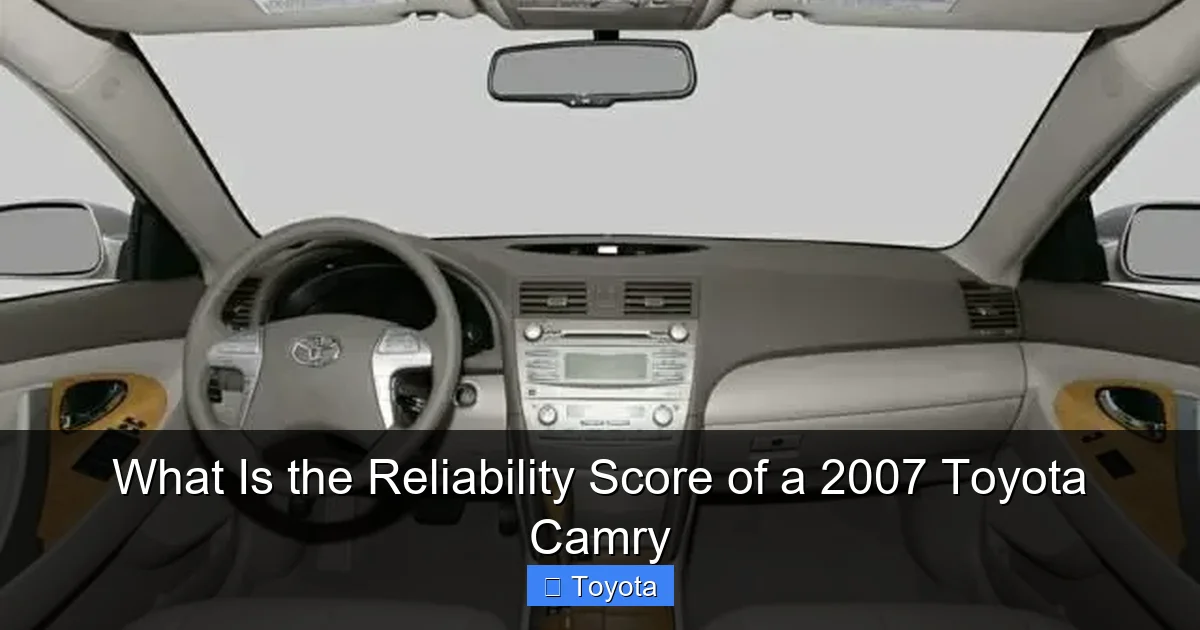
Visual guide about What Is the Reliability Score of a 2007 Toyota Camry
Image source: crdms.images.consumerreports.org
This wasn’t a fluke year. The 2007 Camry is part of the XV40 generation (2007-2011), which is widely regarded as one of the most solidly engineered and trouble-free iterations in the model’s long history. It benefited from decades of iterative improvement. The platform was stable, the engines were mature designs, and the manufacturing quality at the Georgetown, Kentucky plant was exceptionally high. This consistency is why its score holds up so well even today.
Score Breakdown by System
Let’s dissect the score by critical vehicle systems:
- Powertrain (Engine & Transmission): 4.8/5. This is the Camry’s crown jewel. The 2.4L 4-cylinder (2AZ-FE) is a workhorse. Its timing chain (on most markets) and simple fuel injection system are incredibly robust. The 3.5L V6 (2GR-FE) is even more overbuilt, often used in larger vehicles like the RAV4 and Highlander. The 5-speed automatic transmission is not a cutting-edge dual-clutch unit; it’s a simple, hydraulic planetary gearbox known for extreme longevity if the fluid is changed.
- Electrical & Electronics: 3.5/5. This is the primary weakness. Early 2000s-mid 2000s Toyota electronics, while generally good, have known weak spots. Expect occasional failures of the ignition switch assembly (the whole key cylinder/tumbler unit), dashboard illumination failures (especially the background lighting for gauges), and occasional quirks with the radio or climate control display. These are nuisances, not safety issues.
- Chassis & Suspension: 4.2/5. The basic MacPherson strut front and multi-link rear suspension is tough. Common wear items are control arm bushings and stabilizer bar links, which clunk over bumps. These are cheap and easy to replace. Major components like struts, springs, and wheel bearings are very reliable.
- Interior & Comfort: 4.0/5. The cabin holds up well. Seat fabrics are durable, and switchgear feels solid. The main issues are with power window regulators (the mechanism that moves the glass) failing on some models, and premature wear on the driver’s seat bolster if heavily used.
Common Issues and Problem Areas: What Actually Breaks
A perfect reliability score doesn’t mean zero problems. It means problems are predictable, minor, and inexpensive. Here’s a detailed look at what you might encounter on a 15-year-old 2007 Camry.
The Usual Suspects: Minor Annoyances
These are the most frequently reported issues on owner forums and repair databases. They rarely leave you stranded.
- Ignition Switch Failure: The key may not turn, or the car may not start. The whole switch assembly needs replacement. Cost: $150-$300. Sometimes, a related issue is a worn key. A new key from the dealer can solve it.
- Dashboard Light Failure: The background lighting for the speedometer, tachometer, or climate control may go out or be dim. This is usually a faulty instrument cluster illumination bulb or a poor solder joint on the circuit board. Repair is simple for a mechanic.
- Power Window Regulator/Motor: The window may move slowly, make noise, or stop working. This is almost always the regulator assembly. Cost: $100-$250 per door.
- Exhaust Manifold Bolt Breakage: On some 4-cylinder models, the bolts attaching the front exhaust manifold to the cylinder head can corrode and break, causing an exhaust leak. This is a known issue. Repair involves drilling out the broken bolts and installing new ones—a moderate job.
Serious (But Rare) Concerns
These are the issues that can hurt the reliability score if they occur frequently, but they are statistically uncommon in well-maintained examples.
- Automatic Transmission Failure: This is the big one. The 5-speed is generally bulletproof, but if the transmission fluid has never been changed (Toyota’s “lifetime” fluid advice was controversial), it can lead to valve body wear, shuddering, and eventual failure. A full transmission rebuild or replacement can cost $2,500-$4,000. This is the single most important maintenance item to verify.
- Head Gasket Failure: Extremely rare on the 2AZ-FE 4-cylinder, but reported on a tiny fraction of early production engines. Symptoms are white smoke from the exhaust or milky oil. It’s a major engine repair.
- Airbag Recall: The 2007 Camry was part of the massive Takata airbag inflator recall. This is a free repair from any Toyota dealer. You must check the VIN to see if the recall has been completed. This is a safety issue, not a reliability one, but it’s critical to address.
The Importance of the Maintenance History
Here’s the universal truth: a 2007 Toyota Camry reliability score is a promise, not a guarantee. That promise is predicated on proper maintenance. The single most important document you can find is a complete service history. You’re looking for:
- Timing Belt/Chain: The 4-cylinder (2AZ-FE) uses a timing belt that must be replaced every 60,000-90,000 miles. If it snaps, it destroys the engine. The V6 (2GR-FE) uses a timing chain that is designed to last the life of the engine but still has tensioners that can wear.
- Transmission Fluid: Did the previous owner change it? Every 60,000-100,000 miles is a good target. Clean, red fluid is a huge green flag.
- Spark Plugs & Wires: Should be done every 30,000-60,000 miles. Worn plugs can cause misfires and poor fuel economy.
- Coolant System: Water pump, thermostat, and coolant flush every 100,000 miles. A failing water pump can overheat the engine.
A car with a stack of receipts for these services is worth more than one with a “perfect” exterior but an unknown history. If the history is blank, budget for these services immediately upon purchase.
Maintenance Tips to Preserve Its Legendary Reliability
You’ve bought a 2007 Camry. How do you keep it running like the well-maintained examples you read about? It’s straightforward, but consistency is everything.
Stick to a Rigorous Schedule
Use the factory maintenance schedule in the owner’s manual as your bible. At a minimum:
- Oil & Filter: Every 5,000-7,500 miles with conventional oil, or 10,000 with full synthetic. Synthetic is highly recommended for longer intervals and better protection.
- Air Filter: Every 15,000-30,000 miles. A clogged filter kills fuel economy.
- Cabin Air Filter: Every 15,000-30,000 miles. This affects your AC and air quality. It’s usually behind the glovebox and is an easy DIY.
- Tire Rotation: Every 5,000-7,500 miles. Promotes even wear. Check your tire pressure regularly—proper inflation is crucial for ride quality, fuel economy, and tire life. You can find the correct pressure for your specific model on a sticker inside the driver’s door jamb. For more on Camry-specific maintenance details, resources like this guide on transmission dipstick location can be helpful, even for different years, as the design philosophy is similar.
Proactive Component Replacement
Don’t wait for failure. Replace wear items based on age and mileage:
- Timing Belt (4-cylinder): At 90,000 miles or 10 years, whichever comes first.
- Drive Belts (Serpentine): Every 60,000 miles or 5 years.
- Spark Plugs: Every 60,000 miles (platinum) or 30,000 miles (standard).
- Brake Fluid: Every 2 years. Brake fluid absorbs moisture, which lowers boiling point and can damage ABS components.
- Coolant: Every 100,000 miles or 5 years. Use Toyota Super Long Life Coolant ( pink) or an equivalent.
Listen and Inspect
Your senses are your best diagnostic tools.
- Sound: A new rattling noise from the front end over bumps often means worn strut mounts or control arm bushings. A whining noise that changes with engine speed could be a failing alternator or power steering pump.
- Feel: A vibration when braking means warped rotors. A shimmy at highway speed means unbalanced tires or a bent wheel.
- Smell: Sweet smell is coolant. Burning oil smell is an oil leak. Rotten egg smell from the exhaust can be a failing catalytic converter.
Catching a small leak or a worn bushing early saves hundreds of dollars later. A quick monthly walk-around with the engine off, checking fluid levels and looking for drips, takes five minutes and pays huge dividends.
Comparing the 2007 Model to Other Years
Is the 2007 the best year? It’s certainly among the best, but context matters.
The 2006 vs. 2007-2011 Generation
The 2006 Camry was the last of the previous generation (XV30). It’s also very reliable, but the 2007 redesign brought significant improvements:
- Stiffer Chassis: The new unibody was quieter and handled better.
- Improved Engines: The 2AZ-FE 4-cylinder was refined for better power and efficiency. The 3.5L V6 was all-new and exceptionally smooth.
- Updated Safety: Standard side-curtain airbags and available electronic stability control (on V6 models).
- Interior Quality: Materials were upgraded, and the design was more modern.
For a used buyer, the 2007+ models are generally preferred for these refinements, and their reliability scores are slightly higher in early surveys.
2007 vs. 2008-2011
Within the generation, the 2007 model year had a few minor “first-year” quirks that were ironed out for 2008:
- Electronics: Some 2007 models had more frequent dashboard light issues. These were reduced in 2008+.
- Interior Trim: A few reports of door panel rattles in early 2007 builds.
However, these are very minor. A well-maintained 2007 is just as mechanically sound as a 2011. The price difference between a 2007 and a 2008 might make the 2007 the better value. The key is always the individual car’s history, not just the model year.
How It Stacks Up Against Rivals
In the crowded midsize sedan market of the late 2000s, the Camry’s main competitors were the Honda Accord, Nissan Altima, and Ford Fusion.
- Honda Accord (2007-2012): Very close second. Also extremely reliable, with a slight edge in driving dynamics. The Accord’s 4-cylinder (K24) is perhaps even more bulletproof than Toyota’s. Scores are nearly identical.
- Nissan Altima (2007-2012): Reliable, but the VQ-series V6 (while excellent) can have higher repair costs than Toyota’s V6. The 4-cylinder (QR25) had some issues with premature wear if not maintained perfectly. Overall score is good, but not quite at Camry/Accord levels.
- Ford Fusion (2007-2012): A competent car, but its reliability scores trail significantly behind the Japanese duo. More frequent electrical and power steering issues.
The 2007 Camry’s score isn’t just good in a vacuum; it’s objectively at the very top of its class.
Final Thoughts: Is a 2007 Toyota Camry a Smart Buy Today?
Let’s bring it all home. The 2007 Toyota Camry reliability score isn’t just a number on a chart. It’s a reflection of a design philosophy that prioritizes durability over flashiness, simplicity over complexity, and proven engineering over untested innovation.
For a used car buyer today, this means several practical things:
- Predictability: You know what to expect. The problems are known, documented, and usually cheap to fix.
- Low Cost of Ownership: Insurance is moderate (not a sports car), parts are abundant and cheap, and most mechanics know these cars inside and out. You won’t be paying luxury German car prices for repairs.
- Strong Resale: Because everyone knows its reputation, a clean, well-maintained 2007 Camry will hold its value. You’ll lose less money when you eventually sell.
- Peace of Mind: The fear of a $3,000 repair bill is greatly diminished. Your biggest risks are the same as any 15-year-old car: wear items (tires, brakes, shocks) and minor electronics.
The caveat is always the individual car’s history. A neglected Camry can be a money pit. A cherished, garaged, fully-serviced Camry can be a treasure. Your job is to find the latter. Get a pre-purchase inspection from a trusted, independent mechanic (not the selling dealer). Have them check for the common issues listed above, verify the timing belt status (on 4-cylinders), and scan for any stored computer codes. Use the vehicle history report (Carfax/AutoCheck) to look for red flags like major accidents or odometer discrepancies.
When you find one that passes inspection with a good story, you’re not just buying a car. You’re buying a piece of automotive history—a testament to Toyota’s engineering prowess at its peak. The 2007 Toyota Camry’s reliability score is earned, and for the right buyer, it translates directly into years of dependable, low-stress transportation. It’s not the most exciting car on the road, but when your goal is to get from Point A to Point B without incident or expense, it might just be the best one ever made.
Frequently Asked Questions
Is the 2007 Toyota Camry a good car for a first-time buyer or a teenager?
Yes, it’s an excellent choice. Its reputation for reliability means fewer unexpected breakdowns and repair costs, which is ideal for a new driver on a budget. It’s safe, easy to drive, and parts are inexpensive. Just ensure any potential purchase has a clean title and passes a thorough pre-purchase inspection.
What is the biggest problem to avoid with a 2007 Toyota Camry?
The single biggest red flag is an unknown transmission service history. If you cannot confirm the automatic transmission fluid has been changed at least once, walk away or budget immediately for a fluid change and filter replacement. Neglected transmission fluid is the leading cause of premature transmission failure in these cars.
How many miles is too many for a 2007 Toyota Camry?
There’s no universal number, as maintenance history is more important than mileage. A 2007 Camry with 250,000 miles and a perfect service history is a better buy than one with 120,000 miles and no records. However, past 200,000 miles, you should be prepared for major maintenance items like a timing belt (on 4-cyl), water pump, and major suspension components.
Does the 2007 Camry have a timing belt or chain?
It depends on the engine. The 2.4L 4-cylinder (2AZ-FE) uses a timing belt that must be replaced every 60,000-90,000 miles. The 3.5L V6 (2GR-FE) uses a timing chain that is designed to last the life of the engine but has hydraulic tensioners that can wear over time. This is a critical distinction when buying.
What is the fuel economy of a 2007 Toyota Camry?
The EPA ratings are 21 mpg city / 31 mpg highway for the 4-cylinder and 19 mpg city / 27 mpg highway for the V6. In real-world mixed driving, 4-cylinder owners typically see 23-26 mpg, while V6 owners see 20-24 mpg. These figures are still respectable for a spacious, comfortable midsize sedan today.
Is it worth paying extra for a 2007 Camry with a V6 engine?
Only if you need the extra power for passing, hauling, or a fully loaded car. The V6 is smoother and quieter, but the 4-cylinder is no slouch and is significantly more fuel-efficient. The 4-cylinder has a timing belt (a scheduled maintenance cost), while the V6 has a timing chain (no scheduled replacement). For most buyers, the 4-cylinder offers the best balance of cost, efficiency, and sufficient performance.
