
Can a Ford F-150 Pull a Gooseneck Horse Trailer?

The Ford F-150 can pull a gooseneck horse trailer, but success depends entirely on payload capacity—not traditional towing ratings—since a gooseneck loads weight directly over the truck’s rear axle. You must install a certified gooseneck hitch, ensure your trailer’s weight plus cargo stays under your truck’s payload limit, and equip your F-150 with the right tires and brakes for safe, stable towing. Always consult your owner’s manual and weigh your setup before hitting the road.
So, you’ve got a Ford F-150, a couple of horses, and a dream of hitting the trails or heading to a show. The big question buzzing in your head is: Can a Ford F-150 pull a gooseneck horse trailer? It’s a brilliant question, and the answer is a qualified, “Yes, but…” That “but” is packed with critical details that separate a safe, confident haul from a risky, stressful, and potentially dangerous situation. This guide will walk you through everything you need to know, from the numbers on your door jamb sticker to the exact hitch you need and the driving techniques that keep your precious cargo safe. We’re going to break it down in simple, friendly terms.
First, let’s clear up the biggest point of confusion. When people ask if an F-150 can “pull” a trailer, they often think of the maximum towing capacity number Ford advertises—sometimes up to 14,000 lbs for certain models. That number is almost irrelevant for a gooseneck horse trailer. Why? Because a gooseneck trailer’s tongue (the part that goes over the truck bed) sits directly over the truck’s rear axle. This means the weight of the trailer’s front end and its cargo (your horses, gear, etc.) is carried as payload inside the truck bed, not as a traditional “tongue weight” hanging behind the axle. Therefore, your limiting factor is your F-150’s payload capacity—the maximum weight it can safely carry in its cab and bed combined. This is a crucial distinction that every horse owner must understand before hooking up.
Key Takeaways
- Payload is the critical number: Gooseneck trailers are limited by your F-150’s payload capacity (weight in the bed), not its bumper-pull towing capacity.
- A dedicated gooseneck hitch is mandatory: You cannot use a standard ball hitch; a fifth-wheel or gooseneck hitch mounted in the truck bed is required.
- Trailer weight must include everything: Factor in the trailer’s empty weight, horses, gear, water, and feed—all count against your payload.
- Weight distribution and sway control are non-negotiable: Proper loading and potentially a weight-distribution hitch with sway control are essential for stability.
- Model year, engine, and package drastically change capacity: A base V6 F-150 has far less payload than a max-payload V8 or diesel model with the Heavy-Duty Payload Package.
- Truck preparation is key: Upgraded brakes, transmission cooling, and proper tires are often necessary for safe, repeated towing of heavy horse trailers.
📑 Table of Contents
- Demystifying Towing Capacities: Payload vs. Gross Trailer Weight
- The Gooseneck Advantage and Hitch Requirements
- Matching Your Trailer to Your F-150’s Payload
- On the Road: Safe Towing Practices for Horse Trailers
- Common Mistakes and How to Avoid Them
- Model Year Considerations: What F-150 is Best for Horse Trailers?
- Conclusion: Yes, But Knowledge is Your Best Hitch
Demystifying Towing Capacities: Payload vs. Gross Trailer Weight
Let’s get nerdy for a minute, but in a helpful way. Your Ford F-150 has two fundamental weight ratings that matter here:
- Gross Vehicle Weight Rating (GVWR): The absolute maximum total weight the truck can safely weigh when fully loaded (truck + passengers + cargo + fuel + the weight pressing down on the bed from the gooseneck).
- Payload Capacity: This is your magic number. It’s GVWR minus the truck’s “curb weight” (its weight with all fluids, but empty and unloaded). Payload is everything you add: you, your passengers, your tools, and critically, the downward weight from the gooseneck trailer’s tongue.
For a gooseneck, you are essentially stuffing a portion of the trailer’s weight into the bed. A typical three-horse slant-load gooseneck trailer might weigh 3,500 lbs empty. Add three average horses at 1,200 lbs each (3,600 lbs), plus tack, feed, and water (another 300-500 lbs), and your total trailer weight is around 7,400 lbs. The gooseneck tongue weight is usually 20-25% of the loaded trailer weight. So, for that 7,400 lb trailer, the tongue weight pressing into your truck bed is roughly 1,500-1,850 lbs. That entire tongue weight comes out of your F-150’s payload budget.
Decoding Your Truck’s Door Jamb Sticker
Find your definitive payload number. Open the driver’s door and look at the yellow and white sticker on the door jamb. It lists your truck’s specific GVWR and often its payload. If payload isn’t listed, subtract the “Base Curb Weight” (or “Shipping Weight”) from the GVWR. For example: GVWR 6,500 lbs – Curb Weight 4,800 lbs = 700 lb payload. That’s a very low payload truck! A max-payload F-150 might have a GVWR of 7,300 lbs and a curb weight of 4,500 lbs, giving you a 2,800 lb payload. That’s the difference between being able to haul horses or not. Never guess; always use the sticker on your specific truck.
How Engine, Axle Ratio, and Packages Affect Your Payload
Two F-150s that look identical can have vastly different capacities. The biggest payload boosters are:
- The Heavy-Duty Payload Package (HDPP): This is the holy grail for horse owners. It includes a heavier-duty rear axle, upgraded springs (often leaf springs on the rear), and sometimes a different brake package. It can increase payload by 500-1,000 lbs over a standard suspension truck with the same engine.
- Engine Choice: While the larger engines (5.0L V8, 3.5L EcoBoost V6) provide more towing power, they often have a higher curb weight, which can slightly reduce net payload compared to a lighter V6. The max-payload trucks are often the V8 models with the HDPP.
- 4×4 vs. 4×2: Four-wheel-drive systems add significant weight (200-300 lbs), which eats into payload. A 4×2 model with the same package will usually have a higher payload rating.
- Cab and Bed Length: A longer bed (8-foot) often has a higher payload rating than a shorter bed (5.5-foot) because it’s built on a heavier frame. A SuperCrew (4-door) with a 5.5-foot bed might have the lowest payload of all configurations.
Practical Example: A 2020 F-150 Lariat, SuperCrew, 4×4, 5.0L V8, with the 6.5-foot bed and the Heavy-Duty Payload Package might have a payload of ~2,200 lbs. The same truck without the HDPP might only have ~1,500 lbs. That 700 lb difference is the difference between hauling two horses or three.
The Gooseneck Advantage and Hitch Requirements
Why choose a gooseneck for horses? Stability. Because the trailer’s weight is centered over the truck’s rear axle, the combination is much less prone to sway than a bumper-pull (tag-along) trailer. The turning radius is also dramatically better, which is a huge advantage in tight barnyards and show grounds. However, this advantage comes with a strict requirement: you must have a proper gooseneck hitch installed in your truck’s bed.
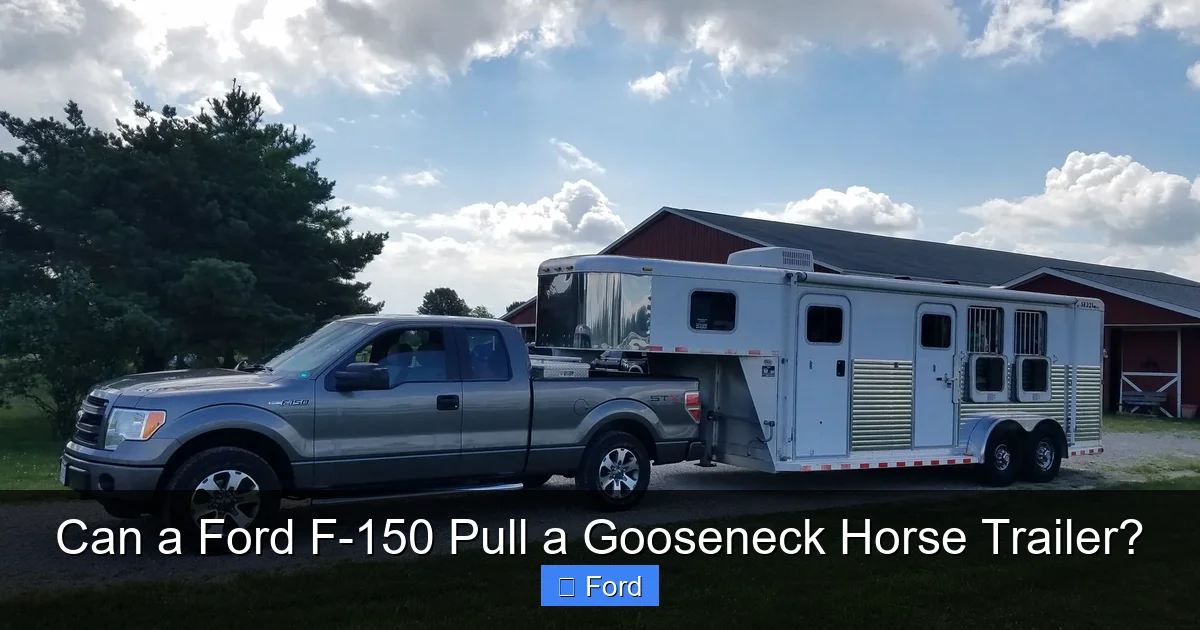
Visual guide about Can a Ford F-150 Pull a Gooseneck Horse Trailer?
Image source: cimg1.ibsrv.net
Fifth-Wheel vs. Gooseneck Hitches: What’s the Difference?
People often use these terms interchangeably, but there’s a subtle difference. A fifth-wheel hitch has a flat, horseshoe-shaped plate with a central jaw that clamps onto a kingpin. It’s designed for large, heavy RVs and some horse trailers. A gooseneck hitch uses a round ball (like a giant trailer ball) that the trailer’s coupler drops onto. Most modern horse gooseneck trailers use a gooseneck ball system. The good news? Many hitches are “combo” units with a fifth-wheel plate that can be removed to reveal a gooseneck ball, or vice versa. For your F-150, you’ll want a hitch that bolts to the frame rails in the bed. Never use a bumper-pull ball mounted in the bed; it’s not engineered for the massive leverage of a gooseneck.
Installing a Gooseneck Hitch in Your F-150
This is not a DIY project for most. You need a hitch specifically designed for your F-150’s exact year, cab, and bed configuration. Brands like B&W, PullRite, and Reese are top-tier. Installation involves:
- Removing the factory spare tire and possibly the bed liner.
- Bolting heavy-duty mounting plates to the truck’s frame rails (the strong metal skeleton under the truck).
- The hitch itself then bolts to these plates. Some systems replace the factory spare tire carrier with a gooseneck ball that folds down.
- Wiring must be run from the front of the truck to the bed for the trailer’s lights and brakes.
Professional installation is highly recommended to ensure it’s done correctly and safely. Once installed, the hitch will have a rating—make sure its weight capacity meets or exceeds your calculated tongue weight. A quality gooseneck hitch for an F-150 will typically be rated for 25,000 lbs or more, so it’s rarely the weak link; your truck’s payload is.
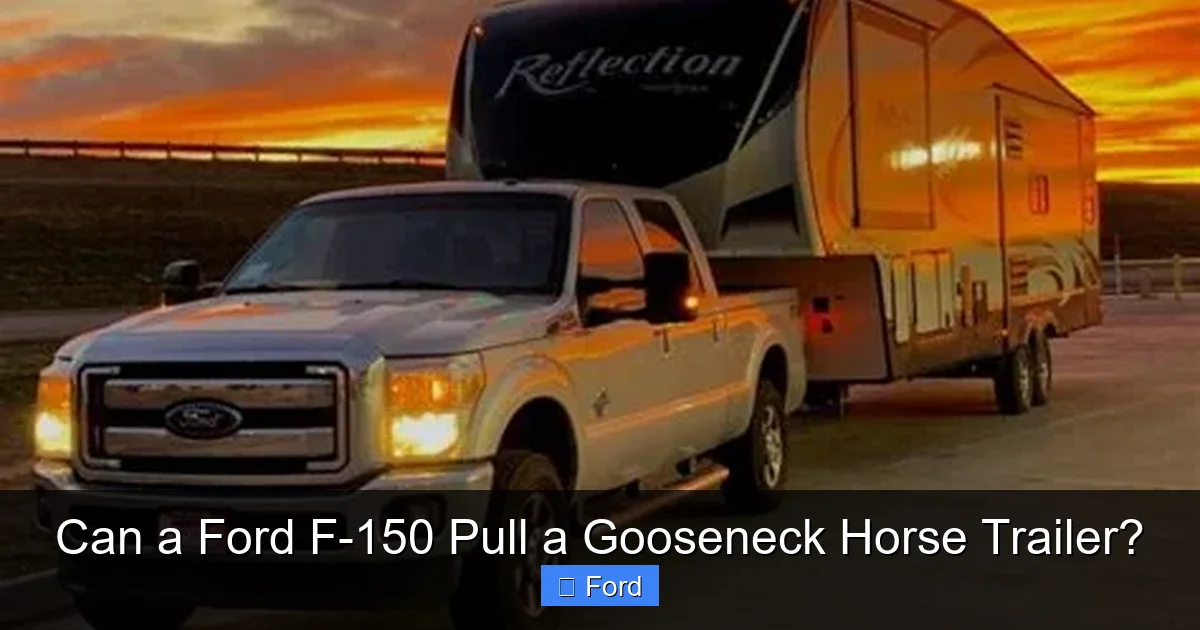
Matching Your Trailer to Your F-150’s Payload
This is the math part, but it’s straightforward. Here is the step-by-step process to see if your dream trailer fits your truck:
Visual guide about Can a Ford F-150 Pull a Gooseneck Horse Trailer?
Image source: autozonic.com
Step 1: Find Your Truck’s Exact Payload
From the door jamb sticker, get your GVWR and curb weight. Subtract curb weight from GVWR. That’s your total payload for everything: you, your passengers, any cargo in the cab, and the gooseneck tongue weight.
Step 2: Get the Trailer’s Actual Weights
You need two numbers from the trailer seller or manufacturer:
- Empty Weight (or UVW – Unloaded Vehicle Weight): The weight of the trailer with nothing in it, but with full fuel/propane if applicable.
- GVWR (Gross Vehicle Weight Rating) of the Trailer: The maximum the trailer itself is designed to weigh, including its own cargo (horses, gear).
Never use the “empty weight” to calculate your payload needs. You must calculate based on your expected loaded weight. A horse trailer’s loaded weight is the sum of its empty weight plus the weight of all horses and gear you plan to carry.
Step 3: Do the Payload Math
Formula: Your F-150’s Payload – (Your Cab Weight: people, gear, fuel) = Available Payload for Trailer Tongue
Example:
- Your F-150’s payload: 1,800 lbs
- You (200 lbs) + passenger (180 lbs) + dog (50 lbs) + tools in cab (50 lbs) + full fuel (100 lbs) = 580 lbs in the cab.
- Available payload for trailer tongue: 1,800 – 580 = 1,220 lbs.
Now, look at your trailer. If you plan to haul two 1,100 lb horses (2,200 lbs) plus tack and feed (200 lbs), your total cargo on the trailer is 2,400 lbs. Add that to the trailer’s empty weight of 3,200 lbs. Your loaded trailer weight is 5,600 lbs. The tongue weight for a gooseneck is typically 20-25% of the loaded weight. So 5,600 lbs x 0.20 = 1,120 lbs. That fits under your 1,220 lb available payload! You’re good. But if you added a third horse or more gear, you’d exceed it.
Trailer Weight Considerations for Horse Trailers
Horse trailers are deceptively heavy. A basic two-horse straight-load might have an empty weight of 2,800 lbs. A large three-horse slant-load with a living quarters can easily weigh 5,500 lbs empty. Always get the actual weight from a scale if possible, or the manufacturer’s spec sheet. Don’t trust a seller’s guess. Also, consider the trailer’s own GVWR. Your F-150’s payload must cover the actual loaded tongue weight, not the trailer’s maximum GVWR. A trailer rated for 10,000 lbs GVWR might only weigh 4,000 lbs empty, so your tongue weight calculation is based on what you actually put in it.
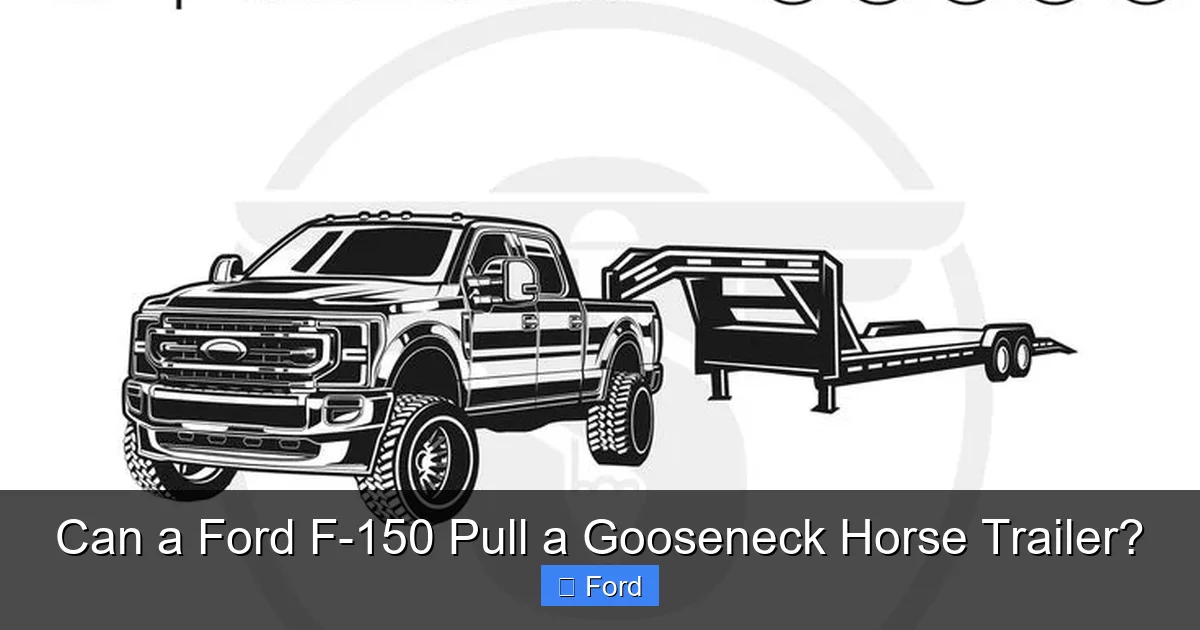
On the Road: Safe Towing Practices for Horse Trailers
You’ve got the right hitch, the math checks out, and your trailer is loaded correctly. Now you’re driving. Towing a live cargo trailer adds layers of responsibility. Horses are sensitive to sudden movements, so smooth, predictable driving is paramount.
Visual guide about Can a Ford F-150 Pull a Gooseneck Horse Trailer?
Image source: i.pinimg.com
Essential Towing Accessories for Safety
Your F-150’s factory brakes may be adequate for a light load, but a loaded horse trailer often exceeds 6,000 lbs. Most states require trailer brakes for anything over a certain weight (often 1,500-3,000 lbs). Ensure your trailer has a functional electric brake system and that your F-150 has a brake controller installed. This is a non-negotiable safety device. It allows you to manually apply the trailer brakes and automatically activates them when you press the truck’s brake pedal.
Sway control is another critical tool. While gooseneck trailers are inherently stable, crosswinds, passing trucks, or sudden steering inputs can still cause sway. A weight-distribution hitch with integrated sway control (often a friction-based or cam-based system) is highly recommended for loads over 5,000 lbs. It evenly distributes the tongue weight across both truck axles and dampens any lateral movement.
Driving Techniques for Horse Trailers
Your driving style must change:
- Accelerate and brake gently and gradually. Think like you’re carrying a cup of water on the dashboard. Horses can lose balance with sudden stops or starts.
- Increase following distance. Stopping distance multiplies. Allow 4-5 seconds of space ahead of you.
- Take corners wider and slower. The gooseneck helps, but the trailer will still cut the corner slightly (“off-tracking”). Your rear wheels will follow a much wider path than your front wheels.
- Be hyper-aware of wind. High-profile vehicles and crosswinds on bridges or open highways are major sway hazards. Reduce speed and keep a firm grip.
- Use your mirrors. You need to see the entire trailer and a good margin around it. Consider extended tow mirrors.
- Plan your stops. Look ahead for wide, level parking areas. Backing up a gooseneck is an art form; practice in an empty lot.
For optimal traction and control, especially when towing heavy loads on varied surfaces, your F-150 needs the right tires. All-season tires might suffice on paved roads, but for gravel, wet pavement, or occasional dirt roads, all-terrain or off-road tires provide a significant safety margin. In winter conditions, dedicated winter tires are essential for both the truck and trailer. We’ve analyzed the market and recommend checking out our guides to the best off-road tires for the Ford F-150 for all-around capability and the best winter tires for the Ford F-150 4×4 for cold-weather hauling.
Common Mistakes and How to Avoid Them
Even experienced truck owners make these errors when first towing a gooseneck horse trailer:
The Dangers of Overloading (The #1 Mistake)
This cannot be stressed enough. Exceeding your payload rating by even 200 lbs puts excessive stress on your rear axle, brakes, and tires. It causes premature wear, poor handling, and dramatically increases stopping distance. The truck’s suspension will be bottomed out, making every bump a jolt to the horses. Always weigh your fully loaded trailer at a public scale (often found at truck stops or grain elevators). Weigh the truck alone first, then with the trailer hitched. The difference is your tongue weight. Add your cab weight to ensure you’re under GVWR and payload.
Improper Loading and Weight Distribution
Horses should be loaded evenly from left to right. Heavy items like feed and water should be placed low and near the trailer’s axle(s). The goal is to have about 10-15% of the trailer’s total loaded weight as tongue weight. Too little tongue weight causes sway; too much overloads the truck’s rear axle and reduces steering control. A gooseneck is less sensitive to this than a bumper-pull, but it still matters.
Ignoring Truck Maintenance
Towing is hard on a vehicle. Before a long trip:
- Service the transmission: Change fluid and filter if it’s due. Consider an auxiliary transmission cooler for heavy, repeated towing.
- Check all fluids: Engine oil, coolant, brake fluid.
- Inspect brakes and tires: Brake pads should have plenty of life. Tires must be properly inflated to the towing pressure listed on the door jamb sticker (often higher than normal pressure). Look for sidewall cracks or uneven wear.
- Verify the battery is strong. Trailer lights and brakes draw power. A weak battery can cause light malfunctions.
For older F-150s, worn shock absorbers can severely degrade towing stability and control. If your truck has over 100,000 miles, consider a shock upgrade. We’ve reviewed excellent options for various model years, including the best shocks for the 2016 Ford F-150 4×4, which is a common year for used trucks. Fresh, heavy-duty shocks make a noticeable difference in ride quality and safety when loaded.
Model Year Considerations: What F-150 is Best for Horse Trailers?
Not all F-150s are created equal. The truck’s capability has evolved significantly over the years, and the specific configuration is everything.
F-150 Generations and Towing Evolution
If you’re buying a used F-150 for horse towing, focus on models from 2009 onward (the 12th generation). These have stronger frames and more available payload packages. The 2015+ (13th generation) introduced the aluminum body, which saved weight and allowed for higher payload ratings in some configurations. The 2021+ models added the hybrid PowerBoost engine, which offers excellent torque for towing but again, check the specific payload on the door jamb as the hybrid system adds weight.
Matching Your Model Year to Trailer Needs
Here’s a general, approximate guideline. You must verify your specific truck’s numbers.
- Base Model V6 (3.3L or 3.5L non-EcoBoost) with Standard Suspension: Payload often 1,300-1,700 lbs. Suitable for a very light, single-horse trailer or a small two-horse bumper-pull. Not ideal for a loaded gooseneck with two large horses.
- V8 (5.0L) or EcoBoost (3.5L) with Standard Suspension: Payload typically 1,600-2,000 lbs. Can handle a moderate two-horse gooseneck (loaded tongue weight ~1,200 lbs) with careful loading and minimal extra gear.
- Any Engine with the Heavy-Duty Payload Package (HDPP): This is your target. Payload often exceeds 2,200 lbs and can reach 2,800+ lbs on certain 4×2, regular cab, long-bed models. This configuration can comfortably handle a three-horse gooseneck with gear.
Trim level matters less than the package. An XLT with the HDPP will out-payload a Lariat without it. Focus on the presence of the HDPP (it may be called “Max Trailer Tow” or “Heavy-Duty Payload” on the window sticker) and the cab/bed/4×4 configuration.
Finally, remember that your F-150’s cabin is about to get acquainted with dirt, hay, and horsehair. Protecting your investment is smart. After a long haul, a thorough cleaning is a chore. Consider installing durable, waterproof seat covers to shield the upholstery. We’ve compiled a list of the best seat covers for the Ford F-150, many of which are designed for heavy-duty use and are easy to wipe clean.
Conclusion: Yes, But Knowledge is Your Best Hitch
So, can a Ford F-150 pull a gooseneck horse trailer? The definitive answer is yes, millions do it safely every year. But the real question isn’t “can it?” but “can YOUR specific F-150, in its exact configuration, safely pull YOUR specific gooseneck trailer, loaded with YOUR horses and gear?” That answer is found not in a forum post or a generic towing chart, but on your truck’s door jamb sticker and in the honest weight of your trailer.
The process is simple in theory: know your payload, install the correct hitch, match the trailer weight, and drive with extreme care. In practice, it requires diligence—weighing your setup, maintaining your truck, and respecting the limits. A gooseneck trailer offers unparalleled stability for equestrian hauling, and a properly equipped F-150 is a fantastic platform for the job. Start with the math. If the numbers work, you’re on your way to many safe and enjoyable rides with your horses. If they don’t, you may need to adjust your trailer choice, lighten your load, or consider a larger truck. There’s no shame in putting safety first; your horses—and your truck—will thank you for it.
Frequently Asked Questions
Can any Ford F-150 pull a gooseneck horse trailer?
No. Only F-150s with sufficient payload capacity can safely do so. A base-model V6 with a short bed and no payload package may have a payload under 1,500 lbs, which is often insufficient for even a small loaded gooseneck. You must check your specific truck’s door jamb sticker for its payload rating.
What is the maximum size gooseneck horse trailer an F-150 can pull?
It’s not about trailer length or number of horses; it’s about weight. A typical F-150 with a good payload package (2,200+ lbs) can handle a 3-horse slant-load gooseneck (loaded weight ~6,000-7,500 lbs). Always calculate based on your truck’s payload minus your cab weight to find the available tongue weight capacity.
Do I need a special hitch, and can I install it myself?
Yes, you need a bed-mounted gooseneck or fifth-wheel hitch specifically designed for your F-150’s year and bed length. While some experienced DIYers can install it, professional installation is strongly recommended to ensure it’s bolted correctly to the frame and wiring is done properly for trailer brakes and lights.
Is a gooseneck better than a bumper-pull for horses with an F-150?
Generally, yes. The gooseneck’s weight-over-the-axle design provides much better stability and less sway than a bumper-pull. It also offers a tighter turning radius. However, it requires a bed-mounted hitch and uses payload capacity, whereas a bumper-pull uses traditional towing capacity and tongue weight.
How do I calculate if my loaded trailer is within my F-150’s limits?
1) Get your truck’s payload from the door jamb. 2) Weigh yourself, passengers, and cab cargo (or estimate). Subtract that from your payload. 3) That’s your max allowed tongue weight. 4) Estimate your trailer’s loaded weight (horses + gear + trailer empty weight). 5) Multiply loaded weight by 0.20 (20%). That’s your expected tongue weight. If step 4 is less than or equal to step 2, you’re likely okay. For certainty, take the loaded truck and trailer to a public scale.
What are the biggest safety risks of overloading my F-150 with a gooseneck?
Overloading leads to: 1) Severe brake fade or failure, as the truck’s brakes are overwhelmed. 2) Dangerous trailer sway due to insufficient tongue weight or poor weight distribution. 3) Premature suspension and tire failure. 4) Extremely poor handling and long stopping distances, putting you, other drivers, and your horses at serious risk. Always stay under your GVWR and payload rating.
