
How Many Miles Can You Get Out of a 2010 Toyota Corolla?

The 2010 Toyota Corolla is renowned for its exceptional reliability and potential to exceed 200,000 miles with diligent maintenance. Real-world examples show many reaching 250,000 to 300,000 miles, especially with a well-preserved engine and transmission. Its longevity hinges on consistent oil changes, timely belt replacements, and addressing minor issues before they escalate. While some high-mileage examples exist, the average owner can confidently expect 15-20 years of service from this dependable compact.
Key Takeaways
- Legendary Reliability: The 2010 Corolla’s 1.8L 2ZR-FE engine is a workhorse designed for longevity, often surpassing 200,000 miles with basic care.
- Maintenance is Non-Negotiable: Adhering to a strict service schedule—especially for timing belts, fluids, and filters—is the single biggest factor in achieving extreme mileage.
- Transmission Longevity Varies: The 4-speed automatic is robust but can wear; the 5-speed manual, when operated correctly, often outlasts the body.
- Rust is the Primary Enemy: In snowy/salty climates, undercarriage and fender well rust can prematurely end a Corolla’s life, regardless of engine health.
- Real-World Proof Exists: Numerous owner reports and taxi fleet data confirm 300,000+ mile examples, proving the platform’s durability when not neglected.
- Cost of Ownership Stays Low: Even at high mileage, parts remain affordable and plentiful, making major repairs economically sensible compared to newer cars.
- Driving Style Matters: Gentle acceleration, proper warm-up, and avoiding consistent high-RPM driving significantly reduce wear on engine and drivetrain components.
📑 Table of Contents
- How Many Miles Can You Realistically Expect from a 2010 Toyota Corolla?
- The Real-World Mileage Spectrum: From Daily Driver to Mileage Marathoner
- Engine & Transmission: The Heart of the Matter
- The Maintenance Must-Dos: Your Mileage Blueprint
- Common Issues and Solutions: What to Watch For
- How the 2010 Corolla Stacks Up Against Itself and Others
- The Bottom Line: Is a High-Mileage 2010 Corolla a Smart Buy Today?
How Many Miles Can You Realistically Expect from a 2010 Toyota Corolla?
When you hear the phrase “high-mileage hero,” the Toyota Corolla almost always comes to mind. The 2010 model year sits at a fascinating crossroads in the Corolla’s history. It was the last year of the ninth generation in North America, bridging the gap between old-school simplicity and modern refinement. This car wasn’t trying to be exciting; it was engineered to be utterly, profoundly dependable. So, when you ask, “How many miles can you get out of a 2010 Toyota Corolla?” you’re not just asking about a number. You’re asking about a philosophy of engineering. The short answer is: potentially hundreds of thousands, but the real answer lives in the details of how that specific car was cared for.
We’re not talking about theoretical maximums from factory stress tests. We’re talking about the mileage you can reasonably expect from a used 2010 Corolla you might buy today, or one you already own. This is a practical guide for real drivers with real budgets. We’ll cut through the internet myths and look at documented owner experiences, the critical mechanical weak points (yes, they exist), and the absolute non-negotiables of maintenance that separate the 150,000-mile clunkers from the 300,000-mile legends. By the end, you’ll know exactly what to look for, what to do, and what to expect from this benchmark of reliability.
The Real-World Mileage Spectrum: From Daily Driver to Mileage Marathoner
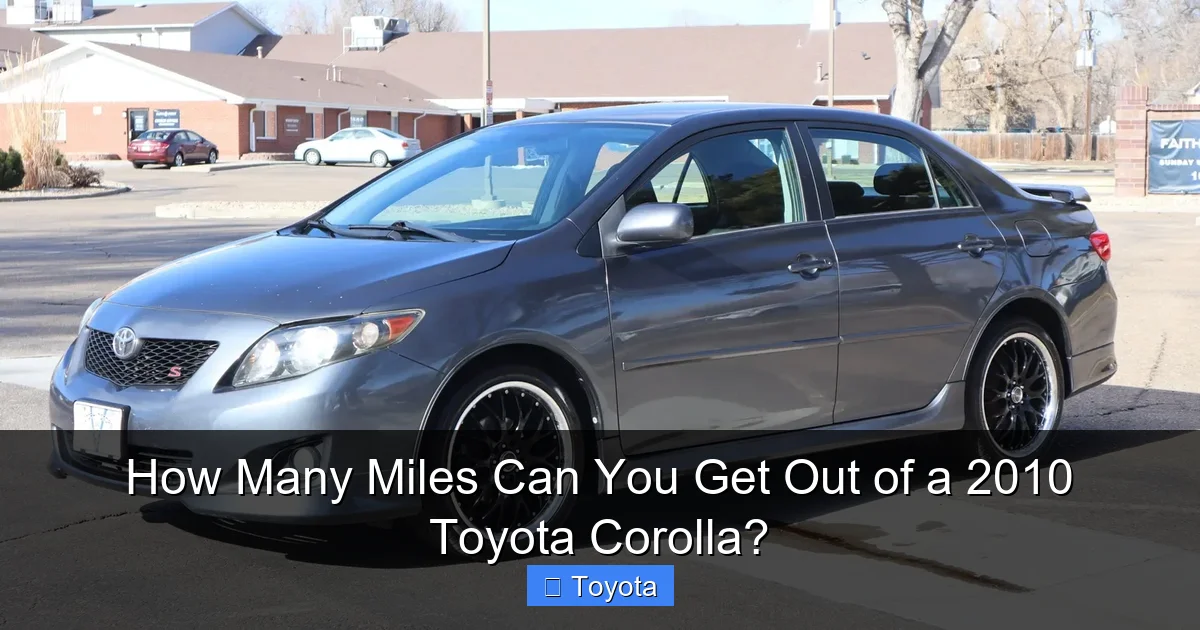
Let’s establish the range. The “average” well-maintained 2010 Toyota Corolla that has not been in major accidents and has its service history can be expected to reliably reach 200,000 to 250,000 miles. This is the realistic, confident expectation for the vast majority of these cars still on the road today. At this point, you’re looking at potential wear items like suspension bushings, minor oil seals, and the ever-present timing belt (more on that later). But the core powertrain—the engine and transmission—should still be solid.
Visual guide about How Many Miles Can You Get Out of a 2010 Toyota Corolla?
Image source: cdn.dealrimages.com
Entering the 300,000-Mile Club
Crossing the 300,000-mile threshold is where we separate the good from the great. This isn’t luck; it’s a testament to obsessive, often meticulous, care. Owners who achieve this milestone typically share common habits: they used full synthetic oil from early on and changed it every 5,000-7,000 miles (not the old 3,000-mile rule, but not the lax 10,000-mile either), they replaced the timing belt and water pump at the first sign of wear or at the recommended 90,000-mile interval without delay, and they addressed small leaks, noises, or hesitations immediately. They also often had the car as a single-owner vehicle, meaning its entire history is known. You can find these examples on forums like CorollaChat or in taxi cabs in cities like Los Angeles or New York, where 1.8L Corollas were popular fleet vehicles. One famous example from a reputable automotive forum detailed a 2010 Corolla with over 350,000 miles on its original, unopened transmission, with only the clutch (in a manual) and standard maintenance items replaced.
The Critical Role of the Previous Owner(s)
This is the biggest variable. A 2010 Corolla with 150,000 miles that has a stack of dated, consistent service receipts from a reputable shop is a far better bet for 200,000+ miles than a 2010 Corolla with 100,000 miles and a blank service history. The latter could have been driven 100,000 miles on the original factory fill oil (unlikely but possible) or suffered from chronic overheating due to a neglected cooling system. When buying, the car’s story is more important than the odometer reading. A vehicle history report (like Carfax or AutoCheck) is essential to verify regular servicing and check for accidents. You might also want to review resources on how many miles a car can last in general to understand the broader context of vehicle longevity.
Engine & Transmission: The Heart of the Matter
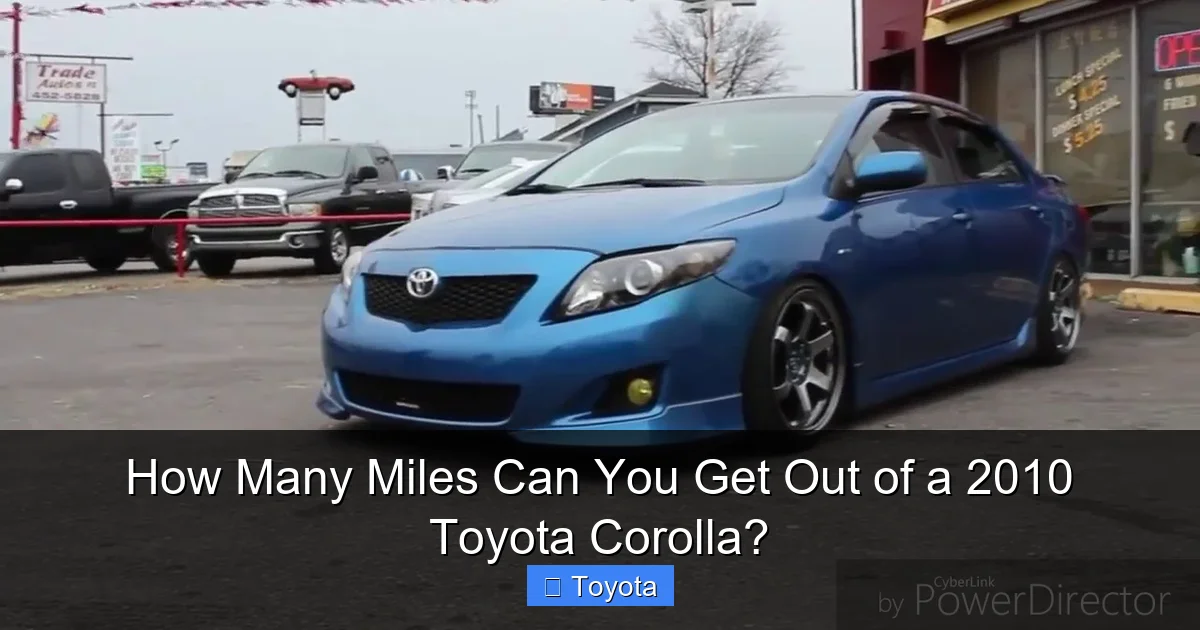
The 2010 Corolla came with one primary engine in the US market: the 1.8-liter 2ZR-FE, a 4-cylinder DOHC unit rated at 132 horsepower. Paired with it was either a 4-speed automatic transmission (the vast majority) or a 5-speed manual. Both are known for durability, but they have different personalities and failure modes.
Visual guide about How Many Miles Can You Get Out of a 2010 Toyota Corolla?
Image source: i.ytimg.com
The 2ZR-FE Engine: A Bulletproof Design with One Quirk
This engine is a masterpiece of丰田’s (Toyota’s) philosophy of proven, low-stress design. It uses a timing chain, not a belt, which is a huge plus for longevity—no scheduled replacement needed. The piston rings and cylinder walls are exceptionally durable. The most common engine-related issue is not a catastrophic failure but an oil consumption problem. Some 2ZR-FE engines, particularly from model years 2007-2011, are known to burn oil at a higher-than-normal rate. This is often due to piston ring design. The fix can range from a simple PCV valve replacement to a more involved engine rebuild. Checking the oil level every 1,000 miles is a critical habit for any high-mileage 2ZR-FE owner. If you’re unsure about the exact oil capacity for your specific model, it’s vital to get that information correct; a resource on how much oil a 2010 Toyota Corolla takes can be a lifesaver. Ignoring oil consumption leads to low oil levels, which causes wear and, eventually, major engine damage.
Transmission: The 4-Speed Automatic vs. The 5-Speed Manual
The 4-speed automatic (A245E) is a tank. It’s not sophisticated, but it’s incredibly robust. The most common failure is a worn valve body causing harsh shifts or slipping, which can often be fixed with a rebuild or a used replacement. The torque converter can also develop lockup clutch issues, causing shuddering. With fluid changes every 30,000-60,000 miles (using the correct WS fluid), these transmissions regularly see 200,000+ miles. The 5-speed manual (C59) is even simpler. Its Achilles’ heel is the clutch, which is a wear item and will need replacement (typically between 100k-150k miles depending on driver). The synchronizers and bearings are very strong. A manual-transmission Corolla with a healthy clutch is arguably the most durable powertrain combination for extreme mileage.
The Maintenance Must-Dos: Your Mileage Blueprint
You cannot overestimate the importance of maintenance. The 2010 Corolla will forgive a lot, but it will not forgive neglect. Here is your non-negotiable checklist for maximizing its life.

Visual guide about How Many Miles Can You Get Out of a 2010 Toyota Corolla?
Image source: i.ytimg.com
The Sacred Schedule: Fluids, Filters, and Belts
Oil & Filter: This is priority #1. Use a high-quality full synthetic oil (like 0W-20 or 5W-20 as specified) and a premium filter. Change it every 5,000-7,500 miles. Do not extend intervals. The oil is the lifeblood of the engine, and the 2ZR-FE’s oil consumption issue makes this even more critical.
Timing Belt/Chain: Here’s a key point: the 2ZR-FE uses a timing chain. There is no scheduled replacement interval. However, the chain tensioner and guides are made of plastic and can wear out. Listen for a cold-start rattle from the front of the engine that goes away after a few seconds. This is a classic sign of a worn tensioner. Replacing the tensioner and guides is a smart preventive measure around 150,000-200,000 miles. This is different from a timing belt, which would be a catastrophic failure if broken. Your chain is safe, but its guides are not.
Other Belts & Hoses: The accessory drive belt (serpentine belt) and all coolant and vacuum hoses should be inspected annually and replaced every 60,000-90,000 miles or at the first sign of cracking. A broken serpentine belt will leave you stranded. A ruptured coolant hose will cause overheating and potentially warped heads.
Transmission Fluid: For the automatic, drain and refill (not a full flush) every 30,000-60,000 miles. This is the single most important thing you can do for transmission longevity. Fresh fluid maintains proper hydraulic pressure and cooling. For the manual, change the gear oil every 30,000 miles.
Coolant: Replace the engine coolant (and flush the system) every 30,000 miles or 3 years. Old coolant loses its anti-corrosion properties and can cause radiator and water pump failure.
Air Filter: Change every 15,000-30,000 miles. A clogged filter hurts fuel economy and performance.
Proactive Component Replacement
Don’t wait for failure. At key mileage milestones, proactively replace wear items:
- ~90,000 miles: Spark plugs (iridium plugs can last 100k+), inspect/replace ignition coils if misfiring.
- ~100,000 miles: Fuel filter (if externally mounted), inspect/replace thermostat.
- ~120,000 miles: All engine and transmission mounts. Worn mounts cause vibrations and stress on other components.
- ~150,000 miles: Consider replacing the timing chain tensioner and guides. Replace all brake fluid (it absorbs moisture).
- Every 30,000 miles: inspect brake pads/rotors, suspension bushings, and ball joints.
Following this disciplined approach is what turns a 200,000-mile car into a 300,000-mile one. It’s about spending a little consistently instead of a lot all at once.
Common Issues and Solutions: What to Watch For
Even the best cars have their weak spots. Knowing them early lets you catch problems before they become expensive repairs.
The Oil Consumption Elephant in the Room
As mentioned, this is the #1 issue. The 2ZR-FE in the 2010 Corolla is a known member of the “oil consumption class action” group. Symptoms: you’ll add a quart between scheduled changes. The oil level on the dipstick will drop noticeably over 1,000 miles. Solutions range from a simple PCV valve replacement (cheap) to a more involved “piston ring job,” which is essentially a partial rebuild. Many owners manage it by simply checking the oil weekly and topping it off. If you’re buying a used one, ask specifically about oil consumption and get a commitment from the seller that it’s not burning excessive oil. A compression test and leak-down test by a mechanic can assess engine health.
Exhaust System Rust
In regions that use road salt, the exhaust system, particularly the muffler and pipes near the rear, can rust through. This is a common repair on 12+ year-old cars. It’s not a safety issue but will cause noise and fail inspection. Replacement with an aftermarket system is often cost-effective.
Electrical Gremlins
Minor electrical issues are common in aging cars: faulty power window switches, worn ignition key tumblers, and occasional instrument cluster gauge failures (especially the speedometer). These are usually inexpensive to fix with used or aftermarket parts. A more serious but rare issue is the failure of the Engine Control Module (ECM), which can cause no-start conditions.
Suspension Wear
After 150,000 miles, expect to replace struts/shocks, control arm bushings, and sway bar links. These parts wear out with age and mileage. The good news is that the Corolla’s suspension is simple and parts are cheap. This is a normal wear item, not a design flaw.
Gas Light Range
A common question is about driving after the fuel light comes on. The 2010 Corolla’s tank holds about 13.2 gallons. With a conservative estimate of 30 MPG, you likely have 30-50 miles remaining when the light illuminates. However, consistently driving on fumes can overheat the in-tank fuel pump (which is cooled by gasoline) and suck up sediment from the tank bottom. It’s best to refuel within 50 miles of the light coming on. For more specifics on your model, you can research how many miles you can drive after the gas light comes on in a Toyota Corolla.
How the 2010 Corolla Stacks Up Against Itself and Others
Is the 2010 model particularly good or bad within the Corolla lineage? And how does it compare to its rivals like the Honda Civic or Nissan Sentra of the same era?
A Pivotal Model Year
The 2010 was the final year of the ninth generation (2007-2010). It’s very similar to the 2009 and 2008 models. The 2011 model received a complete redesign (tenth generation), with a new engine (still 1.8L but updated) and a 6-speed automatic. Some purists prefer the simpler, more rugged 4-speed automatic of the 2007-2010 models over the newer 6-speed, which has more complex solenoids that can fail. The 2010 also has a slightly more conventional interior layout compared to the futuristic (and sometimes criticized) dash of the 2011-2013 models. In terms of core reliability, all ninth-gen Corollas are excellent. The 2010 benefits from being a “last and best” of its generation, with most factory bugs worked out.
vs. The Competition: Honda Civic (8th Gen) & Nissan Sentra (B16)
The 2010 Honda Civic (8th generation) is a very close competitor. Its 1.8L i-VTEC engine (R18A) is also extremely reliable and slightly more powerful. Its main advantage is a more engaging drive. Its main disadvantage can be higher cost for parts and repairs. The Nissan Sentra of the same era (with the 2.0L MR20DE engine) is a competent car but generally does not have the same long-term reputation for trouble-free high mileage as the Toyota or Honda. Its CVT (if equipped in later years) was problematic, but the 2010 Sentra still used a traditional 4-speed automatic. In a straight-up reliability battle for 250,000+ miles, the 2010 Corolla and Civic are neck-and-neck, with a slight edge often given to the Toyota for its ultra-simple, low-stress engineering. For a broader look at how Toyotas stack up, you can read about how many miles a Toyota Avalon can last, which showcases the brand’s engineering in a larger, more luxurious package.
The Bottom Line: Is a High-Mileage 2010 Corolla a Smart Buy Today?
Let’s bring it all home. If you’re considering buying a used 2010 Toyota Corolla with 150,000, 200,000, or even more miles, here is your decision framework.
YES, BUY IT IF:
- It has a verifiable, consistent service history (oil changes, transmission fluid, timing belt/chain service).
- It shows no signs of major rust (especially under the car and in the wheel wells).
- The engine does not consume excessive oil (check the dipstick, look for blue smoke from the exhaust).
- The transmission shifts smoothly (no harsh slamming, slipping, or delayed engagement in an automatic; no gear grind in a manual).
- The price reflects the mileage but is not a “steal” that seems too good to be true (which often means hidden problems).
WALK AWAY IF:
- The service history is nonexistent or spotty.
- There is significant structural rust or the frame feels compromised.
- It burns a quart of oil every 500-1,000 miles (this is a major red flag for a costly future repair).
- The transmission has already been rebuilt or is showing clear signs of imminent failure.
- The asking price is near that of a lower-mileage, similar car without a clear reason.
For the right buyer—someone who understands that a 14-year-old car will need ongoing, thoughtful investment—a well-maintained high-mileage 2010 Corolla is arguably one of the most rational, economical, and reliable used car purchases you can make. It represents the pinnacle of “if it ain’t broke, don’t fix it” engineering, where the cost to keep it running is often a fraction of a car payment on a new vehicle. Its potential is not a mystery; it’s documented in the hundreds of thousands of these cars still daily driving with well over 200,000 miles on the clock. Your job is to find one that has been loved and maintained, and then continue that tradition.
Frequently Asked Questions
What is the highest mileage ever recorded on a 2010 Toyota Corolla?
While official records are scarce, verified owner reports on enthusiast forums and taxi fleet data show numerous 2010 Corollas with 300,000 to 350,000 miles. The limiting factor is rarely the engine but rather body rust, transmission wear (in automatics), or the cost of replacing multiple wear items at once. One documented example had over 380,000 miles before engine replacement.
Is the 1.8L engine in the 2010 Corolla reliable?
Yes, the 2ZR-FE engine is extremely reliable in design. Its primary known issue is excessive oil consumption in some units, which is a manageable nuisance if caught early but can lead to engine failure if ignored. Beyond that, it’s a low-stress, non-interference engine (meaning if the timing chain fails, the pistons won’t hit the valves) that is famous for lasting hundreds of thousands of miles with basic oil changes.
How much does it typically cost to maintain a 2010 Corolla with over 200,000 miles?
Maintenance costs are very low compared to most cars. A major service (oil change, filter, spark plugs, transmission fluid, coolant flush) might cost $400-$600 at a shop. Major repairs like a timing chain tensioner job or a clutch replacement (manual) are in the $800-$1,500 range. An automatic transmission rebuild is the biggest potential cost at $2,500-$3,500. The key is that these repairs are infrequent and the car’s value remains high enough to justify them.
Will a 2010 Corolla with 200,000 miles need a new engine or transmission soon?
Not necessarily. If it has been well-maintained, the engine and transmission should have plenty of life left. The 2ZR-FE engine and 4-speed automatic are both over-engineered for their power output. The more likely needs are wear items: suspension components, engine/transmission mounts, brakes, and the timing chain tensioner. A pre-purchase inspection by a trusted mechanic is crucial to assess the actual health of these major components.
Does the 4-speed automatic transmission in the 2010 Corolla hold up well?
Yes, it is exceptionally robust for its class. Its simplicity is its strength. The most common failure is a worn valve body, which causes harsh or slipping shifts. This is often a $300-$600 repair. With regular fluid changes every 30,000-60,000 miles, these transmissions are documented to last 250,000 miles or more. It does not have the complexity or known widespread failure rates of some contemporary transmissions.
What is the biggest threat to a 2010 Corolla’s longevity?
p>The single biggest threat is rust, especially in regions that use road salt. Rust can compromise the structural integrity of the unibody, frame rails, and suspension mounting points, making the car unsafe long before the engine fails. The second biggest threat is neglected maintenance, specifically running low on oil due to the engine’s consumption issue or skipping transmission fluid changes. A third is a lack of records, which makes it impossible to know the car’s true history and anticipate future needs.
