
What Causes the Check Engine Light to Come on in a Toyota Camry

The check engine light in your Toyota Camry is a warning from the car’s computer that something isn’t right. It can illuminate for hundreds of reasons, ranging from a simple, loose gas cap to major engine or emissions system failures. While sometimes you can address the issue yourself, persistent or flashing lights require immediate professional diagnosis with an OBD2 scanner to prevent costly damage.
Key Takeaways
- The light signals an emissions-related issue: The check engine light primarily monitors your Camry’s emissions control systems. A problem here will trigger the light, even if the car seems to drive fine.
- A loose gas cap is the most common fix: Over a third of check engine light cases are caused by a cap that isn’t tightened properly, breaking the seal in the fuel system.
- A flashing light is an emergency: If the light is blinking, it means severe engine misfiring is occurring. Stop driving immediately to avoid catastrophic damage to the catalytic converter.
- You need a diagnostic code: A mechanic or an OBD2 scanner tool is essential to read the specific trouble code (like P0171 or P0420) that pinpoints the faulty system.
- Don’t ignore it, but don’t panic: A steady light means schedule a diagnosis soon. A flashing light means pull over safely and call for help. Your owner’s manual is your first resource.
- Basic checks can save money: Before heading to a shop, check the gas cap, gas level, and listen for odd noises. Simple fixes might be all that’s needed.
- Related lights can appear: Issues triggering the check engine light might also cause the TRAC OFF, VSC, or even airbag lights to illuminate on your dash.
📑 Table of Contents
- Introduction: That Glowing Dashboard Enigma
- The Most Common & Easily Fixed Causes
- Serious Engine and Performance Problems
- Emissions and Fuel System Evaporative (EVAP) System
- Other Sensor and System Failures
- What to Do When the Light Comes On: A Step-by-Step Guide
- Conclusion: Knowledge is Power (and Savings)
Introduction: That Glowing Dashboard Enigma
You’re driving your trusted Toyota Camry, maybe on your daily commute or a weekend getaway. Suddenly, a small, bright yellow engine-shaped icon illuminates on your dashboard. Your heart might sink a little. The check engine light—it’s one of the most common yet most misunderstood warnings in modern cars. For Camry owners, known for reliability, this light can feel particularly jarring. What does it mean? Is it safe to keep driving? How serious is it?
The truth is, the check engine light (CEL) is your car’s way of having a quiet conversation with you. It’s not a single problem indicator but a general messenger saying, “Hey, the computer noticed something outside normal parameters in the engine or emissions system.” The cause could be a minor, inexpensive fix or a sign of a developing problem that needs attention. This guide will decode that conversation specifically for your Toyota Camry, walking you through the most frequent culprits, what they mean, and the exact steps you should take next.
The Most Common & Easily Fixed Causes
Before we dive into complex mechanical failures, let’s start with the surprisingly simple issues that trigger the check engine light. These are the first things you should check yourself, as they often cost little to nothing to fix.
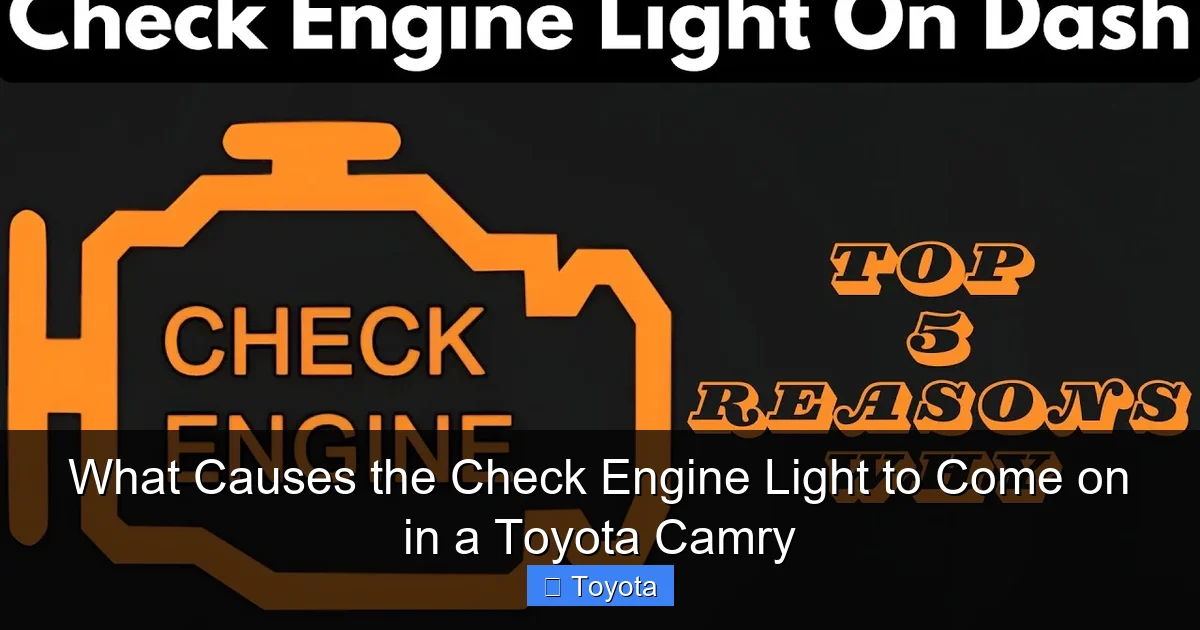
Visual guide about What Causes the Check Engine Light to Come on in a Toyota Camry
Image source: i.ytimg.com
The Loose or Faulty Gas Cap
Yes, really. The number one cause of a check engine light across all makes and models, including the Camry, is a gas cap that isn’t sealed properly. Your fuel system is a closed loop designed to capture gasoline vapors and prevent them from escaping into the atmosphere. If the cap is loose, cracked, or missing its sealing gasket, the EVAP (evaporative emission control) system detects a leak and sets a code, often P0455 (large leak) or P0440 (general system leak).
What to do: Pull over safely (when the engine is off), remove the gas cap, and reinstall it until you hear a definite click. Listen for at least three clicks to ensure it’s seated. Drive for a few days; the light may go off on its own as the system passes its self-test. If it doesn’t, inspect the cap for cracks or a worn seal. A new OEM-style gas cap is a cheap and easy replacement.
Faulty Oxygen (O2) Sensors
Your Camry’s engine has at least two oxygen sensors (upstream and downstream) that monitor the amount of oxygen in the exhaust. They tell the engine computer (ECU) how to adjust the air-fuel mixture for optimal performance and minimal emissions. Over time, these sensors can become contaminated or simply wear out, sending inaccurate data.
Common codes include P0130-P0134 (Bank 1 Sensor 1) and P0140-P0144 (Bank 1 Sensor 2). A failing O2 sensor will usually reduce fuel economy, cause rough idling, and increase emissions. While not an immediate emergency, a bad O2 sensor will eventually harm your catalytic converter, which is a much more expensive repair.
Mass Airflow Sensor (MAF) Issues
The MAF sensor measures the volume of air entering your engine. This data is critical for the ECU to calculate the correct amount of fuel to inject. A dirty or faulty MAF sensor can cause codes like P0101, P0102, or P0103. Symptoms often include poor acceleration, hesitation, stalling, and decreased fuel economy.
Tip: MAF sensors are sensitive. Sometimes, cleaning them carefully with a dedicated MAF cleaner can restore function. Never use compressed air or touch the sensing elements. If cleaning doesn’t work, replacement is necessary.
Serious Engine and Performance Problems
When the check engine light is accompanied by noticeable performance issues—rough running, misfires, or strange noises—the problem is often more serious. In these cases, the light is a critical warning.
Visual guide about What Causes the Check Engine Light to Come on in a Toyota Camry
Image source: shunauto.com
Engine Misfires
A misfire occurs when a cylinder fails to ignite the air-fuel mixture properly. This is a top cause of a flashing check engine light, which is a dire warning. Misfire codes are in the P0300-P0304 range (P0300 is random/multiple, P0301-P0304 are for specific cylinders). Causes in a Camry can include:
- Worn Spark Plugs or Spark Plug Wires: The most common cause of misfires. They simply wear out. Replacing them at the recommended interval (often every 30k-60k miles) is crucial.
- Faulty Ignition Coils: The Camry uses individual coil-on-plug (COP) ignitions. One coil can fail, causing a specific cylinder misfire. They are common wear items.
- Clogged or Bad Fuel Injectors: If an injector isn’t spraying properly, that cylinder will misfire.
- Low Compression: This is a major internal engine problem, caused by worn piston rings, valves, or a blown head gasket. This requires extensive repair.
Why a flashing light is an emergency: Unburned fuel from a misfiring cylinder flows into the exhaust and ignites in the catalytic converter, overheating and destroying it. A new catalytic converter can cost $1,500+. If your light is flashing, pull over safely, shut off the engine, and have the car towed.
Catalytic Converter Failure
The catalytic converter is your car’s exhaust scrubber, turning harmful pollutants into less harmful gases. It can fail due to age, contamination (from burning oil or antifreeze), or the unburned fuel damage mentioned above. A failing converter often triggers codes like P0420 (catalyst system efficiency below threshold). Symptoms include poor acceleration, a sulfur/rotten egg smell, and dark exhaust smoke. This is a costly repair, so addressing the root cause (like a misfire) is paramount.
Emissions and Fuel System Evaporative (EVAP) System
The EVAP system captures gasoline vapors from the tank and burns them in the engine instead of venting them to the air. It’s a complex system of hoses, valves, and the charcoal canister. Leaks are common.
Visual guide about What Causes the Check Engine Light to Come on in a Toyota Camry
Image source: cannonautorepair.com
Purge Valve or Vent Solenoid Failure
These are the electrically controlled valves that manage flow to/from the charcoal canister. They can stick open or closed. A stuck-open purge valve can cause a rough idle at startup. Codes like P0441 (incorrect purge flow) or P0442 (small leak detected) are common. These valves are relatively inexpensive and straightforward to replace.
Charcoal Canister Damage
The canister itself can crack or become saturated with fuel, losing its ability to store vapors. This is less common than valve failure but can cause persistent EVAP leak codes. The canister is usually located near the fuel tank.
Other Sensor and System Failures
Your Camry’s computer relies on a network of sensors. When they fail, the CEL comes on.
Throttle Position Sensor (TPS) / Electronic Throttle Control
Modern Camrys use “drive-by-wire,” where a motor opens the throttle based on pedal position sensor input. A faulty throttle position sensor or motor can cause codes like P0121, P0122, P0123. Symptoms include poor acceleration, throttle hesitation, or an unexpected idle surge. This is a safety-critical system that needs prompt attention.
Exhaust Gas Recirculation (EGR) System
The EGR valve recirculates a small amount of exhaust gas back into the intake to lower combustion temperatures and reduce NOx emissions. It can clog with carbon or fail, sticking open or closed. A stuck-open EGR causes rough, unstable idle. Codes include P0401 (EGR flow insufficient) or P0405 (EGR sensor A circuit). Cleaning or replacing the valve is the fix.
Failing Thermostat or Coolant Temperature Sensor
Your Camry’s engine computer needs to know the exact coolant temperature to manage fuel mixture and emissions. A thermostat that sticks open keeps the engine too cool, while a bad coolant temperature sensor sends wrong data. Both can trigger codes like P0128 (coolant thermostat) or P0115-P0119 (coolant temp sensor circuit). This can hurt fuel economy and performance.
What to Do When the Light Comes On: A Step-by-Step Guide
Now that you know the “what,” here’s the “what now.” Your actions depend on the light’s behavior.
Step 1: Immediate Safety Assessment
Is the light FLASHING or SOLID RED? This is your most critical moment. A flashing CEL or a red light (in some models) indicates a severe misfire. Stop driving as soon as it is safe to do so. Turn off the engine. Have the vehicle towed to a trusted mechanic. Continuing to drive will destroy the catalytic converter.
Is the light SOLID YELLOW/ORANGE? This indicates a non-emergency issue. You can usually drive cautiously to your destination or a repair shop, but schedule diagnosis promptly. Pay attention to any changes in performance, noises, or smells.
Step 2: Basic At-Home Checks (5 Minutes)
Before you call anyone, do these simple things:
- Tighten the gas cap: Do this first. Listen for clicks. Drive for a few cycles (start/stop) and see if it resets.
- Check fuel level: Is the gas light also on? Running extremely low can sometimes cause fuel system issues.
- Listen and feel: With the engine running, does it idle smoothly? Any clicking, tapping, or whistling sounds? Does it hesitate when you accelerate?
- Inspect under the hood: Look for obviously disconnected or damaged hoses, wires, or belts. Check oil and coolant levels (low coolant can sometimes trigger a light).
Step 3: Get the Diagnostic Code
You cannot properly fix the problem without knowing the specific Diagnostic Trouble Code (DTC). You have two main options:
- Use an OBD2 Scanner: Most auto parts stores (like AutoZone, Advance Auto) will scan your Camry’s port for free. You can also buy a basic Bluetooth OBD2 scanner and use a free app on your phone. This is the most efficient way to get the code (e.g., P0420, P0302).
- Visit a Professional: A mechanic will perform a scan and, more importantly, will interpret the code in context. A code like P0171 (system too lean) could be caused by a vacuum leak, a bad MAF sensor, or faulty fuel pressure.
Important: The code tells you which system is affected, not always the exact failed part. Diagnosis requires skill.
Step 4: Research and Decide
Take your code (e.g., “P0441 Toyota Camry”) and search for reputable repair information. Forums like CamryForums or Reddit’s r/Toyota can be invaluable for seeing what fixed the problem for other owners with the same code and model year. This knowledge helps you have an informed conversation with your mechanic and avoid unnecessary repairs. If the code points to a simple fix like a gas cap or MAF cleaning, you might tackle it yourself if you’re handy.
Conclusion: Knowledge is Power (and Savings)
That check engine light in your Toyota Camry is not a design flaw; it’s a sophisticated communication tool from one of the most advanced onboard computers in its class. It’s designed to catch small problems before they become thousand-dollar catastrophes. The key is to respond appropriately. Start with the simplest, most common fixes like the gas cap. Never ignore a flashing light. Always get the specific diagnostic code to guide your next move.
While many issues are minor, others point to the heart of your engine’s health. When in doubt, consult a trusted, certified technician, preferably one familiar with Toyota’s specific engineering. By understanding the potential causes—from a loose cap to a failing oxygen sensor—you transform that glowing dashboard icon from a source of anxiety into a clear, actionable roadmap for maintaining your Camry’s legendary reliability for years to come.
Frequently Asked Questions
Can I keep driving my Toyota Camry if the check engine light is on?
If the light is steady and the car is running normally with no strange noises or performance issues, you can drive it cautiously for a short distance to get it diagnosed. However, if the light is flashing, you must stop driving immediately and tow the vehicle to prevent severe engine damage.
How much does it typically cost to diagnose a check engine light?
Many auto parts stores offer free code scanning. A professional diagnostic fee at a repair shop typically ranges from $75 to $150. This fee is often waived if you proceed with the recommended repair at that shop.
My gas cap was loose. How long will it take for the check engine light to turn off after I tighten it?
After tightening the cap, you must complete a full “drive cycle” where the car’s computer re-runs all its self-monitoring tests. This usually takes 3-5 days of normal driving (including both city and highway, and a complete cold start). The light should go off on its own once the system verifies the leak is fixed.
Could a bad battery cause the check engine light to come on?
A severely weak or failing battery can sometimes cause voltage fluctuations that confuse the car’s computer, potentially setting a variety of warning lights, including the check engine light. However, it’s not a common direct cause. More often, a dead battery will trigger a separate battery/charging system warning. If you have a new battery and a CEL, look elsewhere first.
Will an oil change turn off the check engine light?
No. The check engine light is for emissions and engine management systems. A separate service reminder light (often a wrench icon) indicates scheduled maintenance like an oil change. If your CEL came on after an oil change, it’s likely coincidental or related to something that was disturbed during the service (like an unplugged sensor), not the oil itself.
Can I reset the check engine light myself without fixing the problem?
You can clear the code with an OBD2 scanner, which will turn the light off. However, if the underlying problem persists, the light will return, usually within a few drive cycles. Simply resetting the light is not a repair; it’s just turning off the message. The problem will remain and could worsen. For a true fix, you must address the cause of the code. Some basic maintenance resets, like turning off the maintenance light on a Toyota, are different and safe to do after service.
