
How Do You Reset the Low Tire Light on a 2010 Toyota Camry?

The low tire pressure warning light on your 2010 Toyota Camry activates when the Tire Pressure Monitoring System (TPMS) detects a significant drop in one or more tires. Resetting it requires first ensuring all tires are properly inflated to the manufacturer’s recommended PSI. The standard reset procedure involves using the dedicated TPMS reset button, typically located under the dashboard. After resetting, you must drive the vehicle for a short period to allow the system to re-calibrate and confirm the tires are holding proper pressure.
Key Takeaways
- Safety First: Always check and adjust tire pressures to the correct PSI (found on the driver’s door jamb sticker) before attempting a reset. Driving on under-inflated tires is dangerous and causes premature wear.
- Reset Button Location: The TPMS reset button for a 2010 Camry is almost always located on the lower dash panel, to the left of the steering wheel, behind a small cover or near the hood release.
- Process is Simple: The reset typically involves turning the ignition to “ON” (not start), pressing and holding the button until the TPMS light blinks three times, then releasing and starting the engine.
- Drive Cycle Required: After a successful reset, you must drive at speeds above 25 mph for 5-10 minutes. The system needs this time to verify all sensors are transmitting correct pressure data.
- Persistent Light Means Problem: If the light returns immediately or after a short drive, it indicates a slow leak, a faulty sensor, or a damaged tire that needs professional diagnosis and repair.
- Don’t Ignore the Warning: The low tire light is a critical safety feature. Under-inflated tires reduce handling, increase stopping distances, raise fuel consumption, and can lead to overheating and blowouts.
- Seasonal Changes Affect Pressure: Temperature drops of 10°F can lower tire pressure by about 1 PSI. Check pressures monthly and after major temperature shifts to avoid unnecessary alerts.
📑 Table of Contents
- Understanding Your 2010 Toyota Camry’s Tire Pressure Monitoring System (TPMS)
- Step-by-Step: The Standard Reset Procedure for a 2010 Toyota Camry
- What If the Standard Reset Doesn’t Work? Troubleshooting Common Issues
- Deep Dive: The “Why” Behind the Light – Common Causes of TPMS Alerts
- Proactive Maintenance: Keeping Your TPMS Happy and Your Light Off
- Beyond the Camry: General TPMS Wisdom and Comparison
- Conclusion: A Simple Task with Big Safety Implications
Understanding Your 2010 Toyota Camry’s Tire Pressure Monitoring System (TPMS)
That little yellow exclamation point inside a tire cross-section that has lit up on your dashboard isn’t just being annoying—it’s your car’s way of talking to you. In your 2010 Toyota Camry, this is the Tire Pressure Monitoring System (TPMS) warning light, and its primary job is to get your attention because one or more of your tires has dropped below a safe pressure threshold. It’s a fantastic safety feature mandated by the government, but it can be a nuisance if it’s triggered by a simple temperature change or after you’ve already topped off your tires. Before we dive into the “how-to,” let’s quickly understand what we’re dealing with.
Your Camry uses a direct TPMS. This means each wheel has a small, battery-powered sensor valve stem inside it. These sensors constantly radio the tire’s pressure (and sometimes temperature) to the car’s computer. When the pressure in any tire falls 25% or more below the recommended level, the computer illuminates that warning light. It’s a passive system; it only tells you there’s a problem, not which tire is low or by how much. You have to check all four tires (and the spare, if equipped) manually. The system is designed for safety, not convenience, so it’s fairly sensitive.
Why is this important? Proper tire inflation is critical for your safety, your wallet, and your tires’ lifespan. Under-inflated tires have more flex in the sidewall, which generates heat. That heat can lead to catastrophic tire failure, especially at highway speeds. They also cause poor handling, longer stopping distances, and uneven wear. On the fuel economy side, under-inflated tires increase rolling resistance, meaning your engine has to work harder, burning more gas. So, that little light is a big deal. Now, let’s get to the heart of the matter: turning it off, the right way.
The Golden Rule: Inflate First, Reset Second
I cannot stress this enough. The absolute first step, every single time, is to check and correct the pressure in all five tires (including the spare). Go to a gas station or use your own quality gauge. Find the recommended pressure on the sticker on the driver’s side door jamb or in your owner’s manual. It’s typically 32 PSI for the 2010 Camry, but always verify on your specific vehicle’s sticker, as it can vary by trim level and tire size. Inflate any low tire to exactly that spec. If a tire is significantly lower than the others or you find a nail, you have a leak that needs fixing before the reset will be effective. Resetting the light without fixing the underlying cause is like silencing a smoke alarm while a fire burns—it doesn’t solve the problem.
Step-by-Step: The Standard Reset Procedure for a 2010 Toyota Camry
Okay, your tires are all at the perfect PSI. The spare is good too. Now we can reset the light. For the 2010 model year, the Camry has a straightforward, button-based reset procedure. It’s important to do this in the correct order. You’ll need your key fob or key.
Visual guide about How Do You Reset the Low Tire Light on a 2010 Toyota Camry?
Image source: i.ytimg.com
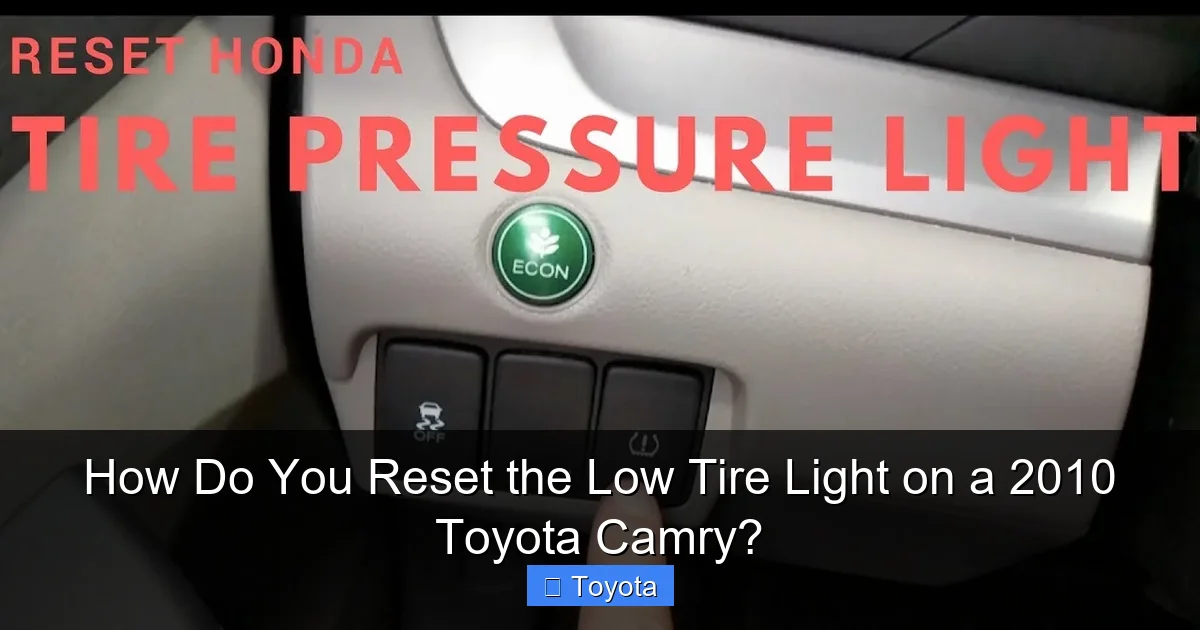
Locating the TPMS Reset Button
First, find the button. Open the driver’s side door and look at the lower dashboard panel, just to the left of the steering column. It’s often behind a small rectangular plastic cover or near the hood release lever. The button itself is usually small, round, and may have “TPMS” or a tire icon with an exclamation point printed next to it. You might need a flashlight. On some models, it’s integrated into a panel with other switches. If you’re having trouble, your owner’s manual will have a diagram in the “Tire Pressure Monitoring System” or “Instrument Panel” section.
The Reset Sequence: A Simple 5-Step Process
Once you’ve located the button, follow these steps precisely:
- Prepare the Vehicle: Ensure all tires are properly inflated. Turn the ignition to the “ON” position. This is the position right before you start the engine, where the dashboard lights come on but the engine is off. Do not start the car yet.
- Press and Hold: Press and hold the TPMS reset button. You’ll need to hold it for several seconds.
- Watch for the Blink: After holding for about 3-5 seconds, you should see the TPMS warning light on the dashboard blink three times. This is your confirmation that the reset signal has been received and the system is ready to relearn.
- Release the Button: Once you see the three blinks, release the button.
- Start the Engine and Drive: Now, start the engine normally. The light may stay on for a few seconds after starting, but it should go out within 30 seconds if the reset was successful and pressures are good. If it stays on, turn the car off and repeat the process. If it goes out, you must now drive the vehicle. The system needs to verify the data. Drive at speeds above 25 mph for at least 5-10 minutes. This allows each sensor to transmit its signal and be recognized by the computer. After this drive cycle, the light should remain off. If it comes back on, there is still a problem.
This is the standard factory procedure. It works for the vast majority of 2010 Camrys. But what if it doesn’t?
What If the Standard Reset Doesn’t Work? Troubleshooting Common Issues
Sometimes, you do everything right and the light remains stubbornly illuminated. This is a clear sign that the problem isn’t just a triggered alert; it’s a system issue. Here’s a systematic way to troubleshoot before you head to the dealer.
Visual guide about How Do You Reset the Low Tire Light on a 2010 Toyota Camry?
Image source: i.ytimg.com
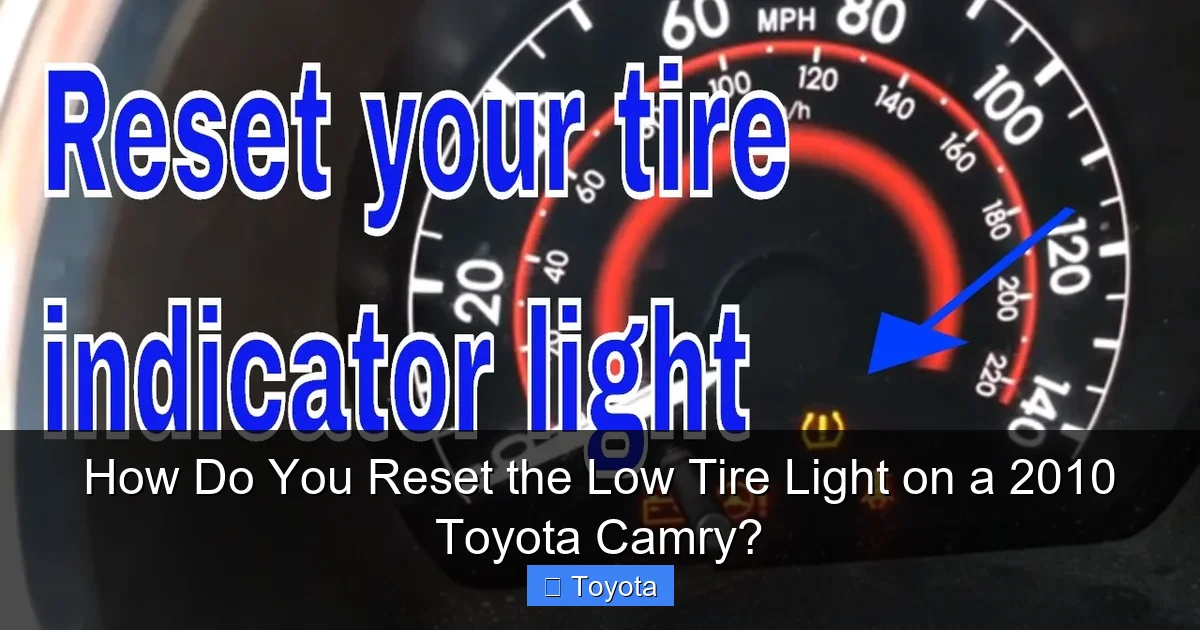
The Light Comes Back On Immediately After Reset
This is the most common post-reset issue. If the light reappears as soon as you start driving or within a minute, it means one or more sensors is still reporting low pressure. Go through this checklist:
- Re-check all pressures with a known-good gauge. Gas station gauges are notoriously inaccurate. Use a personal digital gauge for accuracy. Check when tires are cold (driven less than 1 mile).
- Inspect tires for visible damage. Look for nails, screws, cuts, or bulges in the sidewall. A slow leak will eventually cause pressure to drop again.
- Check the spare tire. If your Camry has a full-size spare with a sensor, it must also be at the correct pressure. A low spare will trigger the light.
- Consider a faulty sensor. TPMS sensors have batteries that last about 7-10 years. In a 2010 vehicle, the original sensors are likely at or past their lifespan. A dead or failing sensor will stop transmitting or send bad data, causing the light to stay on. These require professional replacement and reprogramming.
The Reset Button Seems Unresponsive or the Light Doesn’t Blink
If you hold the button and nothing happens—no blinks, no change—try these steps:
- Confirm you have the correct button. Double-check your owner’s manual. Some early 2010 models might have a different procedure or button location.
- Try a key cycle. Turn the key to “ON,” press the button, then turn the key to “OFF” before restarting. Sometimes the sequence needs a full power cycle.
- Check the fuse. A blown TPMS system fuse could disable the reset function. Locate the fuse box (under the dash and under the hood) and check the TPMS fuse using the diagram in your manual. Replace if blown.
- Weak or dead battery. A severely discharged car battery can cause erratic behavior in the car’s computer systems, including TPMS. Ensure your battery is healthy.
When to Seek Professional Help
If you’ve verified correct pressures, checked for leaks, tried the reset procedure multiple times, and the light persists, it’s time to visit a tire shop or your Toyota dealer. They have specialized tools to:
- Diagnose individual sensor faults. They can scan each wheel’s sensor ID and pressure reading to pinpoint a bad unit.
- Replace and reprogram sensors. When a sensor is replaced, it must be programmed to the vehicle’s computer. This requires proprietary software and tools.
- Perform a system relearn. Sometimes, after sensor replacement or tire rotation, the car needs a full system relearn procedure that goes beyond the simple dash button reset.
Ignoring a persistent TPMS light is not an option. It’s a warning that your tire safety system is compromised.
Deep Dive: The “Why” Behind the Light – Common Causes of TPMS Alerts
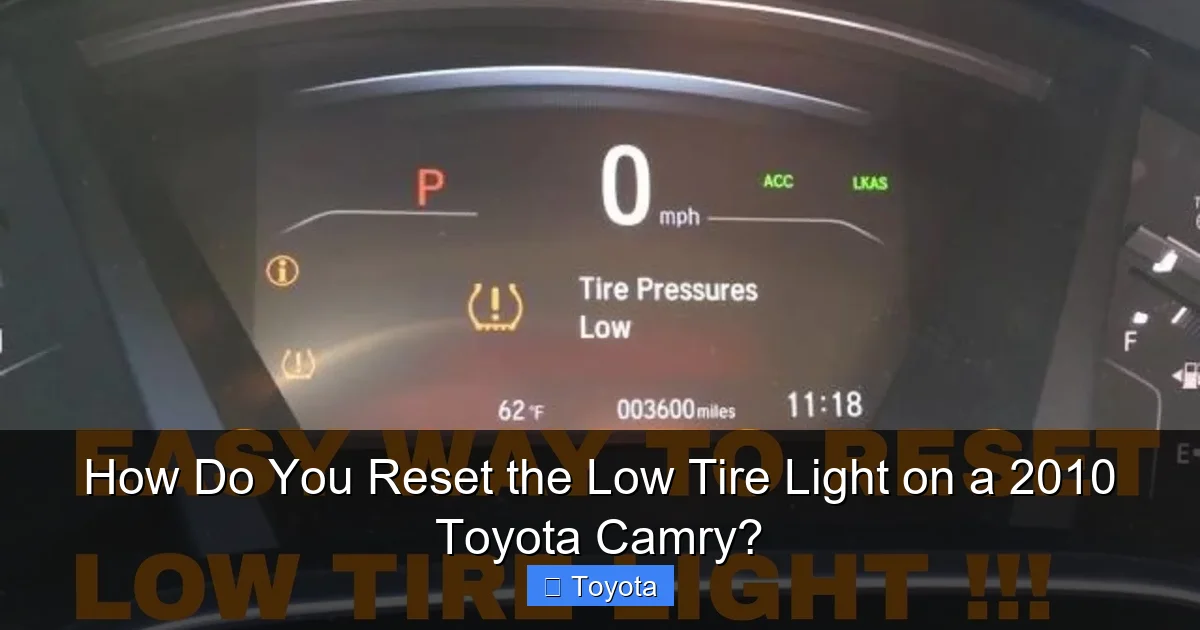
Understanding why the light comes on in the first place can help you prevent future annoyances and address root causes. It’s rarely a mysterious electronic glitch.
Visual guide about How Do You Reset the Low Tire Light on a 2010 Toyota Camry?
Image source: i.ytimg.com
1. Natural Pressure Loss & Temperature Changes
Tires naturally lose about 1 PSI per month due to permeation through the rubber. This is normal. Cold weather is the biggest culprit for sudden alerts. For every 10°F drop in temperature, tire pressure decreases by approximately 1-2 PSI. If you set your tires to spec in the summer and winter arrives, the light will almost certainly come on. This is not a system fault; it’s physics. The solution is to check and adjust pressures seasonally, especially in the fall and early winter.
2. Physical Damage and Leaks
This is the most urgent cause. A puncture from a nail or screw, a damaged valve stem, a bent wheel from a pothole, or a bead leak can all cause rapid pressure loss. Always perform a visual and auditory check (hissing sound) when the light comes on unexpectedly. If you find an object embedded, do not remove it if you plan to drive to a shop—it may plug the hole temporarily. Drive carefully and slowly to a repair facility.
3. Sensor Failure or Battery Death
As mentioned, the sensor’s internal battery lasts about 7-10 years. Your 2010 Camry’s original sensors are now 14+ years old. It’s highly probable that one or more have died. Symptoms include the light coming on and off intermittently, or the light staying on with all tires at perfect pressure. A scan tool will show “no data” or “low battery” for the faulty sensor. Replacement is the only fix.
4. Recent Tire Service
If you’ve recently had your tires rotated, repaired, or replaced, the TPMS system might need a reset or relearn. Sometimes, a sensor can be damaged during mounting/dismounting. Always ask the shop to verify all sensors are working and the system is reset after any tire work. If they didn’t, you’ll be the one dealing with the light.
Proactive Maintenance: Keeping Your TPMS Happy and Your Light Off
An ounce of prevention is worth a pound of cure. Here’s how to minimize TPMS disruptions.
Monthly Pressure Checks are Non-Negotiable
Don’t wait for the light. Get in the habit of checking all tire pressures with an accurate gauge at least once a month and before long trips. This catches slow leaks early and allows you to adjust for seasonal changes proactively. It takes two minutes and saves you from a potential blowout or a frustrating diagnostic bill.
Inspect Tires and Valves Regularly
During your pressure check, look at the tread and sidewalls. Remove any debris from the valve stem area. If a valve stem core is old and leaking, it’s cheap and easy to replace. Consider replacing valve stems whenever you get new tires.
Understand Sensor Lifespan and Replacement Costs
Plan for TPMS sensor replacement. They are wear items. A typical sensor for a Camry costs $50-$100 for the part, plus $50-$100 for labor and programming per wheel. Some aftermarket sensors are cheaper but may have compatibility or longevity issues. When replacing tires, it’s often recommended to replace the sensors at the same time if they are old, as the labor is already being done.
Don’t Use “Fix-a-Flat” or Similar Sealants in a TPMS Tire
These temporary sealants can clog the sensor’s valve stem or damage the sensor itself, leading to a costly replacement. If you have a flat and must use it to limp to a shop, be prepared to have the sensor cleaned or replaced. The best practice is to use a proper tire repair plug/patch from a professional.
Beyond the Camry: General TPMS Wisdom and Comparison
While this guide is specific to your 2010 Camry, the principles of TPMS are universal across most modern vehicles. The core idea—inflate first, reset second—applies everywhere. However, the reset procedure can vary significantly. Some vehicles require a scan tool for reset, while others use a series of stalk button presses instead of a dash button. For instance, the process to reset the tire pressure light on a Honda Civic often involves using the steering wheel controls and menu system, which is quite different from the physical button on your Camry. It’s always best to consult the specific owner’s manual for your vehicle’s exact steps.
For a broader look at how TPMS works and general reset strategies across many makes and models, our comprehensive article on how to reset the tire pressure light is an excellent resource. It covers the differences between direct and indirect systems, common pitfalls, and when professional help is universally needed. Remember, while the symptom (a lit light) is the same, the cure is vehicle-specific.
Conclusion: A Simple Task with Big Safety Implications
Resetting the low tire pressure light on your 2010 Toyota Camry is a quick, five-minute task you can do yourself in your driveway. The key is to never skip the fundamental step of verifying and correcting the actual tire pressures. That little light is your car’s voice, and it’s only asking for one thing: proper inflation. By understanding your TPMS, performing regular maintenance, and following the correct reset sequence, you ensure that voice is heard only when absolutely necessary. You’ll enjoy safer handling, better fuel economy, longer-lasting tires, and peace of mind. If the light refuses to go away after you’ve done everything right, don’t guess—have a professional diagnose it. Your safety, and that of your passengers, depends on reliable tires. Now you have the knowledge to keep your Camry’s warning system honest and your journeys smooth and secure.
Frequently Asked Questions
Why does my tire pressure light come on when my tires look fine?
This is usually due to a drop in ambient temperature, which naturally reduces air pressure inside the tire. It can also indicate a very slow leak you can’t see. Always use a pressure gauge to check all tires, including the spare, when the light illuminates.
How long do I need to drive after resetting the TPMS light?
You need to drive at a steady speed above 25 mph for approximately 5 to 10 minutes. This “drive cycle” allows all four tire sensors to transmit their data and be verified by the car’s computer. The light should go out during or shortly after this drive.
Can I just disconnect the battery to reset the tire light?
No. Disconnecting the battery will reset the car’s clock and radio presets, but it will not reset the TPMS system. The TPMS has its own memory and requires the specific reset button procedure to clear the alert and begin a new learning cycle.
What if the low tire light keeps coming back on after I reset it?
This is a clear sign of an ongoing problem. Re-check all pressures with an accurate gauge. Look for nails, slow leaks, or damaged tires. If pressures are good and the light returns, a TPMS sensor is likely faulty or its battery is dead, requiring professional diagnosis and replacement.
Do I need a special tool to reset the TPMS light on my Camry?
No. The 2010 Toyota Camry is designed with a user-friendly reset process that only requires the ignition key and the dedicated TPMS reset button located on the dashboard. No scan tools or special equipment are needed for the standard reset procedure.
Is it safe to drive with the low tire pressure light on?
It is not safe. The light means at least one tire is significantly under-inflated. Driving on under-inflated tires causes poor handling, longer stopping distances, increased risk of a blowout, and excessive wear. You should check and inflate the tires immediately and only drive a very short distance at low speed to a safe location or repair shop if a tire is damaged.
