
How Do You Reset the Check Engine Light on a 2014 Toyota Sienna

Resetting the check engine light on your 2014 Toyota Sienna is a simple process, but it requires understanding the “why” behind the light first. You can clear the code by disconnecting the battery for a few minutes or, more effectively, by using an OBD2 scanner to erase the trouble code. However, if the underlying problem isn’t fixed, the light will return, often after a short drive. Always diagnose the issue before resetting to avoid masking a serious problem.
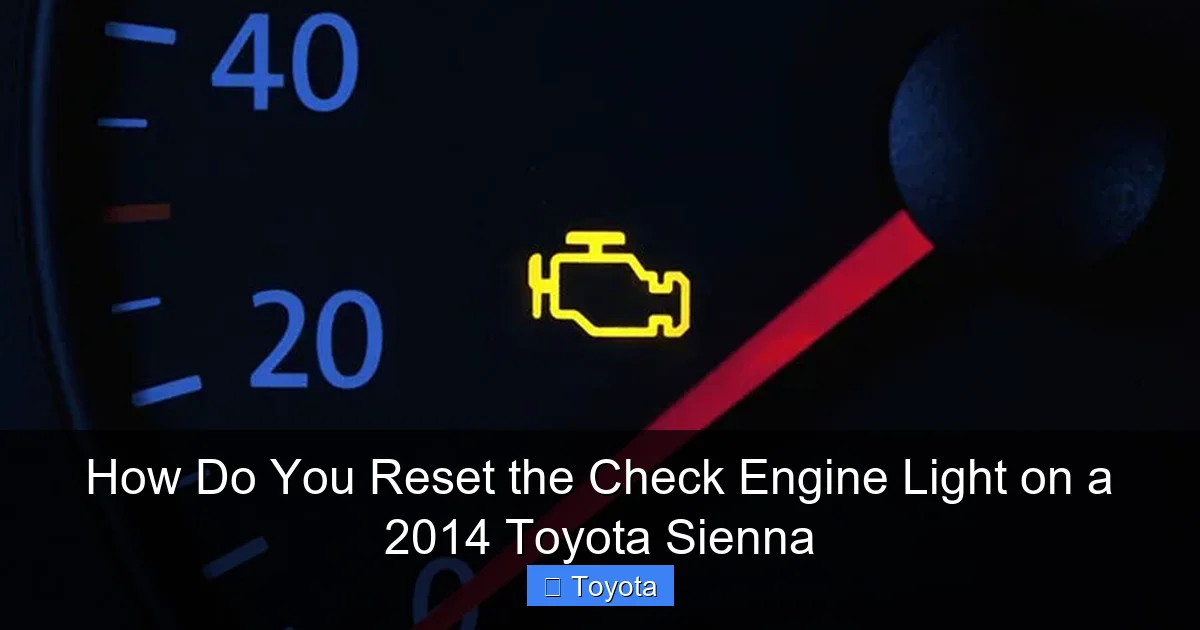
That little amber glow on your dashboard—the check engine light. For any 2014 Toyota Sienna owner, it’s a moment of immediate concern mixed with a dash of frustration. Your mind races: Is it serious? Can I still drive it? How do I make that annoying light go away? You’re not alone. This guide is your definitive, step-by-step manual for understanding and resetting the check engine light on your Sienna. But before we grab tools, we need to have a serious talk about what that light really means and why a blind reset is one of the worst things you can do.
The check engine light, or Malfunction Indicator Lamp (MIL), is your van’s way of saying, “Hey, my computer (the ECM) has detected something outside normal parameters in the engine or emissions system.” It’s not a specific “you need an oil change” light; it’s a general alarm for hundreds of possible issues, from a loose gas cap to a failing catalytic converter. Resetting it is simply telling the computer, “Okay, I acknowledge the message,” but it does not fix the problem that triggered the message in the first place. Think of it like silencing a fire alarm without checking for a fire. This article will walk you through the proper, safe procedures to reset the light on your 2014 Toyota Sienna, but our primary goal is to ensure you diagnose the root cause first.
Key Takeaways
- Diagnosis Before Reset: Never reset the light without first identifying and repairing the cause using an OBD2 scanner. Clearing a code without fixing the issue is pointless and potentially dangerous.
- Battery Disconnect Works: Removing the negative battery terminal for 10-15 minutes will clear the ECM’s memory and turn off the light, but it also resets other systems like radio presets.
- Scanner is Best Practice: Using an OBD2 scanner to read and clear codes is the most reliable, professional method that doesn’t inconvenience you with resetting other vehicle settings.
- Driving Cycle May Be Needed: After a repair, the vehicle may need to complete a specific “drive cycle” under various conditions for the ECM to verify the fix and keep the light off permanently.
- Light Behavior Matters: A steady light indicates a problem that needs attention soon. A flashing light signals a severe issue, like a misfire, that requires immediate stopping and professional diagnosis.
- Professional Help is Smart: If the code is complex (e.g., EVAP, catalytic converter) or the light returns immediately, consult a mechanic. Resetting is not a repair.
- Safety First: Driving with certain check engine lights on can cause further damage or unsafe conditions. Prioritize diagnosis over simply turning off the warning.
📑 Table of Contents
- Understanding Your 2014 Toyota Sienna’s Check Engine Light
- Method 1: The Manual Reset (Battery Disconnect)
- Method 2: The Professional Reset (Using an OBD2 Scanner)
- When Resetting is NOT the Answer: Recognizing Serious Issues
- Common 2014 Toyota Sienna Check Engine Light Causes
- Conclusion: The Smart Approach to Your Sienna’s Light
Understanding Your 2014 Toyota Sienna’s Check Engine Light
Before any reset, knowledge is power. Your 2014 Sienna’s On-Board Diagnostics II (OBD2) system is sophisticated. When it detects a fault, it stores a Diagnostic Trouble Code (DTC) in the Engine Control Module’s memory. The light illuminates to get your attention. The code itself is a starting point for diagnosis, not a final answer. For example, a P0171 code means “System Too Lean,” which could be caused by anything from a dirty mass air flow sensor to a vacuum leak.
Steady vs. Flashing Light: A Critical Difference
This is non-negotiable information. How your light behaves dictates your immediate action.
- Steady Yellow/Amber Light: This indicates a non-emergency issue. The vehicle is likely safe to drive for a short period to get it diagnosed, but you should schedule a repair soon. Common causes include a loose gas cap (which triggers an EVAP system code), faulty oxygen sensors, or a failing catalytic converter.
- Flashing or Blinking Light: This is a SEVERE EMERGENCY. It usually means a cylinder misfire is occurring that can quickly overheat and destroy the catalytic converter. If your light is flashing, pull over safely and shut off the engine immediately. Do not drive the vehicle. Have it towed to a professional. Resetting a flashing light without repair will lead to very expensive damage.
The Golden Rule: Read the Code First
You must retrieve the code before you even think about resetting. This is the single most important step. You need an OBD2 scanner. For a 2014 Sienna, any basic OBD2 scanner (available for $20-$50) will read and clear generic codes. More advanced scanners provide Toyota-specific data. Plug it into the OBD2 port, which is located under the dashboard, just to the right of the steering column (you might need to remove a small plastic cover). Turn the ignition to “ON” (do not start the engine), follow the scanner’s prompts, and write down the code(s). Now, use that code to research the likely causes online or in a repair manual. This research will tell you if it’s a simple fix you can do yourself or a job for a pro. If you need guidance on using a scanner on a different Toyota model, the principles are the same, as explained in our guide for the Toyota Corolla.
Method 1: The Manual Reset (Battery Disconnect)
This is the old-school, no-tool-required method. It works by cutting power to the ECM, forcing it to clear its memory, including the stored trouble code that turned on the light. It’s effective but has significant side effects.
Visual guide about How Do You Reset the Check Engine Light on a 2014 Toyota Sienna
Image source: bryansgarage.com
Step-by-Step Battery Disconnect Procedure
What You’ll Need: A 10mm socket/wrench (common for Sienna battery terminals), and optionally, a memory saver or 12V backup power source.
- Safety First: Park your Sienna on a level surface, engage the parking brake, and turn off all accessories. Open the hood.
- Locate the Battery: The 2014 Sienna’s battery is in the engine bay, typically on the driver’s side near the firewall.
- Identify Terminals: The negative terminal is marked with a minus (-) sign and is usually connected to a black cable. The positive is a plus (+) with a red cable.
- Disconnect NEGATIVE First: Loosen the nut on the negative terminal clamp with your socket/wrench. Carefully lift the clamp off the terminal post. Secure it away from the battery post so it cannot accidentally touch.
- Wait: This is the reset. Leave the negative cable disconnected for at least 10-15 minutes. This duration ensures the ECM’s capacitors fully discharge, clearing volatile memory. Some recommend 30 minutes for a deeper reset.
- Reconnect: Reattach the negative clamp and tighten the nut securely. Do not overtighten.
- Start the Van: Start the engine. The check engine light will likely illuminate for a few seconds as the system performs its startup self-check (bulb check). This is normal. If the light goes OFF after a few seconds, the reset was successful. If it comes back ON, the problem still exists and the code was likely re-triggered immediately.
The Major Downsides of This Method
While simple, this method is a blunt instrument. Disconnecting the battery will reset or disrupt:
- Radio Presets & Clock: You will need to reset your radio stations, clock, and any saved settings.
- Power Window & Sunroof Initialization: The windows and sunroof may need to be re-taught their limits. Consult your owner’s manual for the procedure (usually involves holding the switch in the full-up/full-down position).
- Transmission Adaptations: The transmission control module may lose its learned shift points, leading to slightly harsh or soft shifting for the first few drive cycles until it re-learns your driving style.
- Other Modules: Systems like the tire pressure monitoring system (TPMS) may need a reset or relearn procedure after a power loss.
Because of these hassles, the battery disconnect method is best reserved for situations where you have no scanner and have already fixed a simple problem (like a gas cap) and just need to clear the code. For a proper reset after any repair, a scanner is the professional choice.
Method 2: The Professional Reset (Using an OBD2 Scanner)
This is the recommended, clean, and most effective method. It targets only the check engine light code without affecting other vehicle systems.
Choosing and Using Your Scanner
Any generic OBD2 scanner will work on your 2014 Sienna. Even inexpensive models from auto parts stores can read and clear codes. For more detailed Toyota-specific data (like freeze frame data or live sensor readings), consider a higher-end model from brands like Autel, Launch, or Innova.
- Connect: Plug the scanner’s cable into the OBD2 port under your Sienna’s dash.
- Power On: Turn the ignition to the “ON” position (do not start the engine). The scanner should power on.
- Read Codes: Navigate the scanner menu to “Read Codes” or “Trouble Codes.” Select “Engine” or “Powertrain.” The scanner will communicate with the ECM and display any stored codes, such as “P0420 Catalyst System Efficiency Below Threshold.” Write these down.
- Diagnose: Use the code as your clue. Research it thoroughly. A P0420 could mean a bad catalytic converter, but it could also mean a faulty oxygen sensor or an exhaust leak. Diagnosing correctly is key.
- Clear Codes: Once you have addressed the problem (or if you are certain it was a false alarm like a loose gas cap), navigate the scanner to “Clear Codes” or “Erase DTCs.” Confirm the action.
- Verify: The check engine light should turn off immediately. Start the engine. The light should perform its brief bulb check and then stay off. If it comes back on, either the problem wasn’t fixed, or a new, different problem has developed.
The “Drive Cycle” – The Final Step to Keep the Light Off
Here’s a crucial nuance many people miss. After you clear a code, the ECM’s monitors (self-tests for various systems like the EVAP system, oxygen sensors, and catalytic converter) are reset. The light will stay off only if all these monitors run and pass. The ECM needs to see the system operating under a variety of conditions—cold start, warm operation, specific speeds, etc. This sequence is called a “drive cycle.” If you clear a code and then only drive 2 miles to the store, the monitors may not have completed, and the light may stay off. But if a monitor hasn’t run, the system isn’t fully verified. If a fault re-occurs, the light might come back on quickly. Sometimes, simply driving normally for 50-100 miles under mixed conditions (city and highway, varying speeds) is enough. For some specific repairs, a more precise drive cycle is needed, which you can find in a factory service manual for your Sienna. If the light returns after a proper drive cycle, your repair was not successful.
When Resetting is NOT the Answer: Recognizing Serious Issues
We must emphasize: resetting the light is an administrative action, not a repair. There are scenarios where your only correct move is to seek professional help immediately.
Flashing Light: Stop Driving
Reiterating from earlier: a flashing check engine light means a severe misfire. Unburned fuel is dumping into the exhaust, overheating the catalytic converter. Driving even a mile can cause catastrophic damage costing thousands to replace. This is an urgent tow job.
Serious Performance Symptoms
If your Sienna is experiencing any of these alongside the light, do not reset it. Diagnose and repair first:
- Severe loss of power, engine running roughly, or shaking.
- Strange noises (clunking, knocking, hissing).
- Smoke from the exhaust (blue = burning oil, white = coolant leak, black = overly rich mixture).
- Sweet smell (coolant leak) or rotten egg smell (catalytic converter issue).
- Overheating (temperature gauge in the red).
- Oil pressure light on concurrently.
These symptoms point to active, damaging failures. Resetting the light would be like ignoring a patient’s fever while treating their headache.
Complex or Repeated Codes
Some codes are notoriously tricky. Codes related to the EVAP system (P0440-P0457), catalytic converter efficiency (P0420/P0430), or transmission solenoid performance can have many potential causes. If you clear a code and it returns immediately or after a short drive, the diagnosis was incomplete. This often requires professional-level scan tools to monitor live sensor data and perform specific tests. For example, an EVAP leak might need a smoke machine test. Don’t keep resetting it; get a proper diagnosis.
Common 2014 Toyota Sienna Check Engine Light Causes
Knowing what commonly triggers the light on your specific model can help you anticipate the fix. While any code is possible, here are frequent offenders for the 3GR-FE V6 engine in the 2014 Sienna:
- Loose or Faulty Gas Cap: The #1 cause of EVAP system codes (P0440, P0441, P0442, P0455). Ensure the cap is tightened until it clicks. Inspect the cap’s seal for cracks. A simple fix that a scanner can confirm.
- Oxygen (O2) Sensor Failure: The upstream (before catalytic converter) and downstream (after) O2 sensors wear out. Codes like P0130-P0135 (Bank 1 Sensor 1) or P0140-P0146 (Bank 1 Sensor 2) are common. Replacing them is a common maintenance item.
- Mass Air Flow (MAF) Sensor Contamination: A dirty MAF sensor can cause lean or rich codes (P0171, P0172). It’s often cleanable with MAF sensor cleaner.
- Catalytic Converter Efficiency: The P0420 code. On a high-mileage Sienna, the converter can degrade. However, always rule out a faulty O2 sensor or exhaust leak first, as those can falsely trigger the code.
- Ignition System: Worn spark plugs or failing ignition coils can cause misfire codes (P0300-P0306). The 2014 Sienna’s coils are known to occasionally fail. A misfire is serious and should be repaired promptly.
- Thermostat or Coolant Temperature Sensor: Codes related to engine temperature (P0125, P0115-P0119) can affect fuel mixture and emissions.
Remember, this is just a list of possibilities. You must read your specific code to know for sure. The reset procedure is the same regardless of the code, but the reason for the light dictates whether you should reset it immediately or not.
Conclusion: The Smart Approach to Your Sienna’s Light
Resetting the check engine light on your 2014 Toyota Sienna is a straightforward task with the right tools and knowledge. The cleanest method is using an OBD2 scanner to clear the code after you’ve diagnosed and repaired the underlying issue. The battery disconnect method works but comes with the hassle of resetting other vehicle electronics. The absolute worst thing you can do is ignore a steady light or, worse, reset a flashing light without repair.
Your Sienna is a reliable family hauler, and its check engine light is a vital communication tool. Respect it. Use it as a prompt to investigate. Read the code. Research it. Address the root cause. Then, and only then, use your scanner to clear the code and enjoy the quiet, confident knowledge that your van is truly healthy. If the problem is beyond your comfort zone or diagnostic tools, the investment in a professional diagnosis is money well spent to protect your vehicle and your safety on the road. By following this mindful process, you move from being frustrated by a warning light to being an empowered, informed owner.
Frequently Asked Questions
Will disconnecting the battery reset the check engine light on a 2014 Toyota Sienna?
Yes, disconnecting the negative battery terminal for 10-15 minutes will clear the ECM’s memory and turn off the light. However, it will also reset your radio, clock, window limits, and transmission adaptations, requiring you to reinitialize these systems.
How long does it take for the check engine light to come back on after a reset if the problem isn’t fixed?
It varies. For some issues, like a loose gas cap, the light may come back on within a few drive cycles (50-100 miles). For others, it might take longer. If the light returns immediately after a reset, it means the fault is persistent and severe.
Can I reset the check engine light without a scanner?
Yes, by disconnecting the battery as described above. This is the only non-scanner method. There is no “fuse pull” or “button sequence” trick that reliably clears engine codes without affecting other systems on a 2014 Sienna.
My check engine light is on, but the van runs fine. Can I just reset it and keep driving?
You can, but it’s not advisable. A steady light means the ECM has detected a fault that is increasing emissions. While it may run fine, you could be causing long-term damage (like to the catalytic converter) or wasting fuel. You should read the code and address the issue promptly. If you’re unsure, a quick diagnostic scan at many auto parts stores is free.
After fixing the problem and clearing the code, why is my check engine light still on?
This usually means one of two things: 1) The repair was not successful, and the fault is still present, causing the code to set again immediately. 2) The vehicle has not yet completed all its internal “drive cycle” monitors to verify the repair. You may need to drive under varied conditions for 50-100 miles. If it persists, re-scan for codes.
Is it safe to drive with a check engine light on?
It depends. If the light is steady and the van is running normally (no rough idle, no loss of power, no strange noises/smells), you can likely drive it to a repair shop. However, you should not delay diagnosis. If the light is flashing, you must stop driving immediately and have the vehicle towed, as it indicates a severe misfire that can destroy the catalytic converter.
