
How Do You Reset the Check Engine Light on a 2008 Toyota Tacoma

Resetting the check engine light on a 2008 Toyota Tacoma is a simple process, but it must be done correctly. First, you must diagnose and fix the underlying problem using an OBD2 scanner; simply clearing the light without repair will cause it to return. The two primary reset methods are using a scan tool to clear codes or temporarily disconnecting the battery. Never ignore a steady check engine light, as it indicates an issue that could harm your Tacoma’s engine or emissions system.
Key Takeaways
- Diagnose Before You Reset: Always read and address the diagnostic trouble codes (DTCs) causing the light. Resetting without repair is temporary and misleading.
- Two Main Reset Methods: You can clear codes using an OBD2 scanner (the preferred method) or by disconnecting the negative battery terminal for a few minutes.
- The Light May Return: If the original problem isn’t fixed, the check engine light will illuminate again, often after a short drive cycle as the ECU re-detects the fault.
- Know Your Lights: A steady light means a non-emergency issue (like a loose gas cap). A flashing light indicates a severe problem (like engine misfire) that requires immediate stopping and professional diagnosis.
- Battery Disconnect Has Side Effects: This method may reset other vehicle systems, requiring you to re-enter radio presets, reset the clock, and potentially require a steering angle sensor calibration.
- Professional Help is Sometimes Necessary: For complex codes, intermittent issues, or if you’re uncomfortable, a mechanic can provide a proper diagnosis and reset.
- Maintenance Light is Different: The “Check Engine” light (MIL) is separate from the “Maintenance Required” light. Resetting one does not affect the other; you’ll need a separate procedure for the maintenance light.
📑 Table of Contents
- So, Your 2008 Toyota Tacoma’s Check Engine Light Is On. Now What?
- Understanding the Beast: What the Check Engine Light Really Means
- The Golden Rule: Diagnose Before You Reset (The Most Important Step)
- Method 1: The Clean & Professional Reset with an OBD2 Scanner
- Method 2: The Manual Reset – Disconnecting the Battery
- What About a “Drive Cycle” Reset? Can I Just Drive It Off?
- When You Should Absolutely Call a Professional
- Final Thoughts: Respect the Light, Drive Confidently
So, Your 2008 Toyota Tacoma’s Check Engine Light Is On. Now What?
That little amber light on your dashboard glowing like a warning beacon can instantly put a knot in your stomach. For a trusted workhorse like a 2008 Toyota Tacoma, it feels especially jarring. Your first instinct might be to find the fastest way to make it disappear. But before you go hunting for a reset button or a wrench, take a breath. Resetting the check engine light is not the same as fixing the problem. In fact, clearing that light without addressing its cause is like turning off a fire alarm while a fire is still burning—it doesn’t solve the problem, it just silences the warning.
This guide will walk you through everything you need to know about the check engine light (officially called the Malfunction Indicator Lamp or MIL) on your 2008 Tacoma. We’ll cover what it really means, the critical first step you must take before any reset, the two primary methods to clear it, and why you should never just ignore it. Think of this as your friendly, detailed roadmap to getting your Tacoma back to healthy, code-free running condition.
Understanding the Beast: What the Check Engine Light Really Means
The check engine light is your Tacoma’s way of telling you its computer, the Engine Control Module (ECM), has detected something outside of normal parameters. The ECM constantly monitors dozens of sensors and systems related to emissions, engine performance, and fuel economy. When a sensor reading is too high, too low, or missing entirely, the ECM stores a Diagnostic Trouble Code (DTC) and turns on the light to get your attention.
Visual guide about How Do You Reset the Check Engine Light on a 2008 Toyota Tacoma
Image source: i.ytimg.com
Steady vs. Flashing: A Critical Difference
Not all check engine lights are created equal. On your 2008 Tacoma, the behavior of the light is your first clue about severity.
- Steady, Solid Light: This indicates a non-emergency issue that is increasing emissions. Common culprits include a loose or faulty gas cap, a failing oxygen sensor, or a minor evaporative emissions (EVAP) system leak. You can usually drive the vehicle for a short period to get it diagnosed, but you shouldn’t delay.
- Flashing or Blinking Light: This is your Tacoma’s panicked scream. A flashing MIL means a severe condition is occurring that can cause immediate catalytic converter damage or engine destruction, most commonly a major engine misfire. If your light is flashing, pull over safely and shut off the engine immediately. Have it towed to a mechanic. Do not try to reset a flashing light.
For a 2008 model, common DTCs might include P0171 (System Too Lean), P0420 (Catalyst System Efficiency Below Threshold), or P0300 (Random/Multiple Cylinder Misfire Detected). The specific code is your starting point for repair.
The Golden Rule: Diagnose Before You Reset (The Most Important Step)
Let’s be absolutely clear: you should never reset the check engine light without first understanding and, in most cases, repairing the code that triggered it. Here’s why this step is non-negotiable.
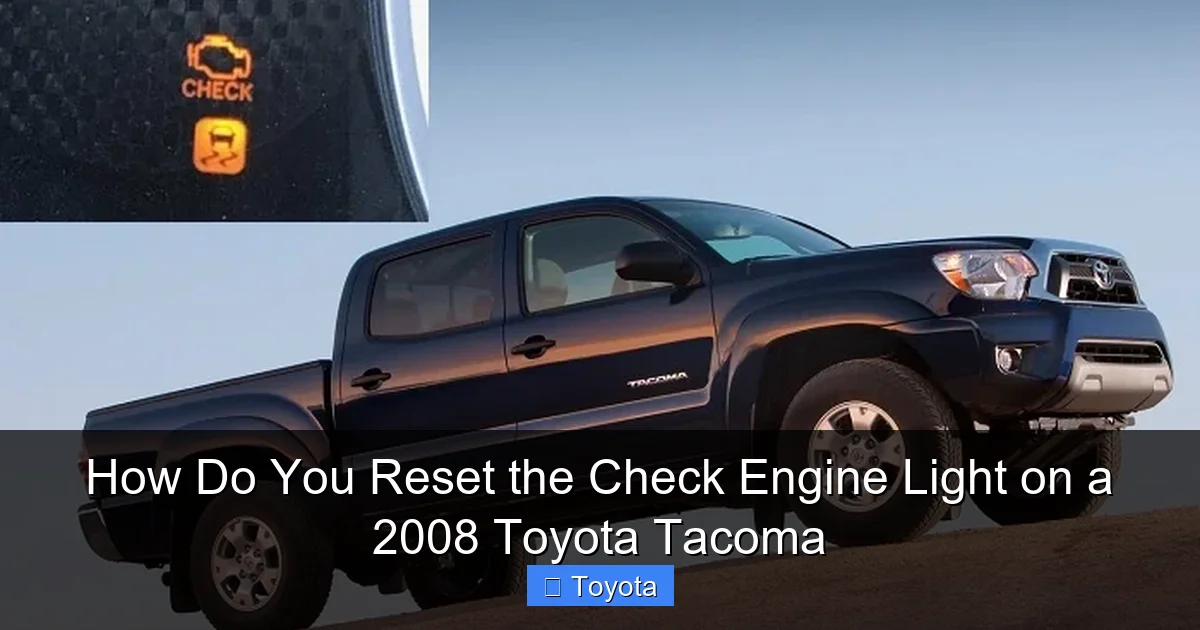
Visual guide about How Do You Reset the Check Engine Light on a 2008 Toyota Tacoma
Image source: cararac.com
Why “Clear and Pray” is a Terrible Strategy
When you clear the codes, you also erase the ECM’s “readiness monitors.” These are specific tests the computer runs to ensure all emission systems are functioning properly. Your Tacoma must complete these monitors before it can pass a mandatory emissions (smog) test. If you clear the light without fixing the problem, the underlying fault will be detected again during the drive cycle, the light will return, and the monitors will reset, failing your inspection. You’ve wasted time and money.
More importantly, you’re ignoring a potential problem. A loose gas cap is one thing, but a code for an oxygen sensor or catalytic converter can lead to poor fuel economy, rough running, and expensive damage if left unchecked. Resetting the light masks the symptom but lets the disease fester.
How to Read the Codes: Your Diagnostic Toolkit
To obey the golden rule, you need to read the codes. You have two main paths:
- Use an OBD2 Scanner (Highly Recommended): This is the professional and DIY standard. Any OBD2 scanner (available from $20 for basic models to $200+ for advanced ones) will plug into your Tacoma’s OBD2 port (located under the dashboard, near the steering column). Turn the ignition to “ON” (not start), and follow the scanner’s prompts to read “Stored” or “Pending” codes. Write down the code(s) (e.g., P0455). This is your diagnosis. You can then research the specific code for your 2008 Tacoma 4-cylinder or V6 to understand the likely cause and repair. Many auto parts stores will also read your codes for free.
- Use the “Paperclip” or “Blink” Method (Limited Use): Some older vehicles, including some 2008 Tacomas, allow you to retrieve codes by turning the ignition key in a specific sequence (ON-OFF-ON-OFF-ON) and counting the check engine light flashes. This method is often unreliable on 2008+ models due to more complex systems and won’t give you the precise alphanumeric code (P0XXX). It’s a last resort. For a proper diagnosis, an OBD2 scanner is essential.
Once you have identified and, ideally, repaired the issue (e.g., tightened the gas cap, replaced the faulty sensor), you are finally ready to reset the light. If you’re unsure about the repair, consult a professional. You can find guides for other Toyota models, like how to reset the check engine light on a Toyota Highlander, which follows a similar OBD2 process.
Method 1: The Clean & Professional Reset with an OBD2 Scanner
This is the correct, manufacturer-recommended way to reset your 2008 Tacoma’s check engine light. It’s quick, doesn’t have negative side effects, and directly targets the computer’s memory.
Step-by-Step Guide to Clearing Codes
- Ensure the Problem is Fixed: Complete your repairs based on the diagnosed code(s).
- Connect Your Scanner: Plug the OBD2 scanner’s cable into your Tacoma’s OBD2 port. Turn the ignition key to the “ON” position (the position right before starting the engine). Do not start the engine.
- Establish Communication: Turn on the scanner and follow its on-screen menu. Select “Read Codes” first to confirm the stored codes are present. Then, navigate to the “Erase Codes,” “Clear Codes,” or “Reset MIL” function.
- Clear and Confirm: Select the option to clear. The scanner may ask for confirmation. The process takes a few seconds. You should see a “DTCs Cleared” or similar message.
- Verify: Turn the ignition off for 10 seconds, then back to “ON.” Start your Tacoma. The check engine light should be off. If it comes back on immediately, the fault is still present or a new one has occurred.
What to Expect After the Reset
After clearing the codes with a scanner, your Tacoma’s ECM will begin running its readiness monitors again. These are specific drive cycles (combinations of speed, load, and engine temperature) that test systems like the EVAP system, oxygen sensors, and catalyst. It can take 50-100 miles of varied driving (including highway and city speeds, and a cool-down period) for all monitors to set to “Ready.” Until then, your vehicle may not pass an emissions test. This is normal. If the light returns before the monitors are set, you have a persistent problem.
Method 2: The Manual Reset – Disconnecting the Battery
This is the old-school method and works on virtually any vehicle, including your 2008 Tacoma. It’s effective because it cuts power to the ECM, forcing it to reset and lose its stored memory, including fault codes. However, it comes with significant caveats and is a blunt instrument compared to a scanner.
Step-by-Step Battery Disconnect Procedure
- Safety First: Ensure the vehicle is parked, turned off, and the parking brake is set. Gather a 10mm socket/wrench (common for Tacoma battery terminals) and optionally, a memory saver or a 10mm fuse for the radio.
- Locate the Negative Terminal: Open the hood. Identify the black, negative (-) battery cable connected to the negative terminal (marked with a “-” sign). This is the one you will disconnect.
- Disconnect the Negative Cable: Loosen the nut on the negative terminal and carefully lift the cable off the post. Secure it away from the battery post so it cannot accidentally touch and create a spark. Do not disconnect the positive (+) cable.
- Wait: Let the vehicle sit with the battery disconnected for at least 10-15 minutes. This ensures the ECM’s capacitors fully discharge, clearing residual memory.
- Reconnect: Reattach the negative cable and tighten the nut securely. Do not overtighten.
- Start and Check: Start your Tacoma. The check engine light should be off. However, you will likely see other lights and warnings on the dash (ABS, Tire Pressure, etc.) as those systems also reset. These should go out after a short drive as they re-calibrate.
Important Side Effects and Considerations
This method is a “reset all” button. Be prepared for these consequences:
- Radio & Clock: You will lose all radio presets, the clock time, and any paired Bluetooth devices.
- Power Window & Sunroof Relearn: On some vehicles, you may need to perform a “relearn” procedure for the one-touch up/down window feature and sunroof. Consult your owner’s manual.
- Steering Angle Sensor: The vehicle’s stability control systems (VSC/TRAC) may detect a fault and illuminate their light until you perform a steering angle sensor calibration. This often involves turning the steering wheel fully left, then fully right, and back to center with the engine running.
- Idle Relearn: The ECM may need to “relearn” the idle speed, causing a slightly high or rough idle for the first few minutes of driving. This is normal and will settle.
- It Doesn’t Fix Anything: Like the scanner method, this only erases the symptom. The underlying problem will cause the light to return once the ECM runs enough diagnostics to detect it again.
Given these hassles, the OBD2 scanner method is vastly superior. If you don’t own a scanner, many local auto parts stores will let you borrow or rent one, or you can purchase a reliable basic model for future use.
What About a “Drive Cycle” Reset? Can I Just Drive It Off?
This is a common point of confusion. There is no magic button or sequence you can perform while driving to manually reset the light. However, there is a concept called a “drive cycle.” If the problem that triggered the code was a temporary, one-time glitch (like a momentary loose gas cap or a single misfire from bad fuel), and you have since fixed it (e.g., tightened the cap), then simply driving your Tacoma under normal conditions may allow the ECM to complete its monitors without detecting the fault again. After successfully completing the drive cycle, the ECM may automatically turn off the check engine light on its own.
However, you cannot force this. The ECM runs its own internal schedule. For a persistent problem (like a bad sensor), the light will come back regardless of driving. Therefore, you should never rely on this as a strategy. Always diagnose and clear the code explicitly if you believe the repair is complete. For specific models like the Toyota Tacoma’s maintenance required light, the procedure is entirely different and often involves a trip odometer button sequence, not an OBD2 function.
When You Should Absolutely Call a Professional
While resetting the light is a DIY task, the diagnostic and repair work leading up to it is not always. Here are clear scenarios to call in a expert:
- The Light is Flashing: As stated, this is an emergency. Stop driving and get towed.
- You Have Complex or Multiple Codes: If your scan reveals multiple codes, especially across different systems (engine, transmission, ABS), it can indicate a complex wiring issue or a failed component affecting multiple systems. This requires professional troubleshooting.
- You’ve Fixed the Code, But It Returns Immediately: This suggests the repair was incomplete or incorrect, or there is an underlying, more serious issue.
- You’re Uncomfortable with the Diagnosis: If the code points to something like a catalytic converter failure, internal engine leak, or transmission solenoid, these are major, expensive repairs. Get a qualified mechanic’s opinion and quote.
- Your Tacoma Fails an Emissions Test After Reset: If you’ve cleared the codes and driven the required miles but still fail, there is a problem with the emissions system that needs expert diagnosis.
A professional technician uses advanced scan tools that can view live sensor data, perform active tests (like cycling an EVAP solenoid), and have access to technical service bulletins (TSBs) for your specific 2008 Tacoma. This level of diagnosis goes far beyond a simple code read.
Final Thoughts: Respect the Light, Drive Confidently
Your 2008 Toyota Tacoma is known for its reliability and longevity. Part of keeping it on the road for years to come is heeding its warnings. The check engine light is not an annoyance to be silenced; it’s a communication tool from your vehicle’s sophisticated computer system. By following the disciplined approach of Diagnose → Repair → Reset, you ensure that when that light goes out, it’s because your Tacoma is truly healthy, not just quiet.
Investing in a good OBD2 scanner is one of the smartest moves a Tacoma owner can make. It empowers you to understand your vehicle, catch small problems before they become big ones, and perform this reset procedure correctly every time. Remember, a well-maintained Tacoma is a happy Tacoma, and a happy Tacoma will keep serving you faithfully for another 200,000 miles.
Frequently Asked Questions
Can I reset the check engine light by just disconnecting the battery?
Yes, disconnecting the negative battery terminal for 10-15 minutes will clear the ECM’s memory and turn off the light. However, this also resets all other vehicle systems like the radio, clock, and stability control, requiring a relearn process. It is a less precise method than using an OBD2 scanner.
How long does it take for the check engine light to reset after fixing the problem?
If you use an OBD2 scanner to clear the codes, the light turns off immediately upon restarting the engine. If you rely on a drive cycle (the ECM auto-clearing), it can take 50-100 miles of varied driving for the light to go out, and only if the problem was truly resolved and no new faults are detected.
Will the check engine light reset itself?
It can, but only under specific conditions. If the fault that triggered the code was a temporary, non-recurring event and the ECM completes its self-diagnostic drive cycle without detecting the issue again, it may turn the light off automatically. For a persistent mechanical or electrical fault, the light will not reset itself and will require manual clearing after repair.
What if the check engine light comes back on right after I reset it?
This is a clear sign that the underlying problem was not properly diagnosed or repaired. The ECM has immediately detected the same fault again. You must re-scan for codes, identify the new or persistent issue, and address that specific repair. Do not keep resetting the light.
Is it illegal to reset the check engine light before a smog/emissions test?
Yes. In states with emissions testing, it is illegal to intentionally clear codes to pass an inspection. Testing equipment will check the status of the ECM’s readiness monitors. If they are not all set to “Ready,” your vehicle will automatically fail the test, regardless of whether the light is on. You must drive the vehicle enough to allow all monitors to set after any code clearing.
How is resetting the check engine light different from resetting the maintenance required light?
They are completely separate systems. The check engine light (MIL) is controlled by the ECM and signals an emissions-related fault. The maintenance required light is a simple mileage or interval reminder for oil changes and other services. Resetting one does not affect the other. The maintenance light on a Tacoma is typically reset using a trip odometer button sequence with the ignition, not an OBD2 scanner. You can find the specific procedure for your model here.
