
What Are the Four Rules of the Toyota Production System?

The Toyota Production System (TPS) is the legendary manufacturing philosophy behind Toyota’s global success. Its power comes from four foundational rules: Continuous Improvement (Kaizen), Respect for People, Just-in-Time, and Jidoka (Automation with a Human Touch). These rules create a culture of efficiency, quality, and empowerment that transcends the auto industry and is adopted by organizations worldwide.
Key Takeaways
- Rule 1 – Continuous Improvement (Kaizen): It’s the relentless pursuit of small, incremental changes by every employee to eliminate waste and improve processes daily.
- Rule 2 – Respect for People: This is the bedrock of TPS, fostering trust, teamwork, and developing each person’s potential to solve problems and add value.
- Rule 3 – Just-in-Time: This rule means producing only what is needed, when it is needed, and in the amount needed, dramatically reducing inventory and waste.
- Rule 4 – Jidoka: Often called “automation with a human touch,” it builds quality into the process by stopping production immediately when a problem is detected.
- They Are Interdependent: These four rules form a symbiotic system; one cannot function effectively without the others. Respect for people enables Kaizen; Jidoka supports Just-in-Time.
- Universal Application: While born in manufacturing, the principles apply to any process—from software development and healthcare to logistics and service industries.
[FEATURED_IMAGE_PLACEHOLDER]
📑 Table of Contents
- Introduction: More Than a Production Line
- Rule 1: Continuous Improvement (Kaizen) – The Relentless Pursuit of Better
- Rule 2: Respect for People – The Human Foundation of the System
- Rule 3: Just-in-Time – Only What’s Needed, When It’s Needed
- Rule 4: Jidoka – Putting Quality on Autopilot
- The Symbiotic System: How the Four Rules Work Together
- Conclusion: Your Own Production System
Introduction: More Than a Production Line
When you think of Toyota, you likely picture reliable vehicles like the Camry or RAV4. But behind that reputation lies something far more profound: a complete philosophy for work and life. The Toyota Production System (TPS) is not just a set of tools; it’s a culture, a mindset, and a set of core rules that have revolutionized global manufacturing. For decades, it was Toyota’s secret weapon, allowing them to build higher-quality cars with less inventory, lower costs, and more engaged employees than anyone thought possible.
So, what are the four fundamental rules that make this system tick? They are the pillars upon which the entire TPS house is built: Continuous Improvement (Kaizen), Respect for People, Just-in-Time, and Jidoka. Understanding these rules is the first step to seeing the world through Toyota’s eyes—a world where every process is questioned, every employee is a problem-solver, and quality is built in from the start. This isn’t just automotive history; it’s a masterclass in operational excellence that you can apply to your own work, team, or business.
Rule 1: Continuous Improvement (Kaizen) – The Relentless Pursuit of Better
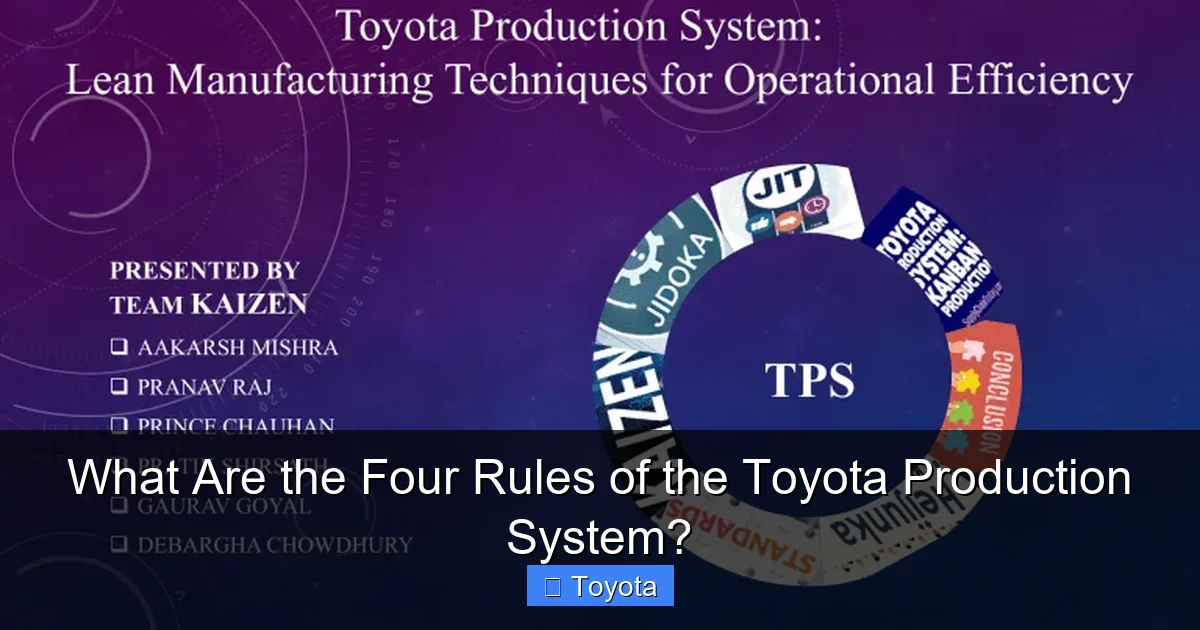
“Kaizen” is a Japanese word meaning “change for the better.” At Toyota, it’s not a occasional initiative or a slogan on a wall. It is the daily, hourly, minute-by-minute commitment to finding and eliminating waste—known as muda in Japanese. This is the engine of TPS.
Visual guide about What Are the Four Rules of the Toyota Production System?
Image source: s2.studylib.net
The Philosophy of Small Steps
Many companies chase massive, disruptive innovations. Toyota believes true, sustainable progress comes from countless tiny improvements made by the people closest to the work. A worker on the assembly line noticing a tool is placed awkwardly and suggesting a better location is practicing Kaizen. A team leader implementing a visual cue to prevent a part from being missed is practicing Kaizen. It’s about creating an environment where everyone is expected to question the status quo and is given the tools and permission to suggest changes.
Practical Application: The PDCA Cycle
Kaizen is structured through the PDCA Cycle (Plan-Do-Check-Act), also known as the Deming Cycle. It’s a simple, scientific method for testing and learning:
- Plan: Identify a problem or opportunity and develop a small-scale test or change.
- Do: Implement the plan on a limited basis.
- Check: Study the results. Did the change improve the process? What did you learn?
- Act: If successful, standardize the new method and train others. If not, learn from it and plan again.
This cycle turns improvement into a never-ending loop. For example, a team might Plan to reduce the time spent fetching tools by creating a shadowboard. They Do a trial on one station. They Check the time saved and worker feedback. They Act by rolling it out to all stations if it works.
Tips for Implementing Kaizen in Your Life
You don’t need a factory to use Kaizen. Start by: 1) Observing your own workflow for 5 minutes of wasted motion or frustration. 2) Asking “Why?” five times to get to a problem’s root cause. 3) Empowering your team or family to suggest one small improvement this week. The goal is progress, not perfection.
Rule 2: Respect for People – The Human Foundation of the System
This is the most critical and often misunderstood rule. “Respect for People” at Toyota is not about being nice; it’s a profound operational principle. It means valuing every individual’s intellect, creativity, and potential. Without it, the other rules collapse. Why would an employee bother suggesting improvements if they feel disrespected or unheard?
Visual guide about What Are the Four Rules of the Toyota Production System?
Image source: etextzone.com
Two Pillars: Respect and Teamwork
Toyota breaks this rule into two complementary ideas:
- Respect: Taking the time to understand each person’s perspective, listening to them fully, and recognizing their inherent worth. It’s the foundation of psychological safety.
- Teamwork: Leveraging the collective intelligence of the group to achieve a common goal. Individualego is set aside for the team’s success.
How It Manifests: Developing Problem-Solvers
Respect for People means management’s job is not to give orders, but to develop people’s ability to identify and solve problems. Leaders are coaches, not commanders. They ask questions (“What do you think is causing this defect?”) instead of giving answers. This builds a workforce of engaged experts who own their processes. This philosophy extends to the entire supply chain. When a supplier struggles, Toyota doesn’t just punish them; they often send engineers to help them improve, viewing them as partners. This deep trust is why you see consistent quality across all Toyota trim levels, from base models to the top-tier 1794 Edition Tundra.
The Cost of Disrespect
A culture without respect breeds fear, hidden problems, and a “pass the buck” mentality. Mistakes are covered up, innovation dies, and turnover soars. TPS flips this script: by respecting people, you unleash their creative energy to continuously improve the system itself.
Rule 3: Just-in-Time – Only What’s Needed, When It’s Needed
Imagine a restaurant where the chef prepares every dish only after a customer orders it. No food sits in the fridge waiting to spoil. That’s the essence of Just-in-Time (JIT). In manufacturing, it means having the right part, at the right place, at the right time, in the exact quantity needed.
Eradicating the Waste of Inventory
Before TPS, the standard was “just-in-case” production—making large batches and storing them in warehouses. Toyota saw this as the worst form of waste (muda). Inventory hides problems. If you have a month’s supply of parts, a machine breakdown or a defect goes unnoticed for weeks. JIT exposes problems immediately because there’s no buffer. If a part doesn’t arrive on time, the line stops. This forces you to fix the root cause (the supplier issue, the machine failure) right now.
The Kanban: The Nervous System of JIT
The primary tool for JIT is the Kanban (meaning “signboard” or “card”). It’s a simple, visual signal—often a card or a digital signal—that tells the preceding process to produce or deliver more parts. It’s a pull system. The final assembly line “pulls” parts from the previous station, which pulls from the one before that, all the way back to raw materials. This creates a smooth, rhythmic flow, like a grocery store restocking shelves based on what customers buy, not on a fixed schedule. Implementing this reliably requires incredible coordination, often supported by sophisticated ERP systems that manage demand signals across the network.
Challenges and Benefits
JIT makes the entire system fragile on the surface—a single hiccup can stop production. But this fragility is its strength. It demands absolute reliability from suppliers, impeccable maintenance of equipment, and excellent cross-training of workers. The benefits are massive: minimal inventory costs, reduced storage space, faster response to changes in demand (like a sudden spike in RAV4 towing capacity queries influencing production), and a crystal-clear view of every problem in the value stream.
Rule 4: Jidoka – Putting Quality on Autopilot
Jidoka translates to “automation with a human touch.” It’s often misunderstood as simply building quality into machines. It’s much more profound. Jidoka means that any machine or person, upon detecting an abnormal condition, stops immediately and signals for help. It builds quality into the process itself, preventing defects from moving down the line to become bigger, costlier problems.
Visual guide about What Are the Four Rules of the Toyota Production System?
Image source: global.toyota
The Andon Cord: The Physical Manifestation
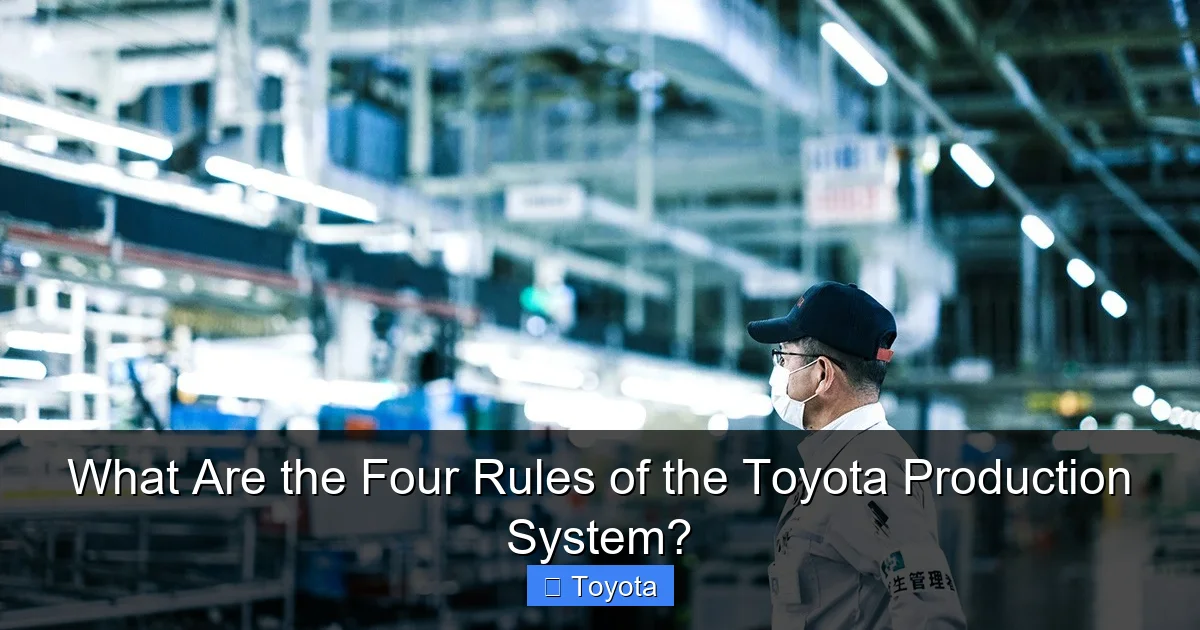
The most famous symbol of Jidoka is the andon cord. In early Toyota plants, a physical rope ran along the assembly line. Any worker who noticed a problem—a missing part, a faulty weld, a safety risk—could pull this cord. The entire line would stop, lights would flash, and a team leader would rush over to help diagnose and fix the issue. This was revolutionary. In traditional factories, the line never stopped; defects were passed on, to be fixed later at great expense. The andon cord gave every single employee the authority and responsibility to stop the process to protect quality. It’s the ultimate expression of “built-in quality.”
Separating Human Work from Machine Work
Jidoka isn’t just about stopping; it’s about freeing humans from repetitive monitoring so they can do creative problem-solving. A machine equipped with Jidoka can detect a deviation (like a part not properly seated) and halt itself. The human’s job shifts from watching the machine to reacting to the stop, investigating the cause (why wasn’t the part seated? Faulty supplier part? Misaligned jig?), and fixing it. This turns workers into investigators and improvers, not just button-pushers.
Jidoka in the Modern World
Today, the “andon” is often a digital button on a screen or an automated sensor. The principle is identical. Software developers use “test-driven development” and continuous integration to stop a code deployment if tests fail. A hospital might have a checklist that halts a surgical procedure if a sterilization step is missed. The goal is always the same: fail fast, fail cheap, and fix the root cause immediately. This principle ensures that whether you’re building a Toyota Camry or a complex data pipeline, quality is never compromised for speed.
The Symbiotic System: How the Four Rules Work Together
It’s a mistake to view these four rules as separate. They are deeply interconnected, forming a robust, self-reinforcing system. Here’s how they feed each other:
- Respect for People enables Kaizen. Employees won’t suggest improvements if they fear punishment for pointing out problems. A culture of respect and psychological safety is the prerequisite for continuous improvement.
- Jidoka enables Just-in-Time. You cannot run a smooth, low-inventory JIT system if defects are flowing downstream. Jidoka stops defects at the source, ensuring only good parts move to the next station, making the entire pull system reliable.
- Just-in-Time exposes problems for Kaizen. With no inventory buffer, every minor issue—a late part, a machine hiccup—stops the line. This visibility creates a constant stream of problems to solve, which is the raw material for Kaizen.
- Kaizen improves the other three. Small, daily improvements make processes more reliable (supporting JIT), build better quality checks (supporting Jidoka), and create a more engaging environment (supporting Respect for People).
Toyota calls this the “TPS House” diagram. The roof is quality, cost, and delivery. The two main pillars are Just-in-Time and Jidoka. The foundation is Stabilized Standardized Work and the Culture of Continuous Improvement (Kaizen), all built on the bedrock of Respect for People. Remove any pillar or part of the foundation, and the house collapses.
Conclusion: Your Own Production System
The four rules of the Toyota Production System are timeless because they address universal truths about work and human nature. Continuous Improvement turns work into a learning laboratory. Respect for People unlocks the creative potential of every individual. Just-in-Time forces clarity and exposes waste. Jidoka builds quality and accountability into every step.
You don’t need to be an automaker to apply them. Ask yourself: Where is the waste in your daily process? Do you empower your team to stop the “line” when they see a problem? Are you building their problem-solving skills? Are you pulling work based on real demand or pushing based on a forecast? Start small. Implement a personal Kanban. Practice the 5 Whys. Give someone the implicit authority to call a timeout. These rules are not about copying Toyota’s tools; they are about adopting a mindset where efficiency, quality, and human dignity are not trade-offs, but mutually reinforcing goals. That is the enduring legacy of the Toyota Production System.
Frequently Asked Questions
Are the four rules of TPS only applicable to manufacturing?
No. These are principles of process management and human organization. They are successfully applied in software development (Agile/Lean), healthcare (patient flow), logistics, and even personal productivity. The core ideas of eliminating waste, building quality, and empowering people are universal.
How does Jidoka differ from simple automation?
Traditional automation aims to speed up production by removing humans from the loop. Jidoka adds a critical human-centric layer: the ability to detect abnormality and stop. It separates the human’s creative, cognitive work (problem-solving) from the machine’s repetitive work, making humans more valuable, not obsolete.
What’s the biggest mistake companies make when trying to implement TPS?
The most common error is focusing only on the tools (kanban, 5S, andon) while neglecting the foundational culture of Respect for People. Without trust and psychological safety, employees will not honestly expose problems, and any tool-based implementation will be superficial and unsustainable. It must be a top-down cultural shift.
Is Just-in-Time the same as having zero inventory?
No. Just-in-Time aims for the *minimum necessary* inventory to create a smooth flow, not necessarily zero. The goal is to reduce inventory to the point where it no longer hides problems. Some buffer is always needed for supply chain disruptions, but JIT constantly pushes to reduce that buffer by improving reliability.
How does Kaizen relate to innovation?
Kaizen is incremental innovation, while breakthrough innovation is radical. TPS values both, but believes that without a foundation of relentless Kaizen (small daily improvements), you cannot sustain or effectively implement major breakthroughs. Kaizen creates the disciplined, waste-free environment where radical innovation can thrive.
Can a small business or team use these four rules?
Absolutely. Start with Respect for People: have open conversations, listen to frontline ideas. Implement a simple visual management system (a whiteboard is a kanban). Institute a rule that anyone can “stop the line” on a project if they see a fundamental flaw. Celebrate small improvements weekly. The scale is different, but the principles are identical.
