
How Many Miles Can a 2018 Toyota Camry Go on a Full Tank?

A 2018 Toyota Camry with a full tank can typically travel between 448 and 672 miles, depending on the engine and driving conditions. The standard 4-cylinder model offers an EPA-estimated 28 mpg city/39 mpg highway, while the V6 provides 22 mpg city/33 mpg highway. Real-world range varies with factors like driving style, weather, and cargo load, but understanding your car’s capabilities helps you plan trips and avoid stressful fuel situations.
Key Takeaways
- Fuel Tank Capacity: The 2018 Camry’s gas tank holds either 15.8 or 16.0 gallons, depending on the trim level, providing the foundation for its total driving range.
- EPA MPG Ratings: The 4-cylinder engine achieves an EPA-estimated 28 mpg in the city and 39 mpg on the highway, while the V6 engine is rated for 22 mpg city and 33 mpg highway.
- Real-World Highway Range: Under optimal highway conditions, a 4-cylinder Camry can exceed 600 miles on a single tank, while the V6 model can reach approximately 525 miles.
- City Driving Impact: Stop-and-go city driving significantly reduces range, with the 4-cylinder model dropping to around 350-400 miles per tank in heavy traffic.
- Gas Light Reserve: The low fuel warning light typically illuminates when 1-2 gallons remain, giving you a final 30-70 miles of range before you should refuel.
- Maximizing Efficiency: Smooth acceleration, proper tire inflation, regular maintenance, and using cruise control on highways can help you achieve or even surpass EPA estimates.
- Model Variations: Hybrid versions of the 2018 Camry offer substantially higher MPG (up to 44 mpg city/47 mpg highway), translating to over 700 miles on a full tank.
📑 Table of Contents
- Understanding Your 2018 Toyota Camry’s Fuel Range
- The Foundation: Fuel Tank Capacity and EPA Ratings
- Real-World Range: It’s Not Always Simple Math
- The Gas Light: Your Final Warning and Its True Meaning
- Maximizing Your Range: Practical Tips for Every Driver
- Long-Distance Travel: Planning for the Open Road
- Conclusion: Confidence Through Knowledge
Understanding Your 2018 Toyota Camry’s Fuel Range
One of the most common questions for any car owner is, “How far can I go on a full tank?” For the 2018 Toyota Camry, a midsize sedan celebrated for its reliability and comfort, this question is especially practical. Whether you’re planning a cross-country road trip, your daily commute, or just want to avoid frequent gas station stops, knowing your car’s true range is key. The answer isn’t a single number because it depends on several factors, including your specific Camry’s engine, your driving habits, and the environment. This guide will break down everything you need to know, from the raw numbers in the owner’s manual to real-world tips for getting the most miles from every gallon.
We’ll start with the hard facts: the size of the fuel tank and the official EPA fuel economy ratings. From there, we’ll explore how those numbers play out in actual driving conditions, which can change your range dramatically. You’ll learn about the crucial warning system—the gas light—and how much farther you can (and shouldn’t) push it. Finally, we’ll provide actionable advice to help you maximize your Camry’s efficiency, ensuring you get the range you expect while keeping your car healthy. By the end, you’ll have a clear, confident understanding of your 2018 Camry’s capabilities.
The Foundation: Fuel Tank Capacity and EPA Ratings
To calculate maximum range, you need two key pieces of data: how much fuel the tank holds and how efficiently the engine uses that fuel. The 2018 Toyota Camry provides a solid starting point for both.
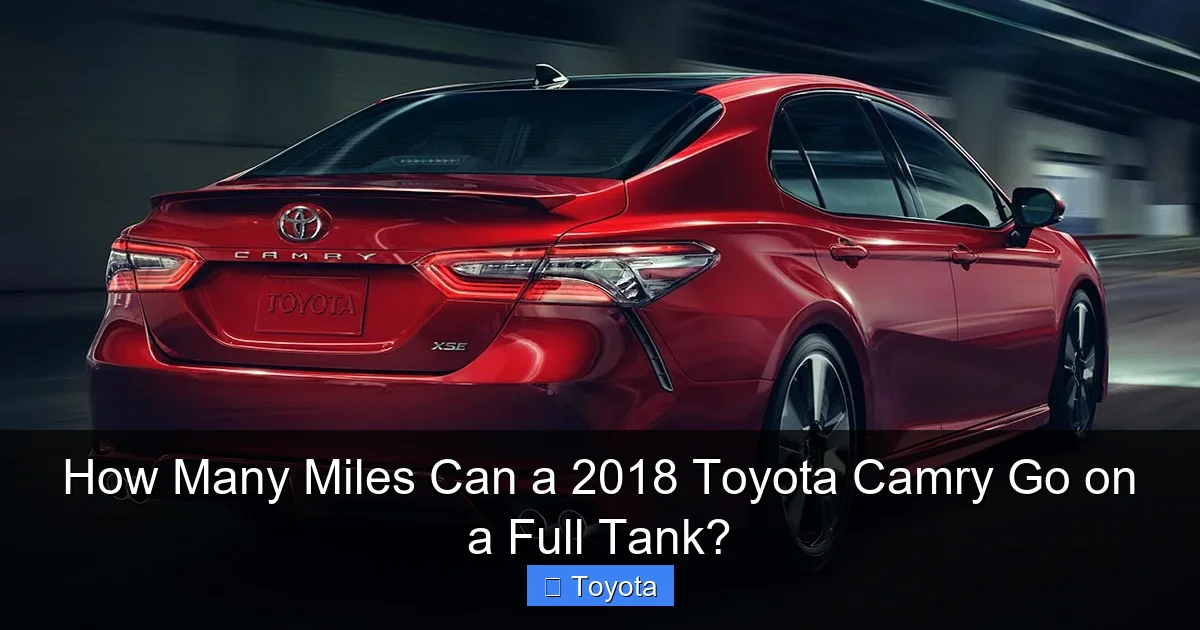
Visual guide about How Many Miles Can a 2018 Toyota Camry Go on a Full Tank?
Image source: article.images.consumerreports.org
Exact Gas Tank Size
The 2018 Camry is equipped with a fuel tank that holds either 15.8 gallons or 16.0 gallons. The specific capacity depends on the trim level. Most base and mid-level trims, including the L, LE, SE, and XLE (for the 4-cylinder), use the 15.8-gallon tank. The XSE and V6-powered trims (like the XLE V6 and XSE V6) typically feature the slightly larger 16.0-gallon tank. For the vast majority of calculations, you can use an average of 16 gallons. This capacity is a critical constant in your range equation. For a deep dive into the exact specifications for your specific model, you can refer to resources that detail how big the gas tank is on a Toyota Camry.
Official EPA Fuel Economy Estimates
The Environmental Protection Agency (EPA) puts every new vehicle through a standardized lab test to determine its miles per gallon (MPG) ratings. For the 2018 Camry, there are two primary powertrain options, each with distinct ratings:
- 2.5L 4-Cylinder Engine: This is the most common engine. EPA ratings are 28 mpg in the city and 39 mpg on the highway. The combined estimate is 32 mpg.
- 3.5L V6 Engine: For those seeking more power, the V6 trades efficiency for performance. Its EPA ratings are 22 mpg city and 33 mpg highway, with a 26 mpg combined estimate.
It’s important to note that the EPA also tested the 2018 Camry Hybrid, which achieves remarkable efficiency—up to 44 mpg city and 47 mpg highway—but this guide focuses on the gasoline-only models. Using the EPA’s combined MPG figure and a 16-gallon tank, the theoretical maximum range is straightforward math: 16 gallons * 32 mpg = 512 miles for the 4-cylinder, and 16 * 26 = 416 miles for the V6. However, these are best-case, lab-based scenarios.
Real-World Range: It’s Not Always Simple Math
If only driving were that simple! The “your mileage may vary” disclaimer exists for a reason. The gap between EPA estimates and what you see on your dashboard can be wide, influenced by a constellation of factors. Understanding these will help you set realistic expectations and, more importantly, learn how to nudge your actual range closer to the ideal.
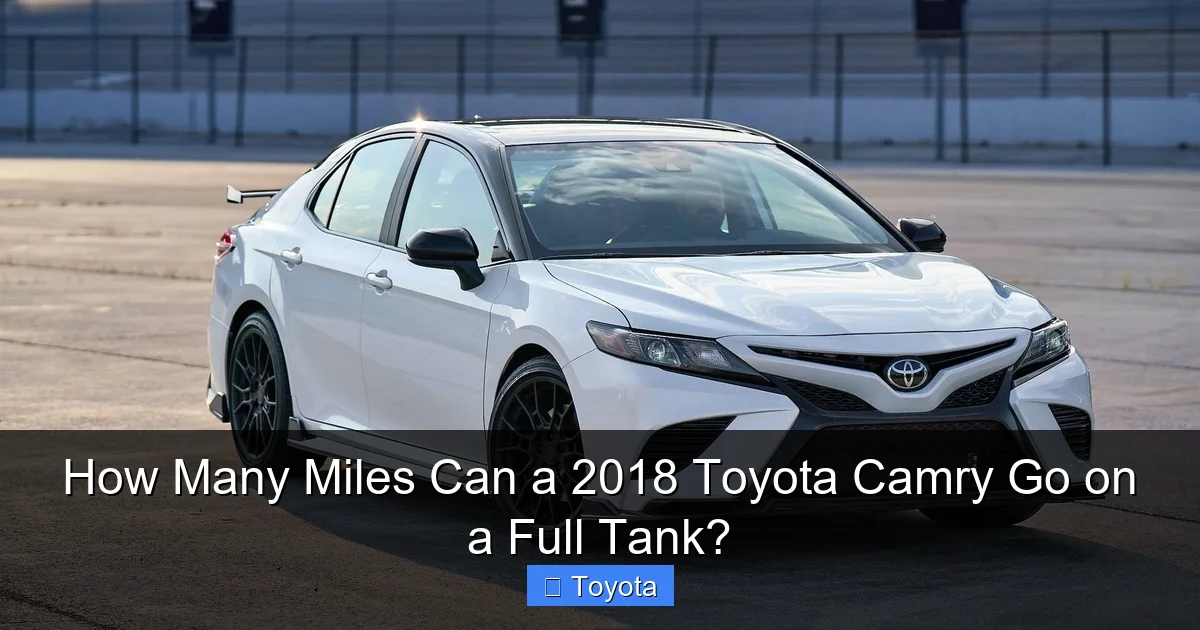
Visual guide about How Many Miles Can a 2018 Toyota Camry Go on a Full Tank?
Image source: i.gaw.to
Highway vs. City: The Great Divide
The single biggest factor affecting your Camry’s range is the type of driving you do. The EPA’s city rating (28 mpg for the 4-cyl) reflects stop-and-go traffic with frequent acceleration and braking—a very inefficient use of fuel. The highway rating (39 mpg) represents steady cruising at a consistent speed, where the engine operates at optimal efficiency. If your commute is 90% highway, you’ll likely see an average MPG of 35-38, translating to 560-608 miles on a full tank. Conversely, a commute trapped in city traffic might yield 24-26 mpg, dropping your range to 384-416 miles. Most drivers fall somewhere in between, with a real-world combined average often 1-3 mpg below the EPA combined estimate.
The Impact of Driving Style and Conditions
Your right foot has more power over your fuel economy than you might think. Aggressive acceleration, hard braking, and excessive speeding (especially above 70 mph) can drastically reduce efficiency. A calm, anticipatory driving style—gradual acceleration, early gentle braking, and maintaining a moderate speed—can improve your mileage by 10-20%. Other conditions include:
- Weather: Cold weather thickens engine oil and increases rolling resistance. Using the heater and defroster also adds load. Hot weather means constant air conditioning, which can reduce MPG by 5-10%.
- Terrain: Hilly or mountainous roads force constant acceleration and engine braking, consuming more fuel than flat, straight highways.
- Vehicle Load: Every extra 100 pounds of cargo or passengers can reduce MPG by about 1-2%. A fully loaded Camry with a roof rack (which adds aerodynamic drag) will see a further penalty.
- Vehicle Maintenance: Under-inflated tires, a dirty air filter, old spark plugs, or overdue oil changes all make the engine work harder and burn more fuel. This is a key reason why following your maintenance schedule is directly tied to fuel economy.
The Gas Light: Your Final Warning and Its True Meaning
That moment when the low fuel warning light (often a yellow gas pump icon) flickers on is a universal source of anxiety. Understanding what it means for your 2018 Camry is crucial for both convenience and safety.
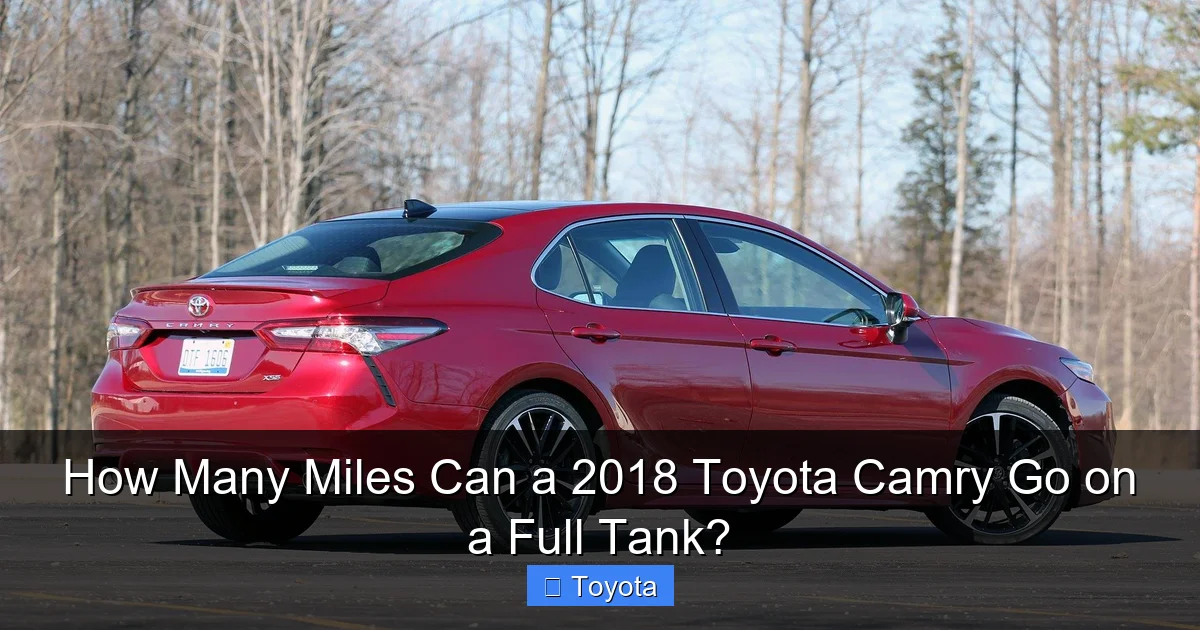
Visual guide about How Many Miles Can a 2018 Toyota Camry Go on a Full Tank?
Image source: cdn.motor1.com
When Does the Light Come On?
The light is triggered by a sensor in the fuel tank. For the 2018 Camry, it typically illuminates when there are approximately 1.0 to 2.0 gallons of fuel remaining. This “reserve” is a buffer designed to give you ample warning to find a gas station, not to test the absolute limits of your tank. The exact trigger point can vary slightly based on sensor calibration and driving angle (fuel sloshing).
How Many Miles Are Left When the Light Comes On?
This is the million-dollar question. Using the low-fuel reserve of ~1.5 gallons and your current MPG, you can estimate the remaining range. For a 4-cylinder Camry averaging 32 mpg: 1.5 gal * 32 mpg = approximately 48 miles. For a V6 averaging 26 mpg: 1.5 * 26 = approximately 39 miles. In reality, you should plan on a 30-50 mile buffer after the light comes on. Driving habits at this point are often more cautious, which might slightly improve the final leg’s MPG. However, it is never advisable to routinely drive until the tank is bone dry. This can cause sediment from the bottom of the tank to be sucked into the fuel system, potentially clogging the fuel filter or injectors, and it risks overheating the in-tank fuel pump, which relies on gasoline for cooling and lubrication. For specific data on how many miles you can drive when the gas light comes on in a Toyota Camry, owner forums and tests consistently show a safe, conservative range of 30-50 miles for this model.
Maximizing Your Range: Practical Tips for Every Driver
Getting the most miles from your Camry isn’t about magic; it’s about consistent, mindful practices. Here’s how you can push your real-world average MPG toward or even beyond the EPA estimates.
Drive Smarter, Not Harder
This is your most powerful tool. Observe the speed limit. Use cruise control on flat highways to maintain a steady speed. Accelerate slowly from a stop as if you have an egg under your foot. Look far ahead at traffic to anticipate stops and coast when possible instead of braking last-minute. These habits alone can save you 15% or more on fuel.
Maintenance is Non-Negotiable
A well-tuned engine is an efficient engine. Stick to your factory-recommended maintenance schedule. This includes:
- Oil Changes: Use the correct oil grade (often 0W-20 for 2018 Camrys). Fresh, clean oil reduces internal friction.
- Tire Pressure: Check monthly. Under-inflated tires increase rolling resistance. Inflate to the PSI listed on your driver’s door jamb sticker, not the tire sidewall.
- Air Filter: A clogged air filter starves the engine of air, making it run richer (using more fuel). Replace it as recommended, or more often in dusty conditions.
- Spark Plugs: Worn plugs cause misfires and poor combustion. Replace them at the specified interval (often 120,000 miles for platinum/iridium plugs in modern Camrys).
Reduce Parasitic Drag
Anything that forces the engine to work harder burns more fuel. Remove unnecessary roof racks or cargo boxes when not in use. Keep your car clean, as a layer of dirt and mud adds slight weight and drag. While it’s minor, every bit helps on long trips.
Plan Your Trips
Combine errands into one trip. A warm engine is more efficient than a cold start. Use navigation apps that offer eco-routes or show real-time traffic to avoid idling and detours. Knowing your route and potential fuel stops along the way eliminates stress and prevents unplanned, inefficient driving.
Long-Distance Travel: Planning for the Open Road
When embarking on a long journey, your Camry’s range becomes a planning parameter. Let’s put the numbers into a practical road trip context.
Calculating Your Safe Stops
Assume a conservative, real-world average MPG for your engine type on a mixed highway/city trip. For a 4-cylinder, use 33 mpg. With a 16-gallon tank, that’s a practical range of about 528 miles. For a V6, use 26 mpg for a practical range of 416 miles. Your strategy should be to refuel when your tank is about 1/4 full, not when the light comes on. This gives you a comfortable buffer for unexpected detours, traffic jams, or gas stations that are closed. For a 4-cylinder, plan your first fuel stop around the 350-400 mile mark. This ensures you never push your luck and always have plenty of fuel to reach your destination or the next available station.
Using Technology to Your Advantage
Your Camry’s trip computer (the “AVG MPG” display) is a valuable tool. Reset it at the start of a highway segment to see your true efficiency on that stretch. Use smartphone apps like GasBuddy to find the cheapest fuel along your route, saving money that can be put toward more miles. Some drivers even use a simple notebook or the notes app to track fill-ups and calculate their own long-term average MPG, which is often more accurate than the car’s estimate.
Conclusion: Confidence Through Knowledge
So, how many miles can a 2018 Toyota Camry go on a full tank? The answer is a range, not a fixed number. For the gasoline 4-cylinder model, a realistic expectation is 450 to 600 miles under normal mixed driving, with the potential to exceed 600 miles on pure, steady highway travel. The V6 model will generally deliver 350 to 500 miles per tank, reflecting its greater thirst for fuel. Your specific number will be written by your driving habits, your environment, and your commitment to maintenance.
The most important takeaway is to know your car’s signals. Respect the gas light as a firm warning to refuel within the next 30-50 miles. Keep your tires inflated and your engine tuned. Drive smoothly. By doing so, you not only maximize the impressive range your Camry is capable of but also protect your investment and ensure it remains a reliable companion for hundreds of thousands of miles. The 2018 Camry’s reputation for longevity is well-earned, and with a little knowledge about its fuel system, you can enjoy every one of those miles with confidence and fewer stops at the pump.
Frequently Asked Questions
What is the absolute maximum range of a 2018 Camry on a full tank?
In ideal, controlled conditions—a bone-stock 4-cylinder model on a long, flat highway with no wind, traveling at a steady 60 mph—you might theoretically approach 650 miles. However, this is not a realistic or safe target for everyday driving. A more practical maximum for most drivers is 550-600 miles on the highway.
Does using the air conditioning significantly reduce my Camry’s range?
Yes, the A/C compressor places a direct load on the engine, reducing MPG. The impact is most noticeable in city driving and during very hot weather. You can expect a 5-10% drop in fuel economy when the A/C is running on high. Using the “Eco” climate setting or recirculating cabin air can help mitigate this loss.
How does the Camry’s range compare to other Toyota sedans like the Corolla or Avalon?
The smaller, lighter Toyota Corolla generally gets slightly higher MPG ratings and thus a similar or slightly longer range despite having a smaller tank. The larger, more luxurious Toyota Avalon has a bigger engine and often a larger tank (18.5 gallons), so its total range can be comparable or even higher, but its MPG is typically lower than the Camry’s 4-cylinder. For specifics on other models, you can research how many miles can a Toyota Avalon last in terms of overall longevity, which is also excellent.
What should I do if I run out of gas in my Camry?
If the engine dies from fuel starvation, safely move the car to the shoulder if possible. Turn on your hazard lights. Call for roadside assistance or a friend with a gas can. Once you add fuel, you may need to cycle the key a few times to prime the fuel pump before the engine will start. Running the tank completely dry can damage the fuel pump, so this should be an extreme last resort.
Is the gas light range different for the 4-cylinder and V6 models?
Yes. While the reserve volume in the tank is likely the same (~1.5 gallons), the remaining distance you can drive depends on your current MPG. A V6 driver getting 25 mpg will have about 37 miles left, while a 4-cylinder driver getting 35 mpg will have about 52 miles left. The V6’s lower efficiency means its gas light gives you slightly fewer miles of warning.
Can I improve my Camry’s highway MPG by disabling certain features?
Disabling non-essential electrical loads can provide a small benefit. Turning off the rear window defroster, high-beam headlights (when not needed), and reducing the fan speed for the HVAC system can slightly reduce engine load. However, the gains are minimal compared to the impact of speed and driving style. The most effective features to use are cruise control for maintaining a constant speed and the “Eco” driving mode (if equipped), which softens throttle response and optimizes transmission shift points for efficiency.
