
How Often Should I Change the Engine Air Filter on My Toyota Rav4?

Changing your Toyota RAV4’s engine air filter is a critical, yet often overlooked, maintenance task. Generally, Toyota recommends replacing it every 15,000 to 30,000 miles, but your driving environment can drastically shorten that lifespan. A clogged filter reduces power, hurts fuel economy, and can cause engine damage. Regularly checking it is easy, and replacing it yourself is a simple, cost-effective DIY project that saves money and keeps your RAV4 running strong.
Key Takeaways
- Standard Replacement Interval: Toyota typically recommends changing the engine air filter in your RAV4 every 15,000 to 30,000 miles under normal driving conditions.
- Your Driving Conditions Matter Most: Frequent driving in dusty, sandy, or high-pollution areas requires more frequent changes, sometimes as often as every 15,000 miles or less.
- It’s a Simple DIY Job: Replacing the engine air filter on a RAV4 is one of the easiest maintenance tasks you can do, usually taking less than 10 minutes with no tools.
- Know the Signs of a Dirty Filter: Reduced acceleration, poor fuel economy, a visibly dirty filter, or strange engine sounds are all signs your filter needs attention.
- Engine Air Filter vs. Cabin Air Filter: The engine air filter cleans air entering your engine. The cabin air filter cleans air entering your car’s interior. They are two separate filters with different service intervals.
- Don’t Neglect It: A severely clogged filter forces your engine to work harder, leading to decreased performance, increased emissions, and potential long-term engine wear.
📑 Table of Contents
- Introduction: Your RAV4’s Lifeline to Clean Air
- What Does the Engine Air Filter Actually Do?
- Toyota’s Official Recommendations for the RAV4
- Real-World Factors That Shorten Your Filter’s Life
- How to Know It’s Time: Visual and Performance Signs
- DIY Guide: Replacing Your RAV4’s Engine Air Filter
- Conclusion: A Simple Habit for a Happy, Healthy RAV4
Introduction: Your RAV4’s Lifeline to Clean Air
Imagine trying to run a marathon while breathing through a dusty, damp cloth. That’s what your Toyota RAV4’s engine experiences when its air filter is clogged. The engine air filter is the first line of defense, ensuring only clean, particle-free air reaches the combustion chambers. Without it, abrasive dust and debris would sandblast your engine’s internal components, leading to premature wear and catastrophic failure. Keeping this simple component clean is one of the most cost-effective ways to protect your investment, maintain performance, and ensure fuel efficiency.
But how often should you actually change it? The answer isn’t just a number from a manual; it’s a conversation between your vehicle’s needs and your real-world driving habits. While Toyota provides a baseline schedule, factors like your daily commute, where you live, and even your driving style play a huge role. This guide will cut through the confusion, giving you the definitive schedule for your RAV4, clear signs it’s time for a change, and the confidence to do it yourself.
What Does the Engine Air Filter Actually Do?
Before we talk about replacement, let’s understand the job. Your RAV4’s engine is a sophisticated air pump. It needs a precise mix of air and fuel to create power. The engine air filter sits in the intake system, trapping dirt, pollen, dust, sand, and other contaminants before they can enter the engine’s sensitive cylinders, valves, and pistons.

Visual guide about How Often Should I Change the Engine Air Filter on My Toyota Rav4?
Image source: images.cars.com
The Consequences of a Dirty Filter
A filter’s job is to get dirty. Over time, the pleated paper or fabric media becomes saturated with particles. This restricts airflow, creating what engineers call “restriction.” A restricted filter has two major negative effects:
- Reduced Power and Acceleration: The engine struggles to get the air it needs. You’ll notice a lack of response when you press the gas pedal, especially during passing maneuvers or when climbing hills. It feels like your RAV4 is suffocating.
- Decreased Fuel Economy: To compensate for the lack of air, your engine’s computer (ECU) will inject more fuel than necessary to maintain the correct air/fuel ratio. This “rich” mixture burns less efficiently, causing you to visit the gas station more often.
In extreme cases, a heavily clogged filter can cause a car to stall or fail emissions tests. More insidiously, if the filter media deteriorates or tears, large particles can bypass it entirely, causing scoring on cylinder walls and valve seats—damage that requires a costly engine rebuild.
Toyota’s Official Recommendations for the RAV4
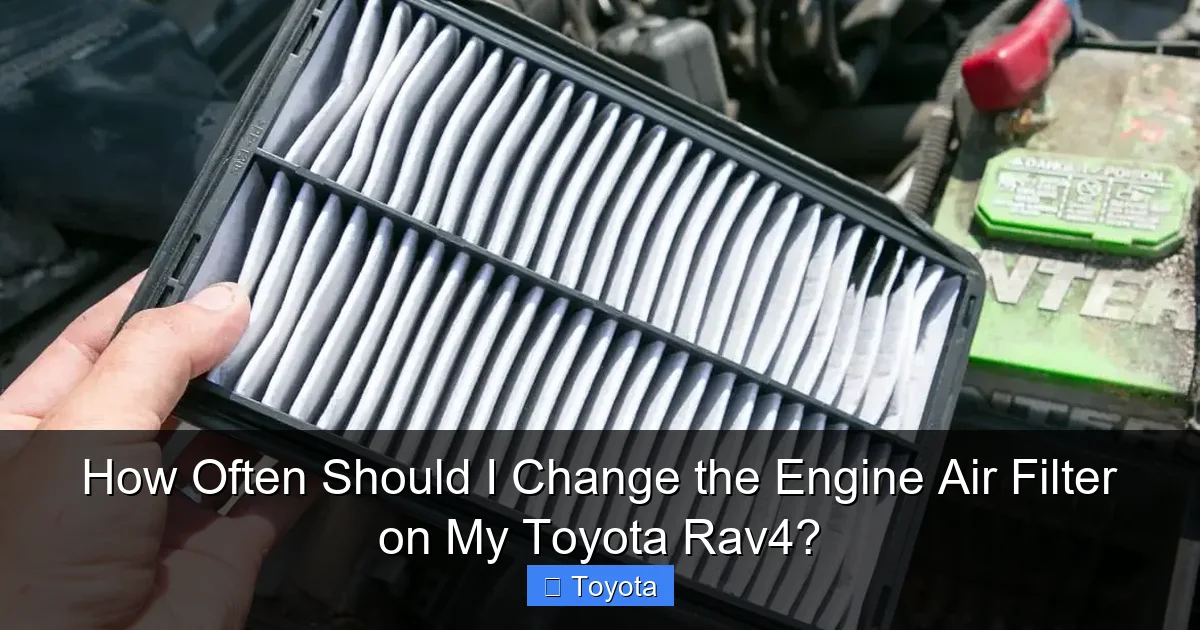
Toyota engineers, having tested countless RAV4s in diverse global conditions, provide a foundational maintenance schedule. You’ll find this in your owner’s manual under the “Scheduled Maintenance” section. For most recent RAV4 model years (2016-current), the factory recommendation is to inspect the engine air filter every 15,000 miles and replace it every 30,000 miles under “normal” driving conditions.
Visual guide about How Often Should I Change the Engine Air Filter on My Toyota Rav4?
Image source: images.cars.com
Understanding “Normal” vs. “Severe” Service
Here’s the critical part: Toyota defines “normal” driving as mostly highway miles in relatively clean environments. For the vast majority of drivers, this is a best-case scenario. However, Toyota explicitly defines a “Severe” operating schedule, which actually applies to more people than they might think. Conditions that fall under “Severe” include:
- Driving in dusty, sandy, or high-pollution areas (urban stop-and-go traffic, construction zones).
- Repeated short trips (less than 5 miles) in cold weather where the engine never fully warms up.
- Extensive idling or low-speed driving for long periods (taxi, delivery, heavy traffic).
- Driving on rough, unpaved roads frequently.
If your RAV4 operates under any of these conditions, Toyota recommends following the “Severe” maintenance schedule, which typically shortens the air filter replacement interval to every 15,000 miles. For a driver who does a mix of highway and city driving in a moderately clean area, a good rule of thumb is to plan for a change around the 20,000-mile mark.
Real-World Factors That Shorten Your Filter’s Life
Let’s get practical. Your specific environment is the single biggest variable. Think about where your RAV4 goes in a typical week.

Visual guide about How Often Should I Change the Engine Air Filter on My Toyota Rav4?
Image source: motorriderz.com
1. The Dusty & Dirty Environment Factor
This is the number one filter-killer. If you live in the Southwest U.S., near a beach, on a dirt road, in an agricultural area, or even in a city with poor air quality, your filter is working overtime. Fine particulate matter (PM2.5) from wildfires, construction, or windblown dust can clog a filter in half the standard time. For these drivers, checking the filter at every oil change (every 5,000-10,000 miles) is a smart habit, and replacing it at 15,000 miles is a wise precaution.
2. The Urban Commuter Factor
Constant stop-and-go traffic in a major metro area means your RAV4 is ingesting a steady stream of exhaust particles, brake dust, and general urban grime. The low-speed, high-idling nature of this driving prevents the engine from reaching optimal operating temperatures where condensation burns off, allowing moisture to mix with dirt and create a pasty clog. If this is your daily life, lean toward the 15,000-mile replacement interval.
3. The Seasonal & Pollen Factor
Spring and early summer can be brutal on filters in regions with high pollen counts. While pollen is generally not as abrasive as sand, a massive influx can quickly load up a filter’s surface area. A good practice is to visually inspect your filter during seasonal changes, especially if you suffer from allergies and notice your cabin air filter also needs frequent changes.
Pro Tip: If you’re already performing other seasonal maintenance, like checking tire pressure, consider adding a quick air filter inspection to your checklist. Knowing how often to check your tire pressure is another key to safe, efficient driving.
How to Know It’s Time: Visual and Performance Signs
You don’t have to wait for a specific mileage. Your RAV4 will give you clues. Here’s what to look and feel for.
The Visual Inspection (The Gold Standard)
This is the most reliable method. Locating the air filter box on your RAV4 is straightforward—it’s usually a large black plastic box near the front of the engine bay on the driver’s side. Opening it is typically as simple as releasing a few clips or loosening a couple of screws (most RAV4s use clips). Once open, pull out the filter.
Hold it up to the sun or a bright light. You should be able to see light easily passing through the pleats. If the filter looks uniformly dark gray or black, and you can barely see any light through it, it’s time for a replacement. If it’s only lightly dusted on the surface, you can often gently tap it out (over a trash can) and reuse it for a short while, but this is a temporary fix at best. Never use compressed air or water to clean a paper filter; you will destroy its delicate media.
The Performance “Gut Feeling”
Even without looking, your driving experience will change:
- Noticeable Loss of Power: Your RAV4 feels sluggish, especially when accelerating onto a highway or climbing a grade.
- Fuel Economy Drop: You’re filling up more frequently despite similar driving habits. A clogged filter can reduce MPG by 5-10%.
- Strange Engine Sounds: You might hear a sucking, whistling, or rasping noise from the engine bay, especially under acceleration. This is air being forced through a tiny restricted opening.
- Check Engine Light (CEL): While less common with just a dirty filter, a severely restricted filter can sometimes trigger a “P0101 – Mass Air Flow Circuit Range/Performance” code. If your light is on, understanding how to diagnose and reset it is the next step, but the filter is a prime suspect.
DIY Guide: Replacing Your RAV4’s Engine Air Filter
Good news: this is perhaps the simplest maintenance item on your RAV4. You can do it in your driveway in under 10 minutes with no tools required on most models. Here’s a general guide (always consult your specific owner’s manual for exact details).
Step-by-Step Replacement
- Purchase the Correct Filter: Find your RAV4’s exact year, trim, and engine type (2.5L 4-cylinder or 2.5L Hybrid). Use this info to buy an OEM (Toyota) or high-quality aftermarket filter (like K&N, Fram, Bosch). You can often find the part number in your manual or on the old filter itself.
- Open the Air Filter Box: Pop the hood. Locate the rectangular black air filter box. Most RAV4s use simple plastic clips around the perimeter. Release them. Some models may have a single bolt or screw.
- Remove the Old Filter: Lift the cover. The filter will sit inside. Note its orientation (which side faces up). Gently lift it out.
- Inspect the Housing: Before installing the new one, look inside the box. Use a clean rag to wipe away any loose leaves, dirt, or debris. Ensure the rubber gasket/seal around the intake tube is intact and clean.
- Install the New Filter: Place the new filter in the box, matching the exact orientation of the old one. It should sit flat and create a good seal against the housing walls.
- Close the Box: Press the cover down firmly until you hear all the clips snap securely into place. Ensure it’s sealed to prevent unfiltered air from sneaking in.
Note: If your RAV4 has a reusable K&N-style filter, the cleaning and re-oiling process is more involved. Follow the manufacturer’s instructions precisely.
When to Consider a Professional
While DIY is easy, there are reasons to have a shop do it:
- You’re already there for an oil change and want to bundle services.
- Your air filter box is unusually dirty, and you want a thorough cleaning of the housing.
- You’re uncomfortable performing any maintenance yourself.
- The filter is stuck or the housing clips are broken (a professional can source and replace parts).
A professional service will typically charge $20-$50 for the filter and 0.5 hours of labor. The DIY cost is just the price of the filter ($15-$40). Keeping up with your oil change schedule is another simple DIY that pairs perfectly with filter checks.
Conclusion: A Simple Habit for a Happy, Healthy RAV4
Your Toyota RAV4 is designed to be reliable and efficient. That reliability starts with a steady supply of clean air. Don’t let a $20 filter undermine your engine’s health, your fuel budget, or your driving enjoyment. The answer to “how often” is a blend of the manufacturer’s 15k-30k mile guideline and your personal reality. If you drive in challenging conditions, aim for the 15,000-mile mark. If you’re mostly on clean highways, 30,000 miles is a safe maximum.
The ultimate takeaway is this: check it at every oil change. Make it a habit. Pop the clips, glance at the filter. It takes 30 seconds. If it’s dark, replace it. If it’s still light tan, you’re good. This simple, proactive habit is the hallmark of a savvy car owner. It’s the cheapest insurance policy you can buy for your engine. So open that hood, take a look, and breathe easy knowing your RAV4 can breathe easy, too.
Frequently Asked Questions
Can I clean my Toyota RAV4’s engine air filter instead of replacing it?
No. Standard paper-pleated engine air filters are not designed to be cleaned. Tapping out loose debris is okay, but washing, blowing with air, or applying oil will destroy the filter’s ability to trap fine particles and can cause it to fail. Always replace it with a new filter.
Is the engine air filter the same as the cabin air filter?
No, they are completely different. The engine air filter sits under the hood and protects your engine. The cabin air filter is inside the vehicle (usually behind the glovebox) and filters air entering the passenger compartment. They have different replacement intervals. Check our guide for replacing the cabin air filter on your RAV4.
What happens if I never change my RAV4’s air filter?
Over time, it will become completely clogged. This will cause significant power loss, poor fuel economy, rough idling, and may trigger a check engine light. Prolonged operation with a severely restricted filter can lead to premature engine wear and, in extreme cases, engine failure due to lack of air or unfiltered contaminants entering the combustion chamber.
Where is the engine air filter located on a Toyota RAV4?
It’s located in a large black plastic box (the air filter housing) in the engine bay, typically on the driver’s side near the firewall. It’s connected to the large intake tube that runs from the throttle body. The box is held closed with several plastic clips or a few screws.
Will changing my air filter improve my RAV4’s gas mileage?
If your old filter was significantly clogged, yes. A new filter restores optimal airflow, allowing the engine’s computer to meter fuel correctly. You can expect a potential improvement of 5-10% in fuel economy if your old filter was severely restricted. The effect is less noticeable if the old filter was only mildly dirty.
Should I use an OEM Toyota filter or an aftermarket one?
Both are fine if they meet the vehicle’s specifications. OEM (Toyota) filters are guaranteed to fit and perform as designed. High-quality aftermarket brands like K&N (for reusable options), Fram, Wix, and Bosch are also excellent and often more affordable. Avoid the cheapest, no-name filters, as their media can be inconsistent and less effective.
