
What Maintenance Is Recommended for a 2020 Toyota Corolla

Maintaining your 2020 Toyota Corolla is straightforward and key to its legendary reliability. Following Toyota’s recommended service schedule—including regular oil changes, tire rotations, and fluid checks—will ensure your Corolla delivers years of efficient, trouble-free driving. Adopting a proactive approach with simple DIY inspections can save you money and prevent costly repairs down the road.
Key Takeaways
- Stick to the schedule: The most critical maintenance is adhering to Toyota’s official service intervals found in your owner’s manual, especially for oil changes and tire rotations.
- Oil is lifeblood: Using the correct 0W-16 synthetic oil and changing it every 7,500-10,000 miles (or 12 months) is non-negotiable for engine health.
- Tires are your connection to the road: Maintain proper pressure (typically 32-35 PSI), rotate them every 5,000-7,500 miles, and replace when tread depth reaches 2/32″.
- Fluids and filters are cheap insurance: Regularly check engine coolant, brake fluid, and windshield washer fluid. Replace cabin and engine air filters as recommended.
- The battery needs attention too: Check terminals for corrosion and test voltage annually, especially before extreme summer or winter temperatures.
- Listen and observe: Unusual noises, vibrations, or dashboard warning lights are your car’s way of asking for help—address them immediately.
- Use genuine Toyota parts and fluids: For optimal compatibility and longevity, especially for complex systems like continuously variable transmission (CVT) fluid.
📑 Table of Contents
- Introduction: Why Maintenance is Your Corolla’s Best Friend
- The Heart of the Matter: Engine Oil & Filter Changes
- Tire Care: Pressure, Rotation, and Alignment
- Brake System: Pads, Rotors, and Fluid
- Fluids, Filters, and Belts: The Supporting Cast
- Battery, Lights, and Wipers: The Basics
- Scheduled Service: Following Toyota’s Guide
- Conclusion: Your Reward is Reliability
Introduction: Why Maintenance is Your Corolla’s Best Friend
You chose a 2020 Toyota Corolla because you value reliability, fuel efficiency, and smart value. This compact sedan has a well-earned reputation for being one of the most dependable cars on the road. But that reputation isn’t magic; it’s earned through consistent, proper maintenance. Think of your maintenance schedule as a health plan for your car. Skipping it is like skipping your annual check-up—problems can fester unnoticed until they become major, expensive issues.
The good news is that maintaining a modern Corolla is simpler than ever. Toyota engineered this generation for easy ownership. Many routine checks are things you can do yourself in minutes with basic tools. For the rest, a trusted mechanic, especially a Toyota dealer, will follow a precise, model-specific protocol. This guide will walk you through every recommended service, explain why it matters, and give you the confidence to manage your Corolla’s care throughout its life. We’ll cover everything from the engine bay to the undercarriage, ensuring you know exactly what your car needs and when.
The Heart of the Matter: Engine Oil & Filter Changes
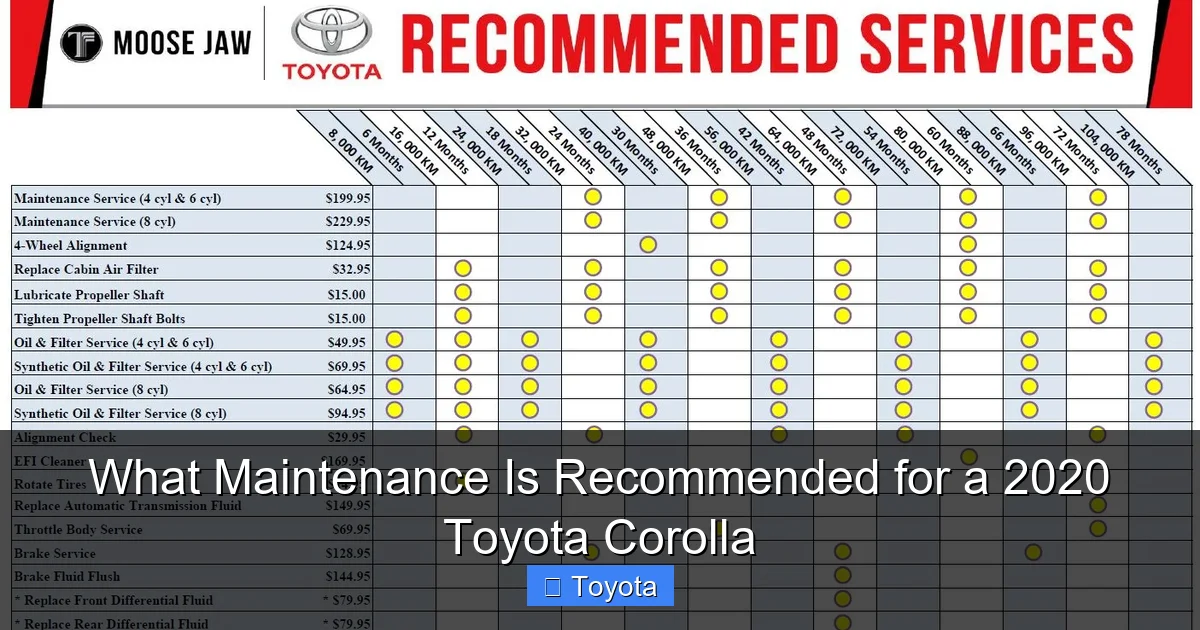
This is the single most important maintenance item for any gasoline engine, and your 2020 Corolla’s 1.8L 4-cylinder is no exception. Clean oil lubricates hundreds of moving parts, reduces friction, cools the engine, and prevents harmful sludge buildup. Neglecting oil changes is the fastest route to engine wear and catastrophic failure.
Visual guide about What Maintenance Is Recommended for a 2020 Toyota Corolla
Image source: d2a8ommgzxxngz.cloudfront.net
What’s Recommended?
For the 2020 Corolla, Toyota specifies 0W-16 full synthetic oil. This ultra-low viscosity oil is designed to flow instantly at cold starts for maximum protection and improve fuel economy. Using the wrong weight (like 5W-30) can void your warranty and harm the engine.
The official oil change interval under normal driving conditions is every 10,000 miles or 12 months, whichever comes first. However, if your driving is classified as “severe” (lots of short trips under 5 miles, extreme temperatures, dusty conditions, heavy traffic, or towing), Toyota recommends changing it every 5,000 miles or 6 months. Most drivers fall somewhere in between; when in doubt, err on the side of caution and change it at 7,500 miles.
Always replace the oil filter with a high-quality unit. A clogged filter restricts oil flow, rendering even new oil ineffective. A professional oil change typically includes checking other fluid levels and a basic safety inspection.
DIY Tip & Pro Insight
You can check your oil level yourself. With the car on level ground, wait a few minutes after turning off the engine, pull the dipstick, wipe it clean, reinsert it fully, and pull it out again. The oil should be between the “F” and “L” marks. If it’s low, add the correct oil. If it looks dark black or gritty, it’s time for a change, regardless of mileage. When you get an oil change, ask to see the old filter—it should be a standard size and look like a metal can. Also, consider using the Eco Heat & Cool system more efficiently; a well-maintained engine operates more efficiently, which supports the climate system’s eco-mode performance.
Tire Care: Pressure, Rotation, and Alignment
Your tires are the only part of your Corolla touching the road. They affect everything: fuel economy, braking, handling, and ride comfort. Proper tire maintenance is a huge factor in both safety and long-term cost savings.
Visual guide about What Maintenance Is Recommended for a 2020 Toyota Corolla
Image source: d1l9oib0dboqqi.cloudfront.net
Maintaining Correct Pressure
The recommended tire pressure for a 2020 Corolla is typically 32 PSI for all four tires when cold (driven less than 2 miles). This is found on a sticker on the driver’s door jamb, not on the tire sidewall. Under-inflated tires increase rolling resistance (killing fuel economy), wear unevenly on the edges, and can overheat. Over-inflated tires wear prematurely in the center and provide a harsh, unsafe ride.
Check pressures monthly and before long trips. Use a reliable digital tire gauge. Don’t forget the spare! Temperature changes affect pressure; a 10°F drop can lower PSI by about 1. For accurate readings, always check when tires are “cold.” If you need to check them after driving, add 3-4 PSI to the reading to compensate for heat expansion.
Rotation and Alignment
Tire rotation is crucial because front and rear tires wear differently due to steering and braking forces. Toyota recommends rotating your Corolla’s tires every 5,000 to 7,500 miles. A typical pattern is front-to-rear on the same side. This promotes even wear and maximizes tread life.
Wheel alignment is not a scheduled service item but should be checked annually or if you notice symptoms like the car pulling to one side, a steering wheel that’s off-center when driving straight, or uneven, rapid tire wear. Hitting a pothole or curb can knock alignment out of spec. A proper alignment ensures straight tracking, even tire wear, and safe handling. If you’re replacing tires, always get an alignment to protect your new investment.
Brake System: Pads, Rotors, and Fluid
Your brakes are your primary safety system. They need to work perfectly every time. The 2020 Corolla uses disc brakes on all corners. The wear items are the brake pads (which squeeze the rotor) and the rotors themselves (the disc that gets squeezed).

Visual guide about What Maintenance Is Recommended for a 2020 Toyota Corolla
Image source: scout.customerscout.net
Inspections and Replacement
There is no set mileage for brake pad replacement—it depends entirely on your driving style. City driving with lots of stop-and-go wears pads much faster than highway driving. Have your brakes inspected at every oil change. A technician will measure pad thickness. Most shops will replace pads when they have 3mm or less of friction material remaining (new pads are typically 10-12mm).
Rotors can last two or three pad sets but may need to be resurfaced (turned) or replaced if they become warped (causing a pulsating brake pedal) or worn below minimum thickness. Listen for squealing (a wear indicator) or grinding (a sign pads are completely gone and metal is scoring the rotor). Both mean immediate service.
Brake Fluid: The Often-Forgotten Item
Brake fluid is hydraulic fluid that transfers your foot’s pressure on the pedal to the brake calipers. It’s hygroscopic, meaning it absorbs moisture from the air over time. This water lowers the fluid’s boiling point, which can lead to brake fade or failure under hard use. Toyota recommends replacing brake fluid every 3 years, regardless of mileage. This is a critical, often overlooked service that directly impacts braking performance and safety.
Fluids, Filters, and Belts: The Supporting Cast
Beyond oil and brake fluid, your Corolla relies on several other liquids and components that need periodic attention.
Essential Fluid Checks
- Engine Coolant (Antifreeze): This regulates engine temperature and prevents corrosion. Check the level in the translucent reservoir (never open when hot). The recommended service interval for a complete drain-and-fill is typically every 100,000 miles or 10 years for the original factory fill, but many technicians recommend checking it more often and replacing it every 50,000 miles for optimal protection.
- Windshield Washer Fluid: Check monthly and top up with a fluid that has winter de-icer if you live in cold climates. This is a simple, free DIY check.
- Power Steering Fluid: Your Corolla uses electric power steering (EPS), so there is no fluid to check or service. This is a common point of confusion for owners of older models.
- Transmission Fluid: This is critical. The CVT in your Corolla uses a special Toyota CVT fluid (WS). For 2020 models, Toyota states the fluid is “lifetime” for the original owner under normal use. However, many independent mechanics and long-term owners recommend a fluid drain-and-fill every 60,000-80,000 miles as preventative maintenance to ensure smooth shifts and long CVT life. Never have a “power flush” done; a simple drain and refill is the correct procedure.
Air Filters: Breathing Easy
Your engine and cabin have air filters that need replacing.
- Engine Air Filter: Prevents dirt and debris from entering the engine. Inspect at every oil change; replace when dirty or every 15,000-30,000 miles. A clogged filter reduces power and fuel economy. It’s usually a simple DIY job located in a black box in the engine bay.
- Cabin Air Filter: Filters air entering the HVAC system from outside. A dirty filter reduces airflow from vents and lets pollutants into the cabin. Replace it every 15,000-30,000 miles or yearly. It’s often located behind the glovebox. Replacing it is a great way to keep your interior air fresh. For more on interior comfort features, you might explore how systems like Eco Heat & Cool work most effectively with a clean cabin environment.
Belts and Hoses
The 2020 Corolla uses a timing chain (not a belt) for the engine’s internal timing, which is designed to last the life of the engine with proper maintenance. However, it has an accessory drive belt (serpentine belt) that runs the alternator, power steering pump (if equipped), and AC compressor. Have this belt inspected at every major service for cracks or glazing. It typically lasts 60,000-100,000 miles. All rubber hoses (coolant, vacuum) should also be inspected for leaks, cracks, or swelling.
Battery, Lights, and Wipers: The Basics
These components are easy to overlook but are vital for daily operation and safety.
Battery Health
The average car battery lasts 3-5 years. The 2020 Corolla’s battery is typically located under the hood. Check the terminals every 6 months for white/green corrosion. Clean them with a baking soda/water solution and a wire brush if needed, and apply a thin layer of dielectric grease to prevent recurrence. Have the battery’s cold cranking amps (CCA) tested annually at a parts store or during an oil change—it’s usually free. A weak battery in winter is a common cause of no-start situations. If your car sits for long periods, consider a trickle charger.
Exterior and Interior Lights
Once a month, walk around your car and check all lights: headlights (low and high beam), taillights, brake lights, turn signals, and reverse lights. Have a helper press the brake pedal while you check the rear, or back up against a wall at night to see reflections. Burned-out bulbs are a safety issue and a ticketable offense. Replacing most bulbs is a simple DIY task, though some (like headlights) may require removing panels. LED bulbs in some trims can last the car’s life.
Wiper Blades
Wiper blades are a wear item affected by sun and ozone. They should be replaced every 6-12 months or when they streak, skip, or smear. The 2020 Corolla uses specific blade sizes (check manual or an auto parts store). Keeping your windshield clean and using washer fluid regularly extends blade life. For the best performance in rain, consider beam-style blades that hug the glass better.
Scheduled Service: Following Toyota’s Guide
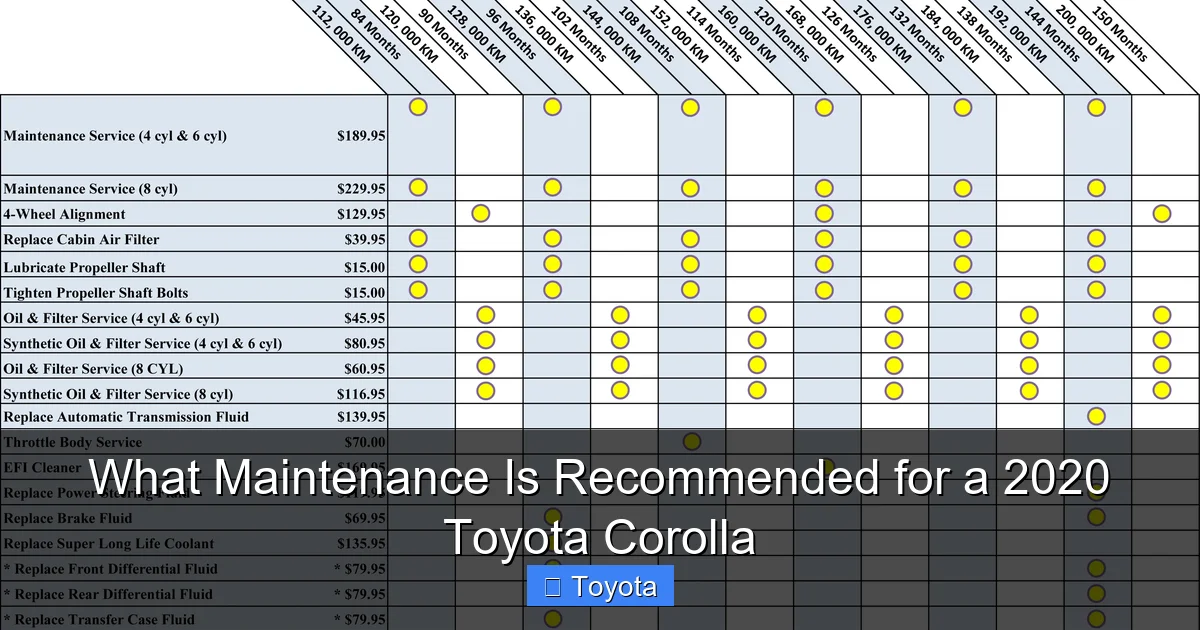
The most authoritative source for your Corolla’s maintenance is the Owner’s Manual and the Warranty & Maintenance Guide (often separate). These documents provide a detailed, mileage-based schedule. Here is a synthesized overview of major milestones.
Every 5,000-7,500 Miles / 6 Months
- Tire rotation
- Oil and filter change (if under severe service or using conventional oil)
- Inspect brakes, tires, and fluid levels
- Check battery and cables
Every 15,000 Miles / 18 Months
- Replace engine air filter
- Replace cabin air filter
- Inspect all lights
- Inspect wiper blades
Every 30,000 Miles / 36 Months
- All items above
- Inspect and lubricate drive shafts (if applicable)
- Inspect exhaust system
- Check steering linkage and suspension components
Every 60,000 Miles / 72 Months
- All items above
- Consider CVT fluid drain-and-fill (see previous section)
- Inspect and potentially replace spark plugs (though many modern iridium plugs last 100k+ miles)
- Replace brake fluid (every 3 years is a good rule)
- Thorough inspection of belts and hoses
The 100,000-Mile Milestone
Reaching 100,000 miles is a significant achievement. At this point, a major comprehensive inspection is wise. This should include a very detailed look at the suspension, steering, drivetrain, and any components not on a regular replacement schedule. If the original spark plugs haven’t been changed, do it now. Consider a coolant system flush if it hasn’t been done. This service essentially “resets” your maintenance clock for the next 100k miles.
Conclusion: Your Reward is Reliability
Owning a 2020 Toyota Corolla is a partnership. You provide consistent, thoughtful maintenance, and it provides years of dependable, low-cost transportation. The routine outlined here isn’t burdensome; it’s a smart investment. The cost of regular oil changes, tire rotations, and fluid checks is a fraction of the cost of a rebuilt engine, a new CVT, or a tow truck bill.
Embrace the simplicity. Keep a small log (paper or digital) of your services. Build a relationship with a trusted mechanic. Use genuine Toyota parts and fluids when possible. By understanding what your car needs and why, you move from being just a driver to an informed owner. That knowledge is power—power that keeps your Corolla’s resale value high and its engine purring smoothly for 200,000 miles and beyond. Start with your owner’s manual today and make a plan. Your future self, and your wallet, will thank you.
Frequently Asked Questions
What is the recommended oil type and change interval for a 2020 Toyota Corolla?
Use only 0W-16 full synthetic oil. Under normal driving, change it every 10,000 miles or 12 months. For severe driving (frequent short trips, extreme temps, etc.), change it every 5,000 miles or 6 months. Always use a Toyota-approved oil filter.
What is the correct tire pressure for a 2020 Toyota Corolla?
The recommended pressure is 32 PSI for all four tires when cold. This is listed on a sticker on the driver’s door jamb. Check pressures at least once a month for optimal fuel economy, tire wear, and safety.
How often should I rotate my tires and replace my wiper blades?
Rotate your tires every 5,000 to 7,500 miles to ensure even wear. Replace windshield wiper blades every 6-12 months, or sooner if they streak or skip. The exact blade size for your Corolla can be found in your owner’s manual or at any auto parts store.
Does my 2020 Corolla need a transmission fluid change?
Toyota states the CVT fluid is “lifetime” for original owners under normal use. However, many mechanics and long-term owners strongly recommend a drain-and-fill every 60,000-80,000 miles as preventative maintenance to ensure smooth operation and extend the transmission’s life. Never perform a power flush.
How do I reset the maintenance required light on my 2020 Corolla?
After an oil change, the light needs resetting. Turn the ignition to “ON” (do not start). Use the trip/odometer button to display the odometer. Turn the ignition “OFF.” While holding the button, turn the ignition back to “ON.” Continue holding until the light blinks and goes out, then release. The process may take 5-10 seconds.
What other fluids should I regularly check besides oil?
Check your engine coolant level (in the translucent reservoir) and windshield washer fluid monthly. Have your brake fluid tested for moisture content and replaced every 3 years. The power steering system is electric and requires no fluid.
