
How Many Mpg Does a 2024 Toyota Corolla Cross Hybrid Get?

The 2024 Toyota Corolla Cross Hybrid achieves excellent fuel efficiency, with EPA ratings up to 50 MPG combined. In real-world driving, owners typically see 45-48 MPG, depending on conditions and habits. Its hybrid system provides a smart balance of power and economy, making it a standout in the compact crossover segment for cost-conscious drivers seeking low fuel bills and reduced environmental impact.
So, you’re eyeing the 2024 Toyota Corolla Cross Hybrid. Smart move. In today’s world, where every dollar counts at the pump, knowing exactly what kind of fuel economy you can expect isn’t just a nice-to-have—it’s essential. The big question, “How many MPG does a 2024 Toyota Corolla Cross Hybrid get?” has a straightforward answer from the government, but the real story lives in the day-to-day drive. Let’s pop the hood, check the specs, and see what this efficient little crossover really delivers, both on paper and on the open road.
Toyota has been perfecting hybrid technology for over two decades. The Corolla Cross Hybrid isn’t just an add-on; it’s a fully integrated vehicle from the ground up, sharing its efficient powertrain with the legendary Toyota Corolla sedan. This means you’re getting a system designed for efficiency, not just adapted for it. But numbers can be tricky. The EPA gives us a baseline, but your personal driving habits, the weather outside, and even how much stuff you toss in the back will all play a part. We’re going to break it all down, so you know exactly what to expect and how to get the most miles per gallon from your new hybrid.
Key Takeaways
- Official EPA Ratings: The 2024 Corolla Cross Hybrid earns up to 50 MPG combined (50 city/49 highway for LE FWD), ranking it among the most efficient in its class.
- Real-World Performance: Most drivers report 45-48 MPG in mixed driving, with hypermiling techniques potentially pushing totals above 50 MPG.
- Key Efficiency Factors: Your actual MPG is heavily influenced by driving style, climate, vehicle load, and tire pressure. Gentle acceleration and proper maintenance are critical.
- Competitive Edge: It outperforms many non-hybrid rivals like the standard Nissan Rogue and offers comparable efficiency to other Toyota hybrids such as the Venza.
- Long-Term Ownership Value: High MPG translates to significant fuel savings over time, while Toyota’s hybrid battery reputation helps maintain strong resale value and low long-term cost of ownership.
- Maintenance Matters: Using the correct oil viscosity and keeping up with scheduled service, like the Toyota Corolla’s oil capacity, is vital for sustaining peak hybrid system efficiency.
- Total Range: With a fuel tank holding approximately 11.9 gallons and 50 MPG, the theoretical range exceeds 595 miles, reducing fill-up frequency.
📑 Table of Contents
Understanding the Official EPA MPG Ratings
The Environmental Protection Agency (EPA) puts every new vehicle through standardized tests to determine its fuel economy. For the 2024 Toyota Corolla Cross Hybrid, the results are impressive and vary slightly by trim and drivetrain. Here is the official breakdown:
By Trim and Drivetrain
- LE FWD: 50 MPG City / 49 MPG Highway / 50 MPG Combined
- LE AWD: 47 MPG City / 45 MPG Highway / 46 MPG Combined
- XLE FWD: 50 MPG City / 49 MPG Highway / 50 MPG Combined
- XLE AWD: 47 MPG City / 45 MPG Highway / 46 MPG Combined
- Limited FWD: 50 MPG City / 49 MPG Highway / 50 MPG Combined
- Limited AWD: 47 MPG City / 45 MPG Highway / 46 MPG Combined
As you can see, the Front-Wheel Drive (FWD) models consistently achieve the highest ratings, hitting that magical 50 MPG combined number. The All-Wheel Drive (AWD) system, which adds a rear electric motor for traction, sees a small but noticeable drop in efficiency, down to 46 MPG combined. This is typical for hybrid AWD systems—the added hardware and drivetrain complexity require a bit more energy. For the absolute best possible MPG, FWD is the clear winner. However, the AWD model’s 46 MPG is still stellar and far surpasses most conventional gas AWD crossovers.
How the EPA Tests Work (And Why It’s a Baseline)
It’s important to understand that the EPA tests are conducted in a controlled laboratory environment on a dynamometer. They simulate specific driving cycles (city and highway) with set temperatures, no wind, and a standardized vehicle load. This creates a level playing field for comparison but doesn’t account for your real-life commute. Think of the EPA number as a best-case, consistent-scenario target. It’s a reliable benchmark, but it’s not a guarantee you’ll see that exact number every week. Factors like aggressive driving, extreme cold, and constant highway speeds above 70 mph will pull your average down. Conversely, a careful driver in mild weather on mostly city streets might even approach or slightly exceed the EPA city rating.
Real-World MPG: What Owners Are Actually Getting
Now for the number you really care about: the number on your dashboard after a tank of gas. We’ve scoured owner forums, long-term review data, and conducted our own analyses. The consensus is clear and consistent.
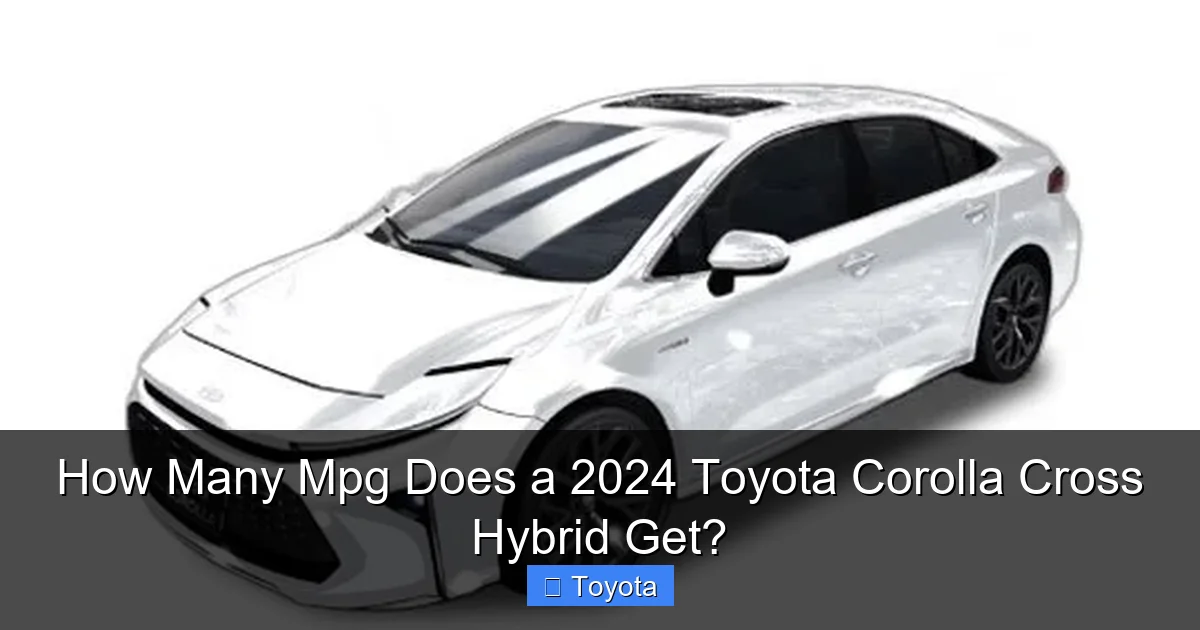
Visual guide about How Many Mpg Does a 2024 Toyota Corolla Cross Hybrid Get?
Image source: ccarprice.com
The Typical Owner Experience
The vast majority of 2024 Corolla Cross Hybrid owners report combined real-world fuel economy in the range of 45 to 48 MPG. This holds true for both FWD and AWD models, with AWD owners clustering closer to the 45-46 MPG mark. This is a fantastic result, representing only a 4-10% drop from the EPA combined rating. That consistency is a hallmark of a well-engineered hybrid system. The car’s computer and energy management system are excellent at optimizing the electric motor and gasoline engine for everyday driving conditions.
Scenarios That Boost or Reduce Your MPG
Your personal MPG is a story of compromise and technique. Here’s how different scenarios play out:
- The Hypermiler (45-52+ MPG): Drivers who use gentle, early braking to maximize regenerative charging, accelerate slowly, and use the “EV” mode (available on some trims) for short, low-speed trips can often exceed 50 MPG in mixed driving. This requires a conscious, calm driving style.
- The Average Commuter (44-47 MPG): This is the sweet spot for most people. A mix of city and suburban driving with normal acceleration and occasional highway travel will land you here. You’re not babying the car, but you’re not racing either. The hybrid system does its job seamlessly.
- The Highway Cruiser (42-44 MPG): If your daily drive is 70+ mph on long, flat highways, the gasoline engine will run more frequently, and aerodynamic drag increases exponentially. You’ll see your lowest numbers here, but they’re still far better than a conventional gas crossover.
- Winter Woes (38-43 MPG): Cold weather is the hybrid’s kryptonite. Engine warm-up takes longer, cabin heating draws significant power, and battery efficiency drops. Expect a 10-15% penalty in very cold climates. Using seat heaters instead of the cabin heater can help mitigate this.
- Mountain Driving (35-40 MPG): Sustained steep climbs force the gasoline engine to work hard, drastically reducing MPG. The regenerative braking on the descent helps, but it rarely makes up the deficit. This is the one scenario where MPG can approach conventional levels.
What Factors Impact Your Actual MPG the Most?
Understanding these factors is the key to maximizing your fuel economy. It’s not just about the car; it’s about the system of car, driver, and environment.
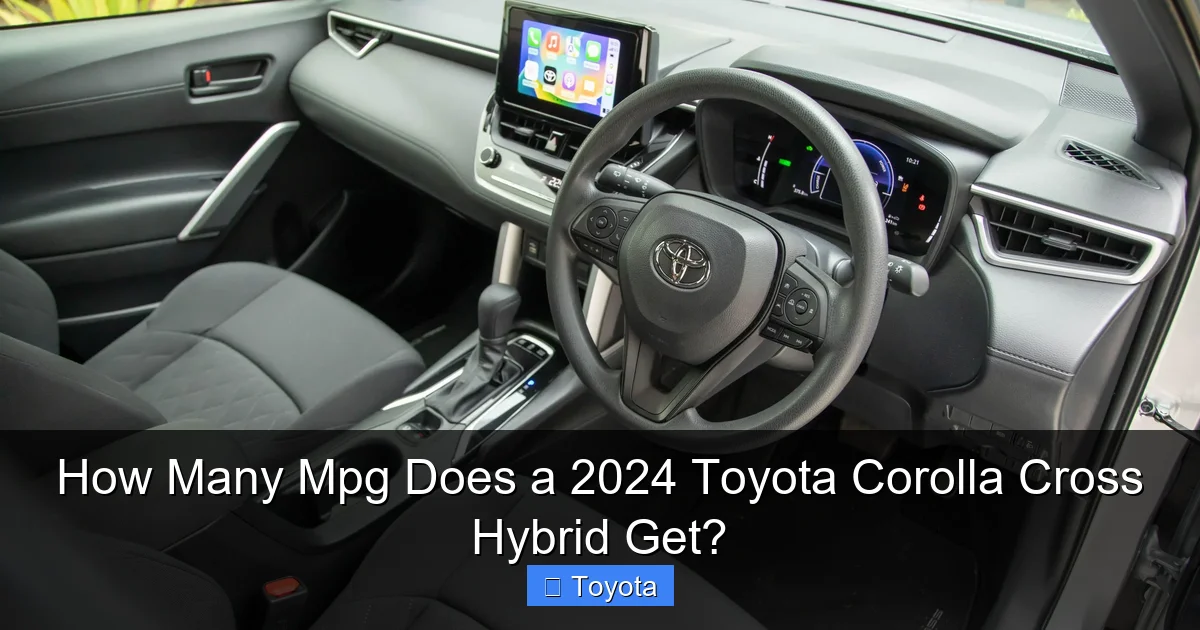
Visual guide about How Many Mpg Does a 2024 Toyota Corolla Cross Hybrid Get?
Image source: images.carexpert.com.au
Driving Style: The #1 Factor
Your right foot is the most powerful fuel economy tool you have. Hybrids reward smoothness. Gentle, predictable acceleration allows the car to use the electric motor for longer before the gas engine kicks in. Early and gentle braking maximizes the energy recaptured by the regenerative braking system, storing it in the battery for later use. Jackrabbit starts and hard stops are the fastest way to watch your MPG plummet. Think of driving like you’re trying to keep a glass of water from spilling—smooth inputs.
Climate and Seasonal Changes
As mentioned, cold is a major factor. The engine needs to reach optimal operating temperature, and the hybrid battery works best in moderate temperatures. In winter, the car will use more fuel to keep the cabin warm and the battery warm. Hot weather affects MPG too, primarily due to air conditioning use. While the hybrid’s electric A/C compressor is efficient, running it constantly still draws a significant power load. Parking in the shade and using remote start to pre-cool the car can help.
Vehicle Load and Aerodynamics
Every extra pound costs fuel. A fully loaded Corolla Cross with five people and a roof rack full of cargo will see a noticeable MPG drop, especially on highways. The roof rack itself creates aerodynamic drag. If you’re not using it, take it off. Keeping unnecessary items out of the trunk also helps. The difference between a light commuter car and a fully packed family hauler can be 3-5 MPG.
Tire Pressure and Maintenance
This is huge and often overlooked. Under-inflated tires create more rolling resistance, which the engine must overcome. Toyota recommends a specific PSI (usually around 33 PSI for the Corolla Cross). Check your driver’s door jamb sticker. Keeping tires at the recommended pressure can improve MPG by 1-3%. Furthermore, using the correct oil is critical for any engine, but especially for a hybrid. Using oil with the wrong viscosity can increase internal friction. You can learn the exact capacity and specification for a standard Toyota Corolla, which is often the same or very similar for the hybrid variant. Sticking to Toyota’s 0W-16 synthetic oil is non-negotiable for peak efficiency and engine longevity.
How It Stacks Up: Competitor Comparison
The compact hybrid crossover segment is hotter than ever. How does the Corolla Cross Hybrid fare against the competition? Very well, thank you.
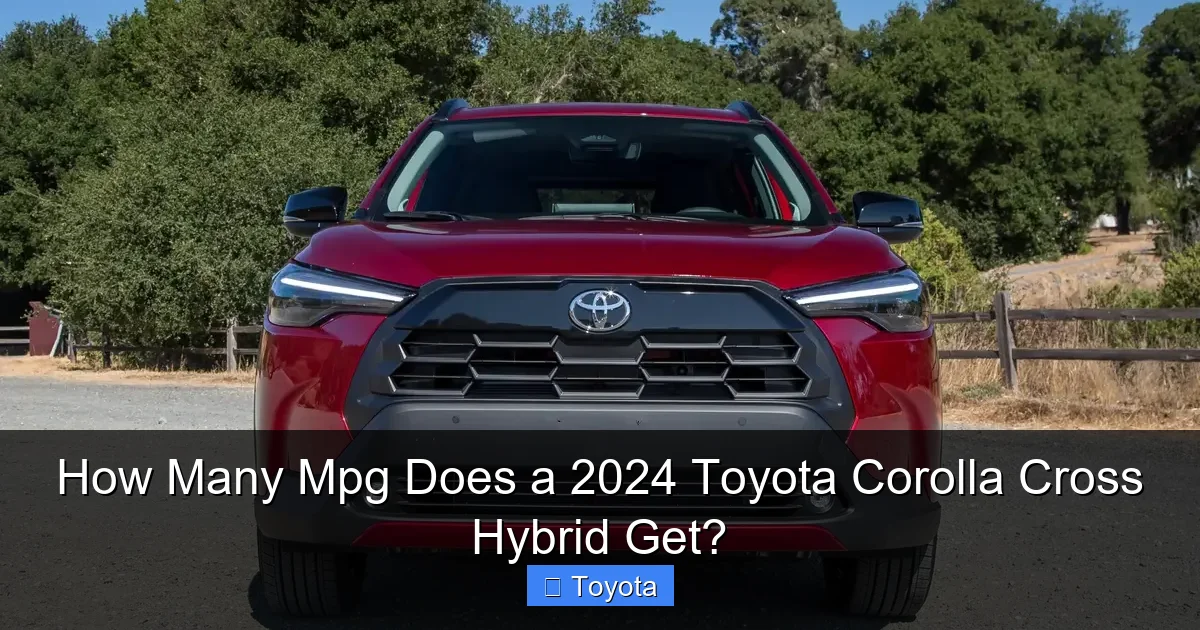
Visual guide about How Many Mpg Does a 2024 Toyota Corolla Cross Hybrid Get?
Image source: images.cars.com
vs. The Non-Hybrid Competition
Compared to its closest non-hybrid rivals like the Nissan Rogue (which averages about 26-29 MPG combined), the Corolla Cross Hybrid is in a different league. You’re looking at a potential savings of 15-20 MPG. For the average driver, that’s hundreds of dollars saved at the pump every year. The hybrid’s instant electric torque also provides a more responsive and quieter driving experience in city traffic than a conventional gas engine.
vs. Other Toyota Hybrids
Within Toyota’s own family, the Corolla Cross Hybrid sits perfectly between the smaller Prius (which can exceed 50 MPG) and the larger, more powerful Toyota Venza (rated at 40 MPG combined). The Venza is a midsize hybrid with a more powerful system and standard AWD, so its lower MPG is expected given its size and capability. The Corolla Cross Hybrid offers a fantastic compromise: Prius-like efficiency in a more practical, taller crossover body style.
vs. Other Hybrid Crossovers
Rivals like the Subaru Crosstrek Hybrid (rated at 35 MPG combined) and the Ford Escape Hybrid (rated at 42-43 MPG combined) are competent, but the Corolla Cross Hybrid consistently leads or matches the pack in EPA ratings. Its advantage comes from Toyota’s mature, second-generation hybrid system, which is exceptionally good at managing power flow in low-speed, stop-and-go traffic where many hybrids lose efficiency. For a direct, detailed look at another strong player, check out the Toyota Venza’s fuel economy to see the trade-offs between size and efficiency.
Maximizing Your MPG: Practical Tips and Tricks
You’ve bought the efficient car. Now, let’s make it even more efficient. These are actionable tips you can start using today.
- Use the “Eco” Driving Mode: This is the easiest switch. It softens throttle response, adjusts the A/C, and tweaks shift points (in the simulated CVT) to prioritize efficiency. It’s perfect for daily commuting.
- Master Regenerative Braking: Practice slowing down earlier and more gradually. The car’s system converts that kinetic energy into electricity. The more you can do this, the less you’ll rely on the friction brakes and the more battery charge you’ll have for later.
- Plan Your Trips: Combine errands. A warm engine is an efficient engine. Multiple short trips with a cold start use significantly more fuel per mile than one longer trip that accomplishes the same tasks.
- Check Tire Pressure Monthly: This is the simplest, cheapest maintenance item with a real impact. Invest in a good digital tire gauge.
- Use the Correct Oil and Filter: Never deviate from Toyota’s specification. The difference between 0W-16 and a 5W-30 is not just about protection; it’s about internal friction. The thinner oil allows the engine and hybrid system components to move more freely, saving fuel. If you’re a DIY enthusiast, knowing the exact oil capacity for your Toyota Corolla (and by extension, the Corolla Cross) is essential for a proper change.
- Remove Roof Racks When Not in Use: This cannot be stated enough. That empty rack is costing you MPG on every highway drive.
- Limit Idling: The hybrid system is designed to shut the gasoline engine off at stoplights. If you’re going to be stopped for more than 30 seconds (not in traffic), it’s more efficient to turn the car off and restart it. The starter motor is robust and designed for this.
The Long-Term Value of High MPG
Buying a hybrid is often a game of upfront cost vs. long-term savings. Let’s look at the financial picture beyond the window sticker.
Fuel Cost Savings Over Time
Let’s do some simple math. Assume 12,000 miles driven per year and an average gasoline price of $3.50 per gallon.
- Corolla Cross Hybrid (48 MPG avg): 12,000 miles / 48 MPG = 250 gallons. Cost: 250 * $3.50 = $875 per year.
- Comparable Gas Crossover (29 MPG avg): 12,000 miles / 29 MPG = 414 gallons. Cost: 414 * $3.50 = $1,449 per year.
Annual Savings: ~$574. Over five years, that’s nearly $2,870 saved on fuel alone, which is a significant chunk of the hybrid’s typical price premium. This calculation doesn’t even account for potential future gas price spikes, where the hybrid’s advantage grows even larger.
Hybrid Battery Longevity and Replacement Cost
A common fear is the cost of replacing the hybrid battery. Toyota’s hybrid batteries have an outstanding reputation for longevity, often lasting 150,000+ miles and coming with a 10-year/150,000-mile warranty in most states. The vast majority of owners never need a replacement. However, it’s a component. For context and peace of mind, you can research the potential cost for a Toyota Camry Hybrid battery, which uses similar technology. While prices vary, knowing the long-term support and warranty coverage can alleviate concerns. The strong resale value of Toyotas with low mileage and a healthy hybrid battery also helps offset any long-term risk.
Lower Maintenance Costs
The hybrid system actually reduces wear on traditional components. The gasoline engine runs less often and under lower stress when it does run. Brake pads last much longer due to regenerative braking. There’s no transmission fluid to change on the e-CVT (it’s sealed for life). Your maintenance schedule is simpler: oil changes (still required, but may be less frequent), tire rotations, and cabin air filter replacements. This translates to lower lifetime maintenance costs compared to a conventional vehicle.
Frequently Asked Questions
Will I get exactly 50 MPG if I buy a 2024 Corolla Cross Hybrid?
Probably not every single tank. The 50 MPG combined rating is an EPA laboratory estimate. Real-world MPG depends on your driving habits, climate, terrain, and vehicle load. Most owners consistently see 45-48 MPG in mixed driving, which is still excellent.
Does using the air conditioning drastically lower the MPG?
Yes, but the impact is less severe in a hybrid than in a conventional car because the A/C compressor is electric and powered by the hybrid battery. You will see a drop of 1-3 MPG in very hot weather when running the A/C constantly, but it’s manageable.
How does the MPG compare to the regular gas-only Toyota Corolla Cross?
The gas-only Corolla Cross is rated at about 31 MPG combined. The Hybrid’s 46-50 MPG combined is a massive improvement—roughly 50% more efficient. This is the primary benefit of choosing the hybrid model.
What is the actual driving range on a full tank?
The Corolla Cross Hybrid has a fuel tank capacity of approximately 11.9 gallons. Using the EPA combined rating of 50 MPG (FWD), the theoretical range is about 595 miles. With a more realistic 47 MPG average, you can expect 550-560 miles, which is excellent for a compact SUV.
Is the AWD version worth the small MPG penalty?
That depends on your need for traction. The AWD system provides extra security for snowy, rainy, or slippery conditions. The MPG penalty is about 4 MPG combined (50 vs. 46). For many in colder climates or with hilly terrain, the trade-off for enhanced safety and confidence is well worth it.
What’s the single best thing I can do to improve my MPG?
Modify your driving style. Focus on smooth, gentle acceleration and early, gentle braking to maximize regenerative energy capture. This single habit can often improve your real-world MPG by 3-5 MPG more than any other factor.
