
How Much Does It Cost to Change Transmission Fluid on a Toyota Corolla?

Changing the transmission fluid in a Toyota Corolla typically costs between $150 and $350 when done professionally at a shop. The exact price depends heavily on your Corolla’s model year, engine type, and whether you use genuine Toyota fluid or a quality alternative. Performing the fluid change yourself can slash the cost to just $50-$100 for parts and fluid, but requires mechanical skill and proper disposal of old fluid. Regular transmission fluid changes are a critical, often overlooked maintenance task that prevents expensive transmission repairs down the road.
Key Takeaways
- Professional Cost Range: Expect to pay $150 to $350 for a professional transmission fluid change on most Toyota Corolla models.
- DIY Savings: You can do it yourself for $50-$100 in parts/fluid, but it’s a messy, skill-intensive job requiring proper tools and disposal.
- Fluid Type is Crucial: Using the correct Toyota specification (WS, T-IV, or older Dexron) is non-negotiable for transmission health and performance.
- Intervals Vary Widely: Modern Corollas with WS fluid may go 60,000-100,000 miles, while older models with Dexron often need service every 30,000-60,000 miles.
- Neglecting This Service is Costly: Old, degraded fluid leads to slipping, harsh shifts, and ultimately, catastrophic transmission failure costing thousands.
- Cost Factors: Your total bill is affected by local labor rates, whether it’s a simple drain-and-fill or a full flush, and the shop’s markup on fluid.
- Not All “Changes” Are Equal: A simple drain-and-fill replaces only about 1/3 of the fluid; a machine flush or multiple drain-and-fills is needed for a true 100% replacement.
📑 Table of Contents
- Introduction: Why This Little Service Matters Big Time
- The Real Cost Breakdown: Professional vs. DIY
- Understanding Transmission Fluid: It’s Not Just “Red Juice”
- Service Interval: How Often Should You Actually Do This?
- How to Know Your Fluid is Screaming for Help: Warning Signs
- Decoding the Quotes: What’s Included and What’s Not
- Conclusion: Investing in Your Corolla’s Heartbeat
Introduction: Why This Little Service Matters Big Time
Let’s talk about one of the most important, yet most misunderstood, pieces of maintenance for your Toyota Corolla. We’re not talking about oil changes or tire rotations. We’re talking about the lifeblood of your car’s ability to move: the transmission fluid. For a car like the Corolla, celebrated for its reliability and low cost of ownership, keeping the transmission happy is absolutely key to enjoying that reputation for the long haul. But here’s the big question everyone has: how much does it cost to change transmission fluid on a Toyota Corolla?
The answer isn’t a single number you can scribble on a sticky note. It’s a range, and where you fall in that range depends on a cocktail of factors—your car’s age, the type of transmission (automatic vs. manual), where you live, and perhaps the biggest decision of all: are you rolling up your sleeves or handing the keys to a pro? In this complete guide, we’re going to pop the hood on this very question. We’ll break down every potential cost, from the $60 DIY job to the $400 premium dealership visit. We’ll explain why the type of fluid is more critical than the price of it, and how to know when your Corolla’s transmission is silently begging for fresh fluid. By the end, you won’t just know the cost; you’ll understand the value.
The Real Cost Breakdown: Professional vs. DIY
When you ask for a quote, you’re essentially choosing between two paths: the professional shop route and the do-it-yourself garage special. Each has its own price tag, its own set of risks, and its own rewards. Let’s dissect them.
Visual guide about How Much Does It Cost to Change Transmission Fluid on a Toyota Corolla?
Image source: paulstravelpictures.com
The Professional Shop Price Tag: What You’re Really Paying For
Driving into a dealership or a trusted independent mechanic and asking for a transmission fluid service will usually get you a quote somewhere between $150 and $350 for a standard Toyota Corolla. But what makes up that number? It’s not just the fluid. You’re paying for:
- Labor: This is the big one. While a fluid change is a straightforward procedure for a trained technician, it still takes time. They’ll lift the car, locate the drain plug or service port, drain the old fluid (which is heavy and messy), and refill it. For a simple drain-and-fill, labor might be 1-1.5 hours. If they perform a “power flush” using a machine, it might take longer. Labor rates vary wildly by region and shop type, from $85/hour at a small independent to $150+/hour at a dealership.
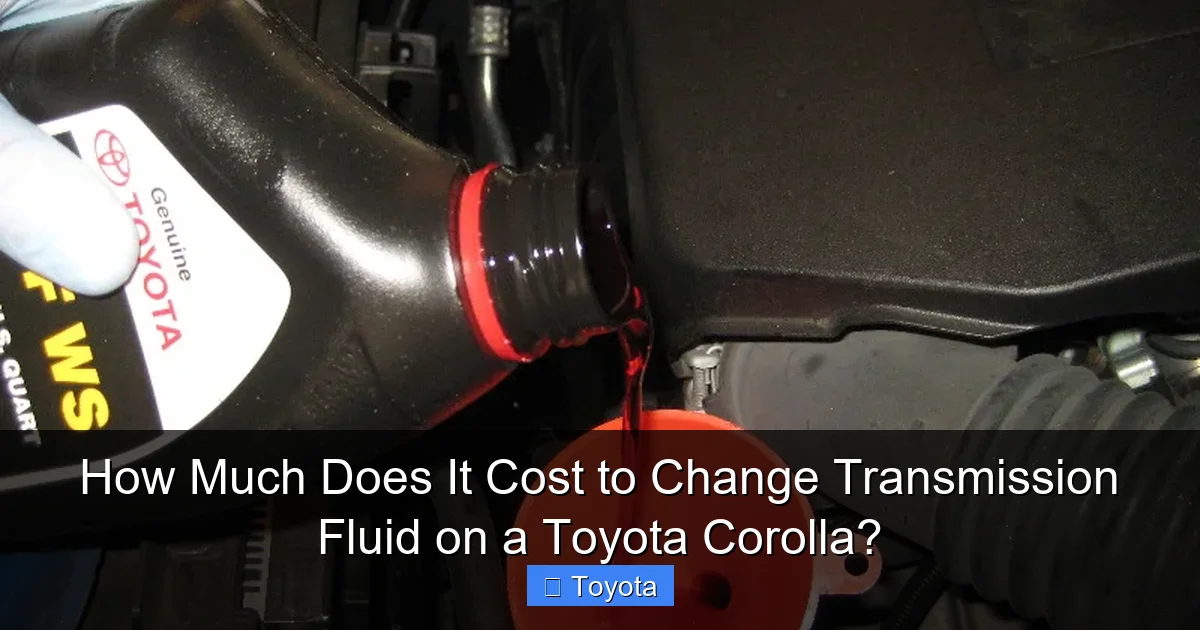
- Fluid: Toyota is very specific about transmission fluid. They have their own branded World Standard (WS) fluid for most modern automatics, and older specifications like Type T-IV or Dexron III for pre-2000s models. A quart of genuine Toyota WS fluid costs about $10-$12. A typical Corolla automatic transmission takes around 4-6 quarts for a drain-and-fill. Some shops will use high-quality aftermarket fluids that meet Toyota’s specs (like Valvoline MaxLife or Pennzoil Platinum) to save you a few dollars per quart. The fluid cost itself is usually $40-$80 of the total bill.
- Shop Supplies & Disposal: This covers the gasket or crush washer for the drain plug, a new filter if your model requires it (many Corollas do not have a serviceable transmission filter), and the crucial cost of properly disposing of the old, toxic transmission fluid. This is usually a flat fee of $10-$20.
So, a $250 bill might look like this: 1.5 hours labor @ $120/hour = $180. 5 quarts of fluid @ $11 = $55. Shop supplies = $15. Total = $250. Always ask for an itemized estimate.
The DIY Route: Calculating Your Potential Savings
For the mechanically inclined and budget-conscious owner, changing your own transmission fluid is a very real possibility. The cost plummets because you eliminate the labor charge. Here’s your shopping list:
- Fluid: You need the exact type. Check your owner’s manual or the dipstick tube. For a 2014-2023 Corolla with the K120 CVT, it’s Toyota WS. For a 2009-2013 with the 4-speed automatic, it’s Toyota WS. For a 2003-2008 with the 4-speed, it’s Type T-IV. For a 1993-2002 with the A340E (some V6 models), it’s Dexron III. Buy enough for a drain-and-fill plus a little extra. Budget $50-$80 for 6 quarts.
- Tools & Supplies: You’ll need a socket and ratchet for the drain plug (usually 22mm or 24mm), a drain pan (at least 6-quart capacity), a funnel with a flexible spout, new drain plug washer (crush washer), and rubber gloves and safety glasses. If you’re ambitious and want to do a “flush” by doing multiple drain-and-fills, you’ll need more fluid. These tools might be things you already own. If not, budget another $20-$40 for basics.
Your total DIY cost: $70-$120. That’s a savings of $100-$230 over a professional service. But the “cost” isn’t just monetary. It’s your time (1-2 hours), your willingness to get dirty, and your confidence in doing it correctly. An improperly done fluid change (overfilled, underfilled, using the wrong fluid, cross-contaminating) can lead to transmission damage that makes the $250 shop bill look like chump change.
Understanding Transmission Fluid: It’s Not Just “Red Juice”
You cannot talk about the cost of a fluid change without talking about the fluid itself. Using the wrong fluid is like giving a vegan a steak—it might seem like food, but the results will be disastrous. Toyota has evolved its transmission fluid specifications over the years, and using the correct one is the single most important factor in the longevity and shift quality of your Corolla’s transmission.

Visual guide about How Much Does It Cost to Change Transmission Fluid on a Toyota Corolla?
Image source: shstreetcar.com
The Evolution of Toyota Transmission Fluid Specs
Your Corolla’s specific fluid depends entirely on its transmission type and model year. Here’s a simple timeline:
- Pre-2000s (Dexron III): Older Corollas with conventional 4-speed automatics (like the A340E) used fluids meeting the General Motors Dexron III specification. Many high-quality aftermarket fluids still meet this spec.
- Early 2000s – Mid 2010s (Type T-IV): This was Toyota’s proprietary fluid for many of its 4- and 5-speed automatics during this era. It’s a high-quality, long-life fluid. Using Dexron III in a T-IV application is generally considered acceptable in a pinch, but for a full service, T-IV is the correct spec.
- 2014-Present (WS – World Standard): This is the current fluid for virtually all modern Toyota automatic transmissions, including the continuously variable transmission (CVT) found in most recent Corollas. WS is a low-viscosity fluid designed for efficiency and smoothness, especially in CVTs. It is NOT interchangeable with older T-IV or Dexron specs. Using the wrong fluid in a WS-spec transmission can cause serious problems.
The Bottom Line: Do not guess. Look in your owner’s manual. Check the dipstick cap (it often lists the fluid type). When in doubt, call a dealership parts department with your VIN. The cost of the correct fluid is part of the service price for a reason—it’s that important.
Service Interval: How Often Should You Actually Do This?
This is where many Corolla owners get confused, because the “official” recommendation has changed dramatically over the years. The old rule of thumb was “every 30,000 miles.” For some older Corollas, that’s still accurate. For the latest models, Toyota often claims the fluid is “lifetime” and never needs changing. Let’s unpack this.
Visual guide about How Much Does It Cost to Change Transmission Fluid on a Toyota Corolla?
Image source: carpursuits.com
Following the Manufacturer’s Guide (The “Lifetime” Myth)
For Corollas equipped with the CVT (2014+ for most models), Toyota’s official maintenance schedule lists the transmission fluid as a “lifetime” fluid. This sounds great—no more scheduled service! But here’s the critical context: “lifetime” in automotive engineering typically means “the designed lifetime of the power train warranty,” which is often 60,000 or 100,000 miles. It does not mean “the lifetime of the car.” Many transmission specialists and long-term owners strongly recommend changing WS fluid in a high-mileage Corolla CVT between 60,000 and 100,000 miles as a preventative measure. The fluid degrades, especially under severe conditions (lots of stop-and-go traffic, towing, extreme heat). Proactive replacement is cheap insurance.
For Older, Non-CVT Corollas
If your Corolla has a traditional automatic (like the 4-speed in 2009-2013 models), the old 30,000-60,000 mile interval is a safe and smart bet. For the very oldest models with Dexron III, sticking to a 30,000-mile interval is prudent, especially if you drive in harsh conditions. Always cross-reference your owner’s manual. If it’s missing or vague, err on the side of caution. A transmission fluid change is one of the most cost-effective forms of preventative maintenance you can perform. It’s far cheaper than a transmission rebuild, which can easily hit $3,000-$5,000.
How to Know Your Fluid is Screaming for Help: Warning Signs
Sometimes, you don’t wait for the mileage sticker. Your Corolla will give you subtle (and not-so-subtle) clues that its transmission fluid is past its prime. Catching these signs early can save you from a catastrophic failure. Here’s what to listen for, feel for, and look for:
The Sensory Checklist
- Color and Smell: This is the easiest DIY check. Pull the transmission dipstick (with the engine warm and running, in Park). Wipe it on a white paper towel. Fresh WS fluid is a clear, reddish color. As it ages and oxidizes, it turns brown, then dark brown, and eventually black. It will also develop a distinct burnt smell. If it’s dark and smells burnt, it’s overdue.
- Shifting Behavior: Are shifts feeling harder than they used to? Is there a hesitation before it engages (a “neutral drop” when shifting from Drive to Reverse)? Does it shift at a higher RPM than normal? These are classic signs of fluid that has lost its lubricity and frictional properties.
- slipping: This is a major red flag. The engine revs up (you hear the RPMs climb), but the car doesn’t accelerate correspondingly. It feels like it’s briefly in neutral. This means the fluid can no longer properly transfer torque. This is a sign of significant internal wear, often accelerated by old fluid.
- Noises: Listen for a new whine, hum, or clunk from the transmission area, especially when shifting or under load. Old fluid doesn’t lubricate bearings and gears as well, leading to increased noise.
If you experience slipping, get it checked immediately. Continuing to drive with slipping can destroy the transmission in a matter of minutes or miles.
Decoding the Quotes: What’s Included and What’s Not
When you call for a quote, you must ask the magic question: “Is that for a drain-and-fill or a full transmission flush?” This is the single biggest source of confusion and cost variance. They are not the same service.
Drain-and-Fill (The Standard Service)
This is what most shops quote and what is listed in the maintenance guide for a “fluid change.” The process: remove the drain plug, let the old fluid pour out into a pan (typically 3-4 quarts), replace the crush washer, tighten the plug, and refill through the dipstick tube with new fluid until it reaches the proper level. The Problem: A standard automatic transmission holds about 8-10 quarts total. A drain-and-fill only replaces about 30-40% of the total fluid volume. The majority of the old, degraded fluid remains in the torque converter, valve body, and cooler lines. It’s better than nothing, but not a complete refresh.
Power Flush / Machine Flush
This uses a specialized machine that connects to the transmission’s cooler lines. It pumps new fluid in under pressure while simultaneously sucking the old fluid out, theoretically replacing nearly 100% of the fluid over the course of an hour or so. This is more thorough and is what is often meant by a “full transmission service.” However, there is debate in the automotive community. Some manufacturers and technicians warn that the high pressure can dislodge sludge and varnish built up in an old transmission, causing clogs. It’s also significantly more expensive, often adding $80-$150 to the labor cost.
The DIY “Multiple Drain-and-Fill” Method
Many savvy DIYers achieve a near-complete fluid replacement without a machine by performing a series of 3-4 drain-and-fills, driving the car normally between each to circulate the fluid. Each drain-and-fill replaces another chunk of the old fluid. This is the most thorough DIY method and costs only the price of extra fluid.
Recommendation: For a Corolla with 60,000+ miles that’s never had a fluid change, consider the multiple drain-and-fill method (DIY) or specifically ask a shop if they offer a “flush” or if they would recommend multiple drain-and-fills. For a regular 60k-mile service, a single drain-and-fill is perfectly adequate and matches Toyota’s official procedure.
Conclusion: Investing in Your Corolla’s Heartbeat
So, how much does it cost to change transmission fluid on a Toyota Corolla? The real answer is this: it costs somewhere between $70 and $400, with the most common professional price landing around $200-$250. But to reduce it to just a number is to miss the point entirely. The cost of the fluid change is an investment—a very small one—against the astronomical cost of a transmission replacement.
Your Toyota Corolla’s transmission is a marvel of engineering, designed for years of smooth, reliable service. But it’s not invincible. It relies on that special fluid to cool, clean, and lubricate its intricate internals. When that fluid breaks down, the entire system suffers. Whether you choose the cost-saving DIY route or the convenience of a professional, the act of performing this service is what matters. It’s a tangible way to protect one of your car’s most vital components.
Don’t let the “lifetime fluid” marketing fool you. Lifetime means warranty period, not eternity. Check your fluid’s color and smell today. Look up your correct fluid specification. Get a quote from your local independent shop—you might be pleasantly surprised. And remember, the most expensive transmission fluid change is the one you never did. For more insights on maintaining your vehicle’s value and performance, you might also be interested in learning about the cost to change oil in a car, another fundamental service that keeps your engine running smoothly.
Frequently Asked Questions
Is it really necessary to change transmission fluid in a modern Toyota Corolla with “lifetime” fluid?
Yes, it is highly recommended. “Lifetime” typically refers to the warranty period (e.g., 60k/100k miles). The fluid still degrades over time due to heat and shear. Changing it between 60,000 and 100,000 miles is a crucial preventative step to ensure your transmission reaches 200,000+ miles. Ignoring this is the leading cause of premature transmission failure in high-mileage Corollas.
Can I use any ATF (Automatic Transmission Fluid) in my Corolla?
Absolutely not. Using the wrong fluid is one of the fastest ways to destroy your transmission. You must use the exact specification called for in your owner’s manual. For most 2014+ Corollas, this is Toyota WS. For 2009-2013 models, it’s often Toyota WS or Type T-IV. For older models, it could be Type T-IV or Dexron III. When in doubt, check the dipstick cap or call a dealership with your VIN.
What’s the difference between a transmission fluid “flush” and a “change”?
A standard “change” or drain-and-fill removes only about 30-40% of the old fluid (what drains from the plug). A “flush” uses a machine to exchange nearly 100% of the fluid by pumping new fluid in while sucking old fluid out via the cooler lines. A flush is more thorough and more expensive. For severely neglected fluid, some shops recommend multiple drain-and-fills or a flush. For regular 60k-mile service, a single drain-and-fill is sufficient and is Toyota’s official procedure.
How long does a professional transmission fluid change take?
A standard drain-and-fill typically takes between 1 to 1.5 hours of labor time. A power flush using a machine may take 1.5 to 2 hours. The actual time you’ll be without your car can vary based on the shop’s schedule. It’s often a same-day service if you drop it off in the morning.
What are the symptoms of bad transmission fluid in a Corolla?
Key symptoms include: harsh or delayed gear shifts, a noticeable shudder or vibration (especially in CVT models), a burning smell, fluid that is dark brown/black instead of clear red on the dipstick, and visible leaks (red or brown spots under the car). The most serious symptom is transmission slipping—where the engine revs but the car doesn’t accelerate properly. This requires immediate attention.
Is changing transmission fluid a good DIY project for a beginner?
It’s on the more challenging side of DIY maintenance. It’s messy, requires you to work under the car safely, and demands precision to avoid underfilling or overfilling (both are damaging). You also need the correct tools and a way to responsibly dispose of the old fluid. For an confident intermediate DIYer with a safe lift or jack stands, it’s a manageable and cost-saving project. For a true beginner, it’s better to watch a detailed video for your specific model year first, or consider it your first step into more advanced maintenance after mastering an oil change.
