
How Often Do You Change the Fuel Filter on a Toyota Camry?

The fuel filter on a Toyota Camry typically needs replacement every 30,000 to 50,000 miles, but this varies significantly by model year and engine type. Modern Camrys (2012+) often have a “lifetime” in-tank filter that may never need service under normal conditions, while older models (pre-2012) with external inline filters require more frequent changes. Ignoring a clogged fuel filter can cause severe engine damage, poor performance, and stranding. Always consult your owner’s manual and consider severe driving conditions that may shorten the interval.
Let’s talk about one of the most overlooked, yet critically important, components under the hood of your Toyota Camry: the fuel filter. It’s a simple part with a huge job—keeping dirt, rust, and other gunk out of your delicate fuel injectors and high-pressure fuel system. A clogged fuel filter is like a clogged artery for your engine; it restricts flow, starves the engine of fuel, and can lead to performance issues, breakdowns, and expensive repairs. So, the big question we get all the time is: “How often do you change the fuel filter on a Toyota Camry?” The answer isn’t as simple as “every X miles” because it depends entirely on which Camry you drive. Buckle up, because we’re diving deep into the fuel filtration system of one of the world’s most popular sedans.
Key Takeaways
- Interval Varies by Generation: Pre-2012 Camrys with external inline filters need changes every 30k-50k miles. 2012+ models typically have an in-tank “lifetime” filter, but “lifetime” often means the life of the fuel pump.
- Two Different Filter Types: Understand if your Camry has an accessible external filter or a internal in-tank filter. The service procedure and cost differ dramatically between the two.
- Symptoms Are Your Warning: Engine sputtering, loss of power under load, hard starting, and poor fuel economy are classic signs of a clogged fuel filter, regardless of mileage.
- DIY vs. Professional: External inline filters are a manageable DIY project for the mechanically inclined. In-tank filters require dropping the fuel tank or specialized tools and are best left to professionals.
- Severe Service Shortens Life:
- Never Skip Related Maintenance: When replacing a fuel filter, always inspect and replace the fuel pump strainer/sock and consider a fuel system cleaning to remove existing contaminants.
- Use Quality Parts: A cheap, poorly made filter can restrict flow or shed particles, causing more harm than good. OEM or high-quality aftermarket filters are essential.
Frequent short trips, dusty environments, and using low-quality or contaminated fuel can clog a filter much faster than the standard interval.
📑 Table of Contents
- Understanding Your Camry’s Fuel System Architecture
- Manufacturer Recommendations & Official Intervals
- The Critical Factors That Change the Game: “Severe Service”
- Symptoms of a Failing Fuel Filter: Don’t Ignore the Warning Signs
- Replacement Procedures: A World of Difference
- Proactive Maintenance and Best Practices
- Conclusion: A Tailored Approach for Your Camry
Understanding Your Camry’s Fuel System Architecture
Before we can talk about change intervals, we need to understand what we’re dealing with. The fuel system in a Toyota Camry has evolved dramatically over the years, and the fuel filter’s location and design are at the heart of that evolution. There are two primary architectures you’ll encounter, and knowing which one you have is the first step to proper maintenance.
The Era of the External Inline Filter (Pre-2012 Models)
If you own a Toyota Camry from model years roughly 2002 through 2011 (this includes the XV30 and XV40 generations), you almost certainly have an external fuel filter. This is a small, cylindrical canister, usually black or silver, located along the fuel line, often near the firewall on the driver’s side or under the car near the rear. It’s a replaceable service item with a defined service life. Its job is to catch contaminants before they reach the fuel tank’s pump and, more importantly, the fuel injectors. This design is straightforward: fuel flows from the tank, through this filter, to the high-pressure pump, and then to the injectors. Because it’s easily accessible, replacing it is a common DIY task or a quick, inexpensive service at a shop.
The Shift to the In-Tank “Lifetime” Filter (2012 and Newer Models)
Starting with the redesigned 2012 Camry (XV50 generation), Toyota made a significant change. They moved the primary filtration screen onto the fuel pump assembly itself, which resides inside the fuel tank. This is often referred to as a “lifetime” fuel filter or a fuel pump strainer. The philosophy here is that by keeping the filter inside the sealed, pressurized environment of the tank, it’s better protected from the elements and potential contaminants that can enter an external line. The term “lifetime” in the owner’s manual typically means the designed service life of the fuel pump assembly, not necessarily the life of your car. For most drivers under normal conditions, Toyota states this filter does not need to be replaced separately. However, if the fuel pump itself ever fails and needs replacement, the filter/strainer comes with it as a single unit.
This design change has a major implication: for most 2012+ Camry owners, there is no scheduled fuel filter replacement. It’s considered a “replace as needed” or “replace with the fuel pump” item. But does that mean you can forget about it? Absolutely not. Your fuel can still contain particulates, and if the strainer does eventually clog, the symptoms will be the same as a failed external filter, but the repair is far more invasive and expensive because it requires removing the fuel tank.
Manufacturer Recommendations & Official Intervals
Now, let’s look at what Toyota officially says. The best source is always your vehicle’s owner’s manual, as recommendations can vary slightly by specific model year and engine (the 2.5L 4-cylinder vs. the 3.5L V6).

Visual guide about How Often Do You Change the Fuel Filter on a Toyota Camry?
Image source: p.globalsources.com
Pre-2012 Camry (External Filter)
For these models, Toyota’s official maintenance schedule typically calls for fuel filter replacement every 30,000 to 50,000 miles. The exact interval might be listed under “Severe Service” or “Normal Service” schedules. For example, many 2007-2011 Camry manuals specify a 30,000-mile interval for the fuel filter under normal conditions. It’s crucial to check your specific manual. This is a non-negotiable, scheduled maintenance item for these vehicles. Skipping it is asking for trouble.
2012+ Camry (In-Tank “Lifetime” Filter)
Open the manual for a 2020 or 2023 Camry, and you will not find a listed mileage interval for the fuel filter. It simply isn’t there. The maintenance schedule will cover engine oil, cabin air filter, engine air filter (which you can learn to change yourself on many models, similar to procedures for a Honda Civic air filter), spark plugs, etc., but the fuel filter is absent. The manual might state that the fuel pump filter is “lifetime” and not a regular maintenance item. This is the official word from Toyota. However, many independent mechanics and long-term owners of these newer Camrys will tell you that while rare, a clogged in-tank strainer can and does happen, especially on high-mileage vehicles or those subjected to poor fuel quality.
The Critical Factors That Change the Game: “Severe Service”
Manufacturer intervals are based on “normal” driving. What constitutes “normal”? It’s a hypothetical average. The real world is messy, and your driving habits can turn normal conditions into “severe service,” which dramatically shortens the life of your fuel filter—and your fuel tank contents.
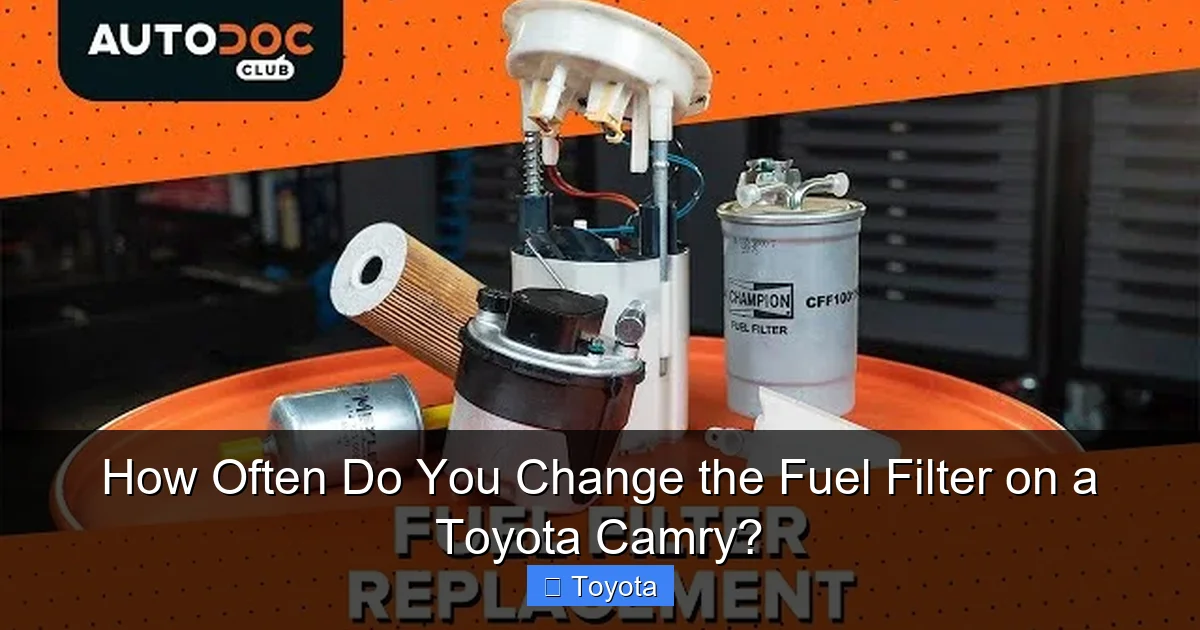
Visual guide about How Often Do You Change the Fuel Filter on a Toyota Camry?
Image source: img.youtube.com
What Qualifies as Severe Service?
Think about conditions that introduce more contaminants into your fuel or force the filter to work harder:
- Frequent Short Trips: Driving less than 5-10 miles at a time doesn’t allow the engine and fuel system to fully warm up. Condensation can form in the tank, and fuel doesn’t burn completely, leading to more deposits.
- Dusty, Dirty Environments: If you drive on unpaved roads, construction zones, or in areas with high airborne particulate matter, more dust and dirt can find its way into the fuel tank during refueling.
- Extreme Temperatures: Constantly driving in very hot or very cold climates can affect fuel composition and condensation rates.
- Low-Quality Fuel: Using fuel from stations with poor turnover or known quality issues introduces more sediment and water into your tank.
- Fuel System Contamination: If a gas station’s underground storage tank is compromised or a mechanic accidentally drops debris into the filler neck during a service, your filter is the first line of defense.
If your Camry’s life is dominated by these conditions, you should consider the “severe service” interval listed in your manual (often 15,000-20,000 miles earlier) as your guide, even for the in-tank filter. While you can’t “replace” the in-tank filter on a schedule, you can be extra vigilant about fuel quality and consider a professional fuel system cleaning service periodically to help keep the strainer clear.
Symptoms of a Failing Fuel Filter: Don’t Ignore the Warning Signs
Whether you have an external filter that’s past its prime or an in-tank strainer that’s clogging, the symptoms are identical because the problem is the same: not enough fuel is reaching the engine. Recognizing these signs early can save you from a costly tow and potential damage to your fuel pump or injectors.
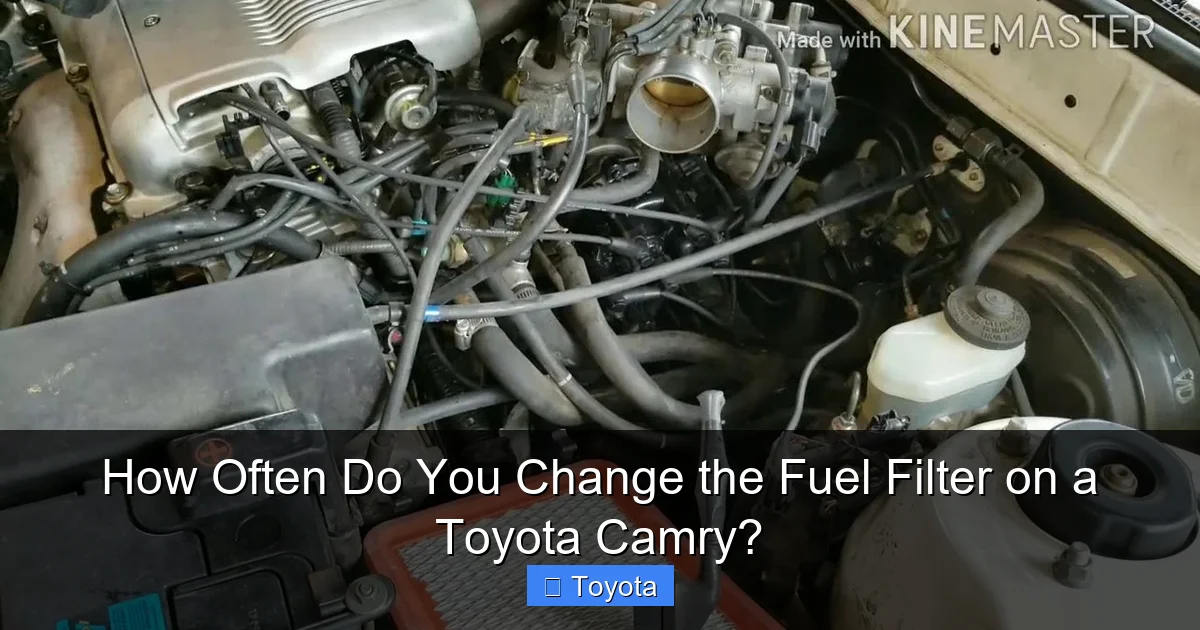
Visual guide about How Often Do You Change the Fuel Filter on a Toyota Camry?
Image source: i.ytimg.com
The Classic Trio: Hesitation, Sputtering, and Stalling
The most common symptom is a lack of fuel under load. You’ll feel it when accelerating onto a highway or climbing a hill. The engine will hesitate, sputter, or feel like it’s “running out of gas” even though the tank is full. It might jerk or buck. In severe cases, the engine may stall completely at idle or while driving. This happens because the filter is so clogged that the fuel pump can’t push enough fuel through it to meet the engine’s demands, especially when more power is needed.
Hard Starting and Rough Idle
A partially clogged filter can make starting the engine difficult, particularly when the engine is cold. You might turn the key and hear the engine crank slowly or unevenly before catching. Once running, the idle might be rough, shaky, or lower than normal. This is because the minimal fuel flow is unstable, causing the engine to run lean (not enough fuel).
Decreased Performance and Fuel Economy
Your Camry might feel sluggish and less responsive overall. The engine control unit (ECU) will try to compensate for the lean condition, but it can only do so much. You might also notice a drop in fuel economy because the engine is working harder to produce the same power and may be running inefficiently due to the improper air/fuel mixture.
Check Engine Light and Diagnostic Codes
A severely clogged filter can trigger the dreaded Check Engine Light. The most common codes you might see are P0171 (System Too Lean – Bank 1) or P0174 (System Too Lean – Bank 2). While these codes have many potential causes, a fuel restriction is a prime suspect, especially if accompanied by the performance symptoms listed above. A mechanic will perform a fuel pressure test to diagnose the issue.
Replacement Procedures: A World of Difference
How you address a fuel filter replacement depends entirely on which type is in your Camry. The cost, time, and complexity are night and day.
Replacing an External Inline Filter (The DIY-Friendly Job)
For pre-2012 Camrys, this is a classic DIY maintenance task. You’ll need a new filter (OEM or a reputable brand like Wix or Denso), a catch pan, some basic hand tools, and possibly a fuel line disconnect tool (for the plastic quick-connect fittings common on these cars). The basic steps are:
- Relieve Fuel System Pressure: This is the most important safety step. You must locate the fuel pump fuse in the engine bay, start the car, and let it run until it stalls to depressurize the lines. Or, you can use a rag to slowly open the filter’s outlet after disconnecting it to bleed pressure.
- Disconnect the Battery: Always a good practice when working with fuel systems.
- Locate and Remove the Old Filter: It’s held in place by brackets. Use the appropriate line disconnect tools to release the plastic fuel lines from the filter’s nipples. Be prepared for a small amount of fuel spillage.
- Install the New Filter: Pay attention to the arrow on the filter housing, which indicates the direction of fuel flow. It must point toward the engine. Reconnect the lines, ensuring they are fully seated and not cross-threaded.
- Re-pressurize the System and Check: Reinstall the fuse, turn the key to “ON” (don’t start) to let the pump prime, then start the car. Check thoroughly for any fuel leaks at the connections.
This job can take 30 minutes to an hour for a competent DIYer and costs $15-$40 for the filter. A shop might charge $80-$150 in labor.
Replacing an In-Tank Strainer (The Professional Job)
For 2012+ Camrys, there is no scheduled external filter change. If a mechanic diagnoses a clogged in-tank strainer, the only way to replace it is to replace the entire fuel pump module. This is a major job. It involves:
- Siphoning or draining the fuel tank.
- Disconnecting all fuel lines, electrical connectors, and vent hoses.
- Supporting the tank and lowering it from the vehicle (this often requires removing the rear suspension components or exhaust on some models).
- Opening the tank’s top access hatch (if equipped) or removing the pump module from the bottom of the tank.
- Replacing the entire pump and strainer assembly.
- Reinstalling the tank and refilling.
This is not a DIY job for 99% of people. It’s labor-intensive, messy, and requires handling gasoline safely. The cost is high: the fuel pump module itself can be $300-$700+, and labor can easily be $500-$1,000+ depending on the shop and region. This stark contrast between the two designs is why knowing your Camry’s year is so important.
Proactive Maintenance and Best Practices
Regardless of your filter type, you can take steps to maximize its life and protect your entire fuel system.
Fuel Quality is Paramount
Always buy fuel from reputable, high-volume stations. These stations have their tanks filtered regularly and turnover fuel quickly, meaning less sediment and water sitting at the bottom. Don’t be tempted by the cheapest gas in town if it’s from a station you don’t trust. Your fuel filter will thank you.
Don’t Run the Tank Bone Dry
Try not to let your fuel level drop below 1/4 tank regularly. The sediment and debris that settles at the bottom of the tank gets sucked into the fuel pickup when the level is very low. Keeping a quarter-tank minimum gives the pickup a cleaner buffer of fuel. It also helps keep the fuel pump submerged and cooled, which is another critical benefit.
Consider Periodic Fuel System Cleaning
For newer Camrys with the in-tank filter, a professional fuel system cleaning service every 30,000-50,000 miles can be a wise investment. These services use concentrated cleaners added to the tank that help dissolve varnish and deposits on injectors and can sometimes help keep the in-tank strainer cleaner. It’s a relatively inexpensive form of preventative medicine.
When Changing One, Change the Related Parts
If you’re replacing an external filter on an older Camry, it’s highly recommended to also replace the fuel pump strainer (the little mesh sock inside the tank) at the same time. This sock is the first line of defense and is often the source of the debris that clogged your filter. It’s cheap insurance. Also, inspect all rubber fuel hoses in the engine bay for cracks or hardening and replace as needed.
Conclusion: A Tailored Approach for Your Camry
So, how often do you change the fuel filter on a Toyota Camry? The definitive answer is: It depends on your model year.
For the vast majority of pre-2012 Camry owners, treat the fuel filter as a critical 30,000 to 50,000-mile service item. Set a calendar reminder, check your manual, and don’t skip it. The cost of prevention is a fraction of the cost of a tow, a new fuel pump, or clogged injectors.
For owners of 2012 and newer Camrys, there is no scheduled replacement. Your strategy shifts from scheduled replacement to symptom awareness and proactive fuel quality management. Know the signs of a clogged filter—hesitation, sputtering, hard starting—and address them immediately with a professional diagnosis. If you put a lot of miles on your car or drive in severe conditions, discuss a potential preventive fuel system cleaning with your trusted mechanic at the interval recommended for your older Camry’s filter.
Ultimately, your Toyota Camry’s fuel filter is a guardian of your engine’s health. By understanding its role, its location, and its specific maintenance needs based on your vehicle’s generation, you can ensure your Camry continues to deliver the reliable, smooth, and efficient ride it’s famous for, mile after mile. When in doubt, consult your owner’s manual or speak with a Toyota specialist who knows the intricacies of your specific model year. Keeping this simple filter clean is one of the most effective ways to protect your investment and avoid a very bad day on the road.
Frequently Asked Questions
Can I drive with a clogged fuel filter?
You might be able to drive short distances at low speeds, but it’s extremely risky. A clogged filter causes lean running, which can overheat and damage your engine’s valves and pistons. It also forces the fuel pump to work harder, leading to premature pump failure. The safest choice is to replace it immediately.
How much does it cost to replace a fuel filter on a Camry?
The cost varies wildly. For a pre-2012 model with an external filter, the part is $15-$40, and DIY labor is free. Professional labor is $80-$150. For a 2012+ model with a clogged in-tank strainer, replacing the entire fuel pump module costs $800-$1,700+ at a dealership or independent shop.
Will the check engine light come on for a bad fuel filter?
Yes, often. A severely restricted filter will cause lean condition codes (P0171/P0174). However, these codes can also indicate many other issues like vacuum leaks or bad sensors. A mechanic will need to perform a fuel pressure test to confirm a restriction is the cause.
Do I need to reset anything after changing the fuel filter?
No, there is no maintenance light or computer reset required after replacing a fuel filter on a Camry. The system doesn’t monitor filter life. However, if you had a Check Engine Light on, you’ll need to clear the codes with a scan tool after the repair to see if the issue is resolved.
Where is the fuel filter located on a Camry?
On pre-2012 models, it’s an external canister on the fuel line, usually near the firewall on the driver’s side or under the car near the rear axle. On 2012+ models, the primary filter is inside the fuel tank, attached to the fuel pump assembly. There is no external serviceable filter.
How long does a fuel filter last in a Toyota Camry?
For external filters (pre-2012), Toyota specifies 30,000-50,000 miles. For in-tank filters (2012+), they are considered “lifetime” and not meant to be replaced separately. In practice, an in-tank strainer can last the life of the vehicle but may clog on high-mileage cars or those with poor fuel quality, requiring pump module replacement.
