
What Does the Triangle with Exclamation Point Mean in a Toyota Highlander?

The triangle with an exclamation point in a Toyota Highlander is the Master Warning Light, a critical alert signaling a serious system malfunction that requires immediate driver attention. It often accompanies a specific message on the multi-information display detailing the issue, which can range from low oil pressure and brake system failures to problems with the AWD or safety systems. Do not ignore this light; safely pull over, assess the situation, and consult your owner’s manual or a certified technician promptly to diagnose and resolve the underlying problem before it leads to vehicle damage or unsafe driving conditions.
Key Takeaways
- It’s the Master Warning: The triangle with an exclamation point is not a single-issue light; it’s the Highlander’s “Master Warning” or “Master Caution” indicator, summoning your attention to a serious problem detailed elsewhere on the dash.
- Always Check the Display: The true meaning is found on the multi-information display between the gauges. The light is a general alert, but the screen message specifies the exact fault (e.g., “CHECK AWD SYSTEM,” “LOW OIL PRESSURE”).
- Serious Issues Only: This warning is reserved for significant faults that could affect safety or cause engine/transmission damage, such as brake system failures, charging system issues, or critical sensor malfunctions.
- Stop Driving Immediately: Unlike a check engine light, the Master Warning often indicates a condition where continuing to drive is dangerous. Safely pull over, turn off the engine, and assess the situation.
- Not for Maintenance Reminders: This is not a service interval light (like an oil change reminder). It indicates an *active, current* malfunction. Ignoring it risks catastrophic failure.
- Can Indicate Multiple Issues: In some cases, especially with electrical gremlins, the Master Warning might illuminate for more than one reason, requiring a professional diagnostic scan to uncover all stored trouble codes.
- Professional Diagnosis is Key: While some causes are simple (low fluid), many involve complex electronic systems. A qualified technician with the proper diagnostic tools is essential for an accurate and safe repair.
📑 Table of Contents
Introduction: That Unmistakable, Urgent Dashboard Signal
You’re cruising down the highway in your trusty Toyota Highlander, the kids are settled in the back, and the cabin is peaceful. Then, it catches your eye. A bright yellow or amber triangle, stark against the black background of the dashboard, with a bold exclamation point smack in the middle. Your heart skips a beat. What in the world does that mean? If you own a Toyota Highlander, this symbol is one of the most urgent and non-negotiable warnings the vehicle can display. It’s the automotive equivalent of someone grabbing your shoulder and saying, “Stop. Now. Listen to me.”
This article is your definitive, comprehensive guide to understanding the triangle with exclamation point in a Toyota Highlander. We will move beyond the initial panic to explain exactly what this Master Warning Light signifies, the common reasons it illuminates, and the critical steps you must take when you see it. From simple fluid checks to complex system failures, we’ll break it down in plain language. Your safety and the longevity of your Highlander depend on recognizing and acting upon this signal with clear-headed urgency.
Decoding the Symbol: It’s Not Just One Thing
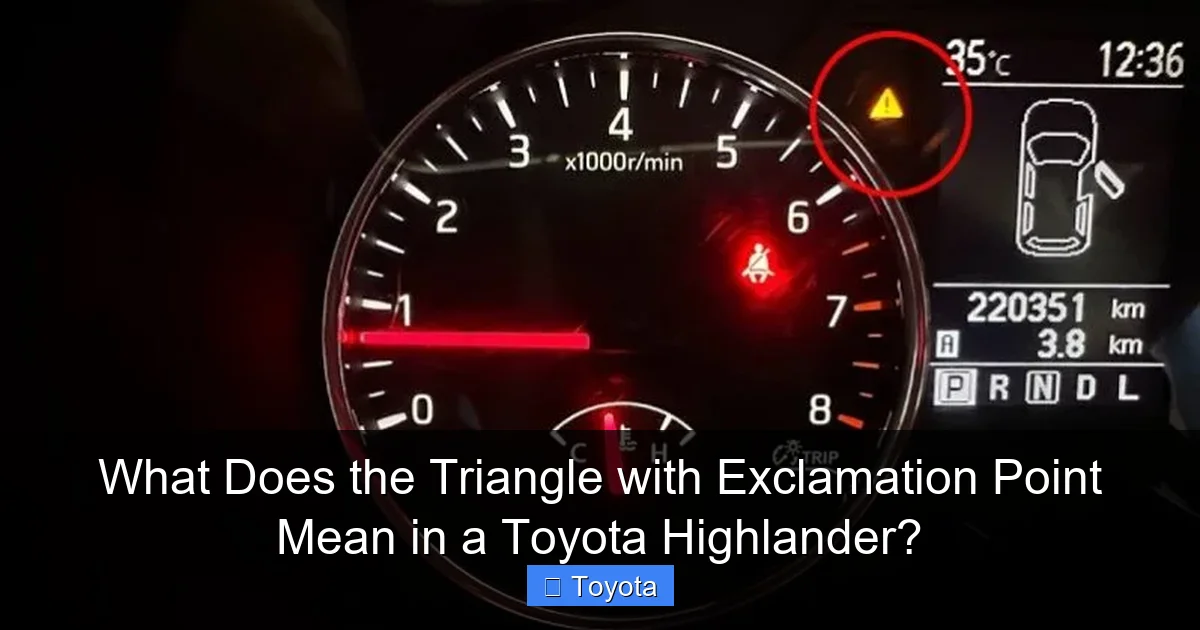
The first and most important concept to grasp is that the triangle with an exclamation point is a general alarm, not a specific diagnosis. Think of it as the “PA System” in your Highlander’s dashboard. The PA system itself (the triangle) is alerting you that something is wrong, but the specific message—the “announcement”—is delivered on the Multi-Information Display (MID) located in the center of your gauge cluster. You will almost always see a text message appear there simultaneously with the light, such as “CHECK BRAKE SYSTEM,” “LOW ENGINE OIL PRESSURE,” or “MALFUNCTION IN AWD SYSTEM.”
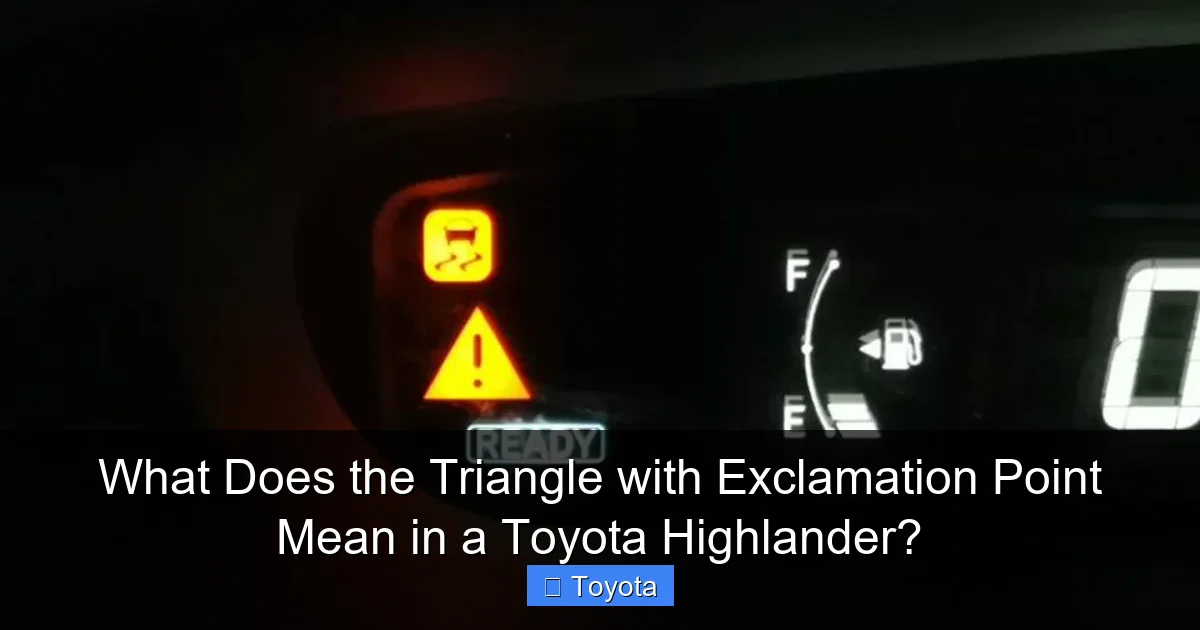
Visual guide about What Does the Triangle with Exclamation Point Mean in a Toyota Highlander?
Image source: attachments.priuschat.com
The Role of the Multi-Information Display (MID)
The MID is your best friend in this scenario. It’s the small LCD screen that normally shows your trip meters, fuel economy, and outside temperature. When the Master Warning activates, this screen becomes a critical diagnostic tool. The message displayed is the computer’s best attempt to tell you the source of the problem. Your immediate action should be to read this message carefully and understand its gravity. If the message is scrolling or changing, note the primary one.
Color Coding: Yellow/Amber vs. Red
In most Toyota Highlander model years, the Master Warning triangle is yellow or amber. A red master warning (or a red version of another symbol) is an even more extreme, “stop immediately” crisis, often for complete brake failure or severe engine issues. However, a yellow Master Warning should still be treated as a “stop as soon as it is safe to do so” situation. Never assume a yellow light means “you can finish your trip.” For the issues this warning covers, “safe to do so” usually means the nearest safe parking spot, not your destination 50 miles away.
Common Culprits: Why Is This Light On?
The Master Warning can be triggered by a wide array of systems in your Highlander. Here are the most frequent and serious causes you need to know about.
Visual guide about What Does the Triangle with Exclamation Point Mean in a Toyota Highlander?
Image source: carwarninglights.net
1. Low Engine Oil Pressure
This is one of the most dangerous reasons for the Master Warning to appear. The message will typically read “LOW ENGINE OIL PRESSURE” or similar. This is not a gentle reminder to add oil; it means oil pressure has dropped to a critically low level, and the engine is moments away from catastrophic damage due to lack of lubrication. If you see this message: Pull over immediately, shut off the engine, and do not restart it. Check the oil level with the dipstick. If it’s low, adding oil may get you to a safe location for a tow, but the cause of the pressure drop (failed pump, blocked pickup, major leak) must be diagnosed. Driving even a short distance with low oil pressure can destroy your engine.
2. Brake System Malfunctions
The safety of your entire family rests on your brakes. A Master Warning with a message like “CHECK BRAKE SYSTEM,” “BRAKE FLUID LOW,” or “BRAKE ASSIST SYSTEM MALFUNCTION” is a five-alarm fire. This could indicate a leak in the hydraulic system, a failure in the anti-lock brake (ABS) module, or a problem with the brake booster. Your stopping distance could be severely increased, or the brakes could fail completely. Action: Pump the brake pedal to build pressure if it feels soft. If it goes to the floor, use extreme caution. Have the vehicle towed. Do not drive.
3. Charging System Failure
If the alternator fails or the drive belt breaks, your Highlander will run solely on battery power until it dies. The Master Warning may appear with “CHARGING SYSTEM MALFUNCTION” or simply illuminate the battery light (which is also often a triangle). You’ll notice dimming headlights and accessories slowing. Action: Turn off all non-essential electrical items (radio, AC, heated seats). Drive immediately (but carefully) to the nearest service center or safe location. The engine will stall once the battery is depleted, leaving you stranded and without power steering/brakes.
4. Problems with All-Wheel Drive (AWD) or 4WD
Your Highlander’s intelligent AWD system is complex. A failure in the transfer case, rear differential, or related sensors can trigger the Master Warning with the message “CHECK AWD SYSTEM” or “SERVICE AWD.” This means the system has defaulted to front-wheel drive only to prevent damage, or it may not be functioning at all, severely reducing traction in poor conditions. For more details on this specific warning, our guide on what does check awd system mean on a Toyota Highlander provides an in-depth look. Action: Drive cautiously, especially in rain or snow. The vehicle will still operate, but without AWD. Have the system scanned by a professional.
5. Safety & Driver-Assist System Failures
Modern Highlanders are packed with safety tech like Toyota Safety Sense (TSS). A failure in a radar sensor, camera, or module for systems like Pre-Collision, Lane Departure Alert, or Adaptive Cruise Control can cause a Master Warning. The message might read “PCS MALFUNCTION” or “LDA UNAVAILABLE.” While the car remains drivable, you’ve lost a crucial layer of electronic safety protection. Action: These systems are sensitive to dirt, snow, or misalignment. Clean the front grille and windshield area thoroughly. If the warning persists, a dealer-level recalibration or repair is needed.
6. Other Critical System Failures
The list extends further. You might see warnings for the Electric Power Steering (EPS) system (“STEERING SYSTEM MALFUNCTION”), a major transmission fault (“TRANSAXLE MALFUNCTION”), or problems with the hybrid system (in Hybrid trims). Any of these can lead to a loss of vehicle control or strand you. The Master Warning is truly a catch-all for “something has gone very wrong with a primary system.”
Immediate Action Plan: What to Do When You See It
Seeing that triangle can be shocking, but your response must be methodical and calm. Follow this sequence of steps the moment the light and message appear.
Visual guide about What Does the Triangle with Exclamation Point Mean in a Toyota Highlander?
Image source: rxmechanic.com
Step 1: Assess and Read
Do not panic. Your first task is to safely glance at the Multi-Information Display and memorize or, if possible, take a photo of the exact wording. This message is your single most important clue. Is it about oil? Brakes? AWD? The specific text dictates the urgency of your next move.
Step 2: Evaluate Driving Conditions
If the message is for a non-critical system (like a minor sensor fault in a driver-assist feature), you may be able to cautiously drive to a nearby shop. However, if the message involves oil pressure, brakes, steering, or charging, you must stop immediately. Ask yourself: Is the pedal feel normal? Is there smoke, steam, or strange noises? Is the steering heavy or loose? These are signs to pull over right now.
Step 3: Safely Pull Over
Signal and merge onto the shoulder or into a parking lot. Turn on your hazard lights. Let the engine idle for a moment if you suspect an oil pressure issue (to see if pressure builds), but be prepared to shut it off completely. Do not attempt to diagnose the problem while in a traffic lane.
Step 4: Perform Basic, Safe Checks
If it’s safe to exit the vehicle, you can perform a few visual checks:
- Oil: Check the dipstick (engine warm, on level ground).
- Coolant: Check the overflow tank level (do not open a hot radiator cap).
- Brake Fluid: Check the reservoir in the engine bay for low fluid.
- Belts: Visually inspect the serpentine belt for breaks or looseness.
- Tires: Ensure all tires are inflated properly and have no major damage.
Step 5: Decide: Tow or Drive (Extreme Caution)
This is the hardest decision. As a general, safety-first rule: if the warning is for oil pressure, brakes, steering, or a major transmission fault, the vehicle must be towed. The risk of sudden, complete failure and causing an accident is too high. For an AWD or electrical system warning, you might cautiously drive a very short distance (<10 miles) to a trusted repair shop, but only if the vehicle feels normal. When in doubt, call for a tow. It's cheaper than a repair bill from a collision or a destroyed engine.
Diagnosis and Repair: Beyond the Dashboard
Once your Highlander is at a repair facility, the real work begins. The Master Warning light itself is just the messenger; the technician must find the source of the message.
The Importance of a Professional Scan
The technician will connect a high-end diagnostic scanner (not a simple OBD-II code reader) to your Highlander’s OBD-II port. This scanner communicates with all the vehicle’s electronic control modules (ECUs)—the engine, transmission, ABS, AWD, body control, etc. It will pull all stored ” Diagnostic Trouble Codes” (DTCs) and, crucially, view live data streams from sensors. For example, a “P0521” code might indicate an oil pressure sensor circuit issue, while a “C0200” code could point to a front/rear differential speed sensor. The scan tells the story of what the computer has detected.
Common Diagnostic Paths
The path depends on the code. For a low oil pressure warning, the technician will check oil level/quality, test the oil pressure with a mechanical gauge, and inspect the oil pump and filter. For a brake system warning, they’ll check fluid level, look for leaks, and test the ABS modulator and wheel speed sensors. For an AWD warning, they’ll often check the transfer case oil level and condition, and test the electromagnetic clutch packs that control torque distribution. Our article on what does check awd system mean on a Toyota Highlander delves deeper into the specific components of that system. Electrical gremlins can be the trickiest, requiring checks for voltage drops, damaged wiring harnesses, or failed control modules.
Why DIY is Often Not an Option
While checking oil or coolant is a simple DIY task, diagnosing the root cause of a Master Warning is rarely a home project. The systems involved are complex, interdependent, and require expensive, manufacturer-specific software to interface with. A misdiagnosis can lead to replacing a perfectly good sensor while the real problem—a wiring chafe behind a panel—remains, causing the warning to return. Investing in professional diagnosis saves time, money, and, most importantly, ensures your safety.
Prevention and Proactive Maintenance
While some failures are random, many Master Warning triggers are preventable with consistent care. Treat your Highlander’s maintenance schedule as a non-negotiable contract for reliability.
Stick to the Factory Maintenance Schedule
This is your single best defense. The Toyota-issued schedule in your owner’s manual outlines exactly when to change the oil, replace filters (engine, cabin), flush fluids (brake, coolant, transmission), and inspect critical components like belts, hoses, and the braking system. Neglecting these services is the fastest path to fluid degradation, component wear, and sensor failure that can trigger the Master Warning.
Pay Attention to Lesser Warnings
The Master Warning is the final escalation. Often, a problem will first present itself with a less severe warning. A single “Service Engine Soon” light (check engine light), a low washer fluid reminder, or a tire pressure warning are your vehicle’s early whispers. Addressing these issues promptly can prevent them from escalating into a Master Warning-level crisis. For instance, ignoring a persistent check engine light for a faulty oxygen sensor can eventually lead to catalytic converter damage or poor performance that triggers other warnings.
Use Genuine Fluids and Quality Parts
When you do perform maintenance, use fluids that meet Toyota’s exact specifications (e.g., genuine Toyota ATF WS for the transmission, Toyota Super Long Life Coolant). Using the wrong viscosity oil or a substandard coolant can lead to sensor inaccuracies, poor lubrication, or corrosion that damages sensitive electronic components and triggers warnings.
Be Mindful of Environmental Factors
Your Highlander’s sensors are exposed. Keep the front grille clear of bug splatter, snow, and ice to ensure the radar for Pre-Collision System and the camera for Lane Tracing Assist function correctly. A blocked sensor can cause those systems to shut down and illuminate the Master Warning. Similarly, deep water fording can contaminate differential or transfer case fluid, leading to AWD warnings later.
Conclusion: Heed the Call
The triangle with an exclamation point in your Toyota Highlander is not a suggestion; it’s a command from your vehicle’s central computer. It means, “I have detected a fault in a system critical to your safety or my operation. You must address this now.” There is no gray area here. The potential consequences of ignoring it—stranding your family on the roadside, facing a massive engine repair bill, or worse, being involved in an accident due to brake or steering failure—are far too severe.
Your action plan is simple: See the light, read the message, stop safely, and seek professional help. Do not reset the light without fixing the problem. Do not “wait and see.” Treat this warning with the absolute seriousness it deserves. By understanding its meaning and responding with urgency, you protect your investment, ensure your peace of mind, and most importantly, keep everyone in your Highlander safe on every journey. Your vehicle is trying to communicate with you. The least you can do is listen.
Frequently Asked Questions
Can I keep driving my Highlander if the triangle with exclamation point comes on?
No, you should not continue driving normally. The light indicates a serious fault. You must safely pull over as soon as possible to read the accompanying message on the dash display. If the message is for oil pressure, brakes, or steering, the vehicle should be towed. For other issues, you may be able to drive a very short distance to a repair shop, but only if the vehicle feels completely normal.
How do I reset the triangle warning light on my Toyota Highlander?
There is no “reset” button for the Master Warning Light. The light will turn off automatically only after the underlying problem is diagnosed and repaired by a technician using a professional scan tool. Simply clearing the code without fixing the cause will cause the light and message to return, often within minutes or after the next drive cycle.
What’s the difference between the Master Warning light and the Check Engine light?
The Check Engine Light (MIL) primarily monitors emissions-related systems. The Master Warning Light (triangle) is a higher-priority alert for serious safety and drivetrain issues like brake failure, low oil pressure, or AWD system faults. The Master Warning often appears with a specific text message, while the Check Engine light requires a scan for codes. Both should be taken seriously, but the Master Warning demands more immediate action.
Could a dead battery or electrical problem cause the triangle light to come on?
Yes. A severely discharged battery or a failing alternator (charging system malfunction) can trigger the Master Warning. Additionally, a widespread electrical issue or a communication breakdown between the vehicle’s multiple computers (modules) can activate this light as a generic alert. A professional diagnostic scan is needed to identify the specific electrical fault.
Is the triangle warning related to the Snow Button on my Highlander?
Not directly. The Snow Button simply changes the throttle response and AWD logic for winter driving. However, if there is an underlying fault in the AWD system itself, activating the Snow Button might cause the system to detect an inconsistency and trigger a “CHECK AWD SYSTEM” message, which would then illuminate the Master Warning triangle. The light is reporting the AWD fault, not the Snow Button’s use.
My Highlander’s Master Warning light came on, but there’s no message on the screen. What does that mean?
This is unusual but can happen if there’s a failure in the display unit itself or a severe communication loss between a control module and the dash. It could also indicate a very generic, undefined fault. In this case, the immediate priority is to have the vehicle’s computer systems scanned for any stored trouble codes, as the lack of a message doesn’t mean there isn’t a serious problem. Proceed with extreme caution and have it towed to a dealer or qualified shop.
