
How Much Does It Cost to Replace the Battery in a Toyota Highlander Hybrid?

Replacing the high-voltage battery in a Toyota Highlander Hybrid is a significant repair, typically costing between $2,500 and $5,500+ for parts and labor. The final price depends heavily on your model year, whether you choose a new OEM, remanufactured, or used battery, and your geographic location. A core charge refund and potential state/federal rebates can offset some of the cost. Proactive maintenance and getting multiple quotes from certified shops are your best strategies for managing this essential expense.
Key Takeaways
- The hybrid battery is not the 12V auxiliary battery: The costly component is the high-voltage (HV) traction battery pack, a completely different system from the small 12V battery that powers accessories. Replacing the 12V battery is a simple, inexpensive task, while the HV battery is a major hybrid system component.
- Costs vary dramatically by model year and battery type: Earlier Highlander Hybrids (2006-2013) use nickel-metal hydride (NiMH) batteries, which are generally less expensive to replace than the newer lithium-ion (Li-ion) batteries found in 2014+ models. A remanufactured unit can save 30-50% compared to a new OEM part.
- Labor is a major cost factor: Replacement is complex, requiring high-voltage safety protocols, system depressurization, and calibration. Expect 2-4 hours of labor at $100-$150/hour at a dealer or independent shop.
- Always factor in the “core charge”: Most battery purchases include a core charge (often $300-$800), which is fully refunded when you return your old battery. Ensure you get this refund in writing.
- Check for warranties and rebates: The HV battery is warrantied by Toyota for 8 years/100,000 miles (10 years/150,000 miles in California-compliant states). Some states and utilities offer rebates for hybrid battery replacements to promote clean vehicle longevity.
- Consider the vehicle’s overall value and condition: On a high-mileage older Highlander, a $5,000 battery replacement might not make financial sense. Compare the repair cost to the car’s market value and the cost of a comparable used hybrid.
- Regular maintenance can extend battery life: Keeping the hybrid system cool (ensuring radiator and cooling fan service), avoiding deep discharges, and addressing check engine lights promptly can help your original battery last 150,000+ miles.
📑 Table of Contents
- Understanding Your Highlander Hybrid’s Heart: The High-Voltage Battery
- The Tell-Tale Signs: How Do You Know the Hybrid Battery is Failing?
- The Price Breakdown: What’s In That $2,500 – $5,500+ Quote?
- Where to Get It Done: Dealer vs. Independent vs. DIY
- Smart Strategies to Save Money and Extend Battery Life
- Long-Term Value: Is It Worth Replacing?
Understanding Your Highlander Hybrid’s Heart: The High-Voltage Battery
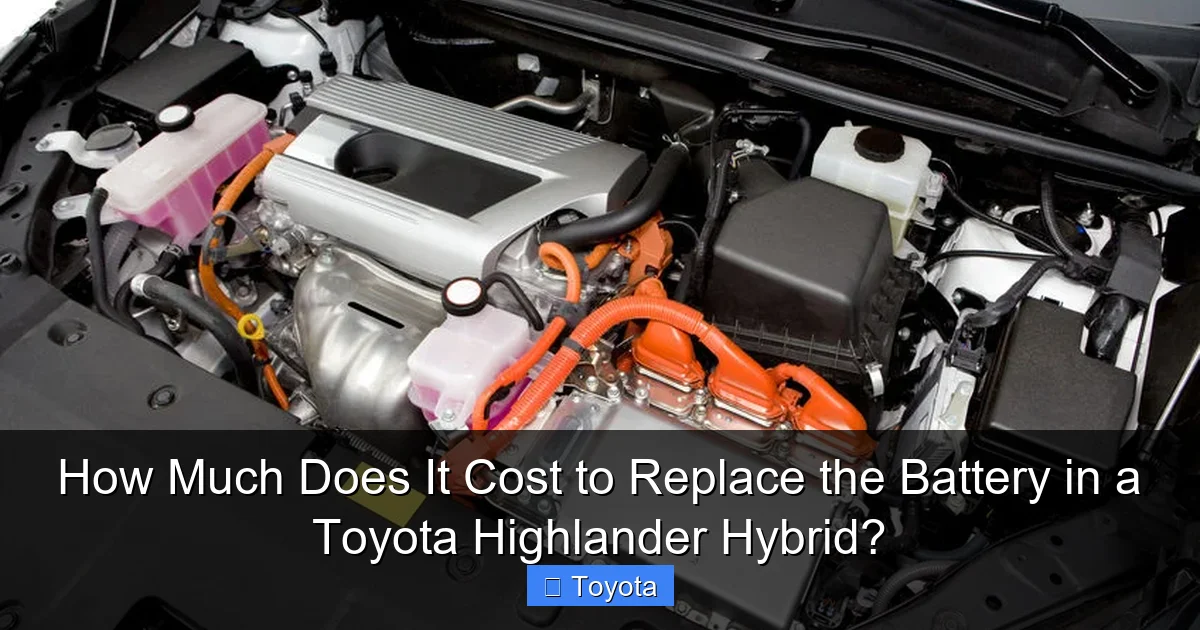
So, that ominous “Check Hybrid System” light just came on in your Toyota Highlander Hybrid. Your heart sinks a little. You know it’s not going to be a cheap fix. But what exactly is the problem? For many hybrid owners, the most intimidating and expensive component is the high-voltage (HV) traction battery pack. This isn’t your car’s small 12V battery that starts the engine and powers the radio. This is the powerful, complex heart of your hybrid system, sitting under the floor in the cargo area or behind the rear seats, storing the energy that powers the electric motor.
Understanding this battery is the first step to tackling its replacement cost. It’s a sophisticated assembly of multiple battery modules (either NiMH or Li-ion cells), a sophisticated Battery Management System (BMS), cooling fans, and high-voltage wiring. Its job is to store and deliver high-voltage electricity (over 200 volts) to the electric motor(s) for propulsion and to capture energy during braking (regenerative braking). When this pack fails, your Highlander Hybrid will either not start, run in a severely degraded “limp mode,” or simply shut down to protect the system. Replacing it is not like swapping out a conventional car battery; it’s a major hybrid system service.
The Two Main Types: NiMH vs. Lithium-Ion
The type of battery in your Highlander Hybrid is the single biggest factor influencing replacement cost. Toyota phased out nickel-metal hydride (NiMH) for lithium-ion (Li-ion) starting with the 2014 model year refresh.
- NiMH (2006-2013 Models): These batteries are heavier, bulkier, and have a different chemistry. While they are generally less expensive to replace than Li-ion packs (often $1,000-$3,000 less for a remanufactured unit), they are also more prone to gradual capacity loss over time. They are a known quantity in the aftermarket, with many remanufacturing specialists.
- Lithium-Ion (2014-Present Models): Li-ion batteries are more energy-dense, lighter, and typically last longer with less capacity fade. However, they are more technologically complex and expensive. A new OEM Li-ion pack for a recent Highlander Hybrid can easily hit $4,000-$6,000 before labor. The aftermarket for remanufactured Li-ion packs is younger but growing.
Pro Tip: You can often identify your battery type by your VIN or by looking at the battery cover. NiMH packs have a large, rectangular, silver or gray cover with vents. Li-ion packs often have a more complex, molded plastic cover with integrated cooling ductwork.
The Tell-Tale Signs: How Do You Know the Hybrid Battery is Failing?
Before you panic and get a quote, make sure the symptoms actually point to the HV battery. A failed hybrid battery pack doesn’t always mean the car is completely dead. Here are the most common red flags.
Visual guide about How Much Does It Cost to Replace the Battery in a Toyota Highlander Hybrid?
Image source: milehybridauto.com
Warning Lights and Messages
The most obvious indicator is the illumination of the “Check Hybrid System” warning light on your dashboard. Sometimes, you might also see a red triangle with an exclamation point, or a message like “Hybrid System Overheated” or “Service Hybrid Battery.” These are the car’s computer telling you the battery pack’s voltage is out of spec or the BMS has detected a critical fault.
Drivability and Performance Issues
You might notice your Highlander Hybrid’s performance has plummeted. The gasoline engine may run constantly, even at low speeds, because it’s trying to compensate for the weak or dead battery. You’ll feel a significant loss of power, and the vehicle may feel sluggish when accelerating. Fuel economy will nosedive, sometimes by 5-10 MPG or more, as the system works harder. The engine may also run louder and more frequently.
Starting and Electrical Problems
In severe cases, the car may not start at all. You might turn the key (or push the start button), hear a click, and see the dash lights come on, but the engine won’t crank. This is because the 12V auxiliary battery is being drained by the faulty HV system or the main contactors won’t engage. Sometimes, the 12V battery itself can be drained by a parasitic draw from a malfunctioning HV battery system.
The “Gut Feeling” and Diagnostic Confirmation
If your Highlander is over 10-12 years old with high mileage (150,000+ miles), HV battery wear is a real possibility. However, these symptoms can also be caused by faulty hybrid system sensors, inverter issues, or even a bad 12V battery. The only way to confirm an HV battery failure is a professional diagnostic scan. A technician will use a specialized scan tool (like Toyota’s Techstream) to read the health and voltage of each individual battery block within the pack. This is a non-negotiable step before committing to a replacement.
The Price Breakdown: What’s In That $2,500 – $5,500+ Quote?
Now, the moment you’ve been waiting for: the cold, hard numbers. Let’s peel back the layers of a typical replacement quote to see where your money goes. Remember, these are national averages; your local market will vary.
Visual guide about How Much Does It Cost to Replace the Battery in a Toyota Highlander Hybrid?
Image source: i.ytimg.com
1. The Battery Itself: The Largest Variable
This is where the biggest price swings happen.
- New OEM (Dealer) Battery: This is the “factory fresh” part, sourced directly through a Toyota dealership. It comes with a full Toyota warranty (often 12 months/unlimited miles). Cost: $3,500 – $6,500+ for Li-ion packs in newer models. NiMH packs for older models start around $2,800.
- Remanufactured (Reman) Battery: This is the most popular and cost-effective option. A reputable remanufacturer (like Green Hybrid Batteries, Hybrid Battery Depot, etc.) completely disassembles a core battery, tests and replaces all weak or failed cells/modules, upgrades components if needed, and reassembles it with new thermal interface material. It’s essentially a “like-new” battery with a solid warranty (typically 2-3 years/24,000-36,000 miles). Cost: $1,800 – $3,500 for most Highlander Hybrids. Li-ion remanufacturing is catching up but still commands a premium over NiMH.
- Used/Salvage Battery: Pulled from a donor vehicle at a junkyard. This is the cheapest option upfront ($800 – $1,800) but carries the highest risk. You have no knowledge of its history, state of charge, or remaining lifespan. It could fail in months. Warranty is usually very short or non-existent. Generally not recommended for a daily driver unless it’s a very short-term fix.
- Aftermarket New Battery: Some manufacturers produce new aftermarket batteries. Quality varies wildly. A premium brand may offer a good product with a decent warranty, but it’s harder to vet than a established remanufacturer. Prices can overlap with remanufactured units.
2. The Core Charge: Don’t Forget Your Refund!
When you buy any replacement hybrid battery, you will pay a “core charge.” This is a deposit (typically $300 to $800) that the seller holds until you return your old, defective battery. This old battery is then sent to a recycler. You must get a core receipt and ensure the seller refunds this charge promptly upon receiving your old core. This is not an extra fee; it’s a refundable deposit. Always clarify the core process upfront.
3. Labor: The Skilled Technician’s Time
This is not a DIY job for the average person. It requires:
- High-voltage safety training and insulated tools.
- Depowering and de-energizing the entire hybrid system following strict Toyota procedures.
- Removing the heavy (100+ lb) battery pack from the vehicle.
- Installing the new pack, reconnecting high-voltage cables, and securing it properly.
- Reinitializing the system, performing a battery calibration, and clearing fault codes.
- Test driving to confirm proper operation.
Labor time at a dealership is typically billed at $120-$180 per hour, with 2.5 to 4.0 hours required. At a reputable independent hybrid specialist, rates might be $90-$130 per hour with similar or slightly longer times. Total labor cost: $250 – $600+.
4. Additional Fees and Taxes
Don’t forget sales tax (6-10% depending on your state), shop supplies fees, and hazardous waste disposal fees (for the old battery electrolyte, though recyclers handle this). These can add $100 – $300 to the final bill.
Sample Cost Scenarios
Let’s put it all together for a 2012 Highlander Hybrid (NiMH) and a 2017 Highlander Hybrid (Li-ion):
- 2012 Highlander Hybrid (NiMH): Remanufactured battery ($2,400) + Core ($500 refundable) + Labor (3 hrs @ $110/hr = $330) + Tax/Fees (~$200) = **~$3,430 out-the-door before core refund.** Net cost after core return: **~$2,930.**
- 2017 Highlander Hybrid (Li-ion): New OEM battery ($5,200) + Core ($700 refundable) + Labor (4 hrs @ $130/hr = $520) + Tax/Fees (~$350) = **~$6,770 out-the-door before core refund.** Net cost after core return: **~$6,070.**
As you can see, the newer model with the more advanced battery is significantly more expensive. For perspective, a standard oil change at a quick-lube shop might cost around $50-$100, highlighting the massive scale of this repair.
Where to Get It Done: Dealer vs. Independent vs. DIY
Choosing where to have this critical service performed is as important as choosing the battery itself. Each option has distinct pros and cons.
Visual guide about How Much Does It Cost to Replace the Battery in a Toyota Highlander Hybrid?
Image source: i.ytimg.com
The Toyota Dealer: Peace of Mind at a Premium
Pros: Factory-trained technicians, genuine OEM parts, full Toyota warranty on the battery and labor, access to latest technical service bulletins (TSBs), and no compatibility worries. They handle all core and recycling logistics. The work is documented in your Toyota service history, which can help with future resale.
Cons: The most expensive option, often by 20-40%. Appointment scheduling can be less flexible. You’re paying for the dealership overhead and brand name.
Best for: Owners of newer vehicles (under 5 years old) still under the original HV battery warranty, those who want maximum warranty protection, or anyone who prioritizes “factory original” above all else.
The Independent Hybrid Specialist: The Sweet Spot
Pros: Significantly lower labor rates. Specialists often have more hands-on experience with hybrid battery replacements than general mechanics. They frequently use high-quality remanufactured batteries with excellent warranties (sometimes better than Toyota’s). More personalized service and often faster turnaround.
Cons: You must vet the shop carefully. Look for ASE certification, specific hybrid training, and years of experience. Warranty is from the battery supplier/shop, not Toyota. Ensure they use OEM-level diagnostic tools for calibration.
Best for: Most owners with out-of-warranty Highlanders. This is where you’ll find the best balance of cost, quality, and service. Get at least 3 detailed quotes from different specialists.
The DIY Route: High Risk, High Reward (For Experts Only)
Pros: Potential for massive savings on labor. You control the parts source. Can be a project for a highly skilled enthusiast with proper HV safety training, insulated tools, and a lock-out/tag-out procedure. You can buy a core battery and remanufacture it yourself (a niche but growing market).
Cons: Extremely dangerous. The HV system can retain a lethal charge for days/weeks after shutdown. One mistake can cause severe injury, death, or catastrophic damage to the vehicle’s electronics (a $10,000+ mistake). Requires specialized knowledge and tools. Most warranties are void if not installed by a certified professional. You assume all liability.
Best for: Professional hybrid technicians or engineers with specific hybrid vehicle training and the proper safety equipment. Not recommended for 99.9% of owners.
Smart Strategies to Save Money and Extend Battery Life
Facing a $5,000 bill is never fun. Here are actionable strategies to reduce the financial impact and, more importantly, to help you avoid needing this replacement for as long as possible.
1. Get Multiple, Detailed Quotes
Never accept the first quote. Contact at least three reputable independent hybrid specialists. Provide them with your exact VIN, model year, and mileage. Ask for a written estimate that breaks down: part number and price (new/remand), core charge, labor hours and rate, and all fees. Compare apples to apples. A shop using a premium remanufactured battery with a 3-year warranty is a different value proposition than one using a cheapest used unit with a 90-day warranty.
2. Ask About Remanufacturing Quality and Warranty
Not all remanufactured batteries are created equal. Ask the shop: “What specific cells/modules do you replace?” A good remanufacturer replaces all cells to a uniform capacity and uses higher-capacity cells if possible. “What is the warranty on the battery and on the labor?” A standard is 3 years/36,000 miles on the battery and 12 months/12,000 miles on labor. Walk away from a 90-day warranty.
3. Investigate Rebates and Incentives
Before you pay, check! Some states (like California, New York, Massachusetts) and local air quality districts offer rebates for hybrid battery replacements to keep clean vehicles on the road. Sometimes utility companies do too. Search “[Your State] hybrid battery rebate.” Also, ask your repair shop if they are aware of any programs. These can knock $500-$1,000 off the net cost.
4. The Core Charge is Your Money – Get It Back!
This seems simple, but it’s often mishandled. Get a core receipt with a specific dollar amount and a promised time frame for the refund (e.g., “within 14 days of receipt”). Follow up if you don’t see it. Some unscrupulous shops will “lose” the core or delay the refund indefinitely.
5. Proactive Maintenance to Delay the Inevitable
While HV batteries do wear out, you can maximize their lifespan:
- Keep the Cooling System Pristine: The HV battery is liquid-cooled. Ensure the hybrid cooling radiator and fan are clean and functional. A clogged radiator or failed cooling fan is a leading cause of premature battery overheating and degradation. This service might cost a few hundred dollars but can add years to your battery life.
- Avoid Deep Discharges: Try not to let the hybrid battery gauge (if equipped) repeatedly drop into the red zone. Frequent deep discharges stress the cells.
- Address Check Engine Lights Immediately: A seemingly unrelated engine misfire or oxygen sensor issue can cause the hybrid system to work harder and put unusual stress on the battery. Fix root causes promptly.
- Use Genuine Toyota 12V Batteries: A failing 12V battery can cause voltage sags that confuse the HV system’s BMS, leading to erroneous fault codes and potential stress.
Long-Term Value: Is It Worth Replacing?
This is the tough, pragmatic question. A $5,000 repair on a 2015 Highlander Hybrid with 180,000 miles is a different calculation than on a 2020 model with 60,000 miles.
Consider These Factors:
- Vehicle’s Overall Condition: Is the body in good shape? Has the transmission, air conditioning, or other major components been recently repaired or are they also on their last legs? One big repair can be the tipping point.
- Market Value: Check the private party and trade-in value of your Highlander Hybrid with a known bad hybrid battery. A car with a failed major component sells for a steep discount. Sometimes, selling it “as-is” to a hybrid specialist or savvy buyer and using that cash plus your repair budget toward a newer used hybrid makes more sense.
- Sentimental vs. Financial Value: If you love the car and plan to keep it for 5+ more years, the repair is an investment in reliable, fuel-efficient transportation. If you’re on the fence about selling soon, the repair may not pencil out.
- Cost Per Mile: Do the math. If the repair costs $4,000 and you plan to drive it for another 80,000 miles, that’s $0.05 per mile just for the battery. Add your other operating costs (fuel, insurance, maintenance). Is that competitive with financing a newer used hybrid? Often, it is, especially when you consider the Highlander’s reputation for longevity.
A Word on Resale: A vehicle with a documented, professional hybrid battery replacement (especially with a good warranty) from a reputable shop can actually be a selling point. It proves the major wear item has been renewed and the car is good for another 100,000+ miles. Keep all receipts and warranty paperwork.
Frequently Asked Questions
Is the Toyota Highlander Hybrid battery covered under warranty?
Yes, the high-voltage traction battery is warrantied by Toyota for 8 years or 100,000 miles (whichever comes first). In states that follow California’s emissions standards (CA, CT, ME, MD, MA, NJ, NY, OR, RI, VT), the warranty is 10 years or 150,000 miles. This covers defects in materials or workmanship. Warranty claims must be processed through a Toyota dealership.
How long should a factory Highlander Hybrid battery last?
With proper care and driving conditions, the original HV battery can easily last 150,000 to 200,000 miles or more. Some early NiMH packs have been known to fail around 100,000-120,000 miles, while many Li-ion packs in later models are exceeding 200,000 miles. Factors like extreme heat, frequent deep discharges, and poor cooling system maintenance can shorten its life.
Can I replace the Highlander Hybrid battery myself to save money?
We strongly advise against it. The high-voltage system carries over 200 volts and can cause severe injury or death if not handled with extreme caution and proper insulated tools. The process also requires specific software for system shutdown, calibration, and reactivation. Incorrect installation can destroy the new battery and other expensive components like the inverter. This is a job for trained professionals only.
What are the symptoms of a failing hybrid battery besides a warning light?
You’ll likely notice a dramatic drop in fuel economy, a constantly running gasoline engine (even at idle or low speed), a significant loss of power and acceleration, and the vehicle may feel like it’s in “limp mode.” In cold weather, the engine may run more frequently to warm the battery. Sometimes, the 12V auxiliary battery can drain prematurely because the failing HV system is drawing excess power.
Should I buy a new, remanufactured, or used hybrid battery?
For most owners, a high-quality remanufactured battery from a reputable specialist is the best value. It offers like-new performance at a 30-50% discount from a new OEM part, with a solid multi-year warranty. A new OEM battery provides maximum warranty peace of mind but at a high cost. A used battery is a gamble with a high risk of short-term failure and is generally not recommended for a primary vehicle.
What happens to my old hybrid battery? Is it recycled?
Yes, absolutely. Hybrid batteries are almost 100% recyclable. When you return your old core (via the core charge process), the remanufacturer or recycler breaks it down. Valuable metals like nickel, lithium, cobalt, and copper are recovered and sold for use in new batteries. The plastic and metal cases are also recycled. Never dispose of a hybrid battery in the trash; it is both hazardous and valuable. Responsible recycling is a standard part of the replacement process.
