
What Is the Life Expectancy of Toyota Hybrid Car Batteries

Toyota hybrid batteries boast an impressive life expectancy of 10-15 years, frequently exceeding the car’s own lifespan. Backed by warranties of up to 10 years or 100,000 miles, they provide long-term reliability and reduced ownership costs.
Key Takeaways
- Expect 10-15 years or 100,000-150,000 miles from a Toyota hybrid battery.
- Warranty covers 8 years/100,000 miles, providing significant early-life protection.
- Driving habits and climate significantly impact long-term battery health and longevity.
- Regular maintenance is not required for the battery but benefits overall hybrid system health.
- Replacement costs are high but have decreased, with options for remanufactured units.
- Toyota recycles nearly all retired hybrid batteries through dedicated programs.
- Get a diagnostic test to accurately assess your specific battery’s remaining health.
📑 Table of Contents
- What Is the Life Expectancy of Toyota Hybrid Car Batteries?
- How Toyota Hybrid Batteries Work (The Simple Version)
- What the Data Says: Real-World Lifespan Expectations
- Key Factors That Influence Your Battery’s Lifespan
- Practical Tips to Maximize Your Toyota Hybrid Battery’s Life
- The Money Talk: Replacement Costs and Warranties
- The Bottom Line: Should You Worry?
What Is the Life Expectancy of Toyota Hybrid Car Batteries?
Let’s be honest—when you first drove your shiny new Toyota Prius, Camry Hybrid, or RAV4 Hybrid off the lot, the last thing on your mind was the car battery dying. You were probably focused on the amazing fuel economy, the smooth, quiet ride, and that feeling of doing your part for the planet. But as the miles tick by, a quiet question starts to whisper in the back of your mind: “How long will this fancy hybrid battery actually last?” It’s a totally valid concern. After all, the battery pack is the heart of the hybrid system, and the idea of a costly replacement can be stressful. I remember chatting with a friend who loved his 2012 Prius but was secretly terrified of a four-figure battery bill. He wasn’t alone in that worry. So, let’s pop the hood, metaphorically speaking, and dive deep into the real-world life expectancy of Toyota hybrid car batteries. We’ll look at the engineering, the data, the factors you can control, and what it all means for your wallet and your peace of mind.
The short answer, which will comfort many, is that Toyota has designed these batteries to last the life of the vehicle. But what does “life of the vehicle” mean in practical terms? And what happens if it doesn’t? We’re going to break it all down, no jargon, just clear facts and practical advice.
How Toyota Hybrid Batteries Work (The Simple Version)
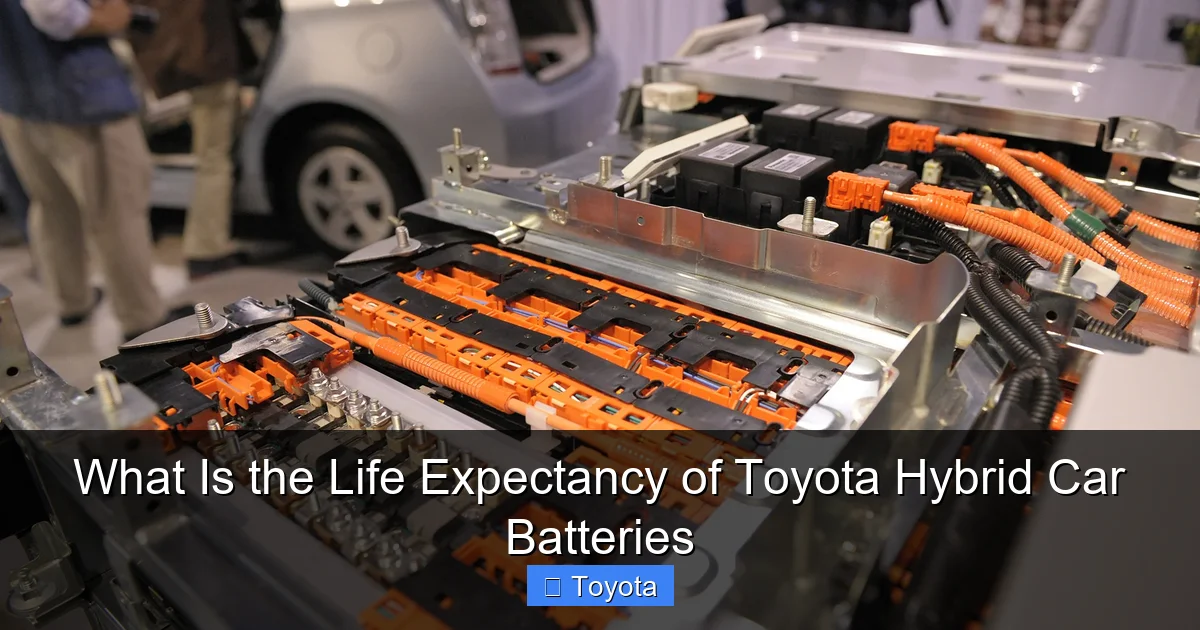
Before we talk about lifespan, we need to understand what we’re talking about. Your Toyota hybrid doesn’t use a single, giant battery like an electric car. Instead, it uses a high-voltage traction battery pack, typically made up of many smaller, rechargeable cells. This pack stores electricity generated by the gasoline engine and regenerative braking. That stored electricity powers the electric motor(s), which assists the engine or, in some cases, powers the car on its own at low speeds.
Visual guide about What Is the Life Expectancy of Toyota Hybrid Car Batteries
Image source: cdn.cartipsdaily.com
Toyota has primarily used two types of batteries over the years:
Nickel-Metal Hydride (NiMH) Batteries
For decades, this was the workhorse of the hybrid world. NiMH batteries are known for their durability, tolerance to abuse (like being fully charged or discharged), and relatively stable chemistry. They’re heavier than lithium-ion but have a proven track record for longevity. You’ll find these in most older Prius models, early Camry Hybrids, and Highlander Hybrids.
Lithium-Ion (Li-ion) Batteries
As technology advanced, Toyota began shifting to lithium-ion batteries, especially in newer models and those where packaging and weight are critical (like the Prius Prime plug-in hybrid). Li-ion batteries offer higher energy density—meaning more power in a smaller, lighter package. They generally have a slightly different degradation profile but are also engineered for extreme longevity.
Both types are managed by a sophisticated Battery Management System (BMS). This computer is the unsung hero, constantly monitoring each cell’s temperature, voltage, and state of charge. It actively works to keep the battery in its optimal operating range, preventing it from getting too hot, too cold, or too charged/discharged. This smart management is a huge reason these batteries last so long.
What the Data Says: Real-World Lifespan Expectations
Now for the numbers you came for. Toyota’s official stance is that the hybrid battery is designed to last the life of the car. In warranty terms, that’s typically 8 years/100,000 miles in most states, and 10 years/150,000 miles in states that follow California’s stricter emissions standards (like California, New York, and Vermont). But warranties are the *minimum* expectation, not the maximum.
Visual guide about What Is the Life Expectancy of Toyota Hybrid Car Batteries
Image source: autozonic.com
Independent studies and real-world owner reports paint a very optimistic picture. Here’s a breakdown:
- Pre-2010 Models (Primarily NiMH): There are countless examples of first-generation Prius models (early 2000s) with well over 200,000, even 300,000+ miles on their original battery packs. While capacity may have diminished slightly (you might see a tiny drop in EV-only mode range or a slight dip in overall fuel economy), the battery is still fully functional and reliable.
- 2010-2020 Models (Mix of NiMH & Early Li-ion): This is the bulk of the used hybrid market. Data from consumer reports and hybrid enthusiast forums shows failure rates are remarkably low. A well-maintained battery from this era has an extremely high probability of reaching 150,000-200,000 miles without significant issues. The BMS technology improved greatly in this period.
- 2020+ Models (Mainstream Li-ion): These are the newest batteries with the latest thermal management and cell chemistry. While we don’t have 20-year data on them yet, engineering standards and accelerated life testing suggest they are built to easily surpass 200,000 miles with minimal degradation. Toyota’s confidence in switching to Li-ion for most new models is a strong signal.
So, while a small percentage of batteries can fail prematurely due to manufacturing defects or extreme neglect, the overwhelming majority will outlast the rest of the powertrain. You are statistically far more likely to need a new catalytic converter or transmission in a high-mileage conventional car than you are to need a new hybrid battery in your Toyota.
Key Factors That Influence Your Battery’s Lifespan
That “designed to last” part is crucial. Toyota engineered these batteries for a specific use case: shallow, frequent charge-discharge cycles (like driving in the city). But your driving habits and environment can either help or hinder that design. Here are the biggest factors under your control:
Visual guide about What Is the Life Expectancy of Toyota Hybrid Car Batteries
Image source: gomechanic.in
1. Climate and Temperature Extremes
This is the single biggest environmental factor. Extreme heat is the arch-nemesis of battery chemistry. If you live in Phoenix or Miami and park your car outside all day, the battery is under more thermal stress. Conversely, extreme cold reduces battery efficiency and can increase internal resistance. The BMS works hard to mitigate this, but constant, severe extremes accelerate degradation. Garaging your car is one of the best things you can do for long-term battery health.
2. Driving Patterns and Cycle Depth
Are you a highway commuter or a city errand-runner? Hybrid batteries love shallow cycles—using 20-40% of their capacity and then recharging. Constantly draining them to near-empty and then fast-charging them (deep cycles) causes more stress. If your daily drive is 50 miles of highway, the battery might only cycle a little. If you do a series of short, stop-and-go trips where the battery does most of the work, that’s still gentle use. It’s the aggressive, deep, frequent cycling that hurts.
3. Maintenance of the Entire Hybrid System
The battery doesn’t exist in a vacuum. A failing 12-volt accessory battery (the small one that powers your lights and computer) can put undue stress on the high-voltage system. Similarly, neglected engine oil or a clogged air filter can cause the gasoline engine to run poorly, which in turn can make the hybrid system work harder to compensate, indirectly taxing the battery. Keeping up with basic maintenance is non-negotiable for overall system health.
4. Vehicle Model and Generation
As technology improves, so does longevity. A 2023 RAV4 Hybrid’s battery is engineered with more advanced cell chemistry and cooling systems than a 2007 Prius’s battery. While both are excellent, the newer one has theoretical advantages. You can also look at specific model reputations; for instance, the first-generation Camry Hybrid (2007-2011) has a stellar reputation for battery durability.
Practical Tips to Maximize Your Toyota Hybrid Battery’s Life
You don’t need to be a mechanic to be a good hybrid steward. Here are actionable, everyday tips:
- Drive Consciously, Not Aggressively: Smooth acceleration and gentle braking are your friends. This maximizes regenerative braking (which recharges the battery) and minimizes deep discharge events. Avoid jackrabbit starts and slamming on the brakes.
- Let the System Do Its Job: Don’t try to “game” the system by forcing EV mode or manually trying to keep the battery at a certain charge level. The BMS is smarter than you are. Just drive normally and let the computer manage the energy flow.
- Don’t Let the Car Sit Unstarted for Months: If you have a seasonal vehicle or won’t drive it for a long time, the 12-volt battery will drain, which can lead to a deep discharge of the high-voltage pack over an extremely long period. Use a trickle charger on the 12V battery if storing long-term.
- Keep It Cool (When Possible): If you have a garage, use it. If you must park outside, seek shade. While the BMS has its own cooling system (often using cabin air or coolant), reducing the baseline heat load helps.
- Address Warning Lights Immediately: If the red or orange hybrid system warning light illuminates on your dashboard, get it checked by a Toyota technician or a reputable hybrid specialist immediately. Ignoring it can turn a minor sensor or cell issue into a major pack failure.
- Use Genuine Toyota Parts for Repairs: When replacing the 12V battery or other related components, use the correct specification parts. An incorrect 12V battery can wreak havoc on the charging system.
One interesting note: when comparing your fuel economy to the EPA estimates, remember that a brand-new battery might not be at its peak efficiency until it goes through a few hundred cycles as the BMS calibrates. Don’t panic if your first few tanks are slightly below sticker numbers.
The Money Talk: Replacement Costs and Warranties
Okay, let’s address the elephant in the room. If a battery *does* need replacement under warranty, you’re likely looking at just a deductible or a small core charge. That’s the best-case scenario. But what about out-of-warranty replacements?
The cost has come down dramatically. A decade ago, a dealer replacement could easily hit $5,000-$8,000. Today, thanks to a robust aftermarket and remanufacturing industry, the landscape is much friendlier:
- Dealer/New OEM: Still the most expensive option, often ranging from $2,500 to $4,500+ depending on the model, plus labor. You get a new, fully warrantied unit with the latest updates.
- Remanufactured/Refurbished: This is the most common and cost-effective path. Companies take used core batteries, test and replace the weak or failed modules/cells, and reassemble them to like-new condition. Prices typically range from $1,500 to $2,800, often with a solid 12-month/12,000-mile warranty. This is a very reliable option for most owners.
- Used/Salvage: The cheapest upfront cost (maybe $800-$1,500), but it’s a gamble. You’re buying a battery with unknown history and potentially 100,000+ miles already on it. It could fail in a year. Generally not recommended unless you’re a DIYer on a very tight budget and understand the risk.
Labor is a significant part of the cost. Replacing a hybrid battery is not a simple job. It involves high-voltage safety procedures, removing heavy components (like the rear seat in a Prius), and precise reinstallation. Always factor in 2-4 hours of professional labor time.
And here’s a pro-tip: when you get a quote, ask if it includes the core charge. You’ll often get a refund when your old battery is returned for recycling.
The Bottom Line: Should You Worry?
In my experience, the level of worry about Toyota hybrid batteries is inversely proportional to the actual failure rate. The fear is real because the *potential* cost is high, but the *probability* of needing that replacement on a well-maintained, non-abused vehicle is strikingly low.
Think of it this way: you’re not buying a ticking time bomb. You’re buying a car with a powertrain component that has been proven, over two decades and millions of units, to be exceptionally robust. The engineering philosophy is conservative and durability-focused. Toyota’s reputation for reliability is built on this exact kind of long-term thinking.
If you’re shopping for a used Toyota hybrid, a simple pre-purchase inspection by a hybrid-aware mechanic can check the battery’s health via diagnostic scanners that read the battery’s state of health (SOH) and cycle count. This is worth the $150 fee for immense peace of mind. For new car buyers, the warranty provides a decade of coverage in many states, which is longer than most people keep a car.
So, breathe easy. Your Toyota hybrid’s battery is very likely to be the last major component you ever have to think about. Focus on enjoying the seamless fuel savings and smooth driving experience. Just keep up with your scheduled maintenance, drive gently, and maybe park in the garage when you can. Your future self, cruising past gas stations with a smile, will thank you for it.
And hey, if you’re curious about the total cost of ownership for a specific model like the RAV4 Hybrid, understanding the invoice price of a Toyota RAV4 can give you a clearer picture of the initial investment you’re making against that legendary reliability. It’s all about the long game.
Frequently Asked Questions
What is the average life expectancy of a Toyota hybrid battery?
Toyota designs its hybrid batteries to last for the life of the vehicle, with an expected lifespan of 100,000 to 150,000 miles or more. All Toyota hybrids come with a standard hybrid battery warranty of 8 years or 100,000 miles, whichever comes first, and in some states, it extends to 10 years or 150,000 miles due to emission regulations.
How much does it cost to replace a Toyota hybrid battery?
The cost to replace a Toyota hybrid battery typically ranges from $2,000 to $4,000 for the part, with total costs (including labor) often between $3,000 and $5,000. Prices vary by model, year, and whether you choose a new OEM part, a remanufactured unit, or a used battery from a salvage yard.
What are the signs of a failing Toyota hybrid battery?
Common signs include a significant drop in fuel economy, the hybrid system warning light illuminating on the dashboard, or the vehicle struggling to start or run on electric power alone. You may also notice the engine running more frequently than usual, even during light acceleration, as the system compensates for reduced battery capacity.
Do Toyota hybrid batteries require special maintenance?
No, Toyota hybrid batteries are designed to be virtually maintenance-free and are sealed units that do not require fluid checks or servicing. Their longevity is supported by the car’s sophisticated computer system, which actively manages battery temperature and state of charge, and by regenerative braking that helps maintain charge without driver intervention.
Does the life of a Toyota hybrid battery differ between older and newer models?
Yes, newer Toyota hybrid models generally feature improved battery chemistry and more advanced thermal management systems, contributing to potentially longer lifespans compared to earlier generations. For example, the nickel-metal hydride (NiMH) batteries in early Prius models have proven very durable, while later models may use lithium-ion batteries with different performance characteristics.
What happens to a Toyota hybrid battery at the end of its life?
Toyota has an established recycling program for its hybrid batteries, ensuring that end-of-life units are responsibly collected and processed. Valuable materials like nickel, lithium, and rare earth metals are recovered for reuse in new batteries or other applications, minimizing environmental impact and supporting sustainability goals.
