
Who Makes Toyota Oil?

You might think Toyota oil is made by Toyota itself—but that’s not the whole story. While Toyota sets strict quality standards, the actual manufacturing is handled by leading global lubricant companies like ExxonMobil and Idemitsu. These partners produce oil under Toyota’s exact specifications to ensure peak engine performance, longevity, and warranty compliance.
Have you ever popped the hood of your Toyota Camry, RAV4, or Prius and wondered, “Who actually makes the oil I’m putting in here?” It’s a fair question—especially when you’re standing in the auto parts aisle staring at rows of bottles labeled “Toyota Genuine Motor Oil.” You might assume Toyota itself brews this golden elixir in a secret lab somewhere in Japan. But the truth is a bit more nuanced—and surprisingly collaborative.
Toyota, like many automakers, doesn’t operate its own oil refineries or blending facilities. Instead, it relies on trusted global partners who manufacture lubricants to Toyota’s exacting specifications. These partnerships ensure that every drop of Toyota Genuine Motor Oil (TGMO) delivers the performance, protection, and efficiency your engine was designed for. From the high-revving inline-fours in a Corolla to the hybrid synergy drive in a Prius, the right oil isn’t just a suggestion—it’s a necessity.
Understanding who makes Toyota oil isn’t just about brand curiosity. It’s about making informed decisions that affect your vehicle’s longevity, fuel economy, and even your warranty coverage. Whether you’re a weekend mechanic or a daily commuter, knowing the source and science behind your engine oil empowers you to care for your Toyota the way it deserves.
Key Takeaways
- Toyota doesn’t manufacture oil in-house: Instead, it partners with top-tier lubricant producers to create oils that meet its rigorous standards.
- ExxonMobil and Idemitsu are major suppliers: These companies produce much of the genuine Toyota Genuine Motor Oil (TGMO) sold worldwide.
- Toyota specifies exact formulations: Every batch of TGMO must pass Toyota’s performance, viscosity, and additive requirements.
- Using genuine Toyota oil protects your warranty: It ensures compliance with factory recommendations and helps avoid voided coverage.
- Aftermarket oils can work—if they meet specs: Look for API, ILSAC, and Toyota-specific certifications like 0W-20 or 5W-30 with proper approvals.
- Oil changes are more than just fluid swaps: Proper oil selection impacts fuel economy, emissions, and engine wear over time.
- Always check your owner’s manual: Your specific Toyota model may require a unique viscosity or synthetic blend for optimal performance.
📑 Table of Contents
- Why Toyota Doesn’t Make Its Own Oil
- The Real Makers: Toyota’s Lubricant Partners
- What Makes Toyota Oil “Genuine”?
- Can You Use Non-Toyota Oil in Your Toyota?
- Choosing the Right Toyota Oil for Your Vehicle
- The Cost of Cutting Corners: Why Quality Oil Matters
- Where to Buy Toyota Genuine Motor Oil
- Conclusion: Trust the Process, Protect Your Toyota
Why Toyota Doesn’t Make Its Own Oil
At first glance, it might seem logical for Toyota to produce its own motor oil. After all, they design the engines, engineer the cooling systems, and calibrate the fuel injection timing. So why outsource something as critical as lubrication?
The answer lies in specialization and scale. Motor oil production is a highly technical, capital-intensive industry requiring massive refineries, advanced chemical engineering, and global distribution networks. Companies like ExxonMobil, Shell, and Idemitsu have spent decades—and billions of dollars—perfecting base oil refinement, additive chemistry, and quality control. For Toyota, partnering with these experts is far more efficient than building an entire lubricants division from scratch.
Moreover, Toyota’s core competency is vehicle manufacturing, not petrochemicals. By collaborating with industry leaders, Toyota ensures its oils meet not only its own standards but also international benchmarks like API (American Petroleum Institute) and ILSAC (International Lubricant Standardization and Approval Committee). This dual compliance gives drivers confidence that their oil is both brand-specific and globally validated.
Another key reason? Consistency. Toyota vehicles are sold in over 170 countries, each with different climates, fuel qualities, and driving conditions. A single in-house oil formula might not perform equally well in the deserts of Arizona and the snowy roads of Norway. By working with global lubricant giants, Toyota can tailor regional formulations while maintaining a unified brand promise.
The Real Makers: Toyota’s Lubricant Partners
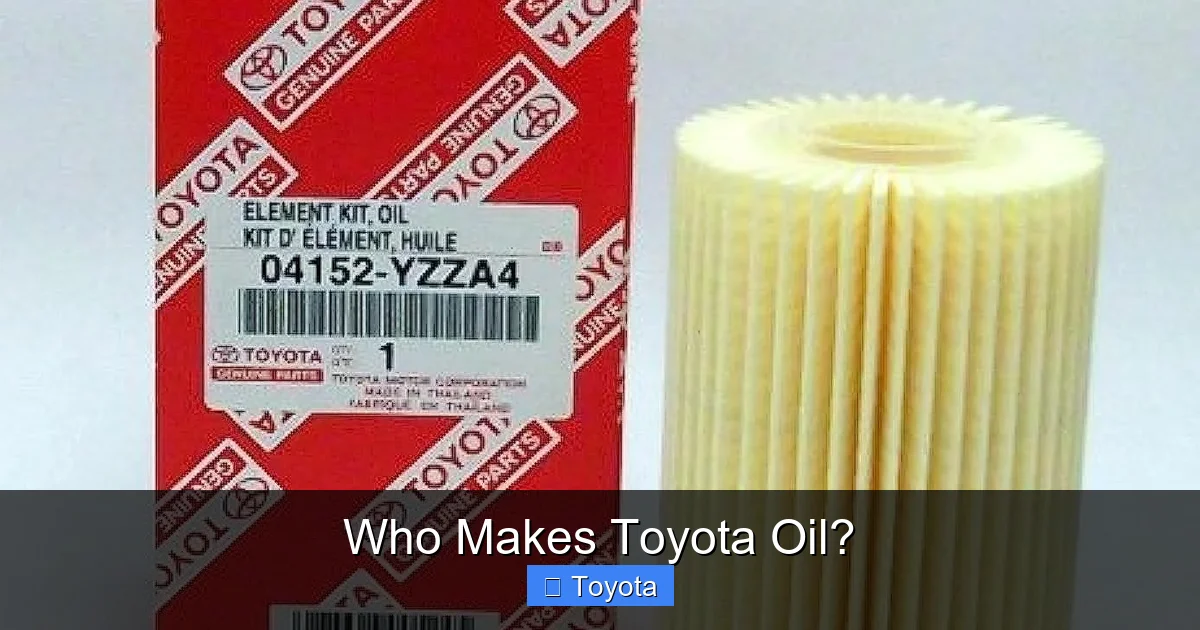
Visual guide about Who Makes Toyota Oil?
Image source: m.media-amazon.com
So, if Toyota isn’t making the oil, who is? The short answer: some of the world’s most respected names in lubricants.
ExxonMobil: A Global Powerhouse
ExxonMobil is one of Toyota’s longest-standing and most prominent oil partners. Through its Mobil 1 brand and private-label agreements, ExxonMobil produces a significant portion of Toyota Genuine Motor Oil, especially in North America and Europe. Their advanced synthetic base oils and proprietary additive packages are engineered to meet Toyota’s strict requirements for wear protection, thermal stability, and sludge resistance.
For example, Mobil 1’s 0W-20 synthetic oil—used in many modern Toyotas—is formulated to flow easily in cold starts (critical for fuel efficiency) while maintaining film strength at high temperatures. This balance is essential for engines like the 2.5L Dynamic Force in the 2023 Camry, which operates at higher compression ratios and tighter tolerances.
Idemitsu Kosan: The Japanese Specialist
Closer to home, Idemitsu Kosan—a Japanese petroleum company with deep roots in Asia—is another major supplier of Toyota oil. Idemitsu has a long history of collaboration with Japanese automakers and is known for its precision in formulating low-viscosity oils that enhance fuel economy without sacrificing protection.
In fact, Idemitsu developed some of the earliest 0W-20 oils specifically for Toyota’s hybrid and direct-injection engines. Their expertise in ester-based synthetic oils allows for superior lubricity and cleaner engine operation, which is vital for direct-injection engines prone to carbon buildup.
Other Regional Partners
Depending on your location, you might also find Toyota oil produced by companies like Chevron (in parts of Latin America) or GS Caltex (in South Korea). These partnerships ensure local availability and compliance with regional regulations, all while adhering to Toyota’s global quality standards.
The bottom line? When you buy a bottle of Toyota Genuine Motor Oil, you’re getting a product co-developed by Toyota engineers and manufactured by some of the most advanced lubricant labs on the planet.
What Makes Toyota Oil “Genuine”?
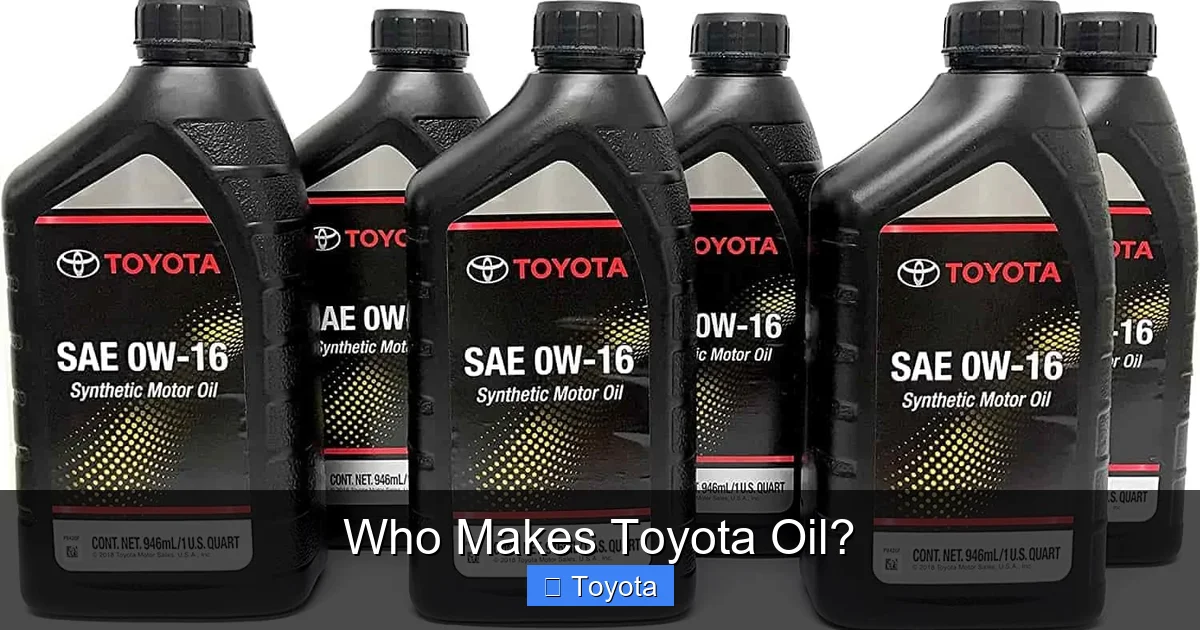
Visual guide about Who Makes Toyota Oil?
Image source: autoauxiliary.com
Not all oils labeled “Toyota” are created equal—and not all are truly “genuine.” So what sets Toyota Genuine Motor Oil apart from the rest?
Strict OEM Specifications
Every batch of TGMO must pass Toyota’s internal testing protocols, which go beyond standard industry certifications. These include:
– **Viscosity stability** across extreme temperatures
– **Shear resistance** to maintain film strength under pressure
– **Detergency and dispersancy** to prevent sludge and varnish
– **Compatibility** with Toyota’s engine materials (seals, gaskets, turbochargers)
– **Fuel economy performance** verified through dyno testing
For instance, Toyota’s 0W-20 oil isn’t just any 0W-20—it’s formulated to reduce internal friction by up to 15% compared to conventional oils, directly contributing to the 40+ mpg ratings in hybrids like the Prius.
Additive Technology Tailored for Toyota Engines
Modern Toyota engines—especially those with direct injection, variable valve timing (VVT-i), and turbocharging—demand specialized additive packages. TGMO includes:
– **Anti-wear agents** like zinc dialkyldithiophosphate (ZDDP) to protect camshafts and lifters
– **Friction modifiers** such as molybdenum compounds for smoother operation
– **Detergents and dispersants** to keep combustion byproducts suspended and prevent deposits
– **Anti-foaming agents** to ensure consistent oil flow under high RPM
These additives are carefully balanced to avoid over-treatment, which can lead to increased volatility or reduced fuel economy.
Validation Through Real-World Testing
Before any oil earns the “Toyota Genuine” label, it undergoes rigorous field testing in actual Toyota vehicles. Engineers log thousands of miles under diverse conditions—stop-and-go city traffic, highway cruising, mountain climbs, and extreme cold or heat—to verify performance and longevity.
This real-world validation ensures that TGMO doesn’t just meet lab benchmarks—it delivers in the real world, where your Toyota lives.
Can You Use Non-Toyota Oil in Your Toyota?
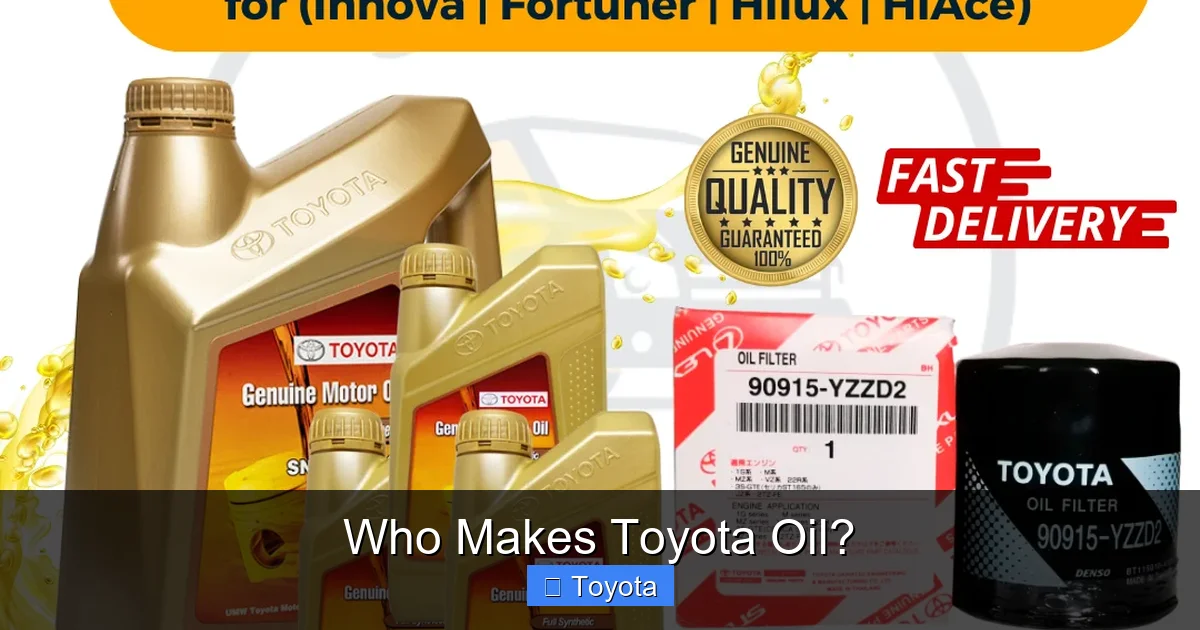
Visual guide about Who Makes Toyota Oil?
Image source: ph-test-11.slatic.net
Here’s a question we hear all the time: “If Toyota oil is made by ExxonMobil anyway, can I just buy Mobil 1 and call it a day?”
The short answer: **Yes—but with caveats.**
Aftermarket Oils That Meet Toyota Specs
Many high-quality aftermarket oils—like Mobil 1, Castrol EDGE, or Valvoline SynPower—are formulated to meet or exceed Toyota’s requirements. If the bottle displays the correct API donut (e.g., “SP” or “SN Plus”) and ILSAC GF-6A certification, and matches your owner’s manual viscosity (like 0W-20 or 5W-30), it’s likely safe to use.
For example, Mobil 1 Extended Performance 0W-20 is virtually identical in formulation to Toyota’s own 0W-20 TGMO, as both are produced by ExxonMobil under similar standards.
Risks of Using the Wrong Oil
However, using an oil that doesn’t meet Toyota’s specifications can lead to problems:
– **Increased engine wear** due to inadequate film strength
– **Reduced fuel economy** from improper viscosity or friction modifiers
– **Sludge buildup** in direct-injection engines if detergency is insufficient
– **Warranty issues** if a dealership determines improper oil contributed to engine damage
We’ve seen cases where owners used conventional 10W-30 in a 2020 RAV4 Hybrid, leading to premature wear on the hybrid motor bearings—components not designed for higher-viscosity oils.
How to Verify Compatibility
Always check your owner’s manual for the recommended oil type and look for these certifications on the bottle:
– **API Service Symbol** (e.g., SP, SN Plus)
– **ILSAC GF-6A** (for fuel-efficient engines)
– **Toyota-specific approvals** (sometimes listed as “Meets Toyota Standard” or “Approved for Toyota Hybrid Engines”)
If in doubt, stick with Toyota Genuine Motor Oil or a trusted aftermarket brand with documented compliance.
Choosing the Right Toyota Oil for Your Vehicle
Not all Toyotas use the same oil. Your model, year, engine type, and driving habits all influence the best choice.
Understanding Viscosity Grades
Viscosity—how thick or thin the oil is—is critical. Modern Toyotas typically use:
– **0W-20:** Standard for most new models (Camry, Corolla, RAV4, Prius). Offers excellent cold-start protection and fuel economy.
– **5W-30:** Common in older models or high-mileage engines. Slightly thicker for added protection in worn components.
– **5W-20 or 10W-30:** Found in select trucks or performance models (e.g., older Tacomas or Tundras).
Using the wrong viscosity can trigger warning lights, reduce efficiency, or even damage engine components.
Synthetic vs. Conventional
Nearly all new Toyotas require **full synthetic oil**. Synthetic oils offer:
– Better performance in extreme temperatures
– Longer service intervals (up to 10,000 miles with TGMO)
– Superior resistance to breakdown and sludge
Conventional oils are generally not recommended for post-2010 models, especially hybrids and turbocharged engines.
High-Mileage Considerations
If your Toyota has over 75,000 miles, consider a high-mileage formula—even if it’s Toyota Genuine. These oils contain extra conditioners to rejuvenate seals and reduce oil consumption, which is common in aging engines.
Driving Conditions Matter
– **Severe driving?** (short trips, towing, extreme heat/cold): Stick to the recommended oil but consider shorter change intervals.
– **Mostly highway driving?** You may safely extend intervals up to the manufacturer’s maximum (e.g., 10,000 miles with TGMO).
– **Hybrid vehicles?** Always use low-viscosity synthetic (0W-20) to protect the electric motor and ensure smooth engine restarts.
The Cost of Cutting Corners: Why Quality Oil Matters
It’s tempting to save a few bucks by buying the cheapest oil on the shelf. But engine oil is one of the most cost-effective maintenance investments you can make.
Long-Term Engine Health
Quality oil reduces friction, dissipates heat, and prevents contamination. Over time, this translates to:
– Fewer repairs (e.g., timing chain wear, turbo failure)
– Lower oil consumption
– Extended engine life (many Toyotas last 200,000+ miles with proper care)
A $50 oil change every 7,500 miles is far cheaper than a $3,000 engine rebuild.
Fuel Economy Impact
Using the correct low-viscosity synthetic oil can improve fuel economy by 1–2%. On a 25 mpg vehicle driving 15,000 miles per year, that’s an extra 60–120 gallons saved annually—worth $200–$400 at today’s prices.
Warranty and Resale Value
Toyota’s warranty requires using oil that meets its specifications. While they can’t void your warranty just for using a different brand, they can deny claims if improper oil contributed to failure. Plus, a well-maintained service history with genuine or approved oils boosts resale value.
Where to Buy Toyota Genuine Motor Oil
You don’t need to visit a dealership to get authentic TGMO—though that’s always an option.
Authorized Toyota Parts Retailers
Many online and brick-and-mortar auto parts stores carry Toyota Genuine Motor Oil. Look for authorized dealers like:
– ToyotaPartsDeal.com
– Parts.Toyota.com
– Local Toyota service centers
These sources guarantee authenticity and often offer competitive pricing.
Big-Box Retailers
Stores like AutoZone, O’Reilly, and Advance Auto Parts frequently stock TGMO, especially popular viscosities like 0W-20 and 5W-30. Just verify the packaging has the Toyota logo and part number (e.g., 08880-80727 for 0W-20).
DIY vs. Professional Changes
While you can buy TGMO and change it yourself, many owners prefer dealership or trusted independent shops for peace of mind. Professionals use OEM filters (like Toyota’s 90915-YZZF1) and follow proper disposal procedures—critical for environmental compliance.
Conclusion: Trust the Process, Protect Your Toyota
So, who makes Toyota oil? The answer is a collaboration between Toyota’s engineering excellence and the world’s leading lubricant manufacturers. Companies like ExxonMobil and Idemitsu produce Toyota Genuine Motor Oil to exact specifications, ensuring every bottle delivers the performance, protection, and efficiency your engine demands.
While you have options—including high-quality aftermarket oils—the safest choice is always one that meets or exceeds Toyota’s standards. Whether you’re driving a fuel-sipping Prius or a rugged Tacoma, the right oil is your engine’s first line of defense.
By understanding where your oil comes from and why it matters, you’re not just maintaining your vehicle—you’re honoring the engineering that makes Toyota one of the most reliable brands on the road. So next time you’re due for an oil change, remember: it’s not just about the fluid. It’s about the trust, science, and partnership behind every drop.
Frequently Asked Questions
Is Toyota oil made by Toyota?
No, Toyota does not manufacture its own motor oil. Instead, it partners with leading lubricant companies like ExxonMobil and Idemitsu to produce Toyota Genuine Motor Oil according to Toyota’s strict specifications.
Can I use Mobil 1 instead of Toyota oil?
Yes, if it meets the same viscosity and certification standards (e.g., 0W-20 with API SP and ILSAC GF-6A). Many Mobil 1 oils are made by the same manufacturer as Toyota oil and are compatible.
What happens if I use the wrong oil in my Toyota?
Using incorrect viscosity or low-quality oil can lead to increased engine wear, reduced fuel economy, sludge buildup, and potential warranty issues if damage occurs.
How often should I change Toyota Genuine Motor Oil?
Most modern Toyotas recommend changes every 7,500 to 10,000 miles when using full synthetic TGMO, but always check your owner’s manual for model-specific guidance.
Is Toyota oil synthetic?
Yes, all Toyota Genuine Motor Oil for current models is full synthetic, designed for superior performance, fuel economy, and engine protection.
Where can I buy authentic Toyota oil online?
You can purchase genuine Toyota oil from authorized retailers like ToyotaPartsDeal.com, Parts.Toyota.com, or major auto parts stores that carry OEM products.
