
Can You Tune a Toyota Camry?

Yes, you absolutely can tune a Toyota Camry—and it’s easier than you think. From mild software tweaks to full performance builds, tuning enhances power, throttle response, and fuel economy. Whether you drive a hybrid or a V6, there are safe, effective ways to unlock your Camry’s hidden potential.
Key Takeaways
- Yes, the Toyota Camry can be tuned: Modern Camrys, especially those with turbocharged or V6 engines, respond well to tuning for improved performance and efficiency.
- ECU tuning is the most effective method: Reprogramming the engine control unit (ECU) can increase horsepower, torque, and throttle response without major mechanical changes.
- Hybrid Camrys can also benefit: While limited, hybrid models can see improvements in throttle mapping and energy management through specialized tuning.
- Aftermarket support is growing: Brands like Cobb Tuning, Unichip, and DiabloSport offer plug-and-play solutions for recent Camry models.
- Warranty and reliability matter: Always choose reputable tuners and avoid aggressive tunes that could void your warranty or damage the engine.
- Supporting mods enhance results: Cold air intakes, exhaust upgrades, and high-flow filters work best when paired with a proper tune.
- DIY vs. professional tuning: Beginners should start with pre-loaded tunes; experienced users can explore custom mapping for maximum gains.
📑 Table of Contents
- Can You Tune a Toyota Camry? The Short Answer
- What Does “Tuning” a Car Mean?
- Which Toyota Camry Models Can Be Tuned?
- Popular Tuning Methods for the Toyota Camry
- Supporting Modifications That Enhance Tuning Results
- Is Tuning Your Camry Safe?
- DIY vs. Professional Tuning: Which Is Right for You?
- Real-World Results: What to Expect After Tuning
- Conclusion: Should You Tune Your Toyota Camry?
Can You Tune a Toyota Camry? The Short Answer
If you’re driving a Toyota Camry and wondering whether you can tune it for better performance, the answer is a resounding yes. Despite its reputation as a reliable family sedan, the Camry has evolved into a surprisingly capable platform for tuning—especially in recent years. Whether you’re behind the wheel of a fuel-efficient 4-cylinder, a powerful V6, or even a hybrid, there are tuning options that can enhance your driving experience.
Tuning a Camry isn’t just about squeezing out extra horsepower. It’s about refining how the car responds to your inputs, improving fuel economy, and making the drive feel more engaging. From subtle throttle response improvements to significant power gains, tuning can transform your Camry from a quiet commuter into a more spirited ride. And the best part? You don’t need to be a gearhead to do it.
What Does “Tuning” a Car Mean?

Visual guide about Can You Tune a Toyota Camry?
Image source: 2040-parts.com
Before diving into the specifics of tuning a Toyota Camry, it’s important to understand what “tuning” actually means. In automotive terms, tuning refers to modifying or reprogramming a vehicle’s electronic control systems—primarily the engine control unit (ECU)—to optimize performance, efficiency, or drivability.
The ECU is essentially the brain of your car. It manages everything from fuel injection and ignition timing to throttle response and emissions. When you tune a car, you’re adjusting the software that tells the ECU how to behave under different conditions. This can result in smoother acceleration, better fuel economy, or increased power output.
There are several types of tuning:
– ECU remapping: Reprogramming the factory software to change engine parameters.
– Piggyback tuning: Using an external device that intercepts and modifies signals between sensors and the ECU.
– Flash tuning: Overwriting the ECU’s firmware with a custom or pre-loaded performance map.
– Hybrid tuning: Adjusting power delivery and energy management in hybrid models.
For the Toyota Camry, ECU tuning—especially flash tuning—is the most common and effective method. It’s non-invasive, reversible, and can be done in under an hour with the right tools.
Which Toyota Camry Models Can Be Tuned?

Visual guide about Can You Tune a Toyota Camry?
Image source: s3.amazonaws.com
Not all Camrys are created equal when it comes to tuning potential. The good news is that most modern Camrys (2012 and newer) have ECUs that can be reprogrammed, especially those with turbocharged or naturally aspirated engines. Let’s break it down by engine type and generation.
4-Cylinder (2.5L Dynamic Force Engine)
The current-generation Camry (2018–present) features Toyota’s 2.5L Dynamic Force 4-cylinder engine. This engine is known for its efficiency and reliability, but it also has untapped performance potential. With a proper tune, you can expect gains of 10–15 horsepower and 10–20 lb-ft of torque. More importantly, tuning improves throttle response and eliminates the dreaded “lag” that some drivers complain about.
This engine responds well to flash tuning using tools like the Cobb Accessport or Unichip. These devices allow you to upload performance maps that adjust air-fuel ratios, ignition timing, and throttle mapping. Some tuners even offer eco-mode tunes that improve fuel economy by smoothing out power delivery.
V6 (3.5L 2GR-FKS Engine)
The 3.5L V6 in the Camry is a hidden gem. Producing around 301 horsepower in stock form, it’s already one of the most powerful engines in its class. But with tuning, you can push it even further. Expect gains of 20–30 horsepower and 25–35 lb-ft of torque with a quality tune.
This engine is highly tunable due to its robust internals and advanced variable valve timing (VVT-i). Tuners can optimize the VVT system for better low-end torque or high-RPM power, depending on your driving style. Combined with a cold air intake and cat-back exhaust, a tuned V6 Camry can feel like a sports sedan.
Turbocharged (Camry TRD or Aftermarket Builds)
While Toyota doesn’t offer a factory-turbocharged Camry, the TRD (Toyota Racing Development) trim and aftermarket builders have experimented with turbo kits. These setups can dramatically increase power—some reaching 400+ horsepower—but they require extensive supporting modifications.
For turbo builds, tuning is not optional—it’s essential. The ECU must be carefully mapped to handle the increased airflow, fuel demand, and boost pressure. Custom tuning by a professional is strongly recommended to avoid engine damage.
Hybrid Camry (2.5L Hybrid Synergy Drive)
Hybrid Camrys are trickier to tune because they rely on a complex interplay between the gasoline engine and electric motor. However, tuning is still possible—especially for throttle response and energy management.
Some tuners offer “hybrid performance” maps that reduce the delay between pressing the accelerator and engine response. Others adjust the battery usage to allow for more aggressive electric motor assist during acceleration. While power gains are minimal (5–10 hp at most), the improvement in drivability can be significant.
Popular Tuning Methods for the Toyota Camry
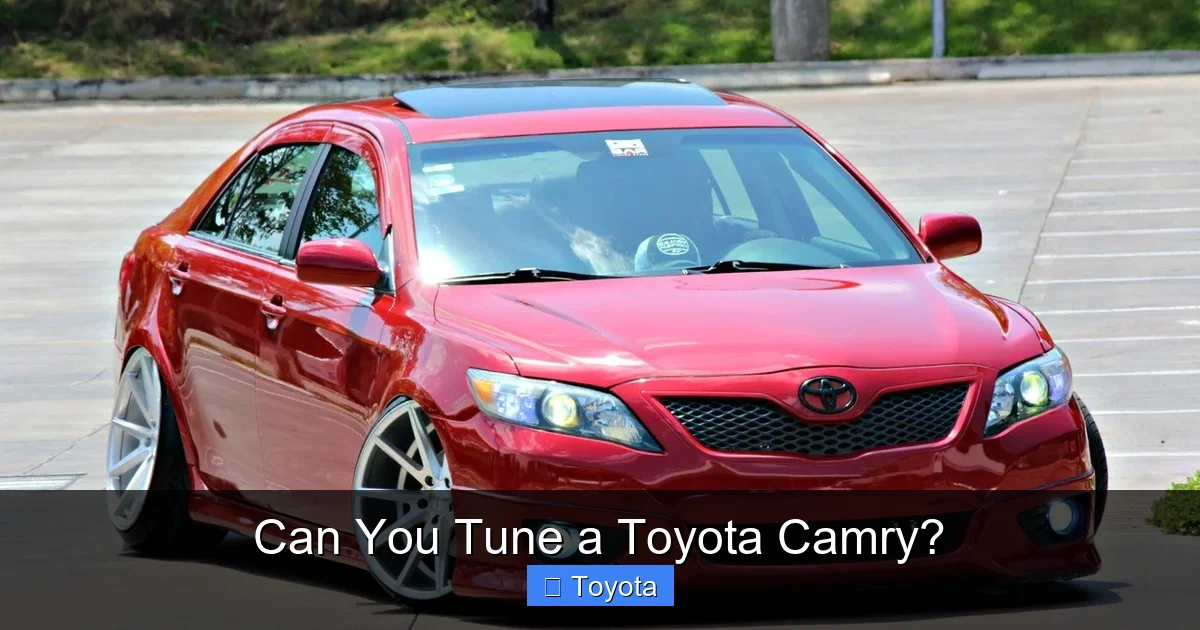
Visual guide about Can You Tune a Toyota Camry?
Image source: cartuning.ws
Now that we’ve covered which Camrys can be tuned, let’s explore the most effective methods. Each has its pros and cons, so choosing the right one depends on your goals, budget, and technical skill.
1. Flash Tuning (Recommended for Most Users)
Flash tuning is the gold standard for modern Camry tuning. It involves connecting a tuning device to your car’s OBD-II port and uploading a new software map to the ECU. This method is fast, reversible, and doesn’t require opening the engine bay.
Popular tools include:
– Cobb Accessport: One of the most trusted names in tuning. Offers pre-loaded maps for the Camry, including “Stage 1” (intake only) and “Stage 2” (intake + exhaust). Easy to use with a color screen and real-time data logging.
– DiabloSport inTune i3: A user-friendly option with a large library of tunes. Great for beginners who want plug-and-play simplicity.
– Unichip: A more advanced piggyback system that allows for custom tuning. Ideal for those planning future modifications.
Flash tuning typically costs between $400 and $700, depending on the device and tuner. Most users see noticeable improvements in throttle response, mid-range torque, and overall smoothness.
2. Piggyback Tuning (For Advanced Users)
Piggyback systems like the Unichip or JB4 (for turbo builds) don’t rewrite the ECU. Instead, they intercept sensor signals and modify them before they reach the ECU. This allows for real-time adjustments without altering the factory software.
Piggyback tuning is ideal for:
– Cars under warranty (since it doesn’t flash the ECU).
– Vehicles with limited tuning support.
– Users who want to experiment with custom maps.
However, piggyback systems require more installation effort and tuning knowledge. They’re best suited for enthusiasts who plan to add forced induction or other major mods.
3. Custom Tuning (For Maximum Performance)
If you’re serious about performance, custom tuning is the way to go. This involves working with a professional tuner who uses dyno testing and real-world data to create a personalized map for your Camry.
Custom tuning can optimize:
– Air-fuel ratios for power or efficiency.
– Ignition timing for knock resistance.
– Throttle mapping for responsiveness.
– Transmission shift points (on automatic models).
The cost ranges from $500 to $1,500, depending on the tuner and complexity. But the results are unmatched—especially when combined with supporting modifications.
Supporting Modifications That Enhance Tuning Results
Tuning works best when paired with the right hardware. While a tune alone can deliver impressive gains, adding performance parts can unlock even more potential. Here are the most effective supporting mods for your Camry.
Cold Air Intake (CAI)
A cold air intake replaces the stock airbox with a high-flow filter and smoother intake tubing. This allows the engine to breathe easier, especially at higher RPMs.
Benefits:
– Improved throttle response.
– Slight horsepower gain (5–10 hp).
– Aggressive engine sound.
Popular brands include K&N, AEM, and Injen. For best results, pair the intake with a tune that adjusts the MAF (mass airflow) sensor readings.
Cat-Back Exhaust System
A cat-back exhaust replaces the muffler and piping from the catalytic converter back. It reduces backpressure and improves exhaust flow.
Benefits:
– Deeper, sportier exhaust note.
– Minor power gains (5–15 hp, depending on design).
– Weight reduction.
Look for systems made from stainless steel with mandrel-bent tubing. Avoid overly loud systems if you drive daily—opt for a balanced tone instead.
High-Flow Air Filter
If a full intake is too much, a high-flow drop-in filter (like K&N) is a simple upgrade. It increases airflow without major changes.
Benefits:
– Easy installation.
– Reusable and washable.
– Noticeable improvement in engine sound and response.
Performance Throttle Body
Upgrading to a larger throttle body can improve airflow into the engine. This is especially effective on V6 models.
Benefits:
– Smoother throttle response.
– Better high-RPM performance.
Note: A tune is required to calibrate the new throttle body and prevent drive-by-wire issues.
Spark Plugs and Ignition Coils
High-performance spark plugs (like iridium or platinum) and upgraded ignition coils ensure a stronger, more consistent spark. This is crucial for tuned engines running higher boost or advanced timing.
Benefits:
– Improved combustion efficiency.
– Reduced misfires under load.
– Better fuel economy.
Is Tuning Your Camry Safe?
Safety is a top concern when modifying any vehicle. The good news is that tuning a Toyota Camry—when done correctly—is generally safe and reliable. Toyota engines are built to last, and modern ECUs are designed to handle a range of operating conditions.
However, there are risks to consider:
– Aggressive tunes can cause engine knock: This happens when fuel ignites prematurely, potentially damaging pistons or valves. Always use high-quality fuel (91+ octane) and avoid tunes that push the limits.
– Warranty implications: Modifying the ECU may void your powertrain warranty. Check with your dealer or use a piggyback system if warranty coverage is a concern.
– Transmission stress: Increased torque can strain the automatic transmission. Some tunes include shift point adjustments to reduce wear.
To stay safe:
– Choose reputable tuners with proven maps.
– Start with mild tunes and monitor engine parameters.
– Use a scan tool to check for error codes or knock events.
– Avoid tuning if your car has mechanical issues.
DIY vs. Professional Tuning: Which Is Right for You?
One of the biggest decisions tuners face is whether to do it themselves or hire a pro. Both options have merit, depending on your experience and goals.
DIY Tuning (Best for Beginners)
If you’re new to tuning, a plug-and-play device like the Cobb Accessport is ideal. These tools come with pre-loaded maps that are safe and effective for stock or lightly modified cars.
Pros:
– Easy to install and use.
– Reversible—you can return to stock anytime.
– Affordable entry point.
Cons:
– Limited customization.
– May not support future mods.
Professional Tuning (Best for Enthusiasts)
For maximum performance, a custom tune from a professional is the way to go. A tuner will use a dyno to measure power and fine-tune the map for your specific setup.
Pros:
– Optimized for your car and mods.
– Can handle complex builds (turbo, nitrous, etc.).
– Includes data logging and support.
Cons:
– More expensive.
– Requires finding a qualified tuner.
Real-World Results: What to Expect After Tuning
So, what can you actually expect after tuning your Camry? Let’s look at some real-world examples.
2018 Camry LE (2.5L 4-Cylinder)
– Stock: 203 hp, 184 lb-ft torque
– After Cobb Stage 1 tune: 215 hp, 195 lb-ft torque
– Improvements: Sharper throttle response, smoother acceleration, 2–3 mpg increase in highway driving.
2020 Camry XSE V6
– Stock: 301 hp, 267 lb-ft torque
– After custom tune + intake: 325 hp, 290 lb-ft torque
– Improvements: Noticeable mid-range pull, quicker 0–60 times, more aggressive exhaust note.
2019 Camry Hybrid
– Stock: 208 hp combined
– After hybrid performance tune: 215 hp, improved throttle response
– Improvements: Less lag off the line, better electric motor assist during acceleration.
These results show that tuning delivers tangible benefits—even on a car as practical as the Camry.
Conclusion: Should You Tune Your Toyota Camry?
Absolutely. Tuning your Toyota Camry is a smart, safe, and rewarding upgrade that enhances performance, drivability, and even fuel economy. Whether you drive a 4-cylinder, V6, or hybrid, there’s a tuning solution that fits your needs and budget.
Start with a reputable flash tuner like the Cobb Accessport for a hassle-free experience. Pair it with a cold air intake or high-flow filter for even better results. And if you’re serious about performance, consider a custom tune from a professional.
Remember: tuning isn’t just for sports cars. The Camry’s robust engineering and growing aftermarket support make it a surprisingly capable platform. With the right approach, you can enjoy a more engaging drive without sacrificing reliability.
So go ahead—unlock your Camry’s potential. You might be surprised at what this humble sedan can do.
Frequently Asked Questions
Can you tune a Toyota Camry hybrid?
Yes, you can tune a Toyota Camry hybrid, but the gains are more about drivability than power. Tuning improves throttle response and optimizes energy management between the engine and electric motor.
Will tuning my Camry void the warranty?
It depends. Flash tuning may void your powertrain warranty if detected by a dealer. Piggyback systems are less likely to cause issues. Always check your warranty terms before tuning.
How much horsepower can you gain from tuning a Camry?
Gains vary by engine. A 4-cylinder can gain 10–15 hp, while a V6 can gain 20–30 hp. Turbo builds can exceed 400 hp with proper supporting mods.
Is tuning a Camry expensive?
Basic flash tuners start around $400. Custom tuning can cost $500–$1,500. Supporting mods like intakes and exhausts add to the total cost.
Can I revert my Camry back to stock after tuning?
Yes. Most tuning devices allow you to restore the original ECU map at any time. This is useful for dealer visits or resale.
Do I need to tune my Camry if I only add an intake?
While not required, tuning is recommended. An intake changes airflow, and a tune ensures the ECU compensates properly for optimal performance and safety.