
How Much Does a Porsche Cayenne Weigh?

The Porsche Cayenne weighs between 4,700 and 5,300 pounds depending on the model, engine, and trim level. Factors like drivetrain, optional features, and body style significantly influence its overall weight, affecting handling, fuel efficiency, and towing capacity.
Key Takeaways
- Weight varies by model: The base Cayenne starts around 4,700 lbs, while high-performance variants like the Cayenne Turbo GT can exceed 5,300 lbs.
- Engine type matters: V6 models are lighter than V8 or hybrid versions due to larger engines and additional components.
- All-wheel drive adds weight: AWD systems increase curb weight by 100–200 lbs compared to rear-wheel-drive setups.
- Optional features impact mass: Panoramic roofs, air suspension, and premium interiors can add 50–150 lbs.
- Hybrid models are heavier: The Cayenne E-Hybrid includes a battery pack and electric motor, increasing weight by up to 400 lbs.
- Weight affects performance and efficiency: Heavier models may have slightly lower fuel economy but often deliver more power and stability.
- Payload and towing capacity are weight-dependent: Knowing your Cayenne’s weight helps determine safe cargo and trailer limits.
📑 Table of Contents
- How Much Does a Porsche Cayenne Weigh?
- Understanding Curb Weight and Why It Matters
- Porsche Cayenne Weight by Model and Trim
- Factors That Influence the Weight of a Porsche Cayenne
- How Weight Affects Towing and Payload Capacity
- Comparing Cayenne Weight to Competitors
- Tips for Managing Weight in Your Porsche Cayenne
- Conclusion
How Much Does a Porsche Cayenne Weigh?
If you’re considering buying a Porsche Cayenne—or you’re just curious about German engineering—you might be wondering: how much does a Porsche Cayenne actually weigh? It’s not a one-size-fits-all answer. The weight of a Porsche Cayenne depends on several factors, including the model year, engine type, drivetrain, trim level, and optional features. From the base Cayenne to the fire-breathing Turbo GT, the numbers can vary significantly.
Porsche has built the Cayenne as a luxury SUV that blends sports car performance with everyday practicality. But with that blend comes a range of configurations, each tipping the scales differently. Whether you’re comparing fuel efficiency, towing capacity, or handling dynamics, understanding the weight of your Cayenne is essential. It affects everything from acceleration and braking to ride comfort and cargo space.
In this guide, we’ll break down the weight of every major Cayenne variant, explain what contributes to the numbers, and help you understand how weight impacts real-world performance. Whether you’re shopping for a used 2015 Cayenne or eyeing the latest 2024 E-Hybrid, this article will give you the full picture.
Understanding Curb Weight and Why It Matters
Visual guide about How Much Does a Porsche Cayenne Weigh?
Image source: gearshifters.org
Before diving into specific numbers, it’s important to understand what “curb weight” means. Curb weight is the total weight of a vehicle with all standard equipment, a full tank of fuel, and all fluids—but without passengers or cargo. It’s the baseline measurement used by manufacturers and regulators to assess performance, safety, and efficiency.
Knowing the curb weight of your Porsche Cayenne helps you make informed decisions. For example, a heavier SUV may feel more stable on the highway but could have slightly lower fuel economy. It also affects how the vehicle handles corners, brakes, and accelerates. In performance terms, weight is a double-edged sword: more mass can mean better traction and comfort, but it can also slow down acceleration and increase stopping distances.
Additionally, curb weight plays a role in towing and payload capacity. The heavier the vehicle, the more it can typically tow—but only up to a point. Porsche designs the Cayenne with a balance in mind: enough weight for stability and power, but not so much that it sacrifices agility. That’s why even the heaviest Cayenne models still feel sporty behind the wheel.
How Weight Impacts Performance and Efficiency
Let’s talk about the real-world effects of weight. A lighter Cayenne, like the base model with a V6 engine, will generally accelerate faster and use less fuel than a heavier Turbo variant. For instance, the 2023 Cayenne with a 3.0L V6 weighs around 4,720 lbs and can go from 0 to 60 mph in about 5.9 seconds. In contrast, the Cayenne Turbo GT, weighing over 5,300 lbs, does it in just 3.1 seconds—thanks to its 631-horsepower engine.
So why is the heavier model faster? Because power matters more than weight in high-performance scenarios. The Turbo GT’s twin-turbo V8 and advanced aerodynamics more than compensate for the extra mass. But for daily driving, especially in city traffic, a lighter Cayenne may feel more responsive and easier to maneuver.
Fuel economy is another area where weight plays a role. The EPA estimates for the 2023 Cayenne V6 are 19 mpg city and 24 mpg highway. The Cayenne Turbo, despite its power, still manages 15 mpg city and 21 mpg highway—not bad for a 5,200-lb SUV. But the hybrid models, which are heavier due to batteries and electric motors, actually achieve better efficiency: the Cayenne E-Hybrid gets up to 46 MPGe combined.
In short, weight isn’t just a number—it’s a key factor in how your Cayenne drives, feels, and performs. Whether you prioritize speed, efficiency, or comfort, understanding the weight helps you choose the right model.
Porsche Cayenne Weight by Model and Trim
Visual guide about How Much Does a Porsche Cayenne Weigh?
Image source: motortrend.com
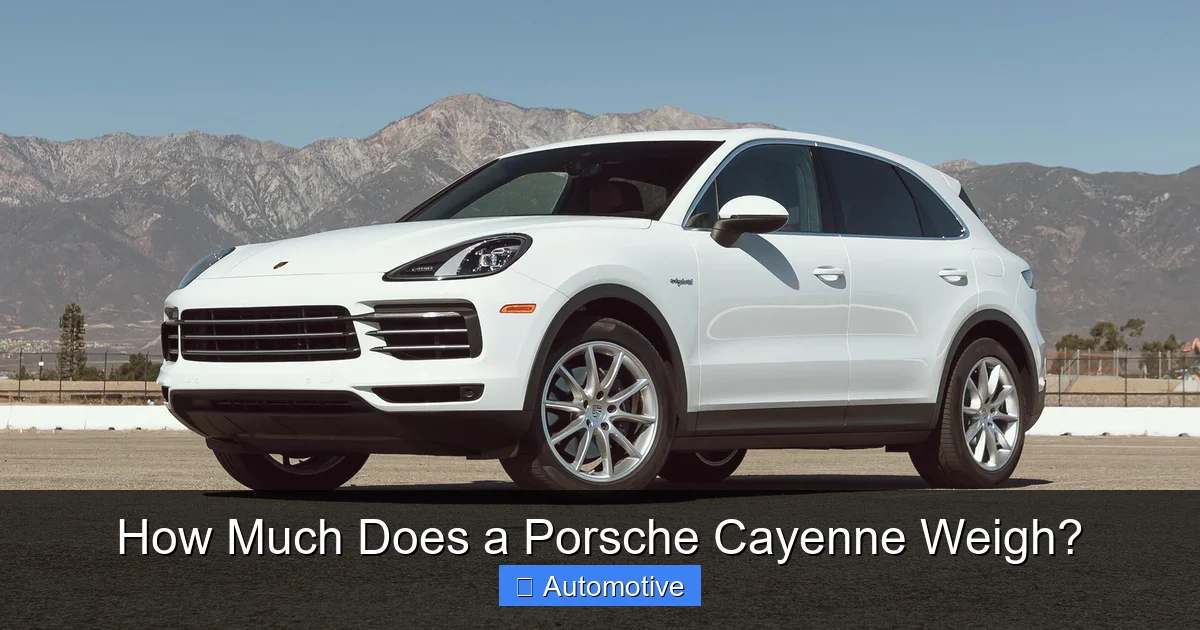
Now let’s get into the specifics. The weight of a Porsche Cayenne varies widely across the lineup. Here’s a detailed breakdown by model, engine, and drivetrain, based on the latest 2023–2024 models.
Base Cayenne (V6)
The entry-level Porsche Cayenne comes with a 3.0-liter turbocharged V6 engine producing 335 horsepower. It’s the lightest in the range, with a curb weight of approximately 4,720 lbs for the rear-wheel-drive (RWD) version. If you opt for all-wheel drive (AWD), which is standard on most trims, the weight increases slightly to around 4,800 lbs.
This model is ideal for buyers who want the Porsche badge and driving dynamics without the extreme power or price of the higher trims. It’s also the most fuel-efficient non-hybrid option, making it a smart choice for daily commuting and long trips.
Cayenne S (V8)
Stepping up to the Cayenne S introduces a 4.0-liter twin-turbo V8 engine with 468 horsepower. This upgrade adds both power and weight. The Cayenne S weighs about 4,950 lbs in AWD configuration. The larger engine, reinforced chassis components, and additional cooling systems contribute to the extra mass.
Despite the added weight, the Cayenne S remains agile and responsive. It accelerates from 0 to 60 mph in just 4.7 seconds—nearly a full second faster than the base model. The V8 also gives it a deeper exhaust note and more confident passing power on highways.
Cayenne GTS
The GTS trim is designed for driving enthusiasts. It features a sport-tuned suspension, upgraded brakes, and a more aggressive exhaust system. The engine is the same 4.0L V8 as the S, but tuned for 455 horsepower and sharper throttle response.
The Cayenne GTS weighs around 5,050 lbs. The sport suspension and additional performance components add weight, but the result is a more engaging driving experience. It’s lower, stiffer, and more planted through corners—perfect for weekend canyon runs or track days.
Cayenne Turbo and Turbo S
The Cayenne Turbo is where things get serious. With a 4.0-liter twin-turbo V8 producing 541 horsepower, it’s a true performance SUV. The Turbo weighs approximately 5,200 lbs, thanks to its larger engine, reinforced drivetrain, and luxury features like air suspension and premium sound systems.
The even more powerful Turbo S (discontinued after 2023) pushed output to 631 horsepower and weighed around 5,250 lbs. These models are built for speed and luxury, with 0–60 times under 3.5 seconds. They’re also equipped with advanced all-wheel steering and adaptive dampers for superior handling.
Cayenne Turbo GT
The pinnacle of the Cayenne lineup is the Turbo GT. Introduced in 2021, it’s the fastest production SUV Porsche has ever made. With 631 horsepower and a top speed of 186 mph, it’s a track-ready beast.
But all that performance comes at a cost—literally and in weight. The Turbo GT weighs about 5,300 lbs, making it the heaviest Cayenne. However, Porsche uses lightweight materials like carbon fiber for the roof and spoiler to offset some of the mass. It also features a roll cage, racing seats, and a stripped-down interior to enhance performance.
Despite its weight, the Turbo GT corners like a sports car, thanks to its rear-axle steering, active aerodynamics, and sticky Pirelli P Zero Corsa tires. It’s not the most practical SUV, but it’s one of the most thrilling to drive.
Cayenne E-Hybrid
The Cayenne E-Hybrid combines a 3.0-liter V6 engine with an electric motor for a total of 455 horsepower. It offers all-electric driving for short distances and improved fuel economy.
However, the hybrid system adds significant weight. The battery pack and electric motor increase the curb weight to around 5,100 lbs—about 400 lbs more than the base V6 model. This extra mass affects handling slightly, but the instant torque from the electric motor improves low-end acceleration.
The E-Hybrid is a great choice for eco-conscious buyers who still want Porsche performance. It can travel up to 14 miles on electric power alone and qualifies for federal tax credits in the U.S.
Factors That Influence the Weight of a Porsche Cayenne
Visual guide about How Much Does a Porsche Cayenne Weigh?
Image source: gearshifters.org
Now that we’ve covered the numbers, let’s explore what actually makes a Cayenne heavier or lighter. Several key factors contribute to the overall weight, and understanding them can help you customize your vehicle to your needs.
Engine and Drivetrain
The engine is one of the biggest contributors to weight. A V6 engine is lighter and more compact than a V8, which requires larger blocks, more cylinders, and additional cooling. Hybrid models add even more complexity with electric motors and battery packs.
Drivetrain also plays a role. All-wheel drive systems include extra components like a transfer case, driveshafts, and differentials, which add 100–200 lbs compared to rear-wheel drive. While AWD improves traction and stability, it does increase weight and can slightly reduce fuel economy.
Body Style and Materials
The Cayenne is available in several body styles: standard SUV, Coupe, and Cross Turismo (wagon-style). The Coupe version has a sloping roofline and is slightly lighter due to reduced interior volume and fewer structural reinforcements. The Cross Turismo, with its raised ride height and off-road features, is heavier.
Porsche uses a mix of steel, aluminum, and carbon fiber in the Cayenne’s construction. High-performance models like the Turbo GT use more aluminum and carbon fiber to reduce weight, while base models rely more on steel for cost savings.
Optional Features and Packages
Luxury and tech features can add significant weight. A panoramic sunroof, for example, adds about 50–70 lbs due to the glass panel and motorized mechanism. Air suspension systems, while improving ride quality, can add 100 lbs or more.
Premium interiors with leather seats, wood trim, and advanced sound systems also increase weight. The Burmester 3D surround sound system, for instance, includes multiple speakers and amplifiers that add bulk.
Even something as simple as larger wheels can make a difference. Upgrading from 19-inch to 22-inch wheels can add 20–30 lbs per corner, affecting both weight and ride comfort.
Hybrid and Electric Components
The Cayenne E-Hybrid’s battery pack alone weighs over 200 lbs. Combined with the electric motor, power electronics, and charging system, the total added weight can exceed 400 lbs compared to a non-hybrid model.
While this reduces efficiency slightly, the hybrid system provides instant torque and the ability to drive in electric-only mode, which can be useful in urban areas or for short commutes.
How Weight Affects Towing and Payload Capacity
One of the most practical reasons to know your Cayenne’s weight is to understand its towing and payload limits. These numbers are directly related to the vehicle’s curb weight and structural design.
Towing Capacity
The Porsche Cayenne is capable of towing up to 7,700 lbs when properly equipped. This is impressive for a luxury SUV and makes it suitable for hauling boats, trailers, or campers.
However, towing capacity depends on the model and drivetrain. The base V6 model can tow up to 7,700 lbs, while the Turbo and hybrid models may have slightly lower ratings due to their heavier components. Always check the owner’s manual or Porsche’s official towing guide for your specific configuration.
To tow safely, you’ll need a hitch receiver, wiring harness, and possibly a brake controller for heavier loads. Porsche offers a factory-installed tow package that includes all necessary components.
Payload Capacity
Payload capacity is the maximum weight your Cayenne can carry, including passengers, cargo, and accessories. It’s calculated by subtracting the curb weight from the gross vehicle weight rating (GVWR).
For example, if a Cayenne has a GVWR of 6,500 lbs and a curb weight of 4,800 lbs, its payload capacity is 1,700 lbs. That’s enough for five adults (about 850 lbs) and 850 lbs of luggage or gear.
Keep in mind that optional features like air suspension or heavy sound systems reduce payload capacity. If you plan to carry heavy loads regularly, consider a lighter trim or avoid unnecessary options.
Comparing Cayenne Weight to Competitors
How does the Porsche Cayenne stack up against rivals like the BMW X5, Mercedes-Benz GLE, and Audi Q7? Let’s take a quick look.
The BMW X5 xDrive40i weighs around 4,850 lbs—similar to the base Cayenne. The Mercedes GLE 450 is slightly heavier at about 5,000 lbs, while the Audi Q7 tips the scales at 5,100 lbs.
Performance variants tell a different story. The BMW X5 M Competition weighs 5,400 lbs, the Mercedes-AMG GLE 63 S is around 5,500 lbs, and the Audi RS Q8 is nearly 5,600 lbs. The Cayenne Turbo GT, at 5,300 lbs, is lighter than all of them, yet still one of the fastest.
This shows Porsche’s focus on balancing weight and performance. Even though the Cayenne isn’t the lightest in its class, it often outperforms heavier competitors thanks to superior engineering and aerodynamics.
Tips for Managing Weight in Your Porsche Cayenne
If you already own a Cayenne or are planning to buy one, here are some tips to manage weight and optimize performance:
- Choose options wisely: Avoid unnecessary heavy features like panoramic roofs or oversized wheels if you prioritize efficiency or handling.
- Keep it clean: Remove heavy items from the trunk when not needed. Even 50 lbs of extra cargo can affect fuel economy.
- Use lightweight accessories: Opt for aluminum roof racks instead of steel, and consider carbon fiber trim for a sporty look without the weight.
- Maintain proper tire pressure: Underinflated tires increase rolling resistance and can make the car feel heavier.
- Consider a lighter trim: If you don’t need V8 power, the base V6 or E-Hybrid offers a great balance of performance and efficiency.
Conclusion
So, how much does a Porsche Cayenne weigh? The answer depends on which one you’re looking at. From the 4,720-lb base model to the 5,300-lb Turbo GT, the Cayenne lineup covers a wide range of weights—each tailored to different driving needs and preferences.
Weight affects everything from fuel economy and acceleration to towing capacity and ride comfort. While heavier models offer more power and luxury, lighter versions provide better efficiency and agility. The key is finding the right balance for your lifestyle.
Whether you’re drawn to the sporty handling of the GTS, the eco-friendly appeal of the E-Hybrid, or the raw power of the Turbo GT, understanding the weight of your Porsche Cayenne helps you make the most of your driving experience. After all, in the world of high-performance SUVs, every pound counts.
Frequently Asked Questions
What is the lightest Porsche Cayenne model?
The lightest Porsche Cayenne is the base model with a 3.0L V6 engine and rear-wheel drive, weighing approximately 4,720 lbs. All-wheel drive versions are slightly heavier at around 4,800 lbs.
How much does a Porsche Cayenne Turbo weigh?
The Porsche Cayenne Turbo weighs about 5,200 lbs. It features a 4.0L twin-turbo V8 engine, air suspension, and other performance components that contribute to its higher weight.
Why is the Cayenne E-Hybrid heavier than the base model?
The Cayenne E-Hybrid is heavier due to its battery pack, electric motor, and power electronics. These components can add up to 400 lbs compared to the non-hybrid V6 model.
Does weight affect the Cayenne’s fuel economy?
Yes, weight impacts fuel economy. Heavier models like the Turbo and E-Hybrid may have lower mpg, but the hybrid system can improve efficiency in city driving through electric-only operation.
Can I reduce the weight of my Porsche Cayenne?
You can reduce weight by removing unnecessary cargo, choosing lighter accessories, and avoiding heavy optional features. However, major weight reduction would require aftermarket modifications.
What is the towing capacity of a Porsche Cayenne?
The Porsche Cayenne can tow up to 7,700 lbs when properly equipped. Towing capacity may vary slightly depending on the model and drivetrain configuration.