
What Is Rsca on a Toyota Tacoma

RSCA on a Toyota Tacoma stands for Rollover Stability Control with Active Braking. It’s a safety feature designed to help prevent rollovers and maintain vehicle stability during sharp turns or sudden maneuvers. This system works alongside other safety technologies to keep you and your passengers safe on and off the road.
If you’ve ever driven a Toyota Tacoma—especially a newer model—you might have noticed a small warning light on your dashboard that looks like a car tipping over. That’s the RSCA indicator. But what exactly is RSCA on a Toyota Tacoma? And why should you care about it?
Let’s break it down in simple terms. RSCA stands for **Rollover Stability Control with Active Braking**. It’s one of Toyota’s advanced safety technologies designed to help prevent your truck from rolling over during extreme driving situations. Think of it as your Tacoma’s built-in guardian angel, especially when you’re navigating tight corners, sudden swerves, or uneven terrain.
Now, you might be thinking, “My Tacoma already has traction control and ABS. Isn’t that enough?” While those systems are important, RSCA goes a step further. It specifically targets rollover risks—something that’s especially relevant for taller, narrower vehicles like pickup trucks. The Tacoma, with its high center of gravity, can be more prone to tipping in certain scenarios. That’s where RSCA steps in to help keep all four wheels planted firmly on the ground.
Key Takeaways
- What RSCA means: RSCA stands for Rollover Stability Control with Active Braking, a key safety system in select Toyota Tacoma models.
- How it works: It uses sensors to detect potential rollover conditions and applies brakes to individual wheels to help stabilize the vehicle.
- When it activates: RSCA typically engages during sharp turns, sudden steering inputs, or uneven terrain, especially at higher speeds.
- Part of a safety suite: RSCA works with other systems like VSC (Vehicle Stability Control) and TRAC (Traction Control) for comprehensive protection.
- Not on all models: RSCA is primarily found in newer Tacoma models, especially those with higher trim levels or off-road packages.
- Maintenance matters: Keeping your Tacoma’s sensors and braking system in good condition ensures RSCA functions properly.
- Real-world benefits: Drivers report increased confidence on winding roads, mountain passes, and off-road trails thanks to RSCA.
📑 Table of Contents
Understanding RSCA: The Basics
So, what exactly is RSCA on a Toyota Tacoma? At its core, RSCA is an electronic stability system that monitors your truck’s movement in real time. It uses a network of sensors—including yaw rate sensors, lateral acceleration sensors, and steering angle sensors—to detect when the vehicle might be at risk of rolling over.
When the system senses that the Tacoma is leaning too far to one side or beginning to tip, it automatically applies the brakes to specific wheels. This braking action helps counteract the roll motion and brings the vehicle back into a stable position. In some cases, it may also reduce engine power to slow the truck down and give the driver more control.
It’s important to note that RSCA is not a substitute for safe driving. It’s a supplemental safety feature that works best when combined with responsible driving habits. But in those split-second moments when things go wrong—like hitting a pothole mid-turn or swerving to avoid an obstacle—RSCA can make a real difference.
How RSCA Differs from Other Stability Systems
You might be wondering how RSCA compares to other systems like VSC (Vehicle Stability Control) or TRAC (Traction Control). While they all work together, each has a specific role.
– **VSC (Vehicle Stability Control):** Helps prevent skidding and loss of control by adjusting engine power and applying brakes when it detects sideways slipping.
– **TRAC (Traction Control):** Prevents wheel spin during acceleration, especially on slippery surfaces.
– **RSCA (Rollover Stability Control with Active Braking):** Focuses specifically on preventing rollovers by monitoring the vehicle’s tilt and applying targeted braking to stabilize it.
In short, VSC and TRAC help you stay on the road, while RSCA helps keep you from flipping off it. All three systems often work in tandem, especially in modern Tacomas equipped with Toyota Safety Sense.
When Does RSCA Activate?
RSCA doesn’t kick in all the time—only when the system detects a potential rollover risk. This usually happens in situations like:
– Taking a sharp turn too quickly
– Swerving suddenly to avoid an obstacle
– Driving on steep inclines or declines
– Navigating off-road trails with uneven terrain
– Driving with a heavy load in the bed (which raises the center of gravity)
For example, imagine you’re driving up a mountain road with tight switchbacks. You take a corner a little too fast, and your Tacoma starts to lean outward. The RSCA sensors detect the lateral force and the risk of tipping. Instantly, the system applies the inside rear brake to help level the truck and reduce the roll angle. You might not even notice it happening—but your Tacoma just avoided a potentially dangerous situation.
How RSCA Works: A Closer Look
Visual guide about What Is Rsca on a Toyota Tacoma
Image source: tacomaexplorer.com
Now that we know what RSCA is and when it activates, let’s dive deeper into how it actually works. Understanding the mechanics can help you appreciate just how advanced this system is—and why it’s such a valuable feature in your Tacoma.
At the heart of RSCA is a sophisticated network of sensors and a central control unit. These components constantly monitor the vehicle’s dynamics and make split-second decisions to maintain stability.
The Role of Sensors
The system relies on several key sensors:
– **Yaw Rate Sensor:** Measures how fast the vehicle is rotating around its vertical axis (like spinning in a circle).
– **Lateral Acceleration Sensor:** Detects side-to-side movement, such as when the truck leans during a turn.
– **Steering Angle Sensor:** Tracks the direction and speed of steering input.
– **Wheel Speed Sensors:** Monitor how fast each wheel is turning.
These sensors feed data to the RSCA control module dozens of times per second. If the system detects that the lateral force is too high—meaning the truck is leaning dangerously to one side—it triggers corrective action.
Active Braking and Engine Control
When a rollover risk is detected, RSCA responds in two main ways:
1. **Selective Braking:** The system applies the brakes to one or more wheels—usually the inside rear wheel during a turn. This creates a counteracting force that helps level the vehicle and reduce roll.
2. **Engine Power Reduction:** In some cases, RSCA may signal the engine control unit to reduce power output. This slows the vehicle down and gives the driver more time to react.
For instance, if you’re driving a loaded Tacoma down a steep hill and take a sharp left turn, the truck might start to tip to the right. RSCA detects the imbalance and applies the right rear brake while slightly reducing engine power. The result? Your Tacoma stays level and under control.
Integration with Other Systems
RSCA doesn’t work in isolation. It’s part of a broader safety ecosystem in the Toyota Tacoma. It communicates with:
– **VSC (Vehicle Stability Control):** To manage overall vehicle dynamics.
– **ABS (Anti-lock Braking System):** To ensure brakes don’t lock up during emergency braking.
– **TRAC (Traction Control):** To maintain grip during acceleration.
This integration ensures that all systems work together seamlessly. For example, if RSCA detects a rollover risk and applies the brakes, ABS ensures the wheels don’t skid, while VSC helps keep the truck pointed in the right direction.
RSCA in Real-World Driving Scenarios
Visual guide about What Is Rsca on a Toyota Tacoma
Image source: image.cnbcfm.com
To truly understand the value of RSCA, it helps to see how it performs in real-life situations. Let’s explore a few common driving scenarios where this system can make a big difference.
Off-Roading on Uneven Terrain
One of the Tacoma’s biggest strengths is its off-road capability. Whether you’re tackling rocky trails, muddy paths, or sandy dunes, your truck is built to handle it. But off-roading also increases the risk of rollovers—especially on side slopes or when navigating obstacles.
Imagine you’re driving up a steep, rocky incline. One wheel hits a large rock, causing the truck to tilt sharply to the side. Without RSCA, this could be the start of a dangerous roll. But with RSCA active, the system detects the sudden shift in balance and applies the appropriate brakes to stabilize the vehicle. It might even reduce engine power to prevent further tipping.
Many off-road enthusiasts report that RSCA gives them more confidence to explore challenging terrain. It’s not a license to drive recklessly, but it does provide an extra layer of protection when things get rough.
Highway Driving and Sudden Maneuvers
Even on paved roads, RSCA can be a lifesaver. Picture this: You’re cruising down the highway at 70 mph when a car suddenly cuts you off. You swerve to avoid a collision, and your Tacoma leans hard to the left. In that moment, RSCA activates, applying the right-side brakes to counteract the roll and keep your truck stable.
This kind of scenario is exactly what RSCA was designed for. It reacts faster than a human ever could, giving you precious milliseconds to regain control.
Driving with a Heavy Load
If you use your Tacoma for hauling—whether it’s construction materials, camping gear, or a trailer—you know that a heavy load can affect handling. The added weight raises the center of gravity, making the truck more prone to tipping.
RSCA is especially valuable in these situations. It continuously monitors the vehicle’s balance and adjusts braking as needed. So whether you’re towing a camper through winding mountain roads or carrying a full bed of firewood, RSCA helps keep your Tacoma stable.
Which Toyota Tacoma Models Have RSCA?
Visual guide about What Is Rsca on a Toyota Tacoma
Image source: twstatic.net
Now that you know what RSCA is and how it works, you’re probably wondering: Does my Tacoma have it?
The good news is that RSCA is available on many newer Toyota Tacoma models—especially those equipped with advanced safety packages. However, it’s not standard on every trim level or model year.
Model Years and Trim Levels
RSCA was introduced in the mid-2010s and became more common in the 2016 and newer Tacoma models. It’s typically found on:
– **TRD Off-Road and TRD Pro trims:** These models are designed for rugged use and often include RSCA as part of their safety suite.
– **Limited and SR5 trims with optional packages:** Some higher-end SR5 and Limited models include RSCA when equipped with the Toyota Safety Sense package.
– **Models with Toyota Safety Sense (TSS):** RSCA is often bundled with TSS, which includes features like pre-collision braking, lane departure warning, and adaptive cruise control.
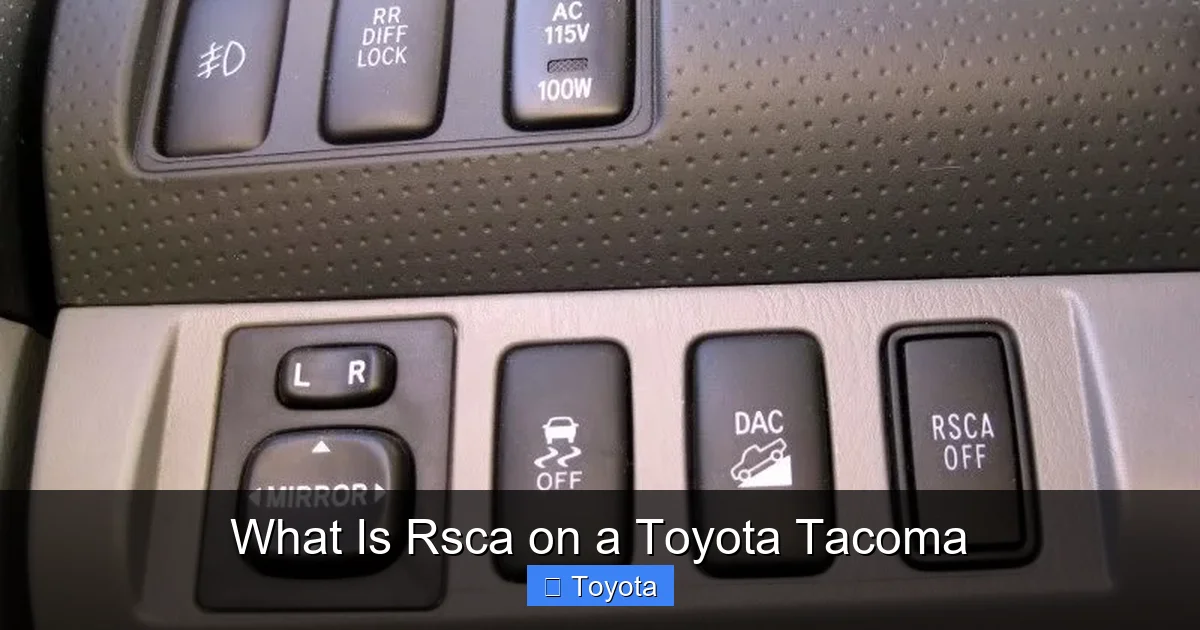
If you’re unsure whether your Tacoma has RSCA, check your owner’s manual or look for the RSCA warning light on your dashboard. It usually appears as a yellow icon showing a car tipping over, often labeled “RSCA OFF” or “VSC OFF” (since the systems are linked).
How to Confirm RSCA Is Active
Most Tacomas with RSCA have the system enabled by default. However, some drivers may accidentally turn it off—especially if they’ve used the VSC OFF button (which often disables RSCA as well).
To check if RSCA is active:
1. Start your truck and wait for the dashboard lights to cycle.
2. Look for the RSCA or VSC warning light. If it’s off, the system is active.
3. If the light is on, press and hold the VSC OFF button (usually located near the gear shift) for a few seconds to reactivate it.
Note: Some off-roaders intentionally disable RSCA for extreme rock crawling, where full wheel articulation is needed. But for everyday driving, it’s best to keep it on.
Maintaining Your RSCA System
Like any advanced safety feature, RSCA works best when your Tacoma is well-maintained. Here are some tips to keep the system functioning properly:
Regular Sensor Checks
The sensors that feed data to RSCA can become dirty or damaged, especially if you drive off-road. Mud, dirt, and debris can block sensor inputs, leading to false readings or system failures.
– Clean your wheel speed sensors and undercarriage regularly.
– Avoid spraying high-pressure water directly at sensors during washing.
– If you notice the RSCA light comes on frequently, have the sensors inspected.
Brake System Maintenance
Since RSCA relies on the braking system to stabilize the vehicle, it’s crucial to keep your brakes in top condition.
– Replace brake pads and rotors as recommended.
– Check brake fluid levels and flush the system every 30,000–50,000 miles.
– Listen for unusual noises or vibrations when braking—these could indicate a problem.
Software Updates
Toyota occasionally releases software updates for safety systems like RSCA. These updates can improve performance, fix bugs, or enhance compatibility with other systems.
– Visit your local Toyota dealer for periodic diagnostics.
– Ask if any recalls or updates apply to your vehicle’s safety systems.
Driving Habits Matter
Finally, remember that RSCA is a safety aid—not a cure for poor driving. To get the most out of it:
– Avoid sudden, aggressive maneuvers.
– Slow down for sharp turns, especially when loaded.
– Distribute weight evenly in the bed.
– Never disable RSCA unless absolutely necessary (e.g., extreme off-roading).
The Future of RSCA and Toyota Safety
As automotive technology evolves, so does RSCA. Toyota continues to refine its safety systems, integrating more advanced sensors, AI-driven algorithms, and predictive analytics.
In newer models, RSCA is often part of a broader suite called **Toyota Safety Sense (TSS)**. This includes features like:
– **Pre-Collision System (PCS):** Detects vehicles, pedestrians, and cyclists.
– **Lane Departure Alert (LDA):** Warns you if you drift out of your lane.
– **Dynamic Radar Cruise Control (DRCC):** Maintains a set distance from the car ahead.
The goal is to create a safer, more intuitive driving experience. And as autonomous driving technology advances, systems like RSCA will play an even bigger role in preventing accidents before they happen.
For Tacoma owners, this means peace of mind—knowing that your truck is equipped with some of the most advanced safety technology on the market.
Conclusion: Why RSCA Matters for Tacoma Owners
So, what is RSCA on a Toyota Tacoma? It’s more than just a dashboard light or a technical acronym. It’s a sophisticated safety system designed to protect you, your passengers, and your vehicle from one of the most dangerous types of accidents: rollovers.
By using real-time data and active braking, RSCA helps keep your Tacoma stable in critical moments. Whether you’re navigating a winding mountain road, swerving to avoid debris, or tackling a rocky trail, this system works silently in the background to keep you safe.
While no safety feature can replace responsible driving, RSCA adds an essential layer of protection—especially for a vehicle as versatile and capable as the Toyota Tacoma. If your truck is equipped with it, make sure it’s active and well-maintained. And if you’re shopping for a used Tacoma, look for models with RSCA to get the full benefit of Toyota’s commitment to safety.
In the end, RSCA isn’t just about technology—it’s about confidence. It’s the peace of mind that comes from knowing your Tacoma has your back, no matter where the road takes you.
Frequently Asked Questions
What does RSCA stand for on a Toyota Tacoma?
RSCA stands for Rollover Stability Control with Active Braking. It’s a safety system designed to help prevent rollovers by applying brakes to specific wheels when the vehicle detects a risk of tipping.
Is RSCA standard on all Toyota Tacoma models?
No, RSCA is not standard on all Tacoma models. It’s typically found on newer models, especially TRD Off-Road, TRD Pro, and Limited trims, or those equipped with Toyota Safety Sense.
Can I turn off RSCA on my Tacoma?
Yes, RSCA can usually be turned off by pressing the VSC OFF button, which often disables both VSC and RSCA. However, it’s recommended to keep it on for everyday driving.
What triggers the RSCA warning light?
The RSCA warning light may come on if the system is disabled, a sensor is malfunctioning, or there’s a problem with the braking or stability systems. If it stays on, have your truck inspected.
Does RSCA work when towing?
Yes, RSCA can help stabilize your Tacoma when towing, especially during sharp turns or sudden maneuvers. It’s particularly useful when carrying heavy loads that raise the center of gravity.
How is RSCA different from VSC?
While VSC helps prevent skidding and loss of control, RSCA specifically targets rollover risks by monitoring the vehicle’s tilt and applying targeted braking to keep it level.
