
How Fast Does a Toyota Camry Go?

The Toyota Camry is known for reliability, not speed—but don’t underestimate it. Depending on the trim and engine, a Camry can reach top speeds between 115 and 135 mph, with 0–60 mph times as low as 5.8 seconds in performance-focused trims.
Key Takeaways
- Top speed varies by model: Most Camrys max out between 115–135 mph, with the TRD and V6 trims leading the pack.
- 0–60 mph in under 6 seconds: The V6 and hybrid performance variants can accelerate from 0 to 60 mph in as little as 5.8 seconds.
- Engine options matter: Four-cylinder, V6, and hybrid powertrains offer different speed and efficiency trade-offs.
- Aerodynamics and weight affect performance: Sleeker designs and lighter materials help improve speed and handling.
- Electronic limiters are common: Many Camrys have speed limiters for safety and fuel economy, not mechanical limits.
- Real-world driving differs from lab tests: Road conditions, altitude, and load impact actual performance.
- Maintenance boosts speed potential: Regular tune-ups and quality fuel help your Camry perform at its best.
📑 Table of Contents
- How Fast Does a Toyota Camry Go? A Deep Dive into Speed and Performance
- Understanding Camry Speed: Top Speed vs. Acceleration
- Camry Engine Options and Their Speed Impact
- Camry Top Speeds by Model Year and Trim
- Factors That Influence Real-World Camry Performance
- How the Camry Compares to Competitors
- Tips to Maximize Your Camry’s Speed and Performance
- Conclusion: Is the Camry Fast Enough for You?
How Fast Does a Toyota Camry Go? A Deep Dive into Speed and Performance
When you think of speed, a Toyota Camry probably isn’t the first car that comes to mind. It’s not a sports car. It’s not a muscle machine. But that doesn’t mean it’s slow. In fact, the Camry has quietly evolved into a surprisingly capable sedan when it comes to acceleration and top speed—especially in its higher trims.
So, how fast does a Toyota Camry go? The answer depends on which model year, engine, and trim level you’re looking at. But across the board, the Camry delivers a smooth, responsive ride that can surprise drivers expecting a sluggish family sedan. Whether you’re merging onto a highway or passing on a two-lane road, the Camry has enough punch to get the job done—and then some.
In this guide, we’ll break down everything you need to know about the Camry’s speed, from top speeds and 0–60 times to engine specs and real-world performance. We’ll also look at how different models compare, what affects speed, and how to get the most out of your Camry’s performance. Whether you’re a current owner or considering a purchase, this article will help you understand just how fast—and how fun—a Camry can be.
Understanding Camry Speed: Top Speed vs. Acceleration

Visual guide about How Fast Does a Toyota Camry Go?
Image source: eduautos.com
Before we dive into numbers, it’s important to understand the difference between top speed and acceleration. Top speed is the maximum velocity a car can reach under ideal conditions. Acceleration, on the other hand, measures how quickly a car can go from 0 to 60 mph—a key factor in everyday driving.
For most drivers, acceleration matters more than top speed. You’ll rarely (if ever) drive at 130 mph on public roads. But quick acceleration helps when merging, passing, or navigating busy intersections. The Camry excels in this area, especially in models with more powerful engines.
Top speed in the Camry is often electronically limited. This means the car’s computer stops it from going faster than a certain speed, usually for safety, fuel efficiency, or tire rating reasons. For example, many Camrys are limited to 115–135 mph, even if the engine could technically go faster.
Acceleration, however, is where the Camry shines in certain trims. The V6 and performance-oriented models like the TRD can sprint from 0 to 60 mph in under six seconds—faster than many drivers expect from a midsize sedan.
What Affects a Camry’s Top Speed?
Several factors influence how fast a Camry can go:
– **Engine power:** More horsepower and torque mean higher potential speed.
– **Aerodynamics:** A sleeker shape reduces drag, allowing the car to cut through the air more efficiently.
– **Weight:** Lighter cars accelerate faster and can reach higher speeds with the same engine.
– **Transmission:** An 8-speed automatic shifts quicker and more efficiently than older 6-speed systems.
– **Tires:** High-performance tires provide better grip and can handle higher speeds safely.
– **Electronic limiters:** Most modern Camrys have speed governors that cap top speed.
For example, a 2023 Camry TRD with the 3.5L V6 engine has more horsepower and a sport-tuned suspension, helping it reach a higher top speed than a base 4-cylinder model. But even the base model can hit 115 mph—plenty fast for legal driving.
Real-World vs. Lab Test Speeds
Manufacturers often publish top speeds based on ideal conditions: flat roads, no wind, perfect weather, and a professional driver. In the real world, your Camry might not hit those exact numbers. Altitude, temperature, road surface, and even how much fuel you’re carrying can affect performance.
For instance, driving at high altitude (like in Denver) reduces engine power because there’s less oxygen for combustion. This can lower both acceleration and top speed. Similarly, a fully loaded Camry with five passengers and luggage will be slower than one with just the driver.
That said, the Camry’s speed ratings are still reliable indicators of performance. Even with real-world variables, you can expect consistent results across similar models.
Camry Engine Options and Their Speed Impact
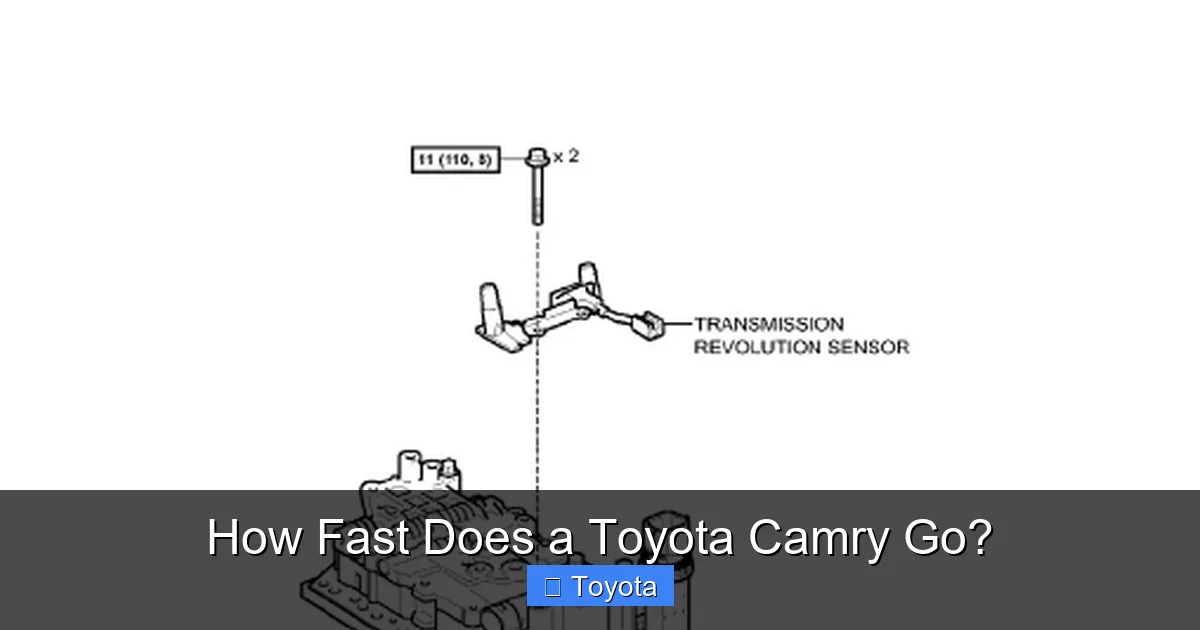
Visual guide about How Fast Does a Toyota Camry Go?
Image source: cimg8.ibsrv.net
One of the biggest factors in how fast a Toyota Camry goes is the engine under the hood. Over the years, Toyota has offered several powertrains, each with different performance characteristics.
Let’s break down the main engine options and how they affect speed.
2.5L Four-Cylinder Engine (Base Model)
The standard engine in most Camrys is a 2.5-liter four-cylinder. In recent models (2021–2024), this engine produces around 203 horsepower and 184 lb-ft of torque. It’s paired with an 8-speed automatic transmission.
This engine is tuned for efficiency, not speed. But don’t let that fool you—it’s still capable. The 0–60 mph time is around 7.5 to 8 seconds, which is respectable for a base midsize sedan. Top speed is electronically limited to about 115 mph.
This engine is perfect for daily commuting, highway cruising, and fuel economy. It won’t win any drag races, but it gets the job done with smooth, reliable power.
3.5L V6 Engine (Mid to High Trims)
Step up to the V6, and the Camry becomes a different animal. The 3.5-liter V6 produces 301 horsepower and 267 lb-ft of torque—a significant jump from the four-cylinder.
This engine is available in trims like the XSE, XLE, and TRD. With this power, the Camry can accelerate from 0 to 60 mph in just 5.8 seconds. That’s faster than many entry-level sports cars.
Top speed increases to around 130–135 mph, depending on the model year and trim. The V6 also improves passing power and highway merging, making long drives more enjoyable.
One downside? Fuel economy takes a hit. The V6 gets about 22–24 mpg combined, compared to 30+ mpg for the four-cylinder. But if performance is your priority, the V6 is worth the trade-off.
Hybrid Powertrain (Hybrid Models)
The Camry Hybrid combines a 2.5-liter four-cylinder engine with an electric motor. Total system output is around 208 horsepower—slightly more than the base engine.
Interestingly, the hybrid can feel quicker in city driving because electric motors deliver instant torque. The 0–60 mph time is similar to the base engine, around 7.5 seconds.
Top speed is limited to about 115 mph, same as the non-hybrid four-cylinder. But the hybrid shines in efficiency, getting up to 52 mpg on the highway.
While not the fastest Camry, the hybrid offers a great balance of speed, efficiency, and low emissions. It’s ideal for eco-conscious drivers who still want a responsive ride.
TRD Performance Trim
For drivers who want a sportier Camry, the TRD (Toyota Racing Development) trim is the way to go. Available with the V6 engine, the TRD adds performance upgrades like:
– Sport-tuned suspension
– Rear spoiler and aerodynamic body kit
– 19-inch alloy wheels
– Sport exhaust system
– Red brake calipers
These changes don’t drastically increase horsepower, but they improve handling, cornering, and overall driving dynamics. The TRD feels more planted and responsive, especially on winding roads.
Acceleration remains around 5.8 seconds to 60 mph, but the driving experience is more engaging. It’s the closest thing to a “sport sedan” in the Camry lineup.
Camry Top Speeds by Model Year and Trim
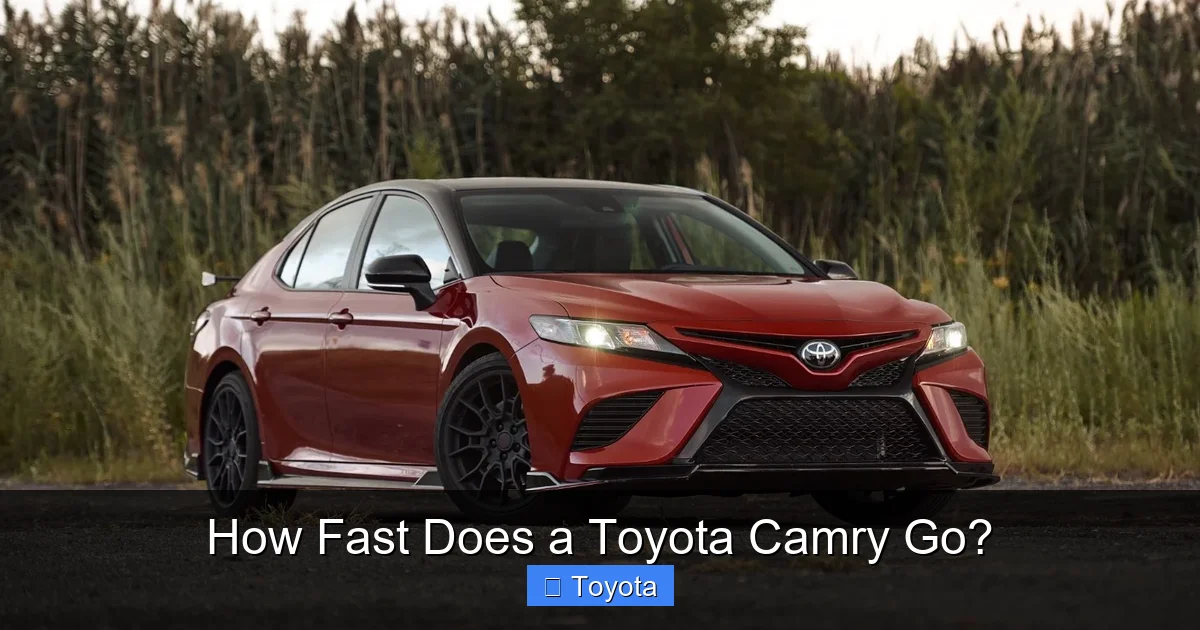
Visual guide about How Fast Does a Toyota Camry Go?
Image source: 2025toyota.com
Now let’s look at how top speed and acceleration have evolved over recent model years. While the Camry has always been a reliable sedan, Toyota has steadily improved its performance.
2021–2024 Toyota Camry
These are the latest models, with updated styling, technology, and performance. Here’s a quick breakdown:
– **Base 2.5L Four-Cylinder:** 0–60 mph in ~7.8 sec, top speed ~115 mph
– **3.5L V6:** 0–60 mph in ~5.8 sec, top speed ~135 mph
– **Hybrid:** 0–60 mph in ~7.5 sec, top speed ~115 mph
– **TRD V6:** 0–60 mph in ~5.8 sec, top speed ~135 mph
The 2023 and 2024 models feature minor refinements, including improved aerodynamics and a more responsive transmission. These changes help the Camry feel quicker and more agile.
2018–2020 Toyota Camry
This generation introduced a major redesign, with a lower, wider stance and more aggressive styling. Performance improved significantly.
– **2.5L Four-Cylinder:** 0–60 mph in ~8.0 sec, top speed ~115 mph
– **3.5L V6:** 0–60 mph in ~6.0 sec, top speed ~130 mph
– **Hybrid:** 0–60 mph in ~7.8 sec, top speed ~115 mph
The V6 was particularly impressive, offering near-sports car acceleration in a family-friendly package.
2015–2017 Toyota Camry
These models were more conservative in design and performance. The V6 produced 268 horsepower, and the 0–60 time was around 6.2 seconds.
Top speed was limited to about 120–125 mph. While not slow, these Camrys felt more focused on comfort than speed.
2012–2014 Toyota Camry
The V6 in these years made 268 horsepower, with a 0–60 time of ~6.5 seconds. Top speed was around 120 mph.
The four-cylinder was less powerful, with 0–60 times closer to 9 seconds. These models were reliable but not performance-oriented.
Factors That Influence Real-World Camry Performance
Even with the same engine and trim, two Camrys can perform differently based on external factors. Here’s what to keep in mind.
Road and Weather Conditions
Wet, icy, or gravel roads reduce traction, making it harder to accelerate quickly. Cold weather can also affect engine performance, especially in the first few minutes of driving.
High temperatures can reduce engine power due to thinner air. On hot summer days, your Camry might feel slightly less responsive.
Altitude
As mentioned earlier, higher altitudes mean less oxygen. This reduces engine power, especially in naturally aspirated engines like the Camry’s.
At 5,000 feet above sea level, you might notice a 5–10% drop in horsepower. This can add a second or more to your 0–60 time.
Vehicle Load
A Camry with five passengers and a full trunk will be slower than one with just the driver. Every extra 100 pounds reduces acceleration and top speed.
For best performance, travel light when you need quick bursts of speed.
Tire Condition and Type
Worn tires reduce grip, making it harder to accelerate and corner. High-performance tires can improve both speed and handling.
If you have a V6 or TRD model, consider upgrading to performance tires for better results.
Maintenance and Fuel Quality
A well-maintained Camry performs better. Regular oil changes, clean air filters, and fresh spark plugs keep the engine running smoothly.
Using premium fuel (91 octane or higher) can help the V6 engine perform at its peak, especially in hot weather or under heavy load.
How the Camry Compares to Competitors
So, how does the Camry stack up against other midsize sedans? Let’s compare it to key rivals like the Honda Accord, Hyundai Sonata, and Nissan Altima.
Honda Accord
The Accord offers a 2.0L turbocharged engine with 252 horsepower. It can hit 0–60 mph in about 6.5 seconds—slower than the Camry V6 but faster than the base Camry.
Top speed is similar, around 125–130 mph. The Accord is more fun to drive in base form, but the Camry V6 still wins in raw power.
Hyundai Sonata
The Sonata N Line has a 2.5L turbo engine with 290 horsepower and a 0–60 time of ~6.0 seconds. It’s close to the Camry V6 in performance.
Top speed is around 130 mph. The Sonata offers a sportier feel, but the Camry has better reliability ratings.
Nissan Altima
The Altima’s top engine is a 2.0L turbo with 248 horsepower. 0–60 time is ~6.8 seconds—slower than the Camry V6.
Top speed is about 120 mph. The Altima focuses more on comfort and efficiency than speed.
Overall, the Camry V6 and TRD trims are among the fastest in the segment. Only a few competitors, like the Kia K5 GT or Mazda6 Turbo, come close.
Tips to Maximize Your Camry’s Speed and Performance
Want to get the most out of your Camry? Here are some practical tips:
Use Premium Fuel (for V6 Models)
Toyota recommends premium fuel for the V6 engine. It helps prevent knocking and allows the engine to run at peak efficiency.
While the car will run on regular gas, you’ll get better performance and fuel economy with premium.
Keep Up with Maintenance
Regular oil changes, air filter replacements, and spark plug checks keep your engine running smoothly. A dirty air filter can reduce horsepower by 5–10%.
Follow the maintenance schedule in your owner’s manual.
Reduce Weight
Remove unnecessary items from your trunk and back seat. Every pound counts when it comes to acceleration.
Consider lightweight accessories if you’re serious about performance.
Upgrade Tires
High-performance tires improve grip and handling. Look for tires with a high speed rating (like V or W) for better results.
Make sure they’re properly inflated—underinflated tires increase rolling resistance.
Use Sport Mode (if equipped)
Many Camrys have a Sport mode that sharpens throttle response and holds gears longer. It’s great for spirited driving.
Just remember it reduces fuel economy.
Avoid Overloading
Carrying heavy loads slows down your Camry. Pack light for trips where performance matters.
Conclusion: Is the Camry Fast Enough for You?
So, how fast does a Toyota Camry go? The answer is: faster than most people think.
With top speeds ranging from 115 to 135 mph and 0–60 times as low as 5.8 seconds, the Camry—especially in V6 or TRD form—offers impressive performance for a midsize sedan.
It may not be a sports car, but it’s no slouch. Whether you’re commuting, road-tripping, or just enjoying a drive on a sunny day, the Camry delivers a smooth, responsive experience.
For drivers who prioritize reliability, comfort, and efficiency, the base or hybrid models are excellent choices. But if you want a little more excitement, the V6 and TRD trims add a thrilling edge without sacrificing practicality.
In the end, the Camry proves that speed and practicality can coexist. It’s not about being the fastest—it’s about being fast enough, with room for five, a big trunk, and Toyota’s legendary dependability.
So the next time someone asks, “How fast does a Toyota Camry go?” you can smile and say, “Faster than you’d expect.”
Frequently Asked Questions
What is the top speed of a Toyota Camry?
The top speed of a Toyota Camry varies by model and engine. Most models are electronically limited to between 115 and 135 mph. The V6 and TRD trims typically reach the higher end of that range.
How fast can a Toyota Camry go from 0 to 60 mph?
A base Camry with the 2.5L engine takes about 7.5 to 8 seconds to reach 60 mph. The V6 and TRD models can do it in as little as 5.8 seconds, making them surprisingly quick for a family sedan.
Is the Toyota Camry V6 faster than the hybrid?
Yes, the V6 is faster in terms of acceleration and top speed. The hybrid focuses on fuel efficiency, with similar 0–60 times but lower top speed and better gas mileage.
Does the Camry have a speed limiter?
Yes, most modern Camrys have electronic speed limiters for safety and tire rating reasons. These prevent the car from exceeding certain speeds, even if the engine could go faster.
Can you increase a Camry’s top speed?
Modifying a Camry to increase top speed is possible but not recommended. It can void your warranty, reduce safety, and damage the engine. Always follow manufacturer guidelines.
Which Camry trim is the fastest?
The TRD trim with the 3.5L V6 engine is the fastest Camry. It offers sport-tuned suspension, aerodynamic upgrades, and the same powerful engine as the XSE V6, with enhanced handling.
