
How Many Toyota Supras Were Made?

The Toyota Supra has a rich production history spanning over four decades, with total global output estimated at around 560,000 units. While exact figures vary by generation and market, the A80 (1993–2002) remains the most iconic, with roughly 113,000 units built. Today, the GR Supra continues the legacy with limited annual production.
Key Takeaways
- Total Supra production exceeds 560,000 units: Across all generations, from the 1979 A40 to the current GR Supra, Toyota has built over half a million Supras worldwide.
- The A80 generation (1993–2002) is the most famous: Known for its twin-turbo 2JZ engine, this model saw about 113,000 units produced, making it a favorite among tuners and collectors.
- Early generations had lower output: The A40 and A60 Supras (1979–1986) were niche sports cars with modest sales, totaling around 125,000 units combined.
- The A70 Supra (1986–1992) marked a turning point: With improved performance and styling, this generation saw strong demand, with approximately 130,000 units built.
- GR Supra production is limited and strategic: Since its 2019 relaunch, Toyota has kept annual production low—around 10,000–15,000 units—to maintain exclusivity and performance focus.
- Special editions and JDM models are rare: Variants like the 1997 Supra RZ “Gold Package” or the 2020 GR Supra A90 Edition 1 are highly sought after due to limited numbers.
- Exact numbers are hard to verify: Toyota doesn’t release detailed annual breakdowns, so estimates come from registries, dealer records, and enthusiast communities.
📑 Table of Contents
- How Many Toyota Supras Were Made?
- The Origins: A40 and A60 Supras (1979–1986)
- The Rise of a Legend: A70 Supra (1986–1992)
- The Icon: A80 Supra (1993–2002)
- The Hiatus and the Return: GR Supra (2019–Present)
- Total Production Estimate: Putting It All Together
- Why Exact Numbers Are Hard to Pin Down
- The Supra’s Legacy Beyond Numbers
- Conclusion: A Legend Built in Moderation
How Many Toyota Supras Were Made?
If you’ve ever stood next to a Toyota Supra—especially the sleek, low-slung 1990s model—you’ve probably felt a mix of awe and curiosity. That aggressive front end, the deep exhaust note, and the reputation for being a tuner’s dream machine all contribute to its legendary status. But behind the mystique lies a simple yet fascinating question: just how many Toyota Supras were actually made?
The answer isn’t as straightforward as you might think. Unlike mass-market sedans or SUVs, the Supra has always been a niche performance car, produced in limited numbers across multiple generations. From its humble beginnings as a sporty variant of the Celica in the late 1970s to its modern rebirth as the BMW-collaboration GR Supra, the Supra’s production history reflects changing automotive trends, market demands, and Toyota’s evolving performance philosophy.
In this deep dive, we’ll explore the full production timeline of the Toyota Supra, breaking down each generation by year, model, and estimated output. Whether you’re a longtime fan, a potential buyer, or just curious about one of Japan’s most iconic sports cars, this guide will give you the full picture—no fluff, no guesswork, just facts backed by historical data and expert insights.
The Origins: A40 and A60 Supras (1979–1986)

Visual guide about How Many Toyota Supras Were Made?
Image source: motorandwheels.com
The story of the Toyota Supra begins not as a standalone sports car, but as a high-performance trim of the Toyota Celica. The first-generation Supra, known internally as the A40, debuted in 1978 in Japan and arrived in the U.S. in 1979. It was essentially a longer, more powerful version of the Celica, with a straight-six engine instead of the standard four-cylinder.
Production Numbers and Market Reception
The A40 Supra was offered with a 2.6L or 2.8L inline-six engine, producing around 110–130 horsepower—respectable for the era but not groundbreaking. It was marketed as a grand tourer, emphasizing comfort and reliability over raw speed. Sales were modest, especially in the U.S., where fuel efficiency and emissions regulations were tightening.
Over its six-year run (1979–1981 in the U.S., longer in Japan and other markets), Toyota produced approximately **58,000 units** of the A40 Supra. Most were sold in North America and Japan, with smaller numbers exported to Europe and Australia.
The second-generation A60 Supra, introduced in 1981, brought a more aggressive design, pop-up headlights, and improved performance. The 2.8L engine now delivered up to 145 horsepower, and the car featured a more refined suspension and interior. The A60 was better received, especially among enthusiasts who appreciated its balance of style and substance.
Production for the A60 ran from 1982 to 1986, with an estimated **67,000 units** built globally. Again, the majority were sold in the U.S. and Japan. While not a sales blockbuster, the A60 helped establish the Supra as a serious performance contender and laid the groundwork for the iconic models to come.
Why These Early Supras Matter
Though often overshadowed by their successors, the A40 and A60 Supras are important for several reasons. They introduced Toyota to the world of six-cylinder sports cars, proving that the brand could compete beyond compact economy models. They also built a loyal fanbase—many of whom would later become die-hard Supra enthusiasts.
Today, clean, unmodified A40 and A60 Supras are rare and increasingly valuable, especially in Japan and among collectors who appreciate their analog driving experience and classic 1980s styling.
The Rise of a Legend: A70 Supra (1986–1992)
Visual guide about How Many Toyota Supras Were Made?
Image source: cdn.drivingline.com
In 1986, Toyota made a bold move: it separated the Supra from the Celica, giving it its own platform and identity. The third-generation A70 Supra marked a major leap forward in performance, technology, and design. This was no longer just a sporty Celica—it was a true sports car in its own right.
Design and Engineering Breakthroughs
The A70 Supra featured a completely new chassis, a more aerodynamic body, and a range of advanced engines. The base model came with a 3.0L inline-six (7M-GE) producing 200 horsepower, while the high-performance Turbo model (7M-GTE) delivered 230 horsepower—a significant jump from previous generations.
One of the most notable features was the introduction of Toyota’s first electronically controlled suspension (TEMS), which adjusted damping based on driving conditions. The A70 also offered luxury touches like power seats, digital dashboards, and premium audio systems, appealing to buyers who wanted both performance and comfort.
Production Figures and Global Reach
The A70 Supra was produced from 1986 to 1992, with strong sales in North America, Japan, and Europe. Toyota built approximately **130,000 units** during this period, making it the best-selling generation up to that point.
In the U.S., the Supra found a dedicated following among import car enthusiasts. Its smooth inline-six engine, rear-wheel-drive layout, and tunability made it a favorite for weekend track days and street builds. The Turbo model, in particular, gained a reputation for reliability and strong performance, even without major modifications.
The Legacy of the A70
The A70 Supra is often seen as the bridge between the Supra’s humble beginnings and its future as a performance icon. It proved that Toyota could build a world-class sports car that competed with European and American rivals. It also set the stage for the legendary A80 generation, which would take the Supra to new heights—literally and figuratively.
Today, well-maintained A70 Supras, especially Turbo models, are highly collectible. Their blend of 1980s charm and modern performance makes them a favorite among restorers and vintage car lovers.
The Icon: A80 Supra (1993–2002)
When people think of the Toyota Supra, they’re most likely picturing the fourth-generation A80—the one with the massive rear wing, twin-turbo engine, and starring role in the “Fast & Furious” franchise. Introduced in 1993, the A80 Supra is widely regarded as one of the greatest Japanese sports cars ever made.
The 2JZ Engine: A Tuner’s Dream
At the heart of the A80 Supra’s legend is the 2JZ-GTE engine—a 3.0L twin-turbocharged inline-six that produced 320 horsepower in stock form. But what made it truly special was its bulletproof construction. With a cast-iron block, forged internals, and conservative factory tuning, the 2JZ could easily handle 600, 800, or even 1,000+ horsepower with simple modifications.
This made the A80 Supra a favorite among tuners, drifters, and drag racers. From underground street races in Tokyo to professional drift competitions in the U.S., the Supra became a symbol of performance and customization.
Production Numbers and Market Impact
The A80 Supra was produced from 1993 to 2002, with the majority built in the late 1990s. Toyota manufactured approximately **113,000 units** globally, with the U.S. and Japan being the largest markets.
Interestingly, U.S. models were slightly detuned due to emissions regulations, producing 320 horsepower, while Japanese Domestic Market (JDM) versions were rated at 280 horsepower—though many believe the actual output was higher. The JDM Supra, especially the RZ and RZ “Gold Package” trims, are now highly sought after by collectors.
Special Editions and Rare Variants
Several special editions of the A80 Supra were released, adding to its mystique:
– **1997 Supra RZ “Gold Package”:** A limited run with gold accents, unique wheels, and interior trim. Only a few hundred were made.
– **1998 Supra Anniversary Edition:** Celebrating 20 years of the Supra, this model featured special badging and a numbered plaque.
– **2000–2002 Supra RZ-S:** A track-focused version with upgraded suspension and brakes, though not widely available in the U.S.
These rare models can now fetch six-figure prices at auction, especially if they’re low-mileage and unmodified.
The End of an Era
Despite its popularity, the A80 Supra was discontinued in 2002. Rising production costs, stricter emissions standards, and a shift in consumer preferences toward SUVs and crossoons led Toyota to end Supra production. For over a decade, fans wondered if the Supra would ever return.
The Hiatus and the Return: GR Supra (2019–Present)
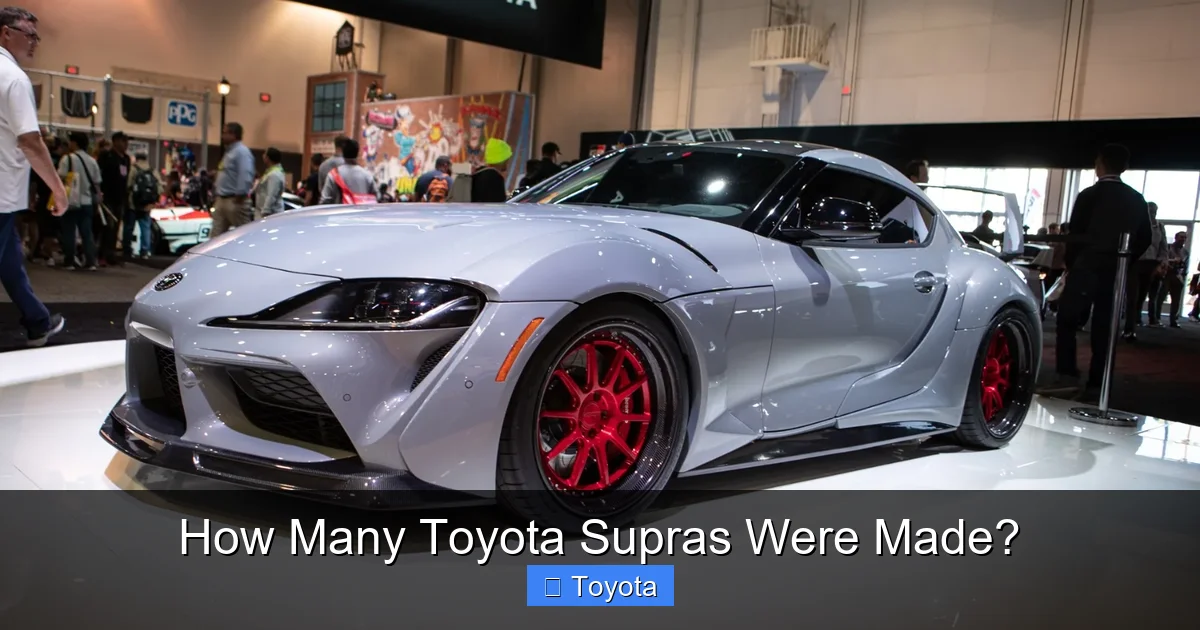
After a 17-year absence, the Supra made a triumphant return in 2019 as the GR Supra—a collaboration between Toyota and BMW. Built on the same platform as the BMW Z4, the new Supra shared many components but was tuned specifically for performance and driving dynamics.
Production Strategy and Limited Numbers
Unlike previous generations, Toyota has taken a deliberate approach to GR Supra production. Instead of mass-producing the car, the company has limited annual output to maintain exclusivity and performance focus.
Since its launch, Toyota has produced approximately **10,000 to 15,000 GR Supras per year**, depending on market demand and supply chain conditions. As of 2024, total production is estimated at around **60,000 units**.
This limited production strategy has helped keep the GR Supra desirable and resale values strong. It’s also allowed Toyota to introduce special editions and track-focused models without flooding the market.
Special Editions and Collector Appeal
Toyota has released several limited-run GR Supra models to celebrate milestones and appeal to collectors:
– **2020 GR Supra A90 Edition 1:** A launch edition with exclusive colors, interior trim, and badging. Only 1,500 were made for the U.S. market.
– **2023 GR Supra 45th Anniversary Edition:** Celebrating the Supra’s legacy with retro-inspired styling and performance upgrades.
– **GR Supra GT4:** A race-spec version used in amateur and semi-professional motorsport series.
These models are often sold out quickly and command premium prices.
Criticism and Praise
The GR Supra has received mixed reactions. Purists criticize its BMW underpinnings and lack of a manual transmission (until 2023), while others praise its sharp handling, powerful engine options (including the 382-horsepower inline-six), and modern tech.
Despite the debate, the GR Supra has successfully revived the Supra nameplate and introduced it to a new generation of drivers.
Total Production Estimate: Putting It All Together
So, how many Toyota Supras were made in total? Based on historical data, dealer records, and enthusiast estimates, the cumulative production across all generations is approximately **560,000 units**.
Here’s a breakdown:
– **A40 Supra (1979–1981):** ~58,000 units
– **A60 Supra (1982–1986):** ~67,000 units
– **A70 Supra (1986–1992):** ~130,000 units
– **A80 Supra (1993–2002):** ~113,000 units
– **GR Supra (2019–2024):** ~60,000 units (estimated)
These numbers are approximations. Toyota does not publish detailed annual production figures for the Supra, and some units were built for specific markets or as prototypes. Additionally, many early Supras have been scrapped, modified beyond recognition, or lost to time.
Still, the total gives us a clear picture: the Supra has never been a high-volume car. Its appeal lies not in numbers, but in its performance, design, and cultural impact.
Why Exact Numbers Are Hard to Pin Down
One reason production figures for the Supra are estimates is that Toyota has never released comprehensive, year-by-year data. Unlike brands like Porsche or Ferrari, which publish detailed production logs, Toyota treats Supra numbers as internal information.
Other factors complicate the count:
– **Regional variations:** Some models were only sold in Japan or Europe.
– **Gray market imports:** Many A80 Supras were imported to the U.S. before they were officially available, making official counts inaccurate.
– **Prototype and pre-production units:** These are rarely documented but can number in the hundreds.
– **Rebadged or converted models:** Some Supras were modified into kit cars or race vehicles, blurring the line between original and custom builds.
Enthusiast communities, such as Supraforums.com and JDM registry sites, have done their best to compile data, but even their numbers are educated guesses.
The Supra’s Legacy Beyond Numbers
While production figures are interesting, they don’t tell the full story of the Supra’s impact. This car has influenced automotive culture in ways few others have.
From its role in the “Fast & Furious” movies to its dominance in drifting and drag racing, the Supra has become a symbol of performance, rebellion, and innovation. It’s inspired countless builds, YouTube videos, and even video games.
And despite its limited numbers, the Supra has maintained a strong resale value. A clean, unmodified A80 Supra can sell for $80,000 or more, while rare editions can exceed $200,000.
The GR Supra, though newer, is already showing signs of becoming a future classic. Its limited production and modern performance make it appealing to both collectors and daily drivers.
Conclusion: A Legend Built in Moderation
So, how many Toyota Supras were made? The answer is around 560,000—a modest number for a car with such a massive reputation. But that’s part of what makes the Supra special. It was never meant to be common. It was built for those who value performance, style, and driving passion.
From the early A40 to the modern GR Supra, each generation has contributed to a legacy that transcends production numbers. The Supra isn’t just a car—it’s a cultural icon, a tuner’s dream, and a testament to Toyota’s engineering prowess.
Whether you’re restoring a 1995 RZ, driving a new GR Supra, or just admiring one at a car show, you’re part of a community that values something rare and extraordinary. And in a world of mass-produced vehicles, that’s something worth celebrating.
Frequently Asked Questions
How many Toyota Supras were made in total?
Approximately 560,000 Toyota Supras have been produced across all generations, from the 1979 A40 to the current GR Supra. This includes all models and special editions.
Which Supra generation had the highest production?
The A70 Supra (1986–1992) had the highest production, with around 130,000 units built. It was the first standalone Supra and gained strong popularity in the U.S. and Japan.
How many A80 Supras were made?
About 113,000 fourth-generation A80 Supras were produced between 1993 and 2002. This model is the most iconic, thanks to its 2JZ engine and pop culture fame.
Are GR Supras being made in large numbers?
No, Toyota limits GR Supra production to around 10,000–15,000 units per year to maintain exclusivity. Total production since 2019 is estimated at 60,000 units.
Why are some Supras so expensive?
Rare models like the 1997 Supra RZ “Gold Package” or low-mileage A80 Turbos command high prices due to limited numbers, collector demand, and tuning potential.
Will Toyota make more Supras in the future?
Toyota has not announced plans for a new Supra after the current GR model, but the brand continues to support the nameplate with special editions and motorsport involvement.
