
Are Toyota 4runners All Wheel Drive

Not all Toyota 4Runners are all-wheel drive (AWD)—many come with part-time four-wheel drive (4WD) instead. The 4Runner offers both rear-wheel drive (RWD) and 4WD options, with no traditional AWD system available. Understanding the difference helps you choose the right setup for your driving conditions.
Key Takeaways
- No AWD Option: Toyota 4Runners do not come with all-wheel drive (AWD); they use either rear-wheel drive (RWD) or part-time four-wheel drive (4WD).
- 4WD Dominates Trim Levels: Most 4Runner trims, especially off-road-focused ones like TRD Off-Road and TRD Pro, come standard with 4WD.
- RWD Available on Base Models: The base SR5 trim is available with RWD, but 4WD is optional and recommended for most buyers.
- 4WD vs AWD Differences: 4WD is better for off-roading and low-traction conditions, while AWD is more suited for everyday driving on wet or snowy roads.
- Manual and Automatic Options: 4Runners with 4WD can be equipped with either automatic or manual transmissions, depending on the model year and trim.
- Advanced 4WD Features: Higher trims include features like crawl control, multi-terrain select, and locking rear differentials for serious off-road performance.
- Fuel Economy Impact: 4WD models typically have lower fuel efficiency than RWD versions due to added weight and drivetrain resistance.
📑 Table of Contents
- Are Toyota 4Runners All Wheel Drive? The Straight Answer
- Understanding 4WD vs AWD: What’s the Real Difference?
- Toyota 4Runner Drivetrain Options by Trim Level
- Performance and Capability of 4Runner’s 4WD System
- Fuel Economy and Practical Considerations
- Who Should Choose a 4Runner with 4WD?
- Conclusion: Is the 4Runner Right for You?
Are Toyota 4Runners All Wheel Drive? The Straight Answer
If you’re shopping for a Toyota 4Runner and wondering whether it comes with all-wheel drive (AWD), you’re not alone. The 4Runner is one of Toyota’s most rugged and capable SUVs, known for its off-road prowess and long-lasting reliability. But when it comes to drivetrain options, things can get a bit confusing—especially if you’re comparing it to other SUVs that offer AWD as a standard or common feature.
So, let’s clear the air: **No, Toyota 4Runners are not all-wheel drive.** Instead, they come with either rear-wheel drive (RWD) or part-time four-wheel drive (4WD). There is no AWD system available on any 4Runner model, regardless of trim or year. This might surprise some buyers, especially those used to crossovers like the Toyota RAV4 or Highlander, which offer AWD across most trims.
But why does this matter? The difference between AWD and 4WD isn’t just semantics—it affects how the vehicle performs in different conditions. AWD systems are designed to send power to all four wheels automatically, improving traction on wet, icy, or slippery roads during normal driving. They’re great for daily commuting and light weather challenges. On the other hand, 4WD systems are built for more extreme conditions—think mud, snow, rocks, and steep inclines. They’re typically engaged manually or via a dial and are not meant for constant use on dry pavement.
The 4Runner’s focus on off-road capability means Toyota has prioritized 4WD over AWD. This design choice aligns with the vehicle’s heritage as a body-on-frame SUV built for adventure. While this might not be ideal for everyone, it’s a major reason why the 4Runner remains a favorite among overlanders, campers, and outdoor enthusiasts.
Understanding 4WD vs AWD: What’s the Real Difference?
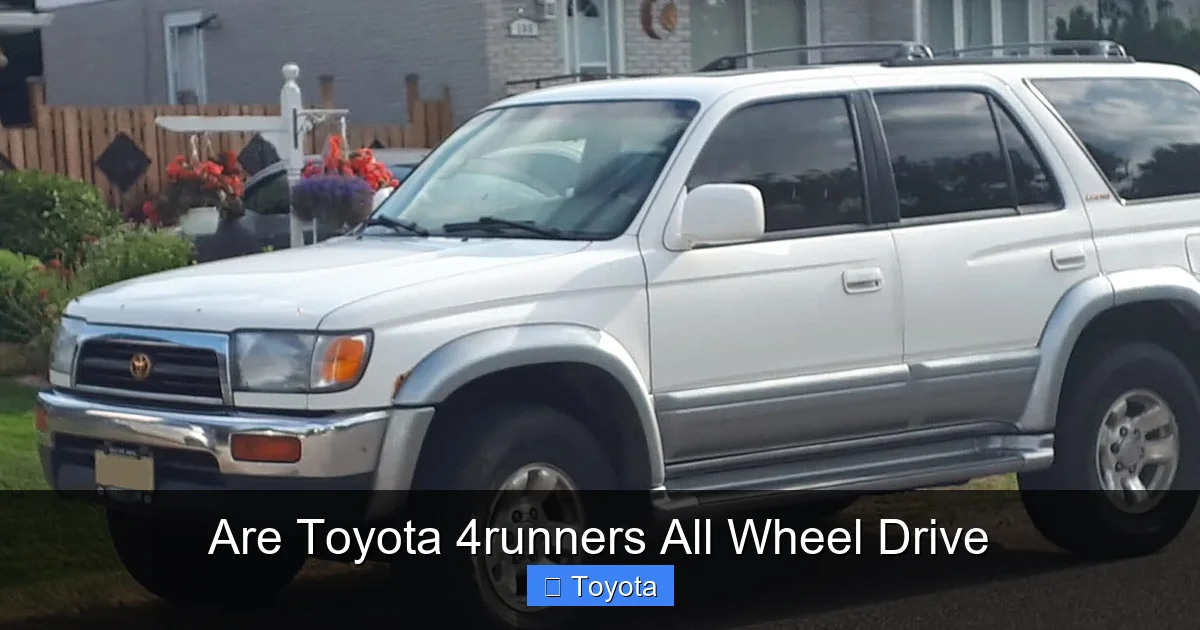
Visual guide about Are Toyota 4runners All Wheel Drive
Image source: 4wdlife.com
Before diving deeper into the 4Runner’s drivetrain options, it’s important to understand the fundamental differences between four-wheel drive (4WD) and all-wheel drive (AWD). These terms are often used interchangeably, but they describe very different systems with distinct purposes.
How All-Wheel Drive (AWD) Works
AWD systems are typically found on unibody vehicles like crossovers and sedans. They’re designed to improve traction and stability during everyday driving. AWD automatically distributes power between the front and rear axles—and sometimes between individual wheels—based on road conditions. Sensors monitor wheel slip and adjust power delivery in real time.
For example, if the front wheels start to lose grip on a rainy road, the AWD system will send more power to the rear wheels to maintain control. This happens seamlessly, often without the driver even noticing. AWD is great for light snow, wet pavement, or gravel roads, but it’s not built for serious off-roading.
Most AWD systems are full-time, meaning they’re always active. Some vehicles also offer part-time AWD, which allows the driver to switch between two-wheel drive and AWD when needed. However, AWD systems generally don’t include low-range gearing or locking differentials—features essential for tackling tough terrain.
How Four-Wheel Drive (4WD) Works
4WD, on the other hand, is a more robust system designed for off-road and low-traction environments. Unlike AWD, 4WD is typically part-time, meaning it’s not intended for constant use on dry pavement. Drivers must manually engage 4WD using a lever or electronic switch, usually when driving on snow, mud, sand, or uneven terrain.
One of the key features of 4WD is the transfer case, which splits power between the front and rear axles. Many 4WD systems also include a low-range gear setting, which provides extra torque for crawling over rocks or climbing steep hills. This is where the 4Runner truly shines—its 4WD system is built for adventure.
For instance, if you’re driving up a snowy mountain pass or navigating a rocky trail, engaging 4WD low range gives you maximum control and power. The system locks the front and rear axles together, ensuring all four wheels turn at the same speed. This prevents wheel slip and helps the vehicle maintain momentum.
Why the 4Runner Chooses 4WD Over AWD
So why doesn’t the 4Runner offer AWD? The answer lies in its design philosophy. The 4Runner is built on a body-on-frame chassis, just like a pickup truck, which makes it more durable and capable off-road. It’s designed to handle rough terrain, not just improve highway traction.
AWD systems are typically lighter and more fuel-efficient, but they lack the strength and features needed for serious off-roading. The 4Runner’s 4WD system includes features like a locking rear differential, crawl control, and multi-terrain select—tools that are essential for tackling challenging trails.
In short, the 4Runner’s 4WD system is a purpose-built solution for drivers who want to go beyond the pavement. While AWD is great for city driving and light weather, 4WD is the real deal when it comes to adventure.
Toyota 4Runner Drivetrain Options by Trim Level
Now that we’ve clarified the difference between AWD and 4WD, let’s look at how the 4Runner’s drivetrain options vary across its trim levels. Understanding which trims come with 4WD—and which ones offer RWD—can help you make the right choice based on your needs.
Base Model: SR5
The SR5 is the entry-level 4Runner trim and offers the most flexibility in terms of drivetrain. It comes standard with rear-wheel drive (RWD), but 4WD is available as an option. For most buyers, especially those in areas with snow, rain, or off-road trails, opting for 4WD is highly recommended.
The RWD SR5 is fine for dry, flat roads and city driving, but it lacks the traction and capability of 4WD. If you plan to take your 4Runner on weekend camping trips or drive in winter conditions, the 4WD version is the better choice. The upgrade typically adds a few thousand dollars to the price, but it’s worth it for the added confidence and capability.
Off-Road Focused: TRD Off-Road and TRD Pro
The TRD Off-Road and TRD Pro trims are where the 4Runner truly comes into its own. These models are designed for serious off-roading and come standard with 4WD. There is no RWD option available on these trims—Toyota assumes that buyers in this segment want maximum capability.
The TRD Off-Road includes features like crawl control, multi-terrain select, and a locking rear differential. These tools help the vehicle navigate tricky terrain with ease. For example, crawl control acts like an off-road cruise control, automatically managing throttle and braking to maintain a steady speed over rocks or steep inclines.
The TRD Pro takes things a step further with upgraded suspension, all-terrain tires, and a more aggressive exterior design. It’s the ultimate 4Runner for overlanding and trail exploration. Both trims are only available with 4WD, reinforcing the 4Runner’s identity as a true off-road machine.
Luxury and Capability: Limited and Nightshade
The Limited and Nightshade trims offer a blend of luxury and capability. The Limited comes standard with 4WD and includes premium features like leather seats, a power moonroof, and advanced safety tech. It’s a great choice for buyers who want a comfortable daily driver that can still handle off-road adventures.
The Nightshade edition is a more stylish version of the Limited, with blacked-out accents and unique wheels. Like the Limited, it comes standard with 4WD. These trims prove that you don’t have to sacrifice comfort for capability—the 4Runner can do both.
Special Editions and Model Year Variations
Over the years, Toyota has released various special edition 4Runners, such as the Wilderness Edition or the Heritage Edition. These models typically come with 4WD as standard, even if they’re based on the SR5 trim. It’s always a good idea to check the specific model year and trim details, as options can vary.
For example, the 2023 4Runner TRD Pro comes exclusively with 4WD and a 5-speed automatic transmission. Earlier models, like those from the 1990s, sometimes offered manual transmissions with 4WD—a feature that’s rare on modern SUVs.
Performance and Capability of 4Runner’s 4WD System
The 4Runner’s 4WD system isn’t just about having power to all four wheels—it’s about how that power is managed and delivered. Toyota has equipped the 4Runner with a range of advanced features that make it one of the most capable SUVs in its class.
Part-Time 4WD with Low Range
The 4Runner uses a part-time 4WD system, which means the driver must manually engage 4WD when needed. This is typically done via a dial on the center console. In normal driving conditions, the vehicle operates in rear-wheel drive to save fuel and reduce wear.
When you switch to 4WD High, power is sent to all four wheels at road speeds. This is useful for driving on snow, mud, or gravel. For more extreme conditions, you can shift into 4WD Low, which provides maximum torque and control at low speeds.
For example, if you’re climbing a steep, rocky trail, 4WD Low allows you to crawl over obstacles without spinning the wheels. The system locks the front and rear axles together, ensuring all four wheels turn at the same speed.
Locking Rear Differential
One of the most important features of the 4Runner’s 4WD system is the locking rear differential. When engaged, this feature locks the rear wheels together, so they turn at the same speed—even if one wheel is off the ground or spinning.
This is crucial for off-roading. Imagine one rear wheel is stuck in mud while the other is on solid ground. Without a locking differential, the stuck wheel would spin while the other does nothing. With the lock engaged, both wheels turn, giving the vehicle the traction it needs to move forward.
The locking rear differential is standard on TRD Off-Road and TRD Pro trims and available on higher SR5 models. It’s a game-changer for serious off-roaders.
Crawl Control and Multi-Terrain Select
Crawl Control is like having an off-road co-pilot. When activated, it automatically manages throttle and braking to maintain a steady, low speed over rough terrain. You simply steer, and the system does the rest.
For example, if you’re descending a steep, rocky hill, Crawl Control keeps the vehicle moving slowly and steadily, preventing wheel spin or loss of control. It’s especially useful for beginners or in high-stress situations.
Multi-Terrain Select allows you to choose the type of terrain you’re driving on—such as mud, sand, or rocks—and adjusts the vehicle’s settings accordingly. The system optimizes throttle response, braking, and traction control for the best performance.
These features are available on TRD Off-Road and TRD Pro trims and make the 4Runner one of the most user-friendly off-road vehicles on the market.
Fuel Economy and Practical Considerations
While the 4Runner’s 4WD system offers impressive capability, it comes with some trade-offs—especially when it comes to fuel economy and daily driving comfort.
Fuel Efficiency: 4WD vs RWD
4WD models generally have lower fuel efficiency than RWD versions. The added weight of the 4WD components and the increased drivetrain resistance mean the engine has to work harder.
For example, a 2023 4Runner SR5 with RWD gets around 17 mpg in the city and 21 mpg on the highway. The same model with 4WD drops to about 16 mpg city and 19 mpg highway. That might not seem like a big difference, but it adds up over time—especially if you drive a lot.
If fuel economy is a top priority, the RWD SR5 might be the better choice. But for most 4Runner buyers, the added capability of 4WD is worth the slight drop in efficiency.
Driving Dynamics and On-Road Behavior
The 4Runner’s body-on-frame design and 4WD system give it a rugged, truck-like feel on the road. It’s not as smooth or refined as a unibody SUV like the Highlander, but that’s part of its charm.
In 4WD High, the vehicle can feel a bit sluggish on dry pavement, and you may notice some binding or chirping during tight turns. That’s because part-time 4WD isn’t designed for constant use on dry roads. It’s best to switch back to RWD or 2WD when driving normally.
For daily commuting, the 4Runner is perfectly capable, but it’s not the most comfortable or efficient choice. It shines when you take it off the beaten path.
Towing and Payload Capacity
The 4Runner’s 4WD system also enhances its towing and payload capacity. With 4WD, the 4Runner can tow up to 5,000 pounds when properly equipped—enough for a small camper, boat, or trailer.
The payload capacity is around 1,500 pounds, which is impressive for an SUV of its size. This makes the 4Runner a great choice for hauling gear on camping trips or work sites.
Who Should Choose a 4Runner with 4WD?
So, who is the 4Runner with 4WD really for? While it’s a versatile vehicle, it’s best suited for certain types of drivers and lifestyles.
Off-Road Enthusiasts and Overlanders
If you love exploring remote trails, camping in the wilderness, or tackling challenging terrain, the 4Runner with 4WD is an excellent choice. Its rugged design, advanced 4WD features, and proven reliability make it a favorite among off-roaders.
The TRD Pro, in particular, is built for adventure. With its upgraded suspension, all-terrain tires, and off-road tech, it’s ready for anything you throw at it.
Buyers in Snowy or Rural Areas
If you live in a region with heavy snow, muddy roads, or unpaved driveways, 4WD can make a big difference. The 4Runner’s 4WD system provides the traction and control you need to get through winter storms or rural backroads.
Even if you don’t plan to go off-roading, 4WD adds peace of mind in low-traction conditions.
Families Who Want Capability and Space
The 4Runner is also a great family SUV. It seats up to seven passengers (on some trims) and offers plenty of cargo space. With 4WD, it’s capable of handling family road trips, ski vacations, or weekend getaways—no matter the weather.
The 4Runner’s safety features, including Toyota Safety Sense, also make it a reliable choice for families.
Not Ideal for City Commuters
On the flip side, the 4Runner isn’t the best choice for city dwellers who primarily drive on paved roads. Its size, fuel economy, and ride quality make it less practical for tight parking spaces and stop-and-go traffic.
If you’re looking for a fuel-efficient, easy-to-maneuver SUV for daily commuting, a crossover like the RAV4 or Highlander might be a better fit.
Conclusion: Is the 4Runner Right for You?
To sum it up: **No, Toyota 4Runners are not all-wheel drive.** They come with either rear-wheel drive or part-time four-wheel drive, with no AWD option available. This design reflects the 4Runner’s focus on off-road capability and durability.
For buyers who value adventure, reliability, and rugged performance, the 4Runner with 4WD is an outstanding choice. Its advanced 4WD features, body-on-frame construction, and Toyota’s reputation for longevity make it a standout in the SUV market.
However, if you’re primarily looking for a fuel-efficient, city-friendly SUV with automatic all-wheel traction, the 4Runner might not be the best fit. In that case, consider a Toyota crossover with AWD.
Ultimately, the 4Runner is built for those who want to go further, explore more, and drive with confidence—no matter where the road (or trail) leads.
Frequently Asked Questions
Are all Toyota 4Runners four-wheel drive?
No, not all 4Runners are four-wheel drive. The base SR5 trim comes standard with rear-wheel drive, but 4WD is available as an option. Higher trims like TRD Off-Road and TRD Pro come standard with 4WD.
Can you drive a 4Runner with 4WD on dry pavement?
It’s not recommended to use 4WD High on dry pavement for extended periods, as it can cause drivetrain binding. 4WD should be used on loose or slippery surfaces like snow, mud, or gravel.
Does the 4Runner have a full-time 4WD system?
No, the 4Runner uses a part-time 4WD system, meaning the driver must manually engage it. There is no full-time 4WD or automatic AWD system available.
What’s the difference between 4Runner 4WD and AWD?
The 4Runner does not have AWD. Its 4WD system is designed for off-road use and requires manual engagement, while AWD systems automatically send power to all wheels and are better for everyday traction.
Which 4Runner trim has the best off-road capability?
The TRD Pro trim offers the best off-road capability, with standard 4WD, upgraded suspension, all-terrain tires, crawl control, and a locking rear differential.
Is the 4Runner good for snow driving?
Yes, the 4Runner with 4WD is excellent for snow driving. Its high ground clearance, 4WD system, and available features like crawl control make it a reliable choice for winter conditions.
